*cover page pattern for activities and
performance test online
IEZEN LOUIS O. CRUZ
BSIT-1A DRAFTING W/ AUTOCAD
CO-002 FURNITURE DRAFTING
MR. RIKKI D. ABRIOL
INSTRUCTOR
Course Policy
The following policies are to be observed and implemented inside the classroom and
online by both the Professor and Students.
• Attendance and punctuality must be strictly observed.
• Maintain respect and discipline.
• Active participation in the discussion through sharing of ideas
and experiences is encouraged.
• Observe tranquility so as to maintain an environment of focus
learning.
• Always check the shared folder/s for relevant readings.
• Be prompt in submitting reports and other requirements.
• Follow house rules in online meetings via Zoom or Google
Meet.
• Keep posted in learning management system of the class.
Class Standing Percentage
Actual and Written Examination 20%
Class Participation / Attendance 10%
Laboratory Plates (Manual) 40%
Laboratory Plates (AutoCAD) 30%
TOTAL 100%
Midterm Final
Class Standing -70%
Term Exam -30%
Class Standing -70%
Term Exam -30%
Final Rating
Midterm Grade (50%) + Final Grade (50%) = Final Rating
What is Lettering?
Lettering is the art of writing or printing
letters by hand either freehand or with the
use of drawing instruments.
Importance of Letters:
1) They are the written language of industry.
2) They record ideas.
3) They add information in a drawing which
the regular orthographic or pictorial drawing
cannot show.
Development of Letters:
1) Egyptian’s Hieroglyphics- more on
symbols
Development of Letters:
2) Phoenician’s Cuneiform Writing
Development of Letters:
3) Greek’s Boustrophedon – Greek Alphabet
Development of Letters:
4) Roman Alphabet/Letters- called the “present
day letters” because most letters in the alphabet that we are
using today came from the Roman Letters.
Development of Letters:
4) Roman Alphabet/Letters- called the “present
day letters” because most letters in the alphabet that we are
using today came from the Roman Letters.
4 Commonly used styles of letter:
1) Gothic Letters- all single strokes letters
are classified as gothic
*Classification of Gothic Letters:
a) Vertical upper case Gothic Letters.
b) Vertical lower case Gothic Letters.
c) Inclined upper case Gothic Letters.
d) Inclined lower case Gothic Letters.
Classification of Gothic Letters:
a) Vertical upper case Gothic Letters.
Classification of Gothic Letters:
b) Vertical lower case Gothic Letters.
Classification of Gothic Letters:
c) Inclined upper case Gothic Letters.
Classification of Gothic Letters:
d) Inclined lower case Gothic Letters.
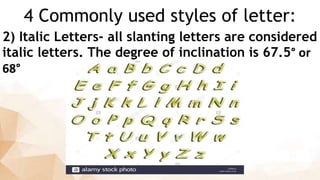
4 Commonly used styles of letter:
2) Italic Letters- all slanting letters are considered
italic letters. The degree of inclination is 67.5° or
68°
4 Commonly used styles of letter:
3) Roman Letters- letters having strokes accented or
consisting of thin & thick strokes
4 Commonly used styles of letter:
4) Text Letters- are commonly used in diplomas,
certificates, wedding invitations, etc. They include all
styles of Old-English Text, German Text, Bradley Text, etc.
If done freehand, speedball pens are used.
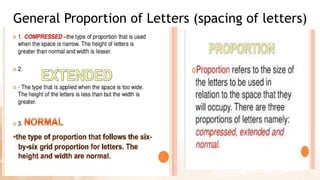
General Proportion of Letters (spacing of letters)
1) Normal Letters- used when the space is
ample.
2) Compressed Letters- used when space is
narrow.
3) Extended Letters- used when the space is
wide.
General Proportion of Letters (spacing of letters)
Guidelines used in Lettering:
1) Horizontal Guidelines- maintains the
straightness of letters.
2) Vertical Guidelines- keep the letters
uniformly vertical.
3) Inclined Guidelines- keep the letters
uniformly inclined.
Guidelines used for lowercase letters:
1) Capline- the uppermost horizontal guideline and
limit the strokes of the ascenders (b, d, k, h, f, l, t)
2) Waistline- maintains the straightness of the body of
letters.
3) Base Line- keep the base of letters uniformly
straight.
4) Drop Line- the lowermost horizontal guideline and
limit the strokes of the descenders (g, j, p, q, y)
Guidelines used for lowercase letters:
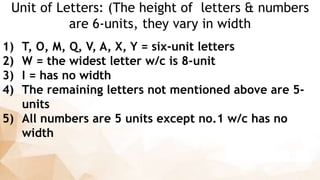
Unit of Letters: (The height of letters & numbers
are 6-units, they vary in width
1) T, O, M, Q, V, A, X, Y = six-unit letters
2) W = the widest letter w/c is 8-unit
3) I = has no width
4) The remaining letters not mentioned above are 5-
units
5) All numbers are 5 units except no.1 w/c has no
width
This single stroke vertical upper case gothic
letters can be used in UNIT OF LETTERS, because
the units are shown in each letter, the graph
guidelines, each square equals 1 unit
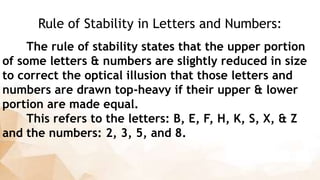
Rule of Stability in Letters and Numbers:
The rule of stability states that the upper portion
of some letters & numbers are slightly reduced in size
to correct the optical illusion that those letters and
numbers are drawn top-heavy if their upper & lower
portion are made equal.
This refers to the letters: B, E, F, H, K, S, X, & Z
and the numbers: 2, 3, 5, and 8.

E-draw-Lettering.pptx

  • 1.
    *cover page patternfor activities and performance test online IEZEN LOUIS O. CRUZ BSIT-1A DRAFTING W/ AUTOCAD CO-002 FURNITURE DRAFTING MR. RIKKI D. ABRIOL INSTRUCTOR
  • 2.
    Course Policy The followingpolicies are to be observed and implemented inside the classroom and online by both the Professor and Students. • Attendance and punctuality must be strictly observed. • Maintain respect and discipline. • Active participation in the discussion through sharing of ideas and experiences is encouraged. • Observe tranquility so as to maintain an environment of focus learning. • Always check the shared folder/s for relevant readings. • Be prompt in submitting reports and other requirements. • Follow house rules in online meetings via Zoom or Google Meet. • Keep posted in learning management system of the class.
  • 3.
    Class Standing Percentage Actualand Written Examination 20% Class Participation / Attendance 10% Laboratory Plates (Manual) 40% Laboratory Plates (AutoCAD) 30% TOTAL 100% Midterm Final Class Standing -70% Term Exam -30% Class Standing -70% Term Exam -30% Final Rating Midterm Grade (50%) + Final Grade (50%) = Final Rating
  • 4.
    What is Lettering? Letteringis the art of writing or printing letters by hand either freehand or with the use of drawing instruments.
  • 5.
    Importance of Letters: 1)They are the written language of industry. 2) They record ideas. 3) They add information in a drawing which the regular orthographic or pictorial drawing cannot show.
  • 6.
    Development of Letters: 1)Egyptian’s Hieroglyphics- more on symbols
  • 7.
    Development of Letters: 2)Phoenician’s Cuneiform Writing
  • 8.
    Development of Letters: 3)Greek’s Boustrophedon – Greek Alphabet
  • 9.
    Development of Letters: 4)Roman Alphabet/Letters- called the “present day letters” because most letters in the alphabet that we are using today came from the Roman Letters.
  • 10.
    Development of Letters: 4)Roman Alphabet/Letters- called the “present day letters” because most letters in the alphabet that we are using today came from the Roman Letters.
  • 11.
    4 Commonly usedstyles of letter: 1) Gothic Letters- all single strokes letters are classified as gothic *Classification of Gothic Letters: a) Vertical upper case Gothic Letters. b) Vertical lower case Gothic Letters. c) Inclined upper case Gothic Letters. d) Inclined lower case Gothic Letters.
  • 12.
    Classification of GothicLetters: a) Vertical upper case Gothic Letters.
  • 13.
    Classification of GothicLetters: b) Vertical lower case Gothic Letters.
  • 14.
    Classification of GothicLetters: c) Inclined upper case Gothic Letters.
  • 15.
    Classification of GothicLetters: d) Inclined lower case Gothic Letters.
  • 16.
    4 Commonly usedstyles of letter: 2) Italic Letters- all slanting letters are considered italic letters. The degree of inclination is 67.5° or 68°
  • 17.
    4 Commonly usedstyles of letter: 3) Roman Letters- letters having strokes accented or consisting of thin & thick strokes
  • 18.
    4 Commonly usedstyles of letter: 4) Text Letters- are commonly used in diplomas, certificates, wedding invitations, etc. They include all styles of Old-English Text, German Text, Bradley Text, etc. If done freehand, speedball pens are used.
  • 19.
    General Proportion ofLetters (spacing of letters) 1) Normal Letters- used when the space is ample. 2) Compressed Letters- used when space is narrow. 3) Extended Letters- used when the space is wide.
  • 20.
    General Proportion ofLetters (spacing of letters)
  • 21.
    Guidelines used inLettering: 1) Horizontal Guidelines- maintains the straightness of letters. 2) Vertical Guidelines- keep the letters uniformly vertical. 3) Inclined Guidelines- keep the letters uniformly inclined.
  • 22.
    Guidelines used forlowercase letters: 1) Capline- the uppermost horizontal guideline and limit the strokes of the ascenders (b, d, k, h, f, l, t) 2) Waistline- maintains the straightness of the body of letters. 3) Base Line- keep the base of letters uniformly straight. 4) Drop Line- the lowermost horizontal guideline and limit the strokes of the descenders (g, j, p, q, y)
  • 23.
    Guidelines used forlowercase letters:
  • 24.
    Unit of Letters:(The height of letters & numbers are 6-units, they vary in width 1) T, O, M, Q, V, A, X, Y = six-unit letters 2) W = the widest letter w/c is 8-unit 3) I = has no width 4) The remaining letters not mentioned above are 5- units 5) All numbers are 5 units except no.1 w/c has no width
  • 25.
    This single strokevertical upper case gothic letters can be used in UNIT OF LETTERS, because the units are shown in each letter, the graph guidelines, each square equals 1 unit
  • 26.
    Rule of Stabilityin Letters and Numbers: The rule of stability states that the upper portion of some letters & numbers are slightly reduced in size to correct the optical illusion that those letters and numbers are drawn top-heavy if their upper & lower portion are made equal. This refers to the letters: B, E, F, H, K, S, X, & Z and the numbers: 2, 3, 5, and 8.