CALEDONIAN COLLEGE OF ENGINEERING
SULTANATE OF OMAN
Module Leader
Dr Satish
Power Electronics
MODULE HANDBOOK
Department of
Electrical and Computer Engineering
2019 - 2020
Semester A
Module Code
M3H624679
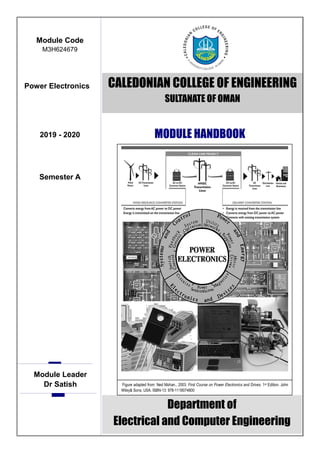
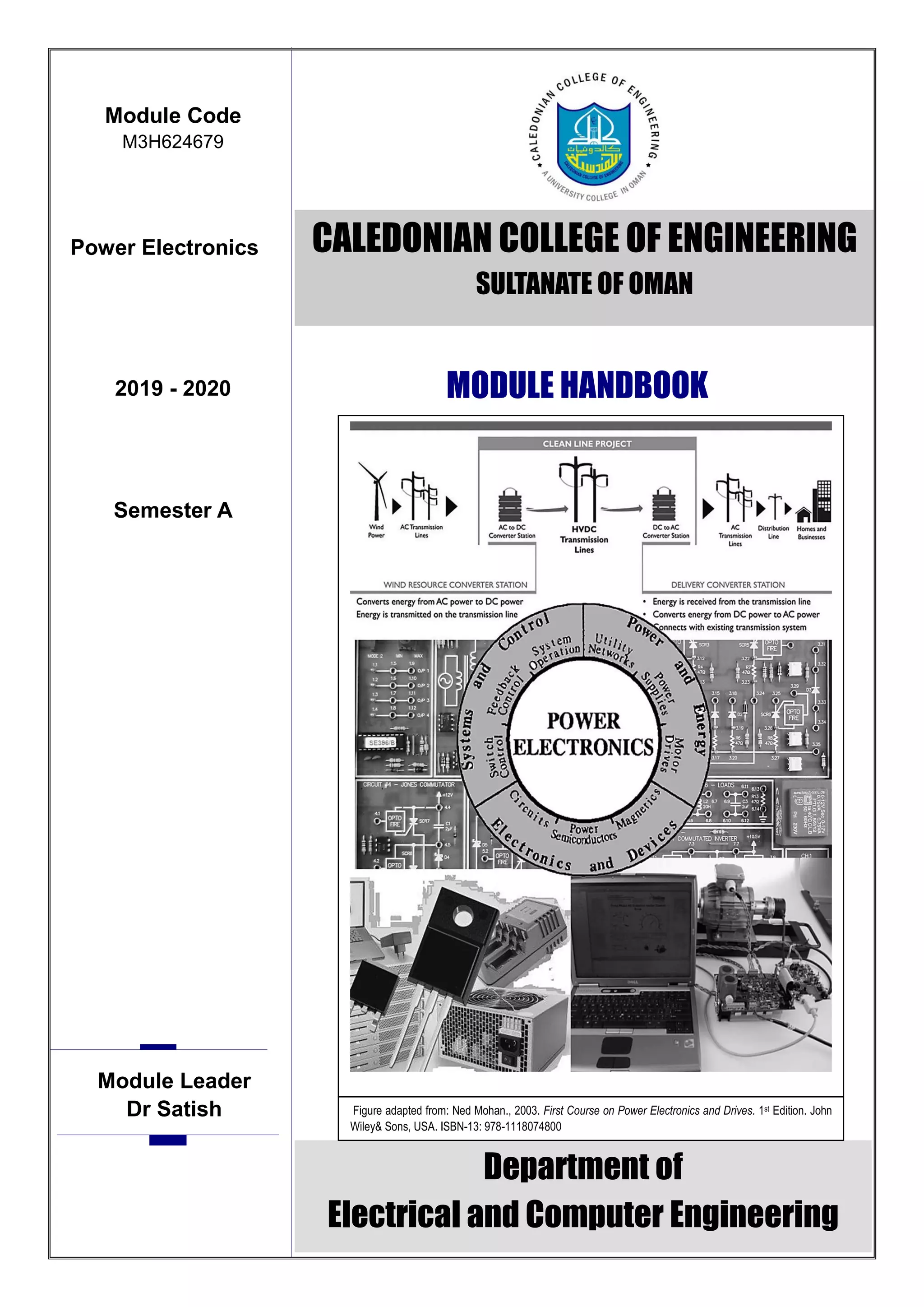
Figure adapted from: Ned Mohan., 2003. First Course on Power Electronics and Drives. 1st Edition. John
Wiley& Sons, USA. ISBN-13: 978-1118074800
Book by Ned Mohan. 6th edition.
Module Handbook: Power Electronics- M3H624679 Session: 2019 –20 Semester: A Ver: 01 2 | P a g e
age 1
SAVE PAPER - do not print this document unless it is necessary consider the environment
Module Handbook: Power Electronics- M3H624679 Session: 2019 –20 Semester: A Ver: 01 3 | P a g e
age 1
1. Module Details
Programme Name Module Code Module Title Credits Level and
Semester
Pre Requisite
Knowledge
BEng Honours in
Electrical Power
Engineering
M3H624679 Power Electronics 20
Level 3
Semester A
Circuit Theory and
Analysis
2. Aim And Objectives
This module examines power electronic devices, circuits, systems and application. An understanding
of the operation and characteristics of the system components will be developed. This will be followed
by a study of the performance of a range of power electronic converters and their application. Circuit
design and analysis techniques will be developed and PSIM will be employed as appropriate.
More specifically, the objectives are:
 To understand the construction and characteristics of different power electronic devices like
Power Diode, Thyristor, GTO, TRIAC, MOSFET and IGBT.
 To understand the working principle of DC/DC Converters.
 To understand the working principle of DC/AC Converters.
 To understand the working principle of single phase and three phase AC/DC converters.
 To analyze the harmonics present and design the filter for Rectifier and Inverter Circuits.
 To study the applications of power electronic converters in AC and DC Motor Drives, switch-
mode power supply, HVDC link, Static VAR Compensator and UPS.
 To understand simulation tool (PSIM) to Model and simulate different circuits.
 To study the protection and thermal aspects of power electronic devices.
3. Syllabus
The teaching syllabus will cover the following areas:
Power Electronic Devices: Construction and characteristics of different power electronic devices
like Diode, Thyristor, power BJT, power MOSFET, TRIAC, IGBT and GTO.
Cooling and Protection: Thermal model, peak and average temperature, transient thermal
impedance, cooling system specifications.
Rectifiers: ac/dc 1-phase and 3-phase controlled (full and half) and uncontrolled converters, mean
voltage, waveforms, power factor, distortion factor, overlap.
Inverters: single phase dc/ac inverter, Voltage Source Inverter, PWM, Quasi -square.
Noise and Thermal Aspects: Harmonic sources, analysis techniques (e.g. Fourier), EMC
considerations (coupling mechanisms, screening, interfaces, grounding, filters, measurement
standards, circuit layout);
Choppers: dc/dc converters, forward, flyback, resonant and Cuk, voltage regulation and ripple, filter
specification;
Cycloconverters: Basic AC/AC 1-phase cycloconverter
Module Handbook: Power Electronics- M3H624679 Session: 2019 –20 Semester: A Ver: 01 4 | P a g e
age 1
Applications: Electric motor drives, switch-mode power supply, HV DC link, static var compensator,
UPS, lighting and heating controls. Power systems (FACTS)
ECAD: Structure, modeling strategy, device/circuit/system and behavior of modeling, parameter
determination, schematic input, steady-state and transient analysis, post-processing (voltage, current,
power, harmonic analysis).
4. Learning Outcomes
On completion of this module the student should be able to:
1. Describe the characteristics of a range of power electronic devices and relate these to typical
applications.(AM1)
2. Analyze the thermal aspects of power electronic devices and outline appropriate protection
schemes for these devices(AM3)
3. Describe and analyze AC/DC, DC/DC, AC/AC and DC/AC static power conversion schemes
(AM7)
4. Describe applications of power electronic conversion schemes and develop a product
specification for such schemes synthesized from the needs of the application.(AM1,AM4)
5. Describe the principles of Electromagnetic compatibility (EMC) and harmonic filters.(AM1, AM6)
6. Work in a project team to solve a power electronic application problem. (AM8, AM9).
5. Learning and Teaching Strategy
This 20 credit module will be delivered through 6 contact hours per week, out of which 4 hours will be
devoted for the lectures and 2 hour for tutorials. Tutorial classes will be conducted to enhance the
student learning process. In addition to the theory classes the study pack for the students will
include, practical demonstrations, directed studies, industrial visits, guest lectures from industry and
computer- supported analysis. The various learning and teaching activities will be formulated so as to
enhance students’ practical design and analytical skills and also to support the development of their
research capabilities as they progress through the module.
Course Work
The students need to carry out a project (Mini Project) in an area directly related to the subject, to get
first level practical exposure to the system oriented hardware work. This is a team work of 2/3 in a
group. The tutors will give description on the project work and laboratory instructor will be providing
the required support to the students to carry out this mini project work in the laboratories. The
progress of the project work should be reported timely to the tutor. At the end of the work, the team
needs to submit a report which demonstrates the working of their project though software simulation
and hardware implementation. Viva for the project work will be conducted individually.
Module Handbook: Power Electronics- M3H624679 Session: 2019 –20 Semester: A Ver: 01 5 | P a g e
age 1
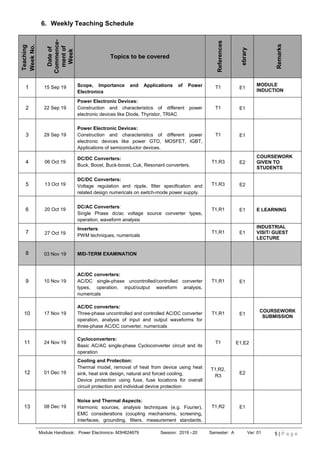
6. Weekly Teaching ScheduleTeaching
WeekNo.
Dateof
Commence-
mentof
Week
Topics to be covered
References
ebrary
Remarks
1 15 Sep 19 Scope, Importance and Applications of Power
Electronics
T1 E1
MODULE
INDUCTION
2 22 Sep 19
Power Electronic Devices:
Construction and characteristics of different power
electronic devices like Diode, Thyristor, TRIAC
T1 E1
3 29 Sep 19
Power Electronic Devices:
Construction and characteristics of different power
electronic devices like power GTO, MOSFET, IGBT,
Applications of semiconductor devices.
T1 E1
4 06 Oct 19
DC/DC Converters:
Buck, Boost, Buck-boost, Cuk, Resonant converters.
T1,R3 E2
COURSEWORK
GIVEN TO
STUDENTS
5 13 Oct 19
DC/DC Converters:
Voltage regulation and ripple, filter specification and
related design numericals on switch-mode power supply.
T1,R3 E2
6 20 Oct 19
DC/AC Converters:
Single Phase dc/ac voltage source converter types,
operation, waveform analysis
T1,R1 E1 E LEARNING
7 27 Oct 19
Inverters:
PWM techniques, numericals
T1,R1 E1
INDUSTRIAL
VISIT/ GUEST
LECTURE
8 03 Nov 19 MID-TERM EXAMINATION
9 10 Nov 19
AC/DC converters:
AC/DC single-phase uncontrolled/controlled converter
types, operation, input/output waveform analysis,
numericals
T1,R1 E1
10 17 Nov 19
AC/DC converters:
Three-phase uncontrolled and controlled AC/DC converter
operation, analysis of input and output waveforms for
three-phase AC/DC converter, numericals
T1,R1 E1
COURSEWORK
SUBMISSION
11 24 Nov 19
Cycloconverters:
Basic AC/AC single-phase Cycloconverter circuit and its
operation
T1 E1,E2
12 01 Dec 19
Cooling and Protection:
Thermal model, removal of heat from device using heat
sink, heat sink design, natural and forced cooling,
Device protection using fuse, fuse locations for overall
circuit protection and individual device protection
T1,R2,
R3
E2
13 08 Dec 19
Noise and Thermal Aspects:
Harmonic sources, analysis techniques (e.g. Fourier),
EMC considerations (coupling mechanisms, screening,
interfaces, grounding, filters, measurement standards,
T1,R2 E1
Module Handbook: Power Electronics- M3H624679 Session: 2019 –20 Semester: A Ver: 01 6 | P a g e
age 1
circuit layout)
14 15 Dec 19
Applications: Electric motor drives, HV DC link, static
VAR compensator, UPS, lighting and heating controls.
Power systems (FACTS).
T1,R2
E1,E2
22 Dec 19 Discussions / Doubt clearing sessions
Text Book
T1
Lander, C.W., 2013. Power Electronics. 3rd edition. McGraw-Hill. ISBN 13:
9780077077143.
References
R1
Rashid, M.H., 2013. Power Electronics Handbook Devices, Circuits and
Applications.3rd
Edition. USA: Butterworth-Heinemann-ISBN-13: 978-0133125900
R2 Ned Mohan, 2012. Power Electronics: First course.1st
Edition. USA: John Wiley&
Sons, ISBN-13: 978-1118074800
R3
Bimbhra, P.S., 2012. Power Electronics. Khanna Publishers. ISBN-13: 978-
8174092793.
Ebrary
E1
Bose, Bimal K.. Power Electronics and Motor Drives : Advances and Trends.
Burlington, MA, USA: Academic Press, 2006. ProQuest ebrary.
http://site.ebrary.com/lib/caledonian/detail.action?adv.x=1&docID=10138178&f00
=subject&p00=POWER+ELECTRONICS . [30th
June 2019].
E2
Rashid., M. Power Electronics Handbook : Devices, Circuits, and Applications
2006, Elsevier Science & Technology, Burlington. Available from: ProQuest
Ebook Central https://ebookcentral.proquest.com/lib/caledonian-
ebooks/reader.action?docID=283963&query=%2522Ned%2BMohan%2522. [30th
June 2019].
Module Handbook: Power Electronics- M3H624679 Session: 2019 –20 Semester: A Ver: 01 7 | P a g e
age 1
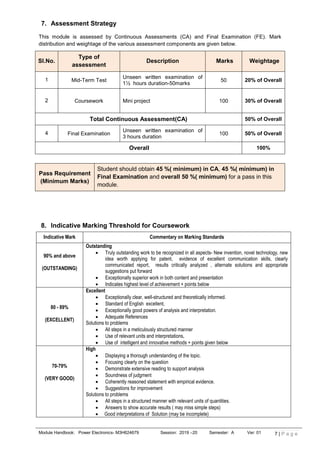
7. Assessment Strategy
This module is assessed by Continuous Assessments (CA) and Final Examination (FE). Mark
distribution and weightage of the various assessment components are given below.
Sl.No.
Type of
assessment
Description Marks Weightage
1 Mid-Term Test
Unseen written examination of
1½ hours duration-50marks
50 20% of Overall
2 Coursework Mini project 100 30% of Overall
Total Continuous Assessment(CA) 50% of Overall
4 Final Examination
Unseen written examination of
3 hours duration
100 50% of Overall
Overall 100%
Pass Requirement
(Minimum Marks)
Student should obtain 45 %( minimum) in CA, 45 %( minimum) in
Final Examination and overall 50 %( minimum) for a pass in this
module.
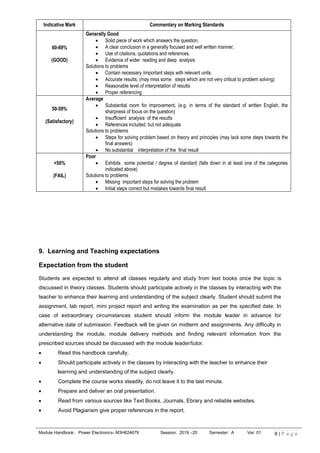
8. Indicative Marking Threshold for Coursework
Indicative Mark Commentary on Marking Standards
90% and above
(OUTSTANDING)
Outstanding
 Truly outstanding work to be recognized in all aspects- New invention, novel technology, new
idea worth applying for patent, evidence of excellent communication skills, clearly
communicated report, results critically analyzed , alternate solutions and appropriate
suggestions put forward
 Exceptionally superior work in both content and presentation
 Indicates highest level of achievement + points below
80 - 89%
(EXCELLENT)
Excellent
 Exceptionally clear, well-structured and theoretically informed.
 Standard of English excellent,
 Exceptionally good powers of analysis and interpretation.
 Adequate References
Solutions to problems
 All steps in a meticulously structured manner
 Use of relevant units and interpretations,
 Use of intelligent and innovative methods + points given below
70-79%
(VERY GOOD)
High
 Displaying a thorough understanding of the topic.
 Focusing clearly on the question
 Demonstrate extensive reading to support analysis
 Soundness of judgment
 Coherently reasoned statement with empirical evidence.
 Suggestions for improvement
Solutions to problems
 All steps in a structured manner with relevant units of quantities.
 Answers to show accurate results ( may miss simple steps)
 Good interpretations of Solution (may be incomplete)
Module Handbook: Power Electronics- M3H624679 Session: 2019 –20 Semester: A Ver: 01 8 | P a g e
age 1
Indicative Mark Commentary on Marking Standards
60-69%
(GOOD)
Generally Good
 Solid piece of work which answers the question,
 A clear conclusion in a generally focused and well written manner,
 Use of citations, quotations and references.
 Evidence of wider reading and deep analysis
Solutions to problems
 Contain necessary /important steps with relevant units.
 Accurate results, (may miss some steps which are not very critical to problem solving)
 Reasonable level of interpretation of results.
 Proper referencing
50-59%
(Satisfactory)
Average
 Substantial room for improvement, (e.g. in terms of the standard of written English, the
sharpness of focus on the question)
 Insufficient analysis of the results
 References included, but not adequate
Solutions to problems
 Steps for solving problem based on theory and principles (may lack some steps towards the
final answers)
 No substantial interpretation of the final result
<50%
(FAIL)
Poor
 Exhibits some potential / degree of standard (falls down in at least one of the categories
indicated above)
Solutions to problems
 Missing important steps for solving the problem
 Initial steps correct but mistakes towards final result
9. Learning and Teaching expectations
Expectation from the student
Students are expected to attend all classes regularly and study from text books once the topic is
discussed in theory classes. Students should participate actively in the classes by interacting with the
teacher to enhance their learning and understanding of the subject clearly. Student should submit the
assignment, lab report, mini project report and writing the examination as per the specified date. In
case of extraordinary circumstances student should inform the module leader in advance for
alternative date of submission. Feedback will be given on midterm and assignments. Any difficulty in
understanding the module, module delivery methods and finding relevant information from the
prescribed sources should be discussed with the module leader/tutor.
 Read this handbook carefully.
 Should participate actively in the classes by interacting with the teacher to enhance their
learning and understanding of the subject clearly.
 Complete the course works steadily, do not leave it to the last minute.
 Prepare and deliver an oral presentation.
 Read from various sources like Text Books, Journals, Ebrary and reliable websites.
 Avoid Plagiarism give proper references in the report.
Module Handbook: Power Electronics- M3H624679 Session: 2019 –20 Semester: A Ver: 01 9 | P a g e
age 1
Expectation from the staff
Tutors should perform the module induction of the module along with HSE induction. The syllabus
should be covered as per the module handbook. Module will be delivered through various teaching
methodologies like power points, videos etc. At the end of each lecture, the concept about the topic
should be understood well.
 Clarify the module from the module handbook
 General induction of the module
 HSE induction
 Cover the syllabus as per the module handbook
 Module will be delivered through various methodologies such PPT, Video, etc
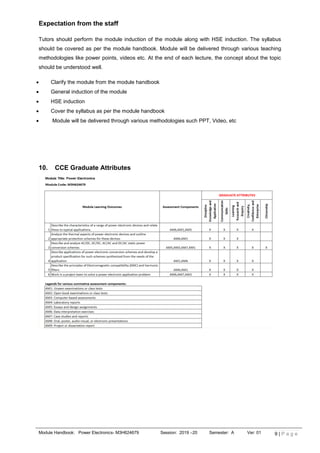
10. CCE Graduate Attributes

Module hand book

  • 1.
    CALEDONIAN COLLEGE OFENGINEERING SULTANATE OF OMAN Module Leader Dr Satish Power Electronics MODULE HANDBOOK Department of Electrical and Computer Engineering 2019 - 2020 Semester A Module Code M3H624679 Figure adapted from: Ned Mohan., 2003. First Course on Power Electronics and Drives. 1st Edition. John Wiley& Sons, USA. ISBN-13: 978-1118074800 Book by Ned Mohan. 6th edition.
  • 2.
    Module Handbook: PowerElectronics- M3H624679 Session: 2019 –20 Semester: A Ver: 01 2 | P a g e age 1 SAVE PAPER - do not print this document unless it is necessary consider the environment
  • 3.
    Module Handbook: PowerElectronics- M3H624679 Session: 2019 –20 Semester: A Ver: 01 3 | P a g e age 1 1. Module Details Programme Name Module Code Module Title Credits Level and Semester Pre Requisite Knowledge BEng Honours in Electrical Power Engineering M3H624679 Power Electronics 20 Level 3 Semester A Circuit Theory and Analysis 2. Aim And Objectives This module examines power electronic devices, circuits, systems and application. An understanding of the operation and characteristics of the system components will be developed. This will be followed by a study of the performance of a range of power electronic converters and their application. Circuit design and analysis techniques will be developed and PSIM will be employed as appropriate. More specifically, the objectives are:  To understand the construction and characteristics of different power electronic devices like Power Diode, Thyristor, GTO, TRIAC, MOSFET and IGBT.  To understand the working principle of DC/DC Converters.  To understand the working principle of DC/AC Converters.  To understand the working principle of single phase and three phase AC/DC converters.  To analyze the harmonics present and design the filter for Rectifier and Inverter Circuits.  To study the applications of power electronic converters in AC and DC Motor Drives, switch- mode power supply, HVDC link, Static VAR Compensator and UPS.  To understand simulation tool (PSIM) to Model and simulate different circuits.  To study the protection and thermal aspects of power electronic devices. 3. Syllabus The teaching syllabus will cover the following areas: Power Electronic Devices: Construction and characteristics of different power electronic devices like Diode, Thyristor, power BJT, power MOSFET, TRIAC, IGBT and GTO. Cooling and Protection: Thermal model, peak and average temperature, transient thermal impedance, cooling system specifications. Rectifiers: ac/dc 1-phase and 3-phase controlled (full and half) and uncontrolled converters, mean voltage, waveforms, power factor, distortion factor, overlap. Inverters: single phase dc/ac inverter, Voltage Source Inverter, PWM, Quasi -square. Noise and Thermal Aspects: Harmonic sources, analysis techniques (e.g. Fourier), EMC considerations (coupling mechanisms, screening, interfaces, grounding, filters, measurement standards, circuit layout); Choppers: dc/dc converters, forward, flyback, resonant and Cuk, voltage regulation and ripple, filter specification; Cycloconverters: Basic AC/AC 1-phase cycloconverter
  • 4.
    Module Handbook: PowerElectronics- M3H624679 Session: 2019 –20 Semester: A Ver: 01 4 | P a g e age 1 Applications: Electric motor drives, switch-mode power supply, HV DC link, static var compensator, UPS, lighting and heating controls. Power systems (FACTS) ECAD: Structure, modeling strategy, device/circuit/system and behavior of modeling, parameter determination, schematic input, steady-state and transient analysis, post-processing (voltage, current, power, harmonic analysis). 4. Learning Outcomes On completion of this module the student should be able to: 1. Describe the characteristics of a range of power electronic devices and relate these to typical applications.(AM1) 2. Analyze the thermal aspects of power electronic devices and outline appropriate protection schemes for these devices(AM3) 3. Describe and analyze AC/DC, DC/DC, AC/AC and DC/AC static power conversion schemes (AM7) 4. Describe applications of power electronic conversion schemes and develop a product specification for such schemes synthesized from the needs of the application.(AM1,AM4) 5. Describe the principles of Electromagnetic compatibility (EMC) and harmonic filters.(AM1, AM6) 6. Work in a project team to solve a power electronic application problem. (AM8, AM9). 5. Learning and Teaching Strategy This 20 credit module will be delivered through 6 contact hours per week, out of which 4 hours will be devoted for the lectures and 2 hour for tutorials. Tutorial classes will be conducted to enhance the student learning process. In addition to the theory classes the study pack for the students will include, practical demonstrations, directed studies, industrial visits, guest lectures from industry and computer- supported analysis. The various learning and teaching activities will be formulated so as to enhance students’ practical design and analytical skills and also to support the development of their research capabilities as they progress through the module. Course Work The students need to carry out a project (Mini Project) in an area directly related to the subject, to get first level practical exposure to the system oriented hardware work. This is a team work of 2/3 in a group. The tutors will give description on the project work and laboratory instructor will be providing the required support to the students to carry out this mini project work in the laboratories. The progress of the project work should be reported timely to the tutor. At the end of the work, the team needs to submit a report which demonstrates the working of their project though software simulation and hardware implementation. Viva for the project work will be conducted individually.
  • 5.
    Module Handbook: PowerElectronics- M3H624679 Session: 2019 –20 Semester: A Ver: 01 5 | P a g e age 1 6. Weekly Teaching ScheduleTeaching WeekNo. Dateof Commence- mentof Week Topics to be covered References ebrary Remarks 1 15 Sep 19 Scope, Importance and Applications of Power Electronics T1 E1 MODULE INDUCTION 2 22 Sep 19 Power Electronic Devices: Construction and characteristics of different power electronic devices like Diode, Thyristor, TRIAC T1 E1 3 29 Sep 19 Power Electronic Devices: Construction and characteristics of different power electronic devices like power GTO, MOSFET, IGBT, Applications of semiconductor devices. T1 E1 4 06 Oct 19 DC/DC Converters: Buck, Boost, Buck-boost, Cuk, Resonant converters. T1,R3 E2 COURSEWORK GIVEN TO STUDENTS 5 13 Oct 19 DC/DC Converters: Voltage regulation and ripple, filter specification and related design numericals on switch-mode power supply. T1,R3 E2 6 20 Oct 19 DC/AC Converters: Single Phase dc/ac voltage source converter types, operation, waveform analysis T1,R1 E1 E LEARNING 7 27 Oct 19 Inverters: PWM techniques, numericals T1,R1 E1 INDUSTRIAL VISIT/ GUEST LECTURE 8 03 Nov 19 MID-TERM EXAMINATION 9 10 Nov 19 AC/DC converters: AC/DC single-phase uncontrolled/controlled converter types, operation, input/output waveform analysis, numericals T1,R1 E1 10 17 Nov 19 AC/DC converters: Three-phase uncontrolled and controlled AC/DC converter operation, analysis of input and output waveforms for three-phase AC/DC converter, numericals T1,R1 E1 COURSEWORK SUBMISSION 11 24 Nov 19 Cycloconverters: Basic AC/AC single-phase Cycloconverter circuit and its operation T1 E1,E2 12 01 Dec 19 Cooling and Protection: Thermal model, removal of heat from device using heat sink, heat sink design, natural and forced cooling, Device protection using fuse, fuse locations for overall circuit protection and individual device protection T1,R2, R3 E2 13 08 Dec 19 Noise and Thermal Aspects: Harmonic sources, analysis techniques (e.g. Fourier), EMC considerations (coupling mechanisms, screening, interfaces, grounding, filters, measurement standards, T1,R2 E1
  • 6.
    Module Handbook: PowerElectronics- M3H624679 Session: 2019 –20 Semester: A Ver: 01 6 | P a g e age 1 circuit layout) 14 15 Dec 19 Applications: Electric motor drives, HV DC link, static VAR compensator, UPS, lighting and heating controls. Power systems (FACTS). T1,R2 E1,E2 22 Dec 19 Discussions / Doubt clearing sessions Text Book T1 Lander, C.W., 2013. Power Electronics. 3rd edition. McGraw-Hill. ISBN 13: 9780077077143. References R1 Rashid, M.H., 2013. Power Electronics Handbook Devices, Circuits and Applications.3rd Edition. USA: Butterworth-Heinemann-ISBN-13: 978-0133125900 R2 Ned Mohan, 2012. Power Electronics: First course.1st Edition. USA: John Wiley& Sons, ISBN-13: 978-1118074800 R3 Bimbhra, P.S., 2012. Power Electronics. Khanna Publishers. ISBN-13: 978- 8174092793. Ebrary E1 Bose, Bimal K.. Power Electronics and Motor Drives : Advances and Trends. Burlington, MA, USA: Academic Press, 2006. ProQuest ebrary. http://site.ebrary.com/lib/caledonian/detail.action?adv.x=1&docID=10138178&f00 =subject&p00=POWER+ELECTRONICS . [30th June 2019]. E2 Rashid., M. Power Electronics Handbook : Devices, Circuits, and Applications 2006, Elsevier Science & Technology, Burlington. Available from: ProQuest Ebook Central https://ebookcentral.proquest.com/lib/caledonian- ebooks/reader.action?docID=283963&query=%2522Ned%2BMohan%2522. [30th June 2019].
  • 7.
    Module Handbook: PowerElectronics- M3H624679 Session: 2019 –20 Semester: A Ver: 01 7 | P a g e age 1 7. Assessment Strategy This module is assessed by Continuous Assessments (CA) and Final Examination (FE). Mark distribution and weightage of the various assessment components are given below. Sl.No. Type of assessment Description Marks Weightage 1 Mid-Term Test Unseen written examination of 1½ hours duration-50marks 50 20% of Overall 2 Coursework Mini project 100 30% of Overall Total Continuous Assessment(CA) 50% of Overall 4 Final Examination Unseen written examination of 3 hours duration 100 50% of Overall Overall 100% Pass Requirement (Minimum Marks) Student should obtain 45 %( minimum) in CA, 45 %( minimum) in Final Examination and overall 50 %( minimum) for a pass in this module. 8. Indicative Marking Threshold for Coursework Indicative Mark Commentary on Marking Standards 90% and above (OUTSTANDING) Outstanding  Truly outstanding work to be recognized in all aspects- New invention, novel technology, new idea worth applying for patent, evidence of excellent communication skills, clearly communicated report, results critically analyzed , alternate solutions and appropriate suggestions put forward  Exceptionally superior work in both content and presentation  Indicates highest level of achievement + points below 80 - 89% (EXCELLENT) Excellent  Exceptionally clear, well-structured and theoretically informed.  Standard of English excellent,  Exceptionally good powers of analysis and interpretation.  Adequate References Solutions to problems  All steps in a meticulously structured manner  Use of relevant units and interpretations,  Use of intelligent and innovative methods + points given below 70-79% (VERY GOOD) High  Displaying a thorough understanding of the topic.  Focusing clearly on the question  Demonstrate extensive reading to support analysis  Soundness of judgment  Coherently reasoned statement with empirical evidence.  Suggestions for improvement Solutions to problems  All steps in a structured manner with relevant units of quantities.  Answers to show accurate results ( may miss simple steps)  Good interpretations of Solution (may be incomplete)
  • 8.
    Module Handbook: PowerElectronics- M3H624679 Session: 2019 –20 Semester: A Ver: 01 8 | P a g e age 1 Indicative Mark Commentary on Marking Standards 60-69% (GOOD) Generally Good  Solid piece of work which answers the question,  A clear conclusion in a generally focused and well written manner,  Use of citations, quotations and references.  Evidence of wider reading and deep analysis Solutions to problems  Contain necessary /important steps with relevant units.  Accurate results, (may miss some steps which are not very critical to problem solving)  Reasonable level of interpretation of results.  Proper referencing 50-59% (Satisfactory) Average  Substantial room for improvement, (e.g. in terms of the standard of written English, the sharpness of focus on the question)  Insufficient analysis of the results  References included, but not adequate Solutions to problems  Steps for solving problem based on theory and principles (may lack some steps towards the final answers)  No substantial interpretation of the final result <50% (FAIL) Poor  Exhibits some potential / degree of standard (falls down in at least one of the categories indicated above) Solutions to problems  Missing important steps for solving the problem  Initial steps correct but mistakes towards final result 9. Learning and Teaching expectations Expectation from the student Students are expected to attend all classes regularly and study from text books once the topic is discussed in theory classes. Students should participate actively in the classes by interacting with the teacher to enhance their learning and understanding of the subject clearly. Student should submit the assignment, lab report, mini project report and writing the examination as per the specified date. In case of extraordinary circumstances student should inform the module leader in advance for alternative date of submission. Feedback will be given on midterm and assignments. Any difficulty in understanding the module, module delivery methods and finding relevant information from the prescribed sources should be discussed with the module leader/tutor.  Read this handbook carefully.  Should participate actively in the classes by interacting with the teacher to enhance their learning and understanding of the subject clearly.  Complete the course works steadily, do not leave it to the last minute.  Prepare and deliver an oral presentation.  Read from various sources like Text Books, Journals, Ebrary and reliable websites.  Avoid Plagiarism give proper references in the report.
  • 9.
    Module Handbook: PowerElectronics- M3H624679 Session: 2019 –20 Semester: A Ver: 01 9 | P a g e age 1 Expectation from the staff Tutors should perform the module induction of the module along with HSE induction. The syllabus should be covered as per the module handbook. Module will be delivered through various teaching methodologies like power points, videos etc. At the end of each lecture, the concept about the topic should be understood well.  Clarify the module from the module handbook  General induction of the module  HSE induction  Cover the syllabus as per the module handbook  Module will be delivered through various methodologies such PPT, Video, etc 10. CCE Graduate Attributes