Module 8
Security and Ethical
    Challenges
Ethics
• It is a set of principles prescribing a behaviour
  code, explains what is good and right and
  wrong
• It outlines moral duties and obligations
• Business Ethics are concerned with moral
  issues in business just like medical ethics in
  medical practice
Computer Crime/ Cyber Crime
• It is defined by the Association of Information
  Technology Professionals (AITP) as:
  1. The unauthorized use , access modification and
     destruction of hardware, software, data or
     network resources
  2. Unauthorized release of information
  3. Unauthorized copying of software
  4. Denying end user access to his own hardware,
     software, data and network resources
  5. Using or conspiring to use computer to obtain
     intangible property illegally
Computer Crime/ Cyber Crime
• It is caused by the criminal or irresponsible
  actions of individuals who are taking
  advantage of the widespread use and
  vulnerability of computers and internet
• It poses serious threat to the integrity, safety
  and survival of most business systems
Hacking and Cracking
• Hacking- It is the obsessive use of computers or the
  unauthorized access and use of networked
  computer systems
• Hacker can be outsider or company employee
• Commits only electronic breaking and entering, that
  is, gets access to a computer system and read some
  files but neither steals nor damages anything
• Can monitor e-mail, web server access or files
  transfers to extract passwords, steal network files or
  plant data that will cause a system to welcome
  intruders
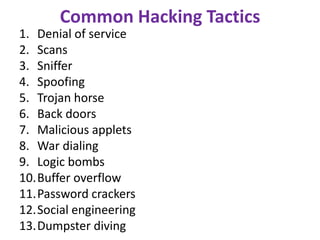
Common Hacking Tactics
1. Denial of service
2. Scans
3. Sniffer
4. Spoofing
5. Trojan horse
6. Back doors
7. Malicious applets
8. War dialing
9. Logic bombs
10.Buffer overflow
11.Password crackers
12.Social engineering
13.Dumpster diving
Cracking
• Cracker refers to people who attempt to gain
  unauthorized access to computer systems
• Maintains knowledge of the vulnerabilities
  and exploits them for private advantage, not
  revealing either to general public or the
  manufacturer for correction
Cyber Theft
• Computer crimes leading to theft of money
• Insiders involve unauthorized network entry
  and fraudulent alteration of computer
  databases
• Early e.g. was the theft of $ 11 million from
  Citibank in 1994
Unauthorized Use at Work
• Can also be called time and resource theft
• Network monitoring software, called sniffers,
  is frequently used to monitor network traffic
  to evaluate network capacity, as well as to
  reveal evidences of improper use
Software Piracy
• Unauthorized copying of software is a major
  form of SW theft
• Unauthorized copying is illegal as SW is
  intellectual property protected by copying
  right law and user licensing agreements
Theft of Intellectual Property
• Occurs in the form of infringements of
  copyrighted material, such as music, videos,
  images, articles, books
Privacy Issues
• Accessing private e-mail conversations and
  computer records and collecting and sharing
  information about individuals gained from their
  visits to Internet Web sites and newsgroups
• Always knowing where the person is
• Using customer information gained from many
  sources to market additional business services
• Collecting telephone numbers, e-mail addresses,
  credit card numbers and other personal
  information to build individual customer profiles
  (unauthorised personal profile)
Privacy on the Internet
• E-mail, chat and newsgroups are still a wide
  open unsecured electronic frontier
• Beware of
  – Collection of data about you without your
    knowledge
Cyber Law
• It is a term used to describe laws intended to
  regulate activities over the internet or via the
  use of electronic data communication
• It encompasses wide variety of legal and
  political issues related to internet and other
  communication technologies including
  Intellectual Property, privacy, freedom of
  expression and jurisdiction
Challenges
1.   Employment challenges
2.   Computer monitoring
3.   Challenges in working conditions
4.   Challenges to individuality
5.   Health issues
6.   Ergonomics
Thank you

Module 8 security and ethical challenges

  • 1.
    Module 8 Security andEthical Challenges
  • 2.
    Ethics • It isa set of principles prescribing a behaviour code, explains what is good and right and wrong • It outlines moral duties and obligations • Business Ethics are concerned with moral issues in business just like medical ethics in medical practice
  • 3.
    Computer Crime/ CyberCrime • It is defined by the Association of Information Technology Professionals (AITP) as: 1. The unauthorized use , access modification and destruction of hardware, software, data or network resources 2. Unauthorized release of information 3. Unauthorized copying of software 4. Denying end user access to his own hardware, software, data and network resources 5. Using or conspiring to use computer to obtain intangible property illegally
  • 4.
    Computer Crime/ CyberCrime • It is caused by the criminal or irresponsible actions of individuals who are taking advantage of the widespread use and vulnerability of computers and internet • It poses serious threat to the integrity, safety and survival of most business systems
  • 5.
    Hacking and Cracking •Hacking- It is the obsessive use of computers or the unauthorized access and use of networked computer systems • Hacker can be outsider or company employee • Commits only electronic breaking and entering, that is, gets access to a computer system and read some files but neither steals nor damages anything • Can monitor e-mail, web server access or files transfers to extract passwords, steal network files or plant data that will cause a system to welcome intruders
  • 6.
    Common Hacking Tactics 1.Denial of service 2. Scans 3. Sniffer 4. Spoofing 5. Trojan horse 6. Back doors 7. Malicious applets 8. War dialing 9. Logic bombs 10.Buffer overflow 11.Password crackers 12.Social engineering 13.Dumpster diving
  • 7.
    Cracking • Cracker refersto people who attempt to gain unauthorized access to computer systems • Maintains knowledge of the vulnerabilities and exploits them for private advantage, not revealing either to general public or the manufacturer for correction
  • 8.
    Cyber Theft • Computercrimes leading to theft of money • Insiders involve unauthorized network entry and fraudulent alteration of computer databases • Early e.g. was the theft of $ 11 million from Citibank in 1994
  • 9.
    Unauthorized Use atWork • Can also be called time and resource theft • Network monitoring software, called sniffers, is frequently used to monitor network traffic to evaluate network capacity, as well as to reveal evidences of improper use
  • 10.
    Software Piracy • Unauthorizedcopying of software is a major form of SW theft • Unauthorized copying is illegal as SW is intellectual property protected by copying right law and user licensing agreements
  • 11.
    Theft of IntellectualProperty • Occurs in the form of infringements of copyrighted material, such as music, videos, images, articles, books
  • 12.
    Privacy Issues • Accessingprivate e-mail conversations and computer records and collecting and sharing information about individuals gained from their visits to Internet Web sites and newsgroups • Always knowing where the person is • Using customer information gained from many sources to market additional business services • Collecting telephone numbers, e-mail addresses, credit card numbers and other personal information to build individual customer profiles (unauthorised personal profile)
  • 13.
    Privacy on theInternet • E-mail, chat and newsgroups are still a wide open unsecured electronic frontier • Beware of – Collection of data about you without your knowledge
  • 14.
    Cyber Law • Itis a term used to describe laws intended to regulate activities over the internet or via the use of electronic data communication • It encompasses wide variety of legal and political issues related to internet and other communication technologies including Intellectual Property, privacy, freedom of expression and jurisdiction
  • 15.
    Challenges 1. Employment challenges 2. Computer monitoring 3. Challenges in working conditions 4. Challenges to individuality 5. Health issues 6. Ergonomics
  • 16.

Editor's Notes

  • #6 O Brien Pg 665
  • #11 O Brien Pg 671Computer programs are valuable property and thus the subject of theft from computer systems
  • #13 O Brien Pg 677
  • #16 O Brien Pg 682