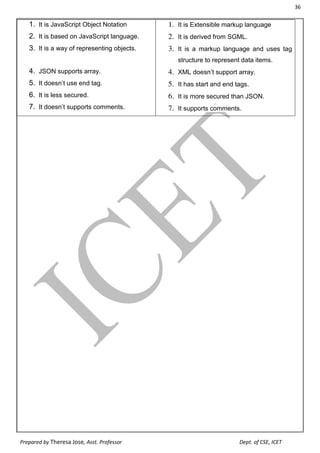
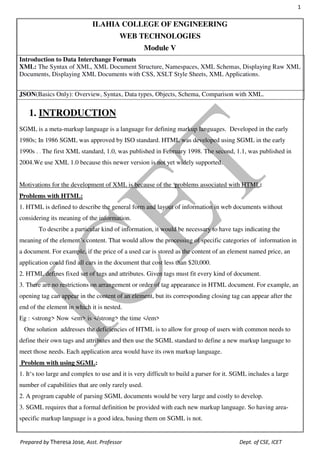
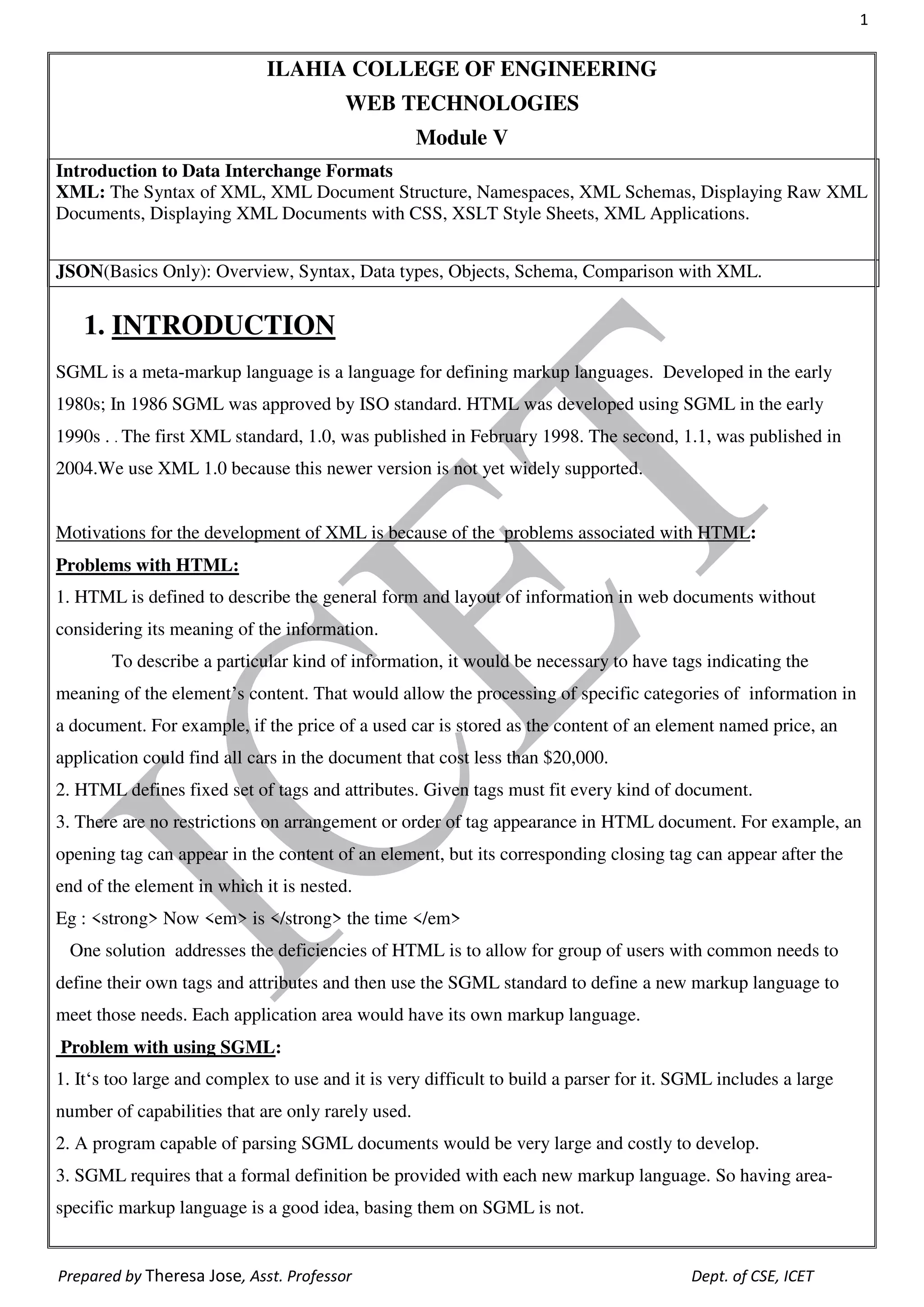
The document provides an introduction to XML, including its history, motivations for development, advantages over HTML, and basic syntax rules. It discusses how XML was designed as a simplified version of SGML to address deficiencies in HTML. The key points are:
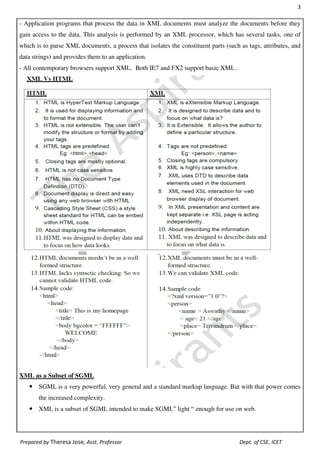
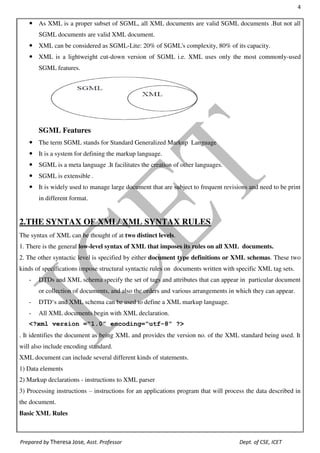
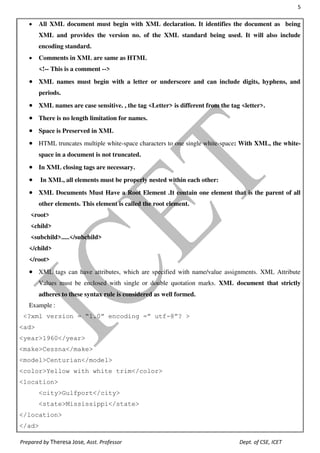
- XML was created to add meaning to documents by allowing users to define their own tags, unlike HTML which only defines a fixed set of tags.
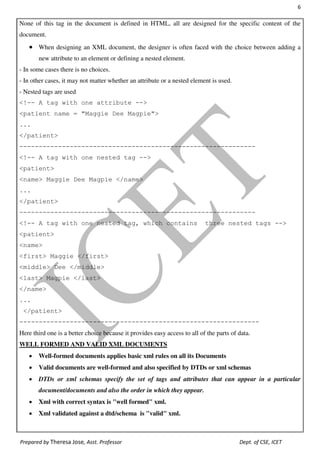
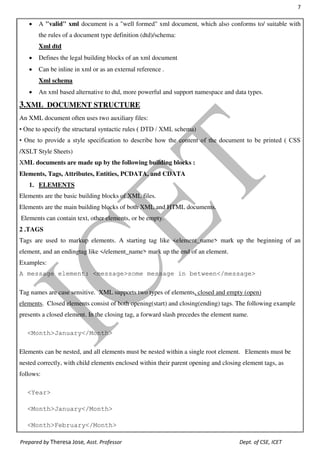
- XML documents must follow syntax rules like having a root element, properly nested tags, and closed tags, to be considered well-formed.
- XML provides a universal way to store and exchange data between different applications, making it useful for data interchange.
![9
Prepared by Theresa Jose, Asst. Professor Dept. of CSE, ICET
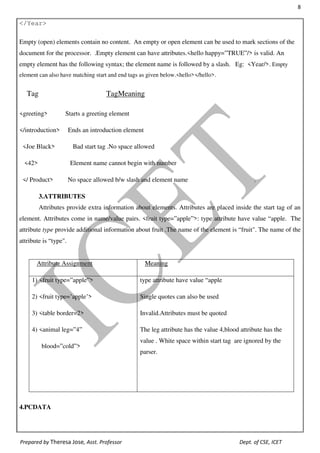
PCDATA means parsed character data. Think of character data as the text found between the start tag and
the end tag of an XML element. PCDATA is text that will be parsed by a parser. Tags inside the text will be
treated as markup and entities will be expanded.
5.CDATA
CDATA also means character data. This section is used to shield a body of text from the attentions of the
XML processor. CDATA is text that will NOT be parsed by a parser. Tags inside the text will NOT be
treated as markup and entities will not be expanded that is used to insert an extra space in an HTML
document.Entities are expanded when a document is parsed by an XML parser.
syntax.
<![CDATA[content]]>
Example
<Document>
<![CDATA[ if a<b and b<c then a<c]] >
</Document>
6.ENTITIES
An XML document consist of one or more entities that are logically related collection of information, .
Entities range from a single special character to a book chapter. An XML document has one document
entity. The document entity can be the entire document , but in many cases it includes references to the
names of entities that are stored elsewhere. For eg: the document entity for a technical article might contain
beginning and ending material but have references to article body sections, which are entities stored in
separate files..All other entities except the document entity must have a name.
Reasons to break a document into multiple entities:
1. Good to define a Large documents as a smaller no. of parts to make it more easier to manage .
2. If the same data appears in more than one place in the document, defining it as an entity allows any no. of
references to a single copy of data.
3. Many documents include information that cannot be represented as text, such as images. Such information
units are usually stored as binary data. Binary entities can only be referenced in the document entities
because XML documents cannot include binary data.
Rules of Entity names:
• No length limitation
• Must begin with a letter, a dash, or a colon
• Can include letters, digits, periods, dashes, underscores, or colons.
• A reference to an entity (Entity Reference) has the form, name with prepended ampersand and
appended semicolon: &entity_name; Eg. &apple_image;
When the processor parses the document it will replace the entity reference with actual characters.](https://image.slidesharecdn.com/module5xmlnotes-221114140313-3d610f5e/85/Module-5-XML-Notes-pdf-9-320.jpg)
![10
Prepared by Theresa Jose, Asst. Professor Dept. of CSE, ICET
One of the common uses of entities is to allow characters that are normally used as markup
delimiters to appear as themselves in a document. Because of this XML includes the entities that are
predefined for HTML.
Regardless of the entity types, all entities are referenced in the same way: &name; This code will
include the simple entity
<!entity iso “International Organization for Standardization”>
within a sentence :
The &iso; sets the standard for character encoding.
when interepted by an XML parser the result is the
The International Organization for Standardization sets the standard
for character encoding.
If several predefined entities must appear near each other in a document, it is better to avoid using
entity references. Character data section can be used. The content of a character data section is not
parsed by the XML parser, so it can include any tags.
The form of a character data section is as follows: <![CDATA[content]]> // no tags can be used
since it is not parsed For example, instead of Start >>>> HERE <<<<
use <![CDATA[Start >>>> HERE <<<<]]>
The opening keyword of a character data section is not just CDATA, it is in effect [CDATA[. There
can be any spaces between [ and C or between A and [.
Because the content of Character data section is not parsed by the XML,any entity references that are
included are not expanded.For Eg: the content of the line
<![CDATA[The form of a tag is <tag name>]]>
is as follows .
Five Built-in Entity
Entity Reference Interpretation
< <
> >
& &
' ‘
" “](https://image.slidesharecdn.com/module5xmlnotes-221114140313-3d610f5e/85/Module-5-XML-Notes-pdf-10-320.jpg)
![12
Prepared by Theresa Jose, Asst. Professor Dept. of CSE, ICET
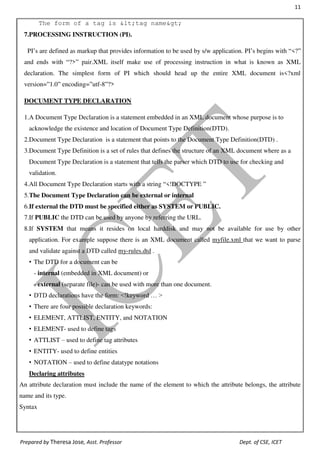
• <!ATTLIST element-name attribute_name attribute type [default-
value]>
If More than one attribute
• <!ATTLIST element_name attribute_name1 attribute_type
default_value_1
attribute_name2 attribute_type default_value_2>
Attribute type :There are ten different types, but we will consider only CDATA .
• Possible Default value for attributes:
• Value - value ,which is used if none is specified in an element (as default)
• #Fixed value - value ,which every element have and can‘t be changed (as constant)
• # Required - no default value is given ,every instance must specify a value
• #Implied - no default value is given ,the value may or may not be specified (optional)
• Example :
<!ATTLIST car doors CDATA "4">
<!ATTLIST car engine_type CDATA #REQUIRED>
<!ATTLIST car make CDATA #FIXED "Ford">
<!ATTLIST car price CDATA #IMPLIED>
The following xml element is valid for this DTD
<car doors = "2" engine_type = "V8">
...
</car>
Attribute that include fixed in the DTD may or may not be specified in particular element instances.
+ - one or more occurences
* - zero or more occurences
? - zero or one occurrence
• Eg DTD Declaration
<!ELEMENT person (parent+, age, spouse?, sibling* )>
Means parent element can occur one or more times, spouse element can occur zero or one time. Sibling
element can occur zero or more times.
INTERNAL DTD
• If the DTD’s are internal then the syntax is
• <!DOCTYPE root-element [<!internal type definition>]>
<?xml version=”1.0” encoding=”utf-8”?>
<!DOCTYPE mail [
<!ELEMENT mail(to,from,heading,body)>](https://image.slidesharecdn.com/module5xmlnotes-221114140313-3d610f5e/85/Module-5-XML-Notes-pdf-12-320.jpg)
![13
Prepared by Theresa Jose, Asst. Professor Dept. of CSE, ICET
<!ELEMENT to (#PCDATA)>
<!ELEMENT from (#PCDATA)>
<!ELEMENT heading (#PCDATA)>
<!ELEMENT body (#PCDATA)>]>
<mail>
<to>Rani</to>
<from>Ravi</from>
<heading>Remainder</heading>
<body>About our parents Wedding Anniversary</body>
</mail>
EXTERNAL DTD
• The DTD section can be placed in an external file .
• If the Document Type Declaration is external then the DTD must be specified either as SYSTEM or
PUBLIC in the Document Type Declaration.
• If the DTD’s are external then the syntax is
<!DOCTYPE root-element SYSTEM “DTD_file_URL”>
or
<!DOCTYPE root-element PUBLIC “public_id” “DTD_file_URL” >
• If SYSTEM the DTD resides on the local hard disk and may not be available for use by other
applications. If PUBLIC the DTD can be used by anyone by referring the URL . The public_id is
unique for standard DTD files on the web.
• //mail.xml
<?xml version=”1.0” encoding = “utf-8”?>
<!DOCTYPE mail SYSTEM “mail.dtd”>
<mail>
<to>Rani</to>
<from>Ravi</from>
<heading>Remainder
</heading>](https://image.slidesharecdn.com/module5xmlnotes-221114140313-3d610f5e/85/Module-5-XML-Notes-pdf-13-320.jpg)
![15
Prepared by Theresa Jose, Asst. Professor Dept. of CSE, ICET
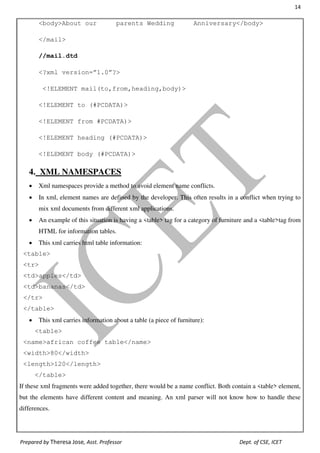
An XML namespace is a collection of element and attribute names used in XML documents. The
name of the namespace usually has the form of a URL. But the XML processors never reference the site
whose URL is used as the name of a namespace. The purpose of the URL is to give the namespace a unique
name. The namespaces can be declared as the value of xmlns in the elements where they are used or in the
xml root element.
SOLVING THE NAME CONFLICT USING A PREFIX
Name conflicts in xml can easily be avoided using a name prefix.
This xml carries information about an html table, and a piece of furniture:
<h:table>
<h:tr>
<h:td>apples</h:td>
<h:td>bananas</h:td>
</h:tr>
</h:table>
<f:table>
<f:name>african coffee table</f:name>
<f:width>80</f:width>
<f:length>120</f:length>
</f:table>
In the example above, there will be no conflict because the two <table> elements have different
names.
XML NAMESPACES - the xmlns ATTRIBUTE
The namespace declaration has the following syntax:
<element_name xmlns[:prefix] ="URL>"
• The square bracket indicates that what is within them is optional. prefix[optional] specify name to be
attached to names in the declared namespace .
Two reasons for prefix :
1. Shorthand for URL is too long to be typed on every occurrence of every name from the namespace.
2. URL may includes characters that are illegal in XML
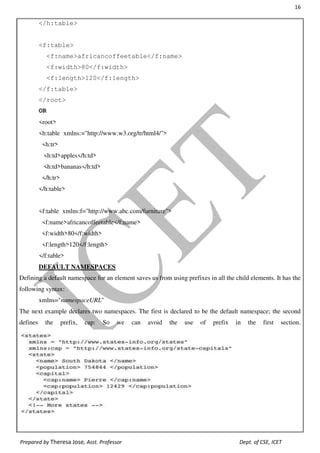
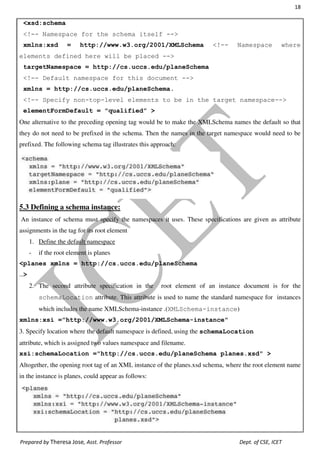
Namespaces can be declared in the elements where they are used or in the xml root element:
<root xmlns:h="http://www.w3.org/tr/html4/"
xmlns:f="http://www.w3schools.com/furniture">
<h:table>
<h:tr>
<h:td>apples</h:td>
<h:td>bananas</h:td>
</h:tr>](https://image.slidesharecdn.com/module5xmlnotes-221114140313-3d610f5e/85/Module-5-XML-Notes-pdf-15-320.jpg)

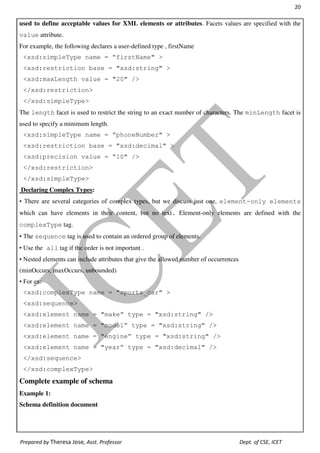
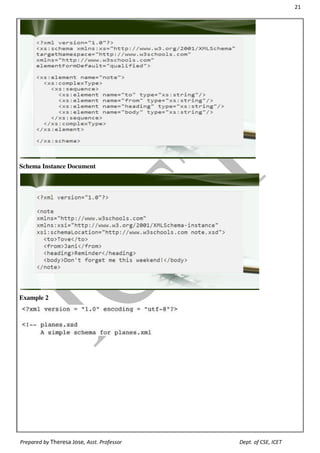
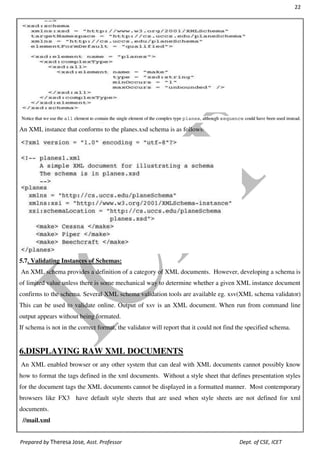
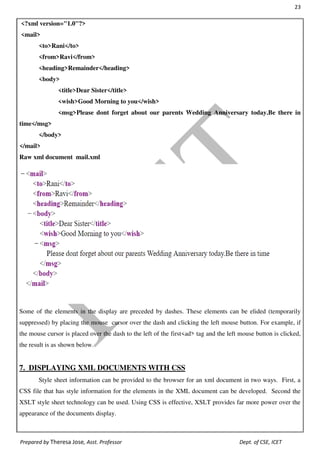
![34
Prepared by Theresa Jose, Asst. Professor Dept. of CSE, ICET
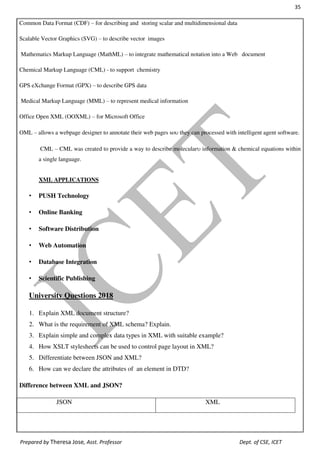
XML Applications
XML enables the users/organizations to create their own elements attributes and entities to describe the structure of
specific type of data they use.
This flexibility leads to use XML in many applications like:
Channel definition format [CDF]
Open software description [OSD]
Resource description framework [RDF]
Mathematical markup language[MathML]
Ontology markup language[OML]
Chemical markup language[CML]](https://image.slidesharecdn.com/module5xmlnotes-221114140313-3d610f5e/85/Module-5-XML-Notes-pdf-34-320.jpg)