MODULE 5
SOFTWARE MANAGEMENT
CONTROL


AN1101 – Module 5.13
EASA SYLLABUS
5.13 Software Management Control
  Level 2
 Awareness of restrictions,
  airworthiness requirements and
  possible catastrophic effects of
  unapproved changes to software
  programmes.
AIM
 Awareness of restrictions using the
  software for aircraft
 Airworthiness requirements and
  approval procedure
 Possible catastrophic effects of
  unapproved changes to software
  programs
INTRODUCTION
 Computer software used to drive
  many type of system in aircraft
 Can not be allowed it to fail during
  operation
 Requirements to evaluate, test and
  verify for fail safe design
 Failure prevention.
APPLICATION OF
SOFTWARE
Some example are:
 primary and secondary flight controls
 engine controls
 electrical generation and distribution
 brakes
 radio and navigation equipment
 flight instruments
 automatic flight control
SOFTWARE APPROVAL
 Software must be verify by authority for
  approval and quality control.
 Initial certification :
    ◦ Software must be design by approved company
    ◦ Approved by Design Organization
    ◦ Software must comply with authority requirement
      (BCAR sec A)
    ◦ Software Validation process approved by local
      authority.
   Post-Certification Modifications
    ◦ Modification must based on rule apply to the
      application on hardware
    ◦ Modification which effect software must be approved
      by the Design Organization
DOCUMENTATION APPROVAL
 Malaysian AN 57 issue in order to
  recognize RTCA/EUROCAE document
  with appropriate guidance material.
 Include in RTCA/EUROCAE :
    ◦ DO-178/ED-12 : Application form for software
      approval and guidance
    ◦ Requirement for software control
    ◦ Software documentation procedure
    ◦ Requirement for configuration management
    ◦ Rule for upgrading software
    ◦ Differential of software level
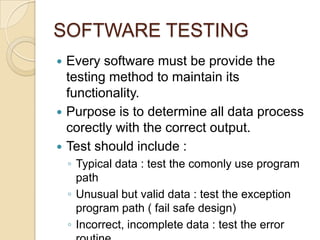
SOFTWARE TESTING
 Every software must be provide the
  testing method to maintain its
  functionality.
 Purpose is to determine all data process
  corectly with the correct output.
 Test should include :
    ◦ Typical data : test the comonly use program
      path
    ◦ Unusual but valid data : test the exception
      program path ( fail safe design)
    ◦ Incorrect, incomplete data : test the error
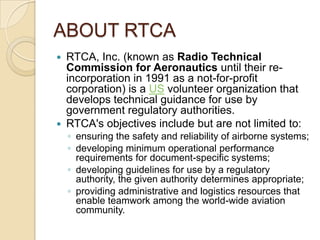
ABOUT RTCA
 RTCA, Inc. (known as Radio Technical
  Commission for Aeronautics until their re-
  incorporation in 1991 as a not-for-profit
  corporation) is a US volunteer organization that
  develops technical guidance for use by
  government regulatory authorities.
 RTCA's objectives include but are not limited to:
    ◦ ensuring the safety and reliability of airborne systems;
    ◦ developing minimum operational performance
      requirements for document-specific systems;
    ◦ developing guidelines for use by a regulatory
      authority, the given authority determines appropriate;
    ◦ providing administrative and logistics resources that
      enable teamwork among the world-wide aviation
      community.
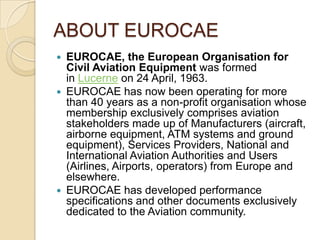
ABOUT EUROCAE
 EUROCAE, the European Organisation for
  Civil Aviation Equipment was formed
  in Lucerne on 24 April, 1963.
 EUROCAE has now been operating for more
  than 40 years as a non-profit organisation whose
  membership exclusively comprises aviation
  stakeholders made up of Manufacturers (aircraft,
  airborne equipment, ATM systems and ground
  equipment), Services Providers, National and
  International Aviation Authorities and Users
  (Airlines, Airports, operators) from Europe and
  elsewhere.
 EUROCAE has developed performance
  specifications and other documents exclusively
  dedicated to the Aviation community.
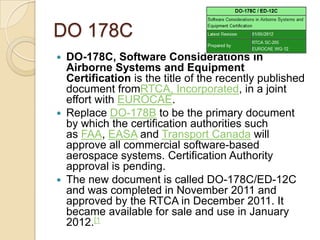
DO 178C
 DO-178C, Software Considerations in
  Airborne Systems and Equipment
  Certification is the title of the recently published
  document fromRTCA, Incorporated, in a joint
  effort with EUROCAE.
 Replace DO-178B to be the primary document
  by which the certification authorities such
  as FAA, EASA and Transport Canada will
  approve all commercial software-based
  aerospace systems. Certification Authority
  approval is pending.
 The new document is called DO-178C/ED-12C
  and was completed in November 2011 and
  approved by the RTCA in December 2011. It
  became available for sale and use in January
  2012.[1
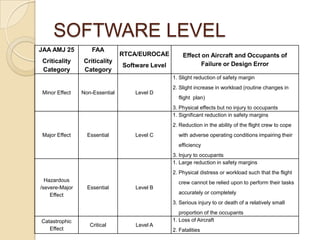
SOFTWARE LEVEL
JAA AMJ 25          FAA
                                RTCA/EUROCAE         Effect on Aircraft and Occupants of
 Criticality    Criticality                                 Failure or Design Error
                                Software Level
 Category       Category
                                                 1. Slight reduction of safety margin
                                                 2. Slight increase in workload (routine changes in
Minor Effect    Non-Essential       Level D
                                                   flight plan)
                                                 3. Physical effects but no injury to occupants
                                                 1. Significant reduction in safety margins
                                                 2. Reduction in the ability of the flight crew to cope
Major Effect      Essential         Level C        with adverse operating conditions impairing their
                                                   efficiency
                                                 3. Injury to occupants
                                                 1. Large reduction in safety margins
                                                 2. Physical distress or workload such that the flight
  Hazardous                                        crew cannot be relied upon to perform their tasks
/severe-Major     Essential         Level B
    Effect                                         accurately or completely
                                                 3. Serious injury to or death of a relatively small
                                                    proportion of the occupants
Catastrophic                                     1. Loss of Aircraft
                   Critical         Level A
   Effect                                        2. Fatalities
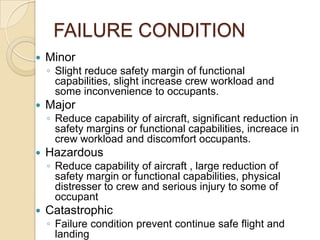
FAILURE CONDITION
   Minor
    ◦ Slight reduce safety margin of functional
      capabilities, slight increase crew workload and
      some inconvenience to occupants.
   Major
    ◦ Reduce capability of aircraft, significant reduction in
      safety margins or functional capabilities, increace in
      crew workload and discomfort occupants.
   Hazardous
    ◦ Reduce capability of aircraft , large reduction of
      safety margin or functional capabilities, physical
      distresser to crew and serious injury to some of
      occupant
   Catastrophic
    ◦ Failure condition prevent continue safe flight and
      landing
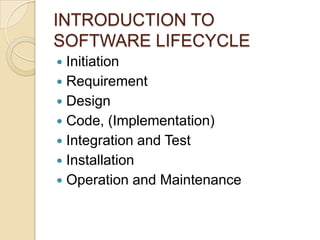
INTRODUCTION TO
SOFTWARE LIFECYCLE
 Initiation
 Requirement
 Design
 Code, (Implementation)
 Integration and Test
 Installation
 Operation and Maintenance
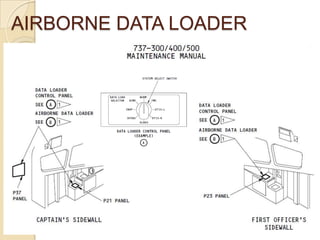
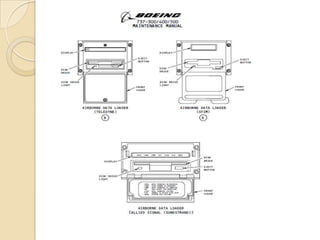
AIRBORNE DATA LOADER
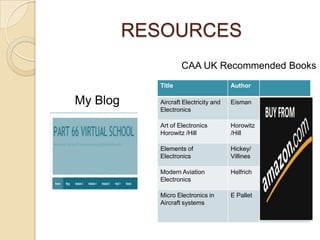
RESOURCES
                    CAA UK Recommended Books
            Title                      Author

My Blog     Aircraft Electricity and   Eisman     0-02-801859-1
            Electronics

            Art of Electronics         Horowitz   0-521-37095-7
            Horowitz /Hill             /Hill

            Elements of                Hickey/    0070286957
            Electronics                Villines

            Modern Aviation            Helfrich   0-13-118803-8
            Electronics

            Micro Electronics in       E Pallet   0-273-08612-X
            Aircraft systems

Module 5 13 software management control

  • 1.
  • 2.
    EASA SYLLABUS 5.13 SoftwareManagement Control Level 2  Awareness of restrictions, airworthiness requirements and possible catastrophic effects of unapproved changes to software programmes.
  • 3.
    AIM  Awareness ofrestrictions using the software for aircraft  Airworthiness requirements and approval procedure  Possible catastrophic effects of unapproved changes to software programs
  • 4.
    INTRODUCTION  Computer softwareused to drive many type of system in aircraft  Can not be allowed it to fail during operation  Requirements to evaluate, test and verify for fail safe design  Failure prevention.
  • 5.
    APPLICATION OF SOFTWARE Some exampleare:  primary and secondary flight controls  engine controls  electrical generation and distribution  brakes  radio and navigation equipment  flight instruments  automatic flight control
  • 6.
    SOFTWARE APPROVAL  Softwaremust be verify by authority for approval and quality control.  Initial certification : ◦ Software must be design by approved company ◦ Approved by Design Organization ◦ Software must comply with authority requirement (BCAR sec A) ◦ Software Validation process approved by local authority.  Post-Certification Modifications ◦ Modification must based on rule apply to the application on hardware ◦ Modification which effect software must be approved by the Design Organization
  • 7.
    DOCUMENTATION APPROVAL  MalaysianAN 57 issue in order to recognize RTCA/EUROCAE document with appropriate guidance material.  Include in RTCA/EUROCAE : ◦ DO-178/ED-12 : Application form for software approval and guidance ◦ Requirement for software control ◦ Software documentation procedure ◦ Requirement for configuration management ◦ Rule for upgrading software ◦ Differential of software level
  • 8.
    SOFTWARE TESTING  Everysoftware must be provide the testing method to maintain its functionality.  Purpose is to determine all data process corectly with the correct output.  Test should include : ◦ Typical data : test the comonly use program path ◦ Unusual but valid data : test the exception program path ( fail safe design) ◦ Incorrect, incomplete data : test the error
  • 9.
    ABOUT RTCA  RTCA,Inc. (known as Radio Technical Commission for Aeronautics until their re- incorporation in 1991 as a not-for-profit corporation) is a US volunteer organization that develops technical guidance for use by government regulatory authorities.  RTCA's objectives include but are not limited to: ◦ ensuring the safety and reliability of airborne systems; ◦ developing minimum operational performance requirements for document-specific systems; ◦ developing guidelines for use by a regulatory authority, the given authority determines appropriate; ◦ providing administrative and logistics resources that enable teamwork among the world-wide aviation community.
  • 10.
    ABOUT EUROCAE  EUROCAE,the European Organisation for Civil Aviation Equipment was formed in Lucerne on 24 April, 1963.  EUROCAE has now been operating for more than 40 years as a non-profit organisation whose membership exclusively comprises aviation stakeholders made up of Manufacturers (aircraft, airborne equipment, ATM systems and ground equipment), Services Providers, National and International Aviation Authorities and Users (Airlines, Airports, operators) from Europe and elsewhere.  EUROCAE has developed performance specifications and other documents exclusively dedicated to the Aviation community.
  • 11.
    DO 178C  DO-178C,Software Considerations in Airborne Systems and Equipment Certification is the title of the recently published document fromRTCA, Incorporated, in a joint effort with EUROCAE.  Replace DO-178B to be the primary document by which the certification authorities such as FAA, EASA and Transport Canada will approve all commercial software-based aerospace systems. Certification Authority approval is pending.  The new document is called DO-178C/ED-12C and was completed in November 2011 and approved by the RTCA in December 2011. It became available for sale and use in January 2012.[1
  • 12.
    SOFTWARE LEVEL JAA AMJ25 FAA RTCA/EUROCAE Effect on Aircraft and Occupants of Criticality Criticality Failure or Design Error Software Level Category Category 1. Slight reduction of safety margin 2. Slight increase in workload (routine changes in Minor Effect Non-Essential Level D flight plan) 3. Physical effects but no injury to occupants 1. Significant reduction in safety margins 2. Reduction in the ability of the flight crew to cope Major Effect Essential Level C with adverse operating conditions impairing their efficiency 3. Injury to occupants 1. Large reduction in safety margins 2. Physical distress or workload such that the flight Hazardous crew cannot be relied upon to perform their tasks /severe-Major Essential Level B Effect accurately or completely 3. Serious injury to or death of a relatively small proportion of the occupants Catastrophic 1. Loss of Aircraft Critical Level A Effect 2. Fatalities
  • 13.
    FAILURE CONDITION  Minor ◦ Slight reduce safety margin of functional capabilities, slight increase crew workload and some inconvenience to occupants.  Major ◦ Reduce capability of aircraft, significant reduction in safety margins or functional capabilities, increace in crew workload and discomfort occupants.  Hazardous ◦ Reduce capability of aircraft , large reduction of safety margin or functional capabilities, physical distresser to crew and serious injury to some of occupant  Catastrophic ◦ Failure condition prevent continue safe flight and landing
  • 14.
    INTRODUCTION TO SOFTWARE LIFECYCLE Initiation  Requirement  Design  Code, (Implementation)  Integration and Test  Installation  Operation and Maintenance
  • 15.
  • 17.
    RESOURCES CAA UK Recommended Books Title Author My Blog Aircraft Electricity and Eisman 0-02-801859-1 Electronics Art of Electronics Horowitz 0-521-37095-7 Horowitz /Hill /Hill Elements of Hickey/ 0070286957 Electronics Villines Modern Aviation Helfrich 0-13-118803-8 Electronics Micro Electronics in E Pallet 0-273-08612-X Aircraft systems