MODULE – IV
FLOOR FINISHES
BC 302 BUILDING MATERIALS AND CONSTRUCTION TECHNIQUES -VI SEM VI
SYLLABUS
Applied finishes - Floor finishes.
Types of flooring, methods of laying, furnishing of floors with different floor
finishes like cement, colored cement, mosaic, terrazzo, tiles, wood, parquet
flooring, stone, etc.
Classification & properties of tiles used in flooring.
Selection criteria & Methods of fixing various types of tiles.
Different type of resilient and vibration resistive floor like rubber, Linoleum
and PVC flooring.
General character and construction process of traditional flooring.
Discussion: Selection of appropriate floor finish based on Cost, cleanliness &
Hygiene.
Exercise: Case study of floor finishing techniques.
BC 302 BUILDING MATERIALS AND CONSTRUCTION TECHNIQUES -VI SEM VI
FLOOR
BC 302 BUILDING MATERIALS AND CONSTRUCTION TECHNIQUES -VI SEM VI
Structural component made to provide a level surface .
It is a horizontal surface that supports the occupants of
a building, furniture and equipment
Divides a building into different levels, one above the
other for creating more accommodation within a limited
space
Floor consists of 2 components
Sub floor/Base course
Floor covering/Flooring
Bottom most portion of a floor
• Purpose: To impart strength & stability to support
the floor covering & all super imposed loads
• Materials used: Brick, Stone, wood, concrete
SUB FLOOR/BASE COURSE
BC 302 BUILDING MATERIALS AND CONSTRUCTION TECHNIQUES -VI SEM VI
Covering over subfloor
Purpose: to provide a hard, clean, smooth, impervious,
durable & attractive surface to the floor
Materials used: Brick, stone, tile, concrete, timber,
mosaic, marble, granite etc.
FLOOR COVERING/FLOORING
BC 302 BUILDING MATERIALS AND CONSTRUCTION TECHNIQUES -VI SEM VI
REQUIREMENTS OF A GOOD FLOOR
BC 302 BUILDING MATERIALS AND CONSTRUCTION TECHNIQUES -VI SEM VI
Hard and smooth surface
Adequate strength and stability
Damp resistant
Good thermal insulation capacity
Durable and easy to maintain
Fire resistant
Aesthetic look
1. Durability and wear factors
2. Cleaning and maintenance
3. Acoustics
4. Static electricity
5. Moisture in slab
6. Price
7. Appearance
8. Safety
9. Resistance to abrasion &slipperiness
FACTORS TO CONSIDER
BC 302 BUILDING MATERIALS AND CONSTRUCTION TECHNIQUES -VI SEM VI
The flooring should be capable of being cleaned easily, and it
should be non-absorbent
Should have effective resistance against absorption of oil,
grease etc
The flooring should have sufficient resistance to wear,
temperature changes, disintegration with time and decay.
Tiles, marble, terrazzo, concrete, mosaic etc. are considered to
be of best types
FACTORS TO CONSIDER
BC 302 BUILDING MATERIALS AND CONSTRUCTION TECHNIQUES -VI SEM VI
It should be sufficiently hard to resist indentation
marks, imprints etc. likely to be caused by shifting of
furniture, equipment etc.
Flooring material should require least maintenance,
repairs can be done easily. Tiles, marble, terrazzo,
concrete etc. require less maintenance.
FACTORS TO CONSIDER
BC 302 BUILDING MATERIALS AND CONSTRUCTION TECHNIQUES -VI SEM VI
• Hard Flooring – durable, noisy, more expensive
• Soft Flooring – warm, quite, difficult to maintain,
allergens
• Resilient Flooring – durable, good acoustics, easy
to maintain
CATEGORIES OF FLOORING
BC 302 BUILDING MATERIALS AND CONSTRUCTION TECHNIQUES -VI SEM VI
Used to improve the appearance of floors.
Provides a clean, damp proof surface
Commonly Used Types
Stone - marble, granite ,kota stone etc
Tiles - ceramic, vitrified , mosaic tile , etc
Terrazzo flooring
Brick flooring
Cement concrete flooring
Timber wooden board sand blocks.
Synthetic flooring
PVC sheets flooring
FLOOR FINISHING MATERIALS
BC 302 BUILDING MATERIALS AND CONSTRUCTION TECHNIQUES -VI SEM VI
PREPARATION OF BED FOR FLOORING
BC 302 BUILDING MATERIALS AND CONSTRUCTION TECHNIQUES -VI SEM VI
Ground should be strong enough to support the floor
The ground surface should be levelled, compacted &
watered before flooring
A porous layer of inert materials like sand or gravel
should be provided just above the prepared bed
The porous layer helps to check the rise of subsurface
water into the floor
BASE PREPARATION
BC 302 BUILDING MATERIALS AND CONSTRUCTION TECHNIQUES -VI SEM VI
•15cm sand cushion provided over rammed & watered
earthen surface
•Over the sand cushion base course of 10cm thick
cement concrete(1:5:10) mix is placed
•Top surface of concrete is roughly finished to develop
good bond b/w the base & topping
•Cure this concrete for 3 days
BC 302 BUILDING MATERIALS AND CONSTRUCTION TECHNIQUES -VI SEM VI
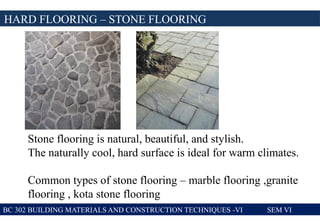
HARD FLOORING – STONE FLOORING
Stone flooring is natural, beautiful, and stylish.
The naturally cool, hard surface is ideal for warm climates.
Common types of stone flooring – marble flooring ,granite
flooring , kota stone flooring
BC 302 BUILDING MATERIALS AND CONSTRUCTION TECHNIQUES -VI SEM VI
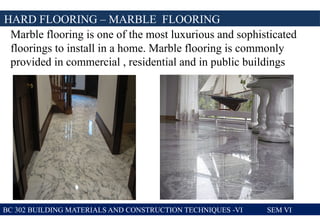
HARD FLOORING – MARBLE FLOORING
Marble flooring is one of the most luxurious and sophisticated
floorings to install in a home. Marble flooring is commonly
provided in commercial , residential and in public buildings
BC 302 BUILDING MATERIALS AND CONSTRUCTION TECHNIQUES -VI SEM VI
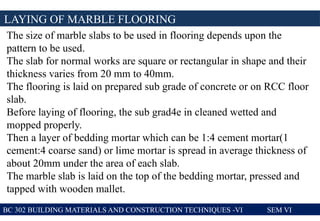
LAYING OF MARBLE FLOORING
The size of marble slabs to be used in flooring depends upon the
pattern to be used.
The slab for normal works are square or rectangular in shape and their
thickness varies from 20 mm to 40mm.
The flooring is laid on prepared sub grade of concrete or on RCC floor
slab.
Before laying of flooring, the sub grad4e in cleaned wetted and
mopped properly.
Then a layer of bedding mortar which can be 1:4 cement mortar(1
cement:4 coarse sand) or lime mortar is spread in average thickness of
about 20mm under the area of each slab.
The marble slab is laid on the top of the bedding mortar, pressed and
tapped with wooden mallet.
BC 302 BUILDING MATERIALS AND CONSTRUCTION TECHNIQUES -VI SEM VI
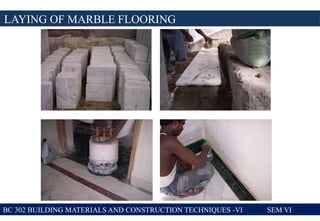
LAYING OF MARBLE FLOORING
BC 302 BUILDING MATERIALS AND CONSTRUCTION TECHNIQUES -VI SEM VI
HARD FLOORING – GRANITE FLOORING
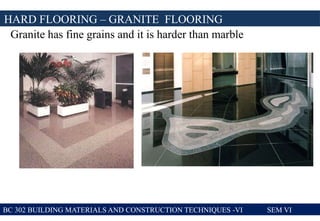
Granite has fine grains and it is harder than marble
BC 302 BUILDING MATERIALS AND CONSTRUCTION TECHNIQUES -VI SEM VI
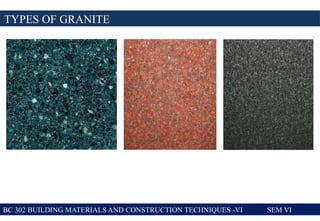
TYPES OF GRANITE
BC 302 BUILDING MATERIALS AND CONSTRUCTION TECHNIQUES -VI SEM VI
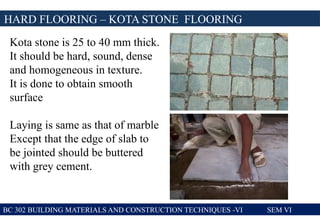
Kota stone is 25 to 40 mm thick.
It should be hard, sound, dense
and homogeneous in texture.
It is done to obtain smooth
surface
Laying is same as that of marble
Except that the edge of slab to
be jointed should be buttered
with grey cement.
HARD FLOORING – KOTA STONE FLOORING
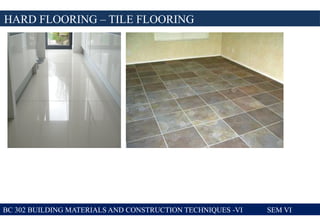
HARD FLOORING – TILE FLOORING
BC 302 BUILDING MATERIALS AND CONSTRUCTION TECHNIQUES -VI SEM VI
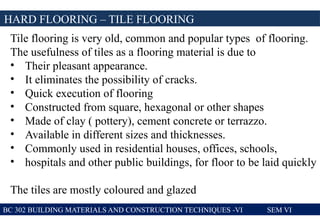
Tile flooring is very old, common and popular types of flooring.
The usefulness of tiles as a flooring material is due to
• Their pleasant appearance.
• It eliminates the possibility of cracks.
• Quick execution of flooring
• Constructed from square, hexagonal or other shapes
• Made of clay ( pottery), cement concrete or terrazzo.
• Available in different sizes and thicknesses.
• Commonly used in residential houses, offices, schools,
• hospitals and other public buildings, for floor to be laid quickly
The tiles are mostly coloured and glazed
HARD FLOORING – TILE FLOORING
BC 302 BUILDING MATERIALS AND CONSTRUCTION TECHNIQUES -VI SEM VI
BASE FOR TILE FLOORING
BC 302 BUILDING MATERIALS AND CONSTRUCTION TECHNIQUES -VI SEM VI
Flooring may be laid on reasonably rigid base.
Surface of the base shall be rough to form suitable key with
bedding mortar.
The base, about 35 to 50 mm below the level of the finished floor,
to be properly graded and free from lose earth, dirt, dust and
lumps
LAYING OF TILE FLOORING
BC 302 BUILDING MATERIALS AND CONSTRUCTION TECHNIQUES -VI SEM VI
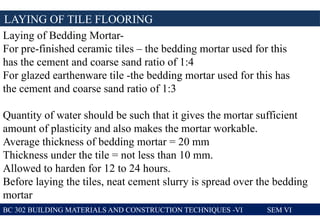
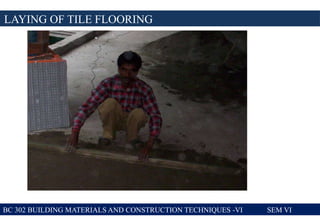
Laying of Bedding Mortar-
For pre-finished ceramic tiles – the bedding mortar used for this
has the cement and coarse sand ratio of 1:4
For glazed earthenware tile -the bedding mortar used for this has
the cement and coarse sand ratio of 1:3
Quantity of water should be such that it gives the mortar sufficient
amount of plasticity and also makes the mortar workable.
Average thickness of bedding mortar = 20 mm
Thickness under the tile = not less than 10 mm.
Allowed to harden for 12 to 24 hours.
Before laying the tiles, neat cement slurry is spread over the bedding
mortar
LAYING OF TILE FLOORING
BC 302 BUILDING MATERIALS AND CONSTRUCTION TECHNIQUES -VI SEM VI
LAYING OF TILE FLOORING
BC 302 BUILDING MATERIALS AND CONSTRUCTION TECHNIQUES -VI SEM VI
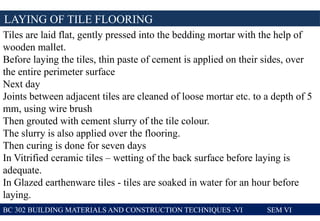
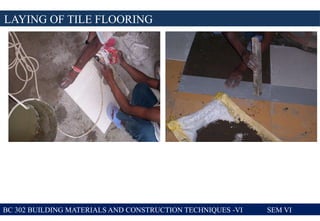
Tiles are laid flat, gently pressed into the bedding mortar with the help of
wooden mallet.
Before laying the tiles, thin paste of cement is applied on their sides, over
the entire perimeter surface
Next day
Joints between adjacent tiles are cleaned of loose mortar etc. to a depth of 5
mm, using wire brush
Then grouted with cement slurry of the tile colour.
The slurry is also applied over the flooring.
Then curing is done for seven days
In Vitrified ceramic tiles – wetting of the back surface before laying is
adequate.
In Glazed earthenware tiles - tiles are soaked in water for an hour before
laying.
BC 302 BUILDING MATERIALS AND CONSTRUCTION TECHNIQUES -VI SEM VI
LAYING OF TILE FLOORING
TILE FLOORING – VITRIFIED TILE
BC 302 BUILDING MATERIALS AND CONSTRUCTION TECHNIQUES -VI SEM VI
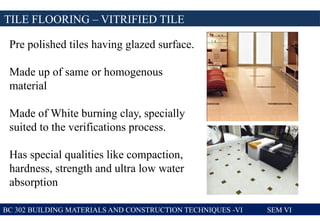
Pre polished tiles having glazed surface.
Made up of same or homogenous
material
Made of White burning clay, specially
suited to the verifications process.
Has special qualities like compaction,
hardness, strength and ultra low water
absorption
TILE FLOORING – VITRIFIED TILE - MANUFACTURE
BC 302 BUILDING MATERIALS AND CONSTRUCTION TECHNIQUES -VI SEM VI
White burning clay is fired at 1200 degree Celsius in 110 m kiln.
This firing yields a tile that confirms all the parameters.
Clay is then mixed with high grade, pure white burning minerals.
Base concrete in a ratio of 1:8:16 or 1:6:12 and the cement and sand
ratio1:4 or 1:5
Tiles laid with the help of wet cement paste
Gap between the tiles grouted by powder mixture.
SIZES
• 290 by 290mm
• 400 by 400 mm
• 596 by 596 mm
THICKNESS - 8mm or 10 mm
TILE FLOORING – VITRIFIED TILE – MERITS & DEMERITS
BC 302 BUILDING MATERIALS AND CONSTRUCTION TECHNIQUES -VI SEM VI
Merits
• Scratch resistant.
• Fire proof.
• More durable.
• Easy maintenance.
• Less slippery.
• More glossy and is widely used in commercial purposes
Demerits
• Non stain resistant.
• Costlier
TILE FLOORING – CERAMIC TILE
BC 302 BUILDING MATERIALS AND CONSTRUCTION TECHNIQUES -VI SEM VI
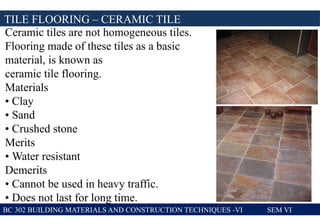
Ceramic tiles are not homogeneous tiles.
Flooring made of these tiles as a basic
material, is known as
ceramic tile flooring.
Materials
• Clay
• Sand
• Crushed stone
Merits
• Water resistant
Demerits
• Cannot be used in heavy traffic.
• Does not last for long time.
TILE FLOORING – COMPARISON
BC 302 BUILDING MATERIALS AND CONSTRUCTION TECHNIQUES -VI SEM VI
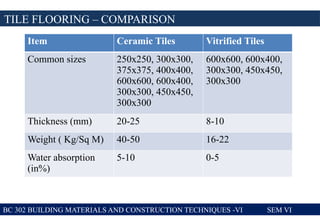
Item Ceramic Tiles Vitrified Tiles
Common sizes 250x250, 300x300,
375x375, 400x400,
600x600, 600x400,
300x300, 450x450,
300x300
600x600, 600x400,
300x300, 450x450,
300x300
Thickness (mm) 20-25 8-10
Weight ( Kg/Sq M) 40-50 16-22
Water absorption
(in%)
5-10 0-5
TILE FLOORING – CEMENT CONCRETE FLOORING TILES
BC 302 BUILDING MATERIALS AND CONSTRUCTION TECHNIQUES -VI SEM VI
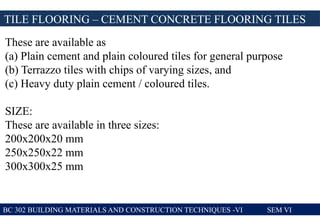
These are available as
(a) Plain cement and plain coloured tiles for general purpose
(b) Terrazzo tiles with chips of varying sizes, and
(c) Heavy duty plain cement / coloured tiles.
SIZE:
These are available in three sizes:
200x200x20 mm
250x250x22 mm
300x300x25 mm
BC 302 BUILDING MATERIALS AND CONSTRUCTION TECHNIQUES -VI SEM VI
HARD FLOORING – TERRAZZO FLOORING
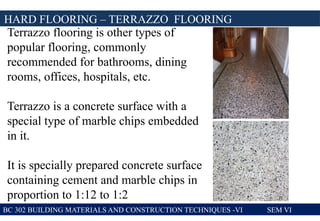
Terrazzo flooring is other types of
popular flooring, commonly
recommended for bathrooms, dining
rooms, offices, hospitals, etc.
Terrazzo is a concrete surface with a
special type of marble chips embedded
in it.
It is specially prepared concrete surface
containing cement and marble chips in
proportion to 1:12 to 1:2
BC 302 BUILDING MATERIALS AND CONSTRUCTION TECHNIQUES -VI SEM VI
HARD FLOORING – LAYING OF TERRAZZO FLOORING
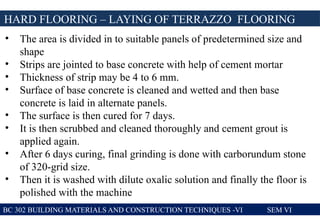
• The area is divided in to suitable panels of predetermined size and
shape
• Strips are jointed to base concrete with help of cement mortar
• Thickness of strip may be 4 to 6 mm.
• Surface of base concrete is cleaned and wetted and then base
concrete is laid in alternate panels.
• The surface is then cured for 7 days.
• It is then scrubbed and cleaned thoroughly and cement grout is
applied again.
• After 6 days curing, final grinding is done with carborundum stone
of 320-grid size.
• Then it is washed with dilute oxalic solution and finally the floor is
polished with the machine
BC 302 BUILDING MATERIALS AND CONSTRUCTION TECHNIQUES -VI SEM VI
HARD FLOORING – LAYING OF TERRAZZO FLOORING
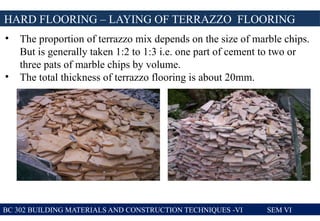
• The proportion of terrazzo mix depends on the size of marble chips.
But is generally taken 1:2 to 1:3 i.e. one part of cement to two or
three pats of marble chips by volume.
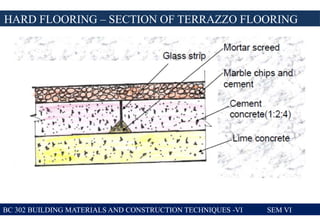
• The total thickness of terrazzo flooring is about 20mm.
BC 302 BUILDING MATERIALS AND CONSTRUCTION TECHNIQUES -VI SEM VI
HARD FLOORING – SECTION OF TERRAZZO FLOORING
BC 302 BUILDING MATERIALS AND CONSTRUCTION TECHNIQUES -VI SEM VI
HARD FLOORING – MOSAIC FLOORING
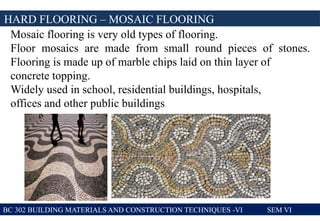
Mosaic flooring is very old types of flooring.
Floor mosaics are made from small round pieces of stones.
Flooring is made up of marble chips laid on thin layer of
concrete topping.
Widely used in school, residential buildings, hospitals,
offices and other public buildings
BC 302 BUILDING MATERIALS AND CONSTRUCTION TECHNIQUES -VI SEM VI
HARD FLOORING – MOSAIC FLOORING
Materials
• White cement or grey cement.
• Marble chips, size varies from 3mm to 6mm.
• Tint of color as desired
Preparation
• The sub base is prepared in ratio 1:6:12.
• It is 3 inch deep
• A 30mm deep plain cement concrete is laid in the ratio of
1:2:4
BC 302 BUILDING MATERIALS AND CONSTRUCTION TECHNIQUES -VI SEM VI
HARD FLOORING – MOSAIC FLOORING
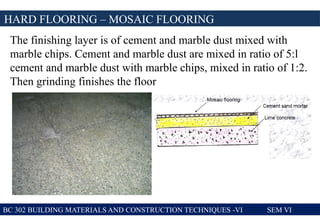
The finishing layer is of cement and marble dust mixed with
marble chips. Cement and marble dust are mixed in ratio of 5:l
cement and marble dust with marble chips, mixed in ratio of 1:2.
Then grinding finishes the floor
BC 302 BUILDING MATERIALS AND CONSTRUCTION TECHNIQUES -VI SEM VI
HARD FLOORING – BRICK FLOORING
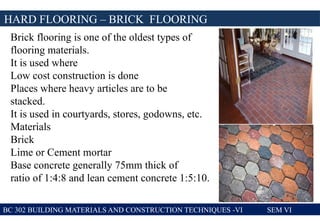
Brick flooring is one of the oldest types of
flooring materials.
It is used where
Low cost construction is done
Places where heavy articles are to be
stacked.
It is used in courtyards, stores, godowns, etc.
Materials
Brick
Lime or Cement mortar
Base concrete generally 75mm thick of
ratio of 1:4:8 and lean cement concrete 1:5:10.
BC 302 BUILDING MATERIALS AND CONSTRUCTION TECHNIQUES -VI SEM VI
HARD FLOORING – LAYING OF BRICK FLOORING
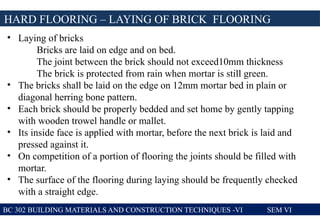
• Laying of bricks
Bricks are laid on edge and on bed.
The joint between the brick should not exceed10mm thickness
The brick is protected from rain when mortar is still green.
• The bricks shall be laid on the edge on 12mm mortar bed in plain or
diagonal herring bone pattern.
• Each brick should be properly bedded and set home by gently tapping
with wooden trowel handle or mallet.
• Its inside face is applied with mortar, before the next brick is laid and
pressed against it.
• On competition of a portion of flooring the joints should be filled with
mortar.
• The surface of the flooring during laying should be frequently checked
with a straight edge.
BC 302 BUILDING MATERIALS AND CONSTRUCTION TECHNIQUES -VI SEM VI
HARD FLOORING – BRICK FLOORING
Curing
Brick work should be protected from rain by suitable covering
when the mortar is still green. Brickwork shall be kept
constantly moist on all faces for a period of 7 days.
Merits
The usefulness of bricks as flooring material lie mainly in their
good wearing quality and ease of quick installation. The
performance depends on the quality of bricks, bedding prepared
and the laying is done. It’s done generally in low cost areas.
BC 302 BUILDING MATERIALS AND CONSTRUCTION TECHNIQUES -VI SEM VI
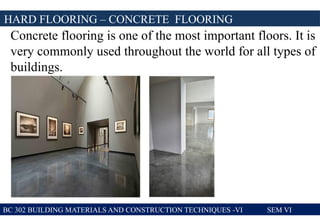
HARD FLOORING – CONCRETE FLOORING
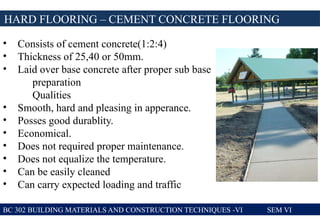
Concrete flooring is one of the most important floors. It is
very commonly used throughout the world for all types of
buildings.
BC 302 BUILDING MATERIALS AND CONSTRUCTION TECHNIQUES -VI SEM VI
HARD FLOORING – CEMENT CONCRETE FLOORING
• Consists of cement concrete(1:2:4)
• Thickness of 25,40 or 50mm.
• Laid over base concrete after proper sub base
preparation
Qualities
• Smooth, hard and pleasing in apperance.
• Posses good durablity.
• Economical.
• Does not required proper maintenance.
• Does not equalize the temperature.
• Can be easily cleaned
• Can carry expected loading and traffic
BC 302 BUILDING MATERIALS AND CONSTRUCTION TECHNIQUES -VI SEM VI
HARD FLOORING – CEMENT CONCRETE FLOORING
Uses
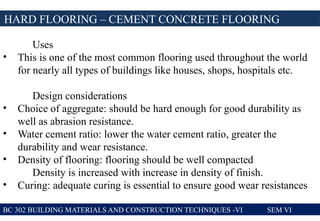
• This is one of the most common flooring used throughout the world
for nearly all types of buildings like houses, shops, hospitals etc.
Design considerations
• Choice of aggregate: should be hard enough for good durability as
well as abrasion resistance.
• Water cement ratio: lower the water cement ratio, greater the
durability and wear resistance.
• Density of flooring: flooring should be well compacted
Density is increased with increase in density of finish.
• Curing: adequate curing is essential to ensure good wear resistances
BC 302 BUILDING MATERIALS AND CONSTRUCTION TECHNIQUES -VI SEM VI
HARD FLOORING – CEMENT CONCRETE FLOORING
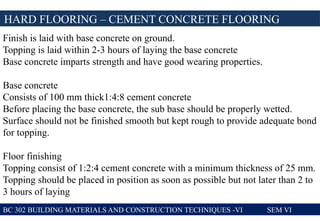
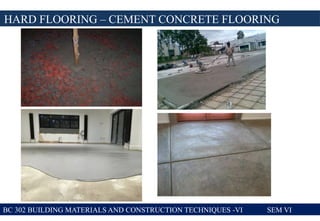
Finish is laid with base concrete on ground.
Topping is laid within 2-3 hours of laying the base concrete
Base concrete imparts strength and have good wearing properties.
Base concrete
Consists of 100 mm thick1:4:8 cement concrete
Before placing the base concrete, the sub base should be properly wetted.
Surface should not be finished smooth but kept rough to provide adequate bond
for topping.
Floor finishing
Topping consist of 1:2:4 cement concrete with a minimum thickness of 25 mm.
Topping should be placed in position as soon as possible but not later than 2 to
3 hours of laying
BC 302 BUILDING MATERIALS AND CONSTRUCTION TECHNIQUES -VI SEM VI
HARD FLOORING – CEMENT CONCRETE FLOORING
BC 302 BUILDING MATERIALS AND CONSTRUCTION TECHNIQUES -VI SEM VI
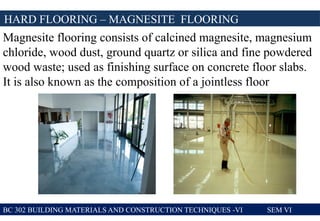
HARD FLOORING – MAGNESITE FLOORING
Magnesite flooring consists of calcined magnesite, magnesium
chloride, wood dust, ground quartz or silica and fine powdered
wood waste; used as finishing surface on concrete floor slabs.
It is also known as the composition of a jointless floor
BC 302 BUILDING MATERIALS AND CONSTRUCTION TECHNIQUES -VI SEM VI
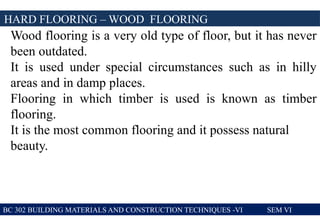
HARD FLOORING – WOOD FLOORING
Wood flooring is a very old type of floor, but it has never
been outdated.
It is used under special circumstances such as in hilly
areas and in damp places.
Flooring in which timber is used is known as timber
flooring.
It is the most common flooring and it possess natural
beauty.
BC 302 BUILDING MATERIALS AND CONSTRUCTION TECHNIQUES -VI SEM VI
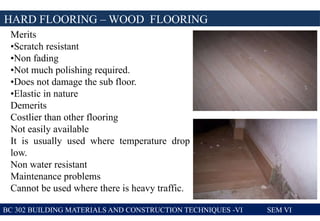
HARD FLOORING – WOOD FLOORING
Merits
•Scratch resistant
•Non fading
•Not much polishing required.
•Does not damage the sub floor.
•Elastic in nature
Demerits
Costlier than other flooring
Not easily available
It is usually used where temperature drop
low.
Non water resistant
Maintenance problems
Cannot be used where there is heavy traffic.
BC 302 BUILDING MATERIALS AND CONSTRUCTION TECHNIQUES -VI SEM VI
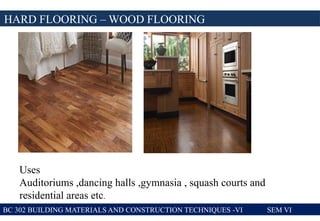
HARD FLOORING – WOOD FLOORING
Uses
Auditoriums ,dancing halls ,gymnasia , squash courts and
residential areas etc.
BC 302 BUILDING MATERIALS AND CONSTRUCTION TECHNIQUES -VI SEM VI
HARD FLOORING – WOOD FLOORING
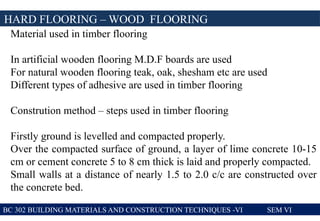
Material used in timber flooring
In artificial wooden flooring M.D.F boards are used
For natural wooden flooring teak, oak, shesham etc are used
Different types of adhesive are used in timber flooring
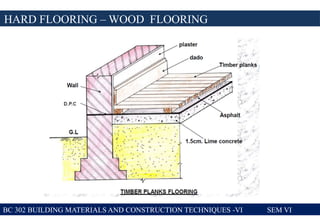
Constrution method – steps used in timber flooring
Firstly ground is levelled and compacted properly.
Over the compacted surface of ground, a layer of lime concrete 10-15
cm or cement concrete 5 to 8 cm thick is laid and properly compacted.
Small walls at a distance of nearly 1.5 to 2.0 c/c are constructed over
the concrete bed.
BC 302 BUILDING MATERIALS AND CONSTRUCTION TECHNIQUES -VI SEM VI
HARD FLOORING – WOOD FLOORING
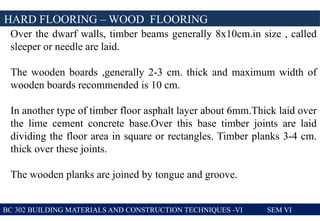
Over the dwarf walls, timber beams generally 8x10cm.in size , called
sleeper or needle are laid.
The wooden boards ,generally 2-3 cm. thick and maximum width of
wooden boards recommended is 10 cm.
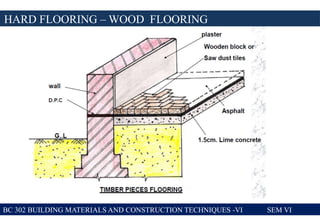
In another type of timber floor asphalt layer about 6mm.Thick laid over
the lime cement concrete base.Over this base timber joints are laid
dividing the floor area in square or rectangles. Timber planks 3-4 cm.
thick over these joints.
The wooden planks are joined by tongue and groove.
BC 302 BUILDING MATERIALS AND CONSTRUCTION TECHNIQUES -VI SEM VI
HARD FLOORING – WOOD FLOORING
BC 302 BUILDING MATERIALS AND CONSTRUCTION TECHNIQUES -VI SEM VI
HARD FLOORING – WOOD FLOORING
BC 302 BUILDING MATERIALS AND CONSTRUCTION TECHNIQUES -VI SEM VI
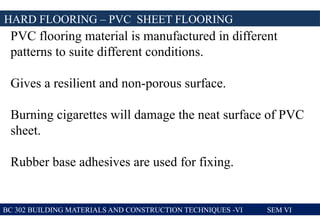
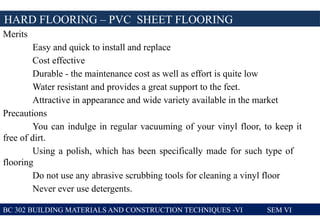
HARD FLOORING – PVC SHEET FLOORING
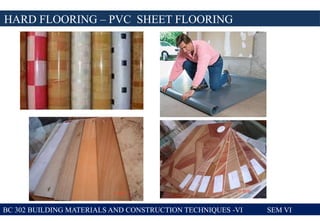
PVC flooring material is manufactured in different
patterns to suite different conditions.
Gives a resilient and non-porous surface.
Burning cigarettes will damage the neat surface of PVC
sheet.
Rubber base adhesives are used for fixing.
BC 302 BUILDING MATERIALS AND CONSTRUCTION TECHNIQUES -VI SEM VI
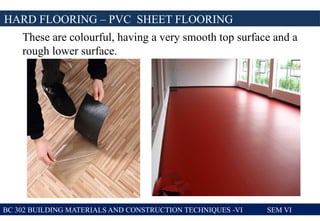
HARD FLOORING – PVC SHEET FLOORING
These are colourful, having a very smooth top surface and a
rough lower surface.
BC 302 BUILDING MATERIALS AND CONSTRUCTION TECHNIQUES -VI SEM VI
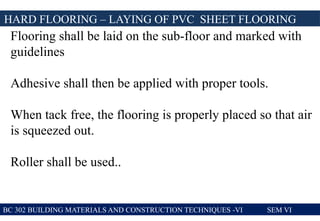
HARD FLOORING – LAYING OF PVC SHEET FLOORING
Flooring shall be laid on the sub-floor and marked with
guidelines
Adhesive shall then be applied with proper tools.
When tack free, the flooring is properly placed so that air
is squeezed out.
Roller shall be used..
BC 302 BUILDING MATERIALS AND CONSTRUCTION TECHNIQUES -VI SEM VI
HARD FLOORING – PVC SHEET FLOORING
Merits
Easy and quick to install and replace
Cost effective
Durable - the maintenance cost as well as effort is quite low
Water resistant and provides a great support to the feet.
Attractive in appearance and wide variety available in the market
Precautions
You can indulge in regular vacuuming of your vinyl floor, to keep it
free of dirt.
Using a polish, which has been specifically made for such type of
flooring
Do not use any abrasive scrubbing tools for cleaning a vinyl floor
Never ever use detergents.
BC 302 BUILDING MATERIALS AND CONSTRUCTION TECHNIQUES -VI SEM VI
HARD FLOORING – PVC SHEET FLOORING
BC 302 BUILDING MATERIALS AND CONSTRUCTION TECHNIQUES -VI SEM VI
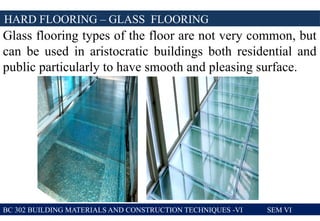
HARD FLOORING – GLASS FLOORING
Glass flooring types of the floor are not very common, but
can be used in aristocratic buildings both residential and
public particularly to have smooth and pleasing surface.
BC 302 BUILDING MATERIALS AND CONSTRUCTION TECHNIQUES -VI SEM VI
HARD FLOORING – LAMINATE FLOORING
Laminate flooring is created by fusing several layers of
material together. It is easy to clean and more durable and
can resist scratches and chipping.
BC 302 BUILDING MATERIALS AND CONSTRUCTION TECHNIQUES -VI SEM VI
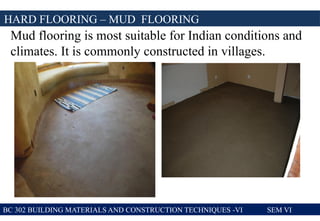
HARD FLOORING – MUD FLOORING
Mud flooring is most suitable for Indian conditions and
climates. It is commonly constructed in villages.
BC 302 BUILDING MATERIALS AND CONSTRUCTION TECHNIQUES -VI SEM VI
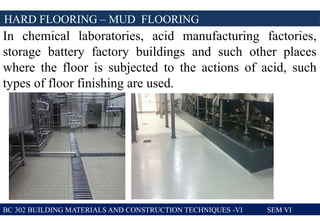
HARD FLOORING – MUD FLOORING
In chemical laboratories, acid manufacturing factories,
storage battery factory buildings and such other places
where the floor is subjected to the actions of acid, such
types of floor finishing are used.
SOFT FLOORING – CARPET FLOORING
BC 302 BUILDING MATERIALS AND CONSTRUCTION TECHNIQUES -VI SEM VI
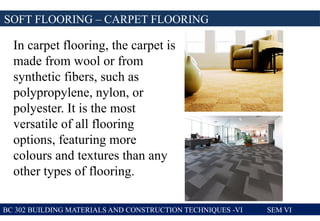
In carpet flooring, the carpet is
made from wool or from
synthetic fibers, such as
polypropylene, nylon, or
polyester. It is the most
versatile of all flooring
options, featuring more
colours and textures than any
other types of flooring.
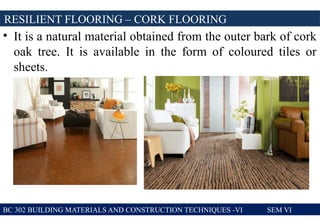
• It is a natural material obtained from the outer bark of cork
oak tree. It is available in the form of coloured tiles or
sheets.
RESILIENT FLOORING – CORK FLOORING
BC 302 BUILDING MATERIALS AND CONSTRUCTION TECHNIQUES -VI SEM VI
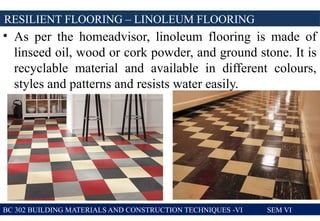
• As per the homeadvisor, linoleum flooring is made of
linseed oil, wood or cork powder, and ground stone. It is
recyclable material and available in different colours,
styles and patterns and resists water easily.
RESILIENT FLOORING – LINOLEUM FLOORING
BC 302 BUILDING MATERIALS AND CONSTRUCTION TECHNIQUES -VI SEM VI
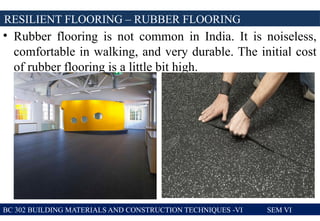
• Rubber flooring is not common in India. It is noiseless,
comfortable in walking, and very durable. The initial cost
of rubber flooring is a little bit high.
RESILIENT FLOORING – RUBBER FLOORING
BC 302 BUILDING MATERIALS AND CONSTRUCTION TECHNIQUES -VI SEM VI
• Market Survey of Tiles
EXERCISE
BC 302 BUILDING MATERIALS AND CONSTRUCTION TECHNIQUES -VI SEM VI
MODULE - 4 Flooring Finishes for learning.pptx

  • 1.
    MODULE – IV FLOORFINISHES BC 302 BUILDING MATERIALS AND CONSTRUCTION TECHNIQUES -VI SEM VI
  • 2.
    SYLLABUS Applied finishes -Floor finishes. Types of flooring, methods of laying, furnishing of floors with different floor finishes like cement, colored cement, mosaic, terrazzo, tiles, wood, parquet flooring, stone, etc. Classification & properties of tiles used in flooring. Selection criteria & Methods of fixing various types of tiles. Different type of resilient and vibration resistive floor like rubber, Linoleum and PVC flooring. General character and construction process of traditional flooring. Discussion: Selection of appropriate floor finish based on Cost, cleanliness & Hygiene. Exercise: Case study of floor finishing techniques. BC 302 BUILDING MATERIALS AND CONSTRUCTION TECHNIQUES -VI SEM VI
  • 3.
    FLOOR BC 302 BUILDINGMATERIALS AND CONSTRUCTION TECHNIQUES -VI SEM VI Structural component made to provide a level surface . It is a horizontal surface that supports the occupants of a building, furniture and equipment Divides a building into different levels, one above the other for creating more accommodation within a limited space Floor consists of 2 components Sub floor/Base course Floor covering/Flooring
  • 4.
    Bottom most portionof a floor • Purpose: To impart strength & stability to support the floor covering & all super imposed loads • Materials used: Brick, Stone, wood, concrete SUB FLOOR/BASE COURSE BC 302 BUILDING MATERIALS AND CONSTRUCTION TECHNIQUES -VI SEM VI
  • 5.
    Covering over subfloor Purpose:to provide a hard, clean, smooth, impervious, durable & attractive surface to the floor Materials used: Brick, stone, tile, concrete, timber, mosaic, marble, granite etc. FLOOR COVERING/FLOORING BC 302 BUILDING MATERIALS AND CONSTRUCTION TECHNIQUES -VI SEM VI
  • 6.
    REQUIREMENTS OF AGOOD FLOOR BC 302 BUILDING MATERIALS AND CONSTRUCTION TECHNIQUES -VI SEM VI Hard and smooth surface Adequate strength and stability Damp resistant Good thermal insulation capacity Durable and easy to maintain Fire resistant Aesthetic look
  • 7.
    1. Durability andwear factors 2. Cleaning and maintenance 3. Acoustics 4. Static electricity 5. Moisture in slab 6. Price 7. Appearance 8. Safety 9. Resistance to abrasion &slipperiness FACTORS TO CONSIDER BC 302 BUILDING MATERIALS AND CONSTRUCTION TECHNIQUES -VI SEM VI
  • 8.
    The flooring shouldbe capable of being cleaned easily, and it should be non-absorbent Should have effective resistance against absorption of oil, grease etc The flooring should have sufficient resistance to wear, temperature changes, disintegration with time and decay. Tiles, marble, terrazzo, concrete, mosaic etc. are considered to be of best types FACTORS TO CONSIDER BC 302 BUILDING MATERIALS AND CONSTRUCTION TECHNIQUES -VI SEM VI
  • 9.
    It should besufficiently hard to resist indentation marks, imprints etc. likely to be caused by shifting of furniture, equipment etc. Flooring material should require least maintenance, repairs can be done easily. Tiles, marble, terrazzo, concrete etc. require less maintenance. FACTORS TO CONSIDER BC 302 BUILDING MATERIALS AND CONSTRUCTION TECHNIQUES -VI SEM VI
  • 10.
    • Hard Flooring– durable, noisy, more expensive • Soft Flooring – warm, quite, difficult to maintain, allergens • Resilient Flooring – durable, good acoustics, easy to maintain CATEGORIES OF FLOORING BC 302 BUILDING MATERIALS AND CONSTRUCTION TECHNIQUES -VI SEM VI
  • 11.
    Used to improvethe appearance of floors. Provides a clean, damp proof surface Commonly Used Types Stone - marble, granite ,kota stone etc Tiles - ceramic, vitrified , mosaic tile , etc Terrazzo flooring Brick flooring Cement concrete flooring Timber wooden board sand blocks. Synthetic flooring PVC sheets flooring FLOOR FINISHING MATERIALS BC 302 BUILDING MATERIALS AND CONSTRUCTION TECHNIQUES -VI SEM VI
  • 12.
    PREPARATION OF BEDFOR FLOORING BC 302 BUILDING MATERIALS AND CONSTRUCTION TECHNIQUES -VI SEM VI Ground should be strong enough to support the floor The ground surface should be levelled, compacted & watered before flooring A porous layer of inert materials like sand or gravel should be provided just above the prepared bed The porous layer helps to check the rise of subsurface water into the floor
  • 13.
    BASE PREPARATION BC 302BUILDING MATERIALS AND CONSTRUCTION TECHNIQUES -VI SEM VI •15cm sand cushion provided over rammed & watered earthen surface •Over the sand cushion base course of 10cm thick cement concrete(1:5:10) mix is placed •Top surface of concrete is roughly finished to develop good bond b/w the base & topping •Cure this concrete for 3 days
  • 14.
    BC 302 BUILDINGMATERIALS AND CONSTRUCTION TECHNIQUES -VI SEM VI HARD FLOORING – STONE FLOORING Stone flooring is natural, beautiful, and stylish. The naturally cool, hard surface is ideal for warm climates. Common types of stone flooring – marble flooring ,granite flooring , kota stone flooring
  • 15.
    BC 302 BUILDINGMATERIALS AND CONSTRUCTION TECHNIQUES -VI SEM VI HARD FLOORING – MARBLE FLOORING Marble flooring is one of the most luxurious and sophisticated floorings to install in a home. Marble flooring is commonly provided in commercial , residential and in public buildings
  • 16.
    BC 302 BUILDINGMATERIALS AND CONSTRUCTION TECHNIQUES -VI SEM VI LAYING OF MARBLE FLOORING The size of marble slabs to be used in flooring depends upon the pattern to be used. The slab for normal works are square or rectangular in shape and their thickness varies from 20 mm to 40mm. The flooring is laid on prepared sub grade of concrete or on RCC floor slab. Before laying of flooring, the sub grad4e in cleaned wetted and mopped properly. Then a layer of bedding mortar which can be 1:4 cement mortar(1 cement:4 coarse sand) or lime mortar is spread in average thickness of about 20mm under the area of each slab. The marble slab is laid on the top of the bedding mortar, pressed and tapped with wooden mallet.
  • 17.
    BC 302 BUILDINGMATERIALS AND CONSTRUCTION TECHNIQUES -VI SEM VI LAYING OF MARBLE FLOORING
  • 18.
    BC 302 BUILDINGMATERIALS AND CONSTRUCTION TECHNIQUES -VI SEM VI HARD FLOORING – GRANITE FLOORING Granite has fine grains and it is harder than marble
  • 19.
    BC 302 BUILDINGMATERIALS AND CONSTRUCTION TECHNIQUES -VI SEM VI TYPES OF GRANITE
  • 20.
    BC 302 BUILDINGMATERIALS AND CONSTRUCTION TECHNIQUES -VI SEM VI Kota stone is 25 to 40 mm thick. It should be hard, sound, dense and homogeneous in texture. It is done to obtain smooth surface Laying is same as that of marble Except that the edge of slab to be jointed should be buttered with grey cement. HARD FLOORING – KOTA STONE FLOORING
  • 21.
    HARD FLOORING –TILE FLOORING BC 302 BUILDING MATERIALS AND CONSTRUCTION TECHNIQUES -VI SEM VI Tile flooring is very old, common and popular types of flooring. The usefulness of tiles as a flooring material is due to • Their pleasant appearance. • It eliminates the possibility of cracks. • Quick execution of flooring • Constructed from square, hexagonal or other shapes • Made of clay ( pottery), cement concrete or terrazzo. • Available in different sizes and thicknesses. • Commonly used in residential houses, offices, schools, • hospitals and other public buildings, for floor to be laid quickly The tiles are mostly coloured and glazed
  • 22.
    HARD FLOORING –TILE FLOORING BC 302 BUILDING MATERIALS AND CONSTRUCTION TECHNIQUES -VI SEM VI
  • 23.
    BASE FOR TILEFLOORING BC 302 BUILDING MATERIALS AND CONSTRUCTION TECHNIQUES -VI SEM VI Flooring may be laid on reasonably rigid base. Surface of the base shall be rough to form suitable key with bedding mortar. The base, about 35 to 50 mm below the level of the finished floor, to be properly graded and free from lose earth, dirt, dust and lumps
  • 24.
    LAYING OF TILEFLOORING BC 302 BUILDING MATERIALS AND CONSTRUCTION TECHNIQUES -VI SEM VI Laying of Bedding Mortar- For pre-finished ceramic tiles – the bedding mortar used for this has the cement and coarse sand ratio of 1:4 For glazed earthenware tile -the bedding mortar used for this has the cement and coarse sand ratio of 1:3 Quantity of water should be such that it gives the mortar sufficient amount of plasticity and also makes the mortar workable. Average thickness of bedding mortar = 20 mm Thickness under the tile = not less than 10 mm. Allowed to harden for 12 to 24 hours. Before laying the tiles, neat cement slurry is spread over the bedding mortar
  • 25.
    LAYING OF TILEFLOORING BC 302 BUILDING MATERIALS AND CONSTRUCTION TECHNIQUES -VI SEM VI
  • 26.
    LAYING OF TILEFLOORING BC 302 BUILDING MATERIALS AND CONSTRUCTION TECHNIQUES -VI SEM VI Tiles are laid flat, gently pressed into the bedding mortar with the help of wooden mallet. Before laying the tiles, thin paste of cement is applied on their sides, over the entire perimeter surface Next day Joints between adjacent tiles are cleaned of loose mortar etc. to a depth of 5 mm, using wire brush Then grouted with cement slurry of the tile colour. The slurry is also applied over the flooring. Then curing is done for seven days In Vitrified ceramic tiles – wetting of the back surface before laying is adequate. In Glazed earthenware tiles - tiles are soaked in water for an hour before laying.
  • 27.
    BC 302 BUILDINGMATERIALS AND CONSTRUCTION TECHNIQUES -VI SEM VI LAYING OF TILE FLOORING
  • 28.
    TILE FLOORING –VITRIFIED TILE BC 302 BUILDING MATERIALS AND CONSTRUCTION TECHNIQUES -VI SEM VI Pre polished tiles having glazed surface. Made up of same or homogenous material Made of White burning clay, specially suited to the verifications process. Has special qualities like compaction, hardness, strength and ultra low water absorption
  • 29.
    TILE FLOORING –VITRIFIED TILE - MANUFACTURE BC 302 BUILDING MATERIALS AND CONSTRUCTION TECHNIQUES -VI SEM VI White burning clay is fired at 1200 degree Celsius in 110 m kiln. This firing yields a tile that confirms all the parameters. Clay is then mixed with high grade, pure white burning minerals. Base concrete in a ratio of 1:8:16 or 1:6:12 and the cement and sand ratio1:4 or 1:5 Tiles laid with the help of wet cement paste Gap between the tiles grouted by powder mixture. SIZES • 290 by 290mm • 400 by 400 mm • 596 by 596 mm THICKNESS - 8mm or 10 mm
  • 30.
    TILE FLOORING –VITRIFIED TILE – MERITS & DEMERITS BC 302 BUILDING MATERIALS AND CONSTRUCTION TECHNIQUES -VI SEM VI Merits • Scratch resistant. • Fire proof. • More durable. • Easy maintenance. • Less slippery. • More glossy and is widely used in commercial purposes Demerits • Non stain resistant. • Costlier
  • 31.
    TILE FLOORING –CERAMIC TILE BC 302 BUILDING MATERIALS AND CONSTRUCTION TECHNIQUES -VI SEM VI Ceramic tiles are not homogeneous tiles. Flooring made of these tiles as a basic material, is known as ceramic tile flooring. Materials • Clay • Sand • Crushed stone Merits • Water resistant Demerits • Cannot be used in heavy traffic. • Does not last for long time.
  • 32.
    TILE FLOORING –COMPARISON BC 302 BUILDING MATERIALS AND CONSTRUCTION TECHNIQUES -VI SEM VI Item Ceramic Tiles Vitrified Tiles Common sizes 250x250, 300x300, 375x375, 400x400, 600x600, 600x400, 300x300, 450x450, 300x300 600x600, 600x400, 300x300, 450x450, 300x300 Thickness (mm) 20-25 8-10 Weight ( Kg/Sq M) 40-50 16-22 Water absorption (in%) 5-10 0-5
  • 33.
    TILE FLOORING –CEMENT CONCRETE FLOORING TILES BC 302 BUILDING MATERIALS AND CONSTRUCTION TECHNIQUES -VI SEM VI These are available as (a) Plain cement and plain coloured tiles for general purpose (b) Terrazzo tiles with chips of varying sizes, and (c) Heavy duty plain cement / coloured tiles. SIZE: These are available in three sizes: 200x200x20 mm 250x250x22 mm 300x300x25 mm
  • 34.
    BC 302 BUILDINGMATERIALS AND CONSTRUCTION TECHNIQUES -VI SEM VI HARD FLOORING – TERRAZZO FLOORING Terrazzo flooring is other types of popular flooring, commonly recommended for bathrooms, dining rooms, offices, hospitals, etc. Terrazzo is a concrete surface with a special type of marble chips embedded in it. It is specially prepared concrete surface containing cement and marble chips in proportion to 1:12 to 1:2
  • 35.
    BC 302 BUILDINGMATERIALS AND CONSTRUCTION TECHNIQUES -VI SEM VI HARD FLOORING – LAYING OF TERRAZZO FLOORING • The area is divided in to suitable panels of predetermined size and shape • Strips are jointed to base concrete with help of cement mortar • Thickness of strip may be 4 to 6 mm. • Surface of base concrete is cleaned and wetted and then base concrete is laid in alternate panels. • The surface is then cured for 7 days. • It is then scrubbed and cleaned thoroughly and cement grout is applied again. • After 6 days curing, final grinding is done with carborundum stone of 320-grid size. • Then it is washed with dilute oxalic solution and finally the floor is polished with the machine
  • 36.
    BC 302 BUILDINGMATERIALS AND CONSTRUCTION TECHNIQUES -VI SEM VI HARD FLOORING – LAYING OF TERRAZZO FLOORING • The proportion of terrazzo mix depends on the size of marble chips. But is generally taken 1:2 to 1:3 i.e. one part of cement to two or three pats of marble chips by volume. • The total thickness of terrazzo flooring is about 20mm.
  • 37.
    BC 302 BUILDINGMATERIALS AND CONSTRUCTION TECHNIQUES -VI SEM VI HARD FLOORING – SECTION OF TERRAZZO FLOORING
  • 38.
    BC 302 BUILDINGMATERIALS AND CONSTRUCTION TECHNIQUES -VI SEM VI HARD FLOORING – MOSAIC FLOORING Mosaic flooring is very old types of flooring. Floor mosaics are made from small round pieces of stones. Flooring is made up of marble chips laid on thin layer of concrete topping. Widely used in school, residential buildings, hospitals, offices and other public buildings
  • 39.
    BC 302 BUILDINGMATERIALS AND CONSTRUCTION TECHNIQUES -VI SEM VI HARD FLOORING – MOSAIC FLOORING Materials • White cement or grey cement. • Marble chips, size varies from 3mm to 6mm. • Tint of color as desired Preparation • The sub base is prepared in ratio 1:6:12. • It is 3 inch deep • A 30mm deep plain cement concrete is laid in the ratio of 1:2:4
  • 40.
    BC 302 BUILDINGMATERIALS AND CONSTRUCTION TECHNIQUES -VI SEM VI HARD FLOORING – MOSAIC FLOORING The finishing layer is of cement and marble dust mixed with marble chips. Cement and marble dust are mixed in ratio of 5:l cement and marble dust with marble chips, mixed in ratio of 1:2. Then grinding finishes the floor
  • 41.
    BC 302 BUILDINGMATERIALS AND CONSTRUCTION TECHNIQUES -VI SEM VI HARD FLOORING – BRICK FLOORING Brick flooring is one of the oldest types of flooring materials. It is used where Low cost construction is done Places where heavy articles are to be stacked. It is used in courtyards, stores, godowns, etc. Materials Brick Lime or Cement mortar Base concrete generally 75mm thick of ratio of 1:4:8 and lean cement concrete 1:5:10.
  • 42.
    BC 302 BUILDINGMATERIALS AND CONSTRUCTION TECHNIQUES -VI SEM VI HARD FLOORING – LAYING OF BRICK FLOORING • Laying of bricks Bricks are laid on edge and on bed. The joint between the brick should not exceed10mm thickness The brick is protected from rain when mortar is still green. • The bricks shall be laid on the edge on 12mm mortar bed in plain or diagonal herring bone pattern. • Each brick should be properly bedded and set home by gently tapping with wooden trowel handle or mallet. • Its inside face is applied with mortar, before the next brick is laid and pressed against it. • On competition of a portion of flooring the joints should be filled with mortar. • The surface of the flooring during laying should be frequently checked with a straight edge.
  • 43.
    BC 302 BUILDINGMATERIALS AND CONSTRUCTION TECHNIQUES -VI SEM VI HARD FLOORING – BRICK FLOORING Curing Brick work should be protected from rain by suitable covering when the mortar is still green. Brickwork shall be kept constantly moist on all faces for a period of 7 days. Merits The usefulness of bricks as flooring material lie mainly in their good wearing quality and ease of quick installation. The performance depends on the quality of bricks, bedding prepared and the laying is done. It’s done generally in low cost areas.
  • 44.
    BC 302 BUILDINGMATERIALS AND CONSTRUCTION TECHNIQUES -VI SEM VI HARD FLOORING – CONCRETE FLOORING Concrete flooring is one of the most important floors. It is very commonly used throughout the world for all types of buildings.
  • 45.
    BC 302 BUILDINGMATERIALS AND CONSTRUCTION TECHNIQUES -VI SEM VI HARD FLOORING – CEMENT CONCRETE FLOORING • Consists of cement concrete(1:2:4) • Thickness of 25,40 or 50mm. • Laid over base concrete after proper sub base preparation Qualities • Smooth, hard and pleasing in apperance. • Posses good durablity. • Economical. • Does not required proper maintenance. • Does not equalize the temperature. • Can be easily cleaned • Can carry expected loading and traffic
  • 46.
    BC 302 BUILDINGMATERIALS AND CONSTRUCTION TECHNIQUES -VI SEM VI HARD FLOORING – CEMENT CONCRETE FLOORING Uses • This is one of the most common flooring used throughout the world for nearly all types of buildings like houses, shops, hospitals etc. Design considerations • Choice of aggregate: should be hard enough for good durability as well as abrasion resistance. • Water cement ratio: lower the water cement ratio, greater the durability and wear resistance. • Density of flooring: flooring should be well compacted Density is increased with increase in density of finish. • Curing: adequate curing is essential to ensure good wear resistances
  • 47.
    BC 302 BUILDINGMATERIALS AND CONSTRUCTION TECHNIQUES -VI SEM VI HARD FLOORING – CEMENT CONCRETE FLOORING Finish is laid with base concrete on ground. Topping is laid within 2-3 hours of laying the base concrete Base concrete imparts strength and have good wearing properties. Base concrete Consists of 100 mm thick1:4:8 cement concrete Before placing the base concrete, the sub base should be properly wetted. Surface should not be finished smooth but kept rough to provide adequate bond for topping. Floor finishing Topping consist of 1:2:4 cement concrete with a minimum thickness of 25 mm. Topping should be placed in position as soon as possible but not later than 2 to 3 hours of laying
  • 48.
    BC 302 BUILDINGMATERIALS AND CONSTRUCTION TECHNIQUES -VI SEM VI HARD FLOORING – CEMENT CONCRETE FLOORING
  • 49.
    BC 302 BUILDINGMATERIALS AND CONSTRUCTION TECHNIQUES -VI SEM VI HARD FLOORING – MAGNESITE FLOORING Magnesite flooring consists of calcined magnesite, magnesium chloride, wood dust, ground quartz or silica and fine powdered wood waste; used as finishing surface on concrete floor slabs. It is also known as the composition of a jointless floor
  • 50.
    BC 302 BUILDINGMATERIALS AND CONSTRUCTION TECHNIQUES -VI SEM VI HARD FLOORING – WOOD FLOORING Wood flooring is a very old type of floor, but it has never been outdated. It is used under special circumstances such as in hilly areas and in damp places. Flooring in which timber is used is known as timber flooring. It is the most common flooring and it possess natural beauty.
  • 51.
    BC 302 BUILDINGMATERIALS AND CONSTRUCTION TECHNIQUES -VI SEM VI HARD FLOORING – WOOD FLOORING Merits •Scratch resistant •Non fading •Not much polishing required. •Does not damage the sub floor. •Elastic in nature Demerits Costlier than other flooring Not easily available It is usually used where temperature drop low. Non water resistant Maintenance problems Cannot be used where there is heavy traffic.
  • 52.
    BC 302 BUILDINGMATERIALS AND CONSTRUCTION TECHNIQUES -VI SEM VI HARD FLOORING – WOOD FLOORING Uses Auditoriums ,dancing halls ,gymnasia , squash courts and residential areas etc.
  • 53.
    BC 302 BUILDINGMATERIALS AND CONSTRUCTION TECHNIQUES -VI SEM VI HARD FLOORING – WOOD FLOORING Material used in timber flooring In artificial wooden flooring M.D.F boards are used For natural wooden flooring teak, oak, shesham etc are used Different types of adhesive are used in timber flooring Constrution method – steps used in timber flooring Firstly ground is levelled and compacted properly. Over the compacted surface of ground, a layer of lime concrete 10-15 cm or cement concrete 5 to 8 cm thick is laid and properly compacted. Small walls at a distance of nearly 1.5 to 2.0 c/c are constructed over the concrete bed.
  • 54.
    BC 302 BUILDINGMATERIALS AND CONSTRUCTION TECHNIQUES -VI SEM VI HARD FLOORING – WOOD FLOORING Over the dwarf walls, timber beams generally 8x10cm.in size , called sleeper or needle are laid. The wooden boards ,generally 2-3 cm. thick and maximum width of wooden boards recommended is 10 cm. In another type of timber floor asphalt layer about 6mm.Thick laid over the lime cement concrete base.Over this base timber joints are laid dividing the floor area in square or rectangles. Timber planks 3-4 cm. thick over these joints. The wooden planks are joined by tongue and groove.
  • 55.
    BC 302 BUILDINGMATERIALS AND CONSTRUCTION TECHNIQUES -VI SEM VI HARD FLOORING – WOOD FLOORING
  • 56.
    BC 302 BUILDINGMATERIALS AND CONSTRUCTION TECHNIQUES -VI SEM VI HARD FLOORING – WOOD FLOORING
  • 57.
    BC 302 BUILDINGMATERIALS AND CONSTRUCTION TECHNIQUES -VI SEM VI HARD FLOORING – PVC SHEET FLOORING PVC flooring material is manufactured in different patterns to suite different conditions. Gives a resilient and non-porous surface. Burning cigarettes will damage the neat surface of PVC sheet. Rubber base adhesives are used for fixing.
  • 58.
    BC 302 BUILDINGMATERIALS AND CONSTRUCTION TECHNIQUES -VI SEM VI HARD FLOORING – PVC SHEET FLOORING These are colourful, having a very smooth top surface and a rough lower surface.
  • 59.
    BC 302 BUILDINGMATERIALS AND CONSTRUCTION TECHNIQUES -VI SEM VI HARD FLOORING – LAYING OF PVC SHEET FLOORING Flooring shall be laid on the sub-floor and marked with guidelines Adhesive shall then be applied with proper tools. When tack free, the flooring is properly placed so that air is squeezed out. Roller shall be used..
  • 60.
    BC 302 BUILDINGMATERIALS AND CONSTRUCTION TECHNIQUES -VI SEM VI HARD FLOORING – PVC SHEET FLOORING
  • 61.
    Merits Easy and quickto install and replace Cost effective Durable - the maintenance cost as well as effort is quite low Water resistant and provides a great support to the feet. Attractive in appearance and wide variety available in the market Precautions You can indulge in regular vacuuming of your vinyl floor, to keep it free of dirt. Using a polish, which has been specifically made for such type of flooring Do not use any abrasive scrubbing tools for cleaning a vinyl floor Never ever use detergents. BC 302 BUILDING MATERIALS AND CONSTRUCTION TECHNIQUES -VI SEM VI HARD FLOORING – PVC SHEET FLOORING
  • 62.
    BC 302 BUILDINGMATERIALS AND CONSTRUCTION TECHNIQUES -VI SEM VI HARD FLOORING – GLASS FLOORING Glass flooring types of the floor are not very common, but can be used in aristocratic buildings both residential and public particularly to have smooth and pleasing surface.
  • 63.
    BC 302 BUILDINGMATERIALS AND CONSTRUCTION TECHNIQUES -VI SEM VI HARD FLOORING – LAMINATE FLOORING Laminate flooring is created by fusing several layers of material together. It is easy to clean and more durable and can resist scratches and chipping.
  • 64.
    BC 302 BUILDINGMATERIALS AND CONSTRUCTION TECHNIQUES -VI SEM VI HARD FLOORING – MUD FLOORING Mud flooring is most suitable for Indian conditions and climates. It is commonly constructed in villages.
  • 65.
    BC 302 BUILDINGMATERIALS AND CONSTRUCTION TECHNIQUES -VI SEM VI HARD FLOORING – MUD FLOORING In chemical laboratories, acid manufacturing factories, storage battery factory buildings and such other places where the floor is subjected to the actions of acid, such types of floor finishing are used.
  • 66.
    SOFT FLOORING –CARPET FLOORING BC 302 BUILDING MATERIALS AND CONSTRUCTION TECHNIQUES -VI SEM VI In carpet flooring, the carpet is made from wool or from synthetic fibers, such as polypropylene, nylon, or polyester. It is the most versatile of all flooring options, featuring more colours and textures than any other types of flooring.
  • 67.
    • It isa natural material obtained from the outer bark of cork oak tree. It is available in the form of coloured tiles or sheets. RESILIENT FLOORING – CORK FLOORING BC 302 BUILDING MATERIALS AND CONSTRUCTION TECHNIQUES -VI SEM VI
  • 68.
    • As perthe homeadvisor, linoleum flooring is made of linseed oil, wood or cork powder, and ground stone. It is recyclable material and available in different colours, styles and patterns and resists water easily. RESILIENT FLOORING – LINOLEUM FLOORING BC 302 BUILDING MATERIALS AND CONSTRUCTION TECHNIQUES -VI SEM VI
  • 69.
    • Rubber flooringis not common in India. It is noiseless, comfortable in walking, and very durable. The initial cost of rubber flooring is a little bit high. RESILIENT FLOORING – RUBBER FLOORING BC 302 BUILDING MATERIALS AND CONSTRUCTION TECHNIQUES -VI SEM VI
  • 70.
    • Market Surveyof Tiles EXERCISE BC 302 BUILDING MATERIALS AND CONSTRUCTION TECHNIQUES -VI SEM VI