FUNCTIONS OF
HRM
Module 3
MPA 212
Ist Semester 2019
OBJECTIVES
•Different functions of HRM
•Interre;ationship with other
process of managing people in
the organization
INTRODUCTION• Efforts to reform the way which
governments handle the personnel
management function have a long history
in the USA as they have struggled with
changing political and economic
circumstances. These administrative
reforms are typically design to reflect new
models or emerging paradigms for public
management. With each reform,
changes, large (tidal waves) or small in
the administrative system of the
government is implemented and the
effects of those changes often last long
after the reform itself become a distant
memory. Kellough and Nigro (2006).
Public
expectations are
high, effective
public
management can
be difficult.
• A reform index is developed to
document the considerable variation
among the states in their approach to
personnel practices. Several state
characteristics are associated with
scores on this index, including
legislative professionalism, which
bears a positive relationship to reform,
and the level of unemployment within
a state and the proportion of state
employees associated with public
employee unions, which are both
negatively associated with reform.
The Act espoused
efficiency, as well as the
elimination of politics from
personnel decisions,
effective methods of
recruiting and selecting
and paying employees
Pendleton Act of 1883
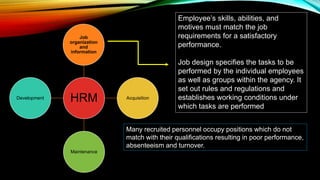
HRM
Job
organization
and
information
Acquisition
Maintenance
Development
Employee’s skills, abilities, and
motives must match the job
requirements for a satisfactory
performance.
Job design specifies the tasks to be
performed by the individual employees
as well as groups within the agency. It
set out rules and regulations and
establishes working conditions under
which tasks are performed
Many recruited personnel occupy positions which do not
match with their qualifications resulting in poor performance,
absenteeism and turnover.
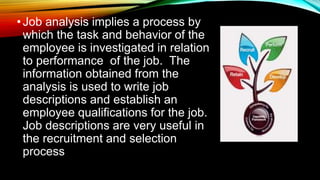
•Job analysis implies a process by
which the task and behavior of the
employee is investigated in relation
to performance of the job. The
information obtained from the
analysis is used to write job
descriptions and establish an
employee qualifications for the job.
Job descriptions are very useful in
the recruitment and selection
process
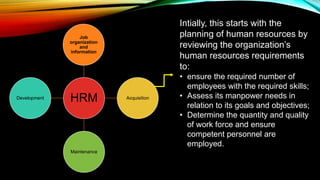
HRM
Job
organization
and
information
Acquisition
Maintenance
Development
Intially, this starts with the
planning of human resources by
reviewing the organization’s
human resources requirements
to:
• ensure the required number of
employees with the required skills;
• Assess its manpower needs in
relation to its goals and objectives;
• Determine the quantity and quality
of work force and ensure
competent personnel are
employed.
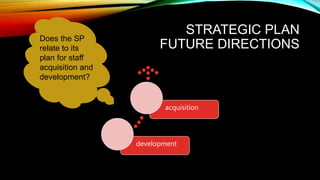
STRATEGIC PLAN
FUTURE DIRECTIONS
development
acquisition
Does the SP
relate to its
plan for staff
acquisition and
development?
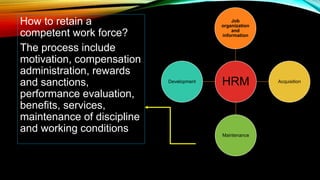
How to retain a
competent work force?
The process include
motivation, compensation
administration, rewards
and sanctions,
performance evaluation,
benefits, services,
maintenance of discipline
and working conditions
HRM
Job
organization
and
information
Acquisition
Maintenance
Development
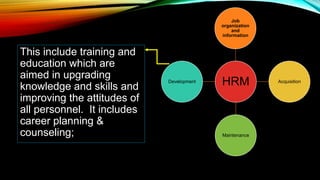
This include training and
education which are
aimed in upgrading
knowledge and skills and
improving the attitudes of
all personnel. It includes
career planning &
counseling;
HRM
Job
organization
and
information
Acquisition
Maintenance
Development
MODULE 4: ORGANIZATION
LOCATION OF HRM DEPARTMENT
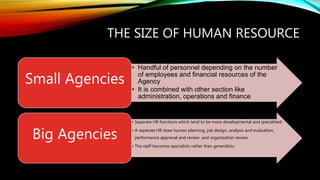
THE SIZE OF HUMAN RESOURCE
• Handful of personnel depending on the number
of employees and financial resources of the
Agency
• It is combined with other section like
administration, operations and finance
Small Agencies
• Separate HR functions which tend to be more developmental and specialized.
• A separate HR does human planning, job design, analysis and evaluation,
performance appraisal and review and organization review.
• The staff becomes specialists rather than generalists.
Big Agencies
•Many HR units in the bureaucracy do not perform
line functions. They are not even integrated into
the top management. HR function as a whole is
not integral to the functioning of the organization
and appears to be a separate concern for line
management.

Module 3 Functions of HRM

  • 1.
    FUNCTIONS OF HRM Module 3 MPA212 Ist Semester 2019
  • 2.
    OBJECTIVES •Different functions ofHRM •Interre;ationship with other process of managing people in the organization
  • 3.
    INTRODUCTION• Efforts toreform the way which governments handle the personnel management function have a long history in the USA as they have struggled with changing political and economic circumstances. These administrative reforms are typically design to reflect new models or emerging paradigms for public management. With each reform, changes, large (tidal waves) or small in the administrative system of the government is implemented and the effects of those changes often last long after the reform itself become a distant memory. Kellough and Nigro (2006). Public expectations are high, effective public management can be difficult.
  • 4.
    • A reformindex is developed to document the considerable variation among the states in their approach to personnel practices. Several state characteristics are associated with scores on this index, including legislative professionalism, which bears a positive relationship to reform, and the level of unemployment within a state and the proportion of state employees associated with public employee unions, which are both negatively associated with reform. The Act espoused efficiency, as well as the elimination of politics from personnel decisions, effective methods of recruiting and selecting and paying employees Pendleton Act of 1883
  • 5.
    HRM Job organization and information Acquisition Maintenance Development Employee’s skills, abilities,and motives must match the job requirements for a satisfactory performance. Job design specifies the tasks to be performed by the individual employees as well as groups within the agency. It set out rules and regulations and establishes working conditions under which tasks are performed Many recruited personnel occupy positions which do not match with their qualifications resulting in poor performance, absenteeism and turnover.
  • 6.
    •Job analysis impliesa process by which the task and behavior of the employee is investigated in relation to performance of the job. The information obtained from the analysis is used to write job descriptions and establish an employee qualifications for the job. Job descriptions are very useful in the recruitment and selection process
  • 7.
    HRM Job organization and information Acquisition Maintenance Development Intially, this startswith the planning of human resources by reviewing the organization’s human resources requirements to: • ensure the required number of employees with the required skills; • Assess its manpower needs in relation to its goals and objectives; • Determine the quantity and quality of work force and ensure competent personnel are employed.
  • 8.
    STRATEGIC PLAN FUTURE DIRECTIONS development acquisition Doesthe SP relate to its plan for staff acquisition and development?
  • 9.
    How to retaina competent work force? The process include motivation, compensation administration, rewards and sanctions, performance evaluation, benefits, services, maintenance of discipline and working conditions HRM Job organization and information Acquisition Maintenance Development
  • 10.
    This include trainingand education which are aimed in upgrading knowledge and skills and improving the attitudes of all personnel. It includes career planning & counseling; HRM Job organization and information Acquisition Maintenance Development
  • 11.
  • 12.
    THE SIZE OFHUMAN RESOURCE • Handful of personnel depending on the number of employees and financial resources of the Agency • It is combined with other section like administration, operations and finance Small Agencies • Separate HR functions which tend to be more developmental and specialized. • A separate HR does human planning, job design, analysis and evaluation, performance appraisal and review and organization review. • The staff becomes specialists rather than generalists. Big Agencies
  • 13.
    •Many HR unitsin the bureaucracy do not perform line functions. They are not even integrated into the top management. HR function as a whole is not integral to the functioning of the organization and appears to be a separate concern for line management.