Representation of
Functions
General Mathematics
Ericko P. Alegria, LPT
Teacher: Ericko P. Alegria, LPT
Course: Bachelor of Science in Computer Engineering
Continuous Professor’s Education (CPE)
LET Passer: September 29, 2019
Major: Mathematics (secondary)
Objectives:
• Represent real-life situations using
functions, including piecewise function;
and
• Represent real-life situation using one-
to-one functions.
Relation
• A relation is a set of ordered pairs.
• The domain of a relation is the set of
first coordinates.
• The range is the set of second
coordinates.
Example: Relation
Letter Number
M 6
A 2
T 8
H 4
Set of Ordered Pairs
The domain is;
The range is;
Function
• A function is a relation in which each
element of the domain corresponds to
exactly one element of the range.
• The domain can be called inputs.
• The range can be called outputs.
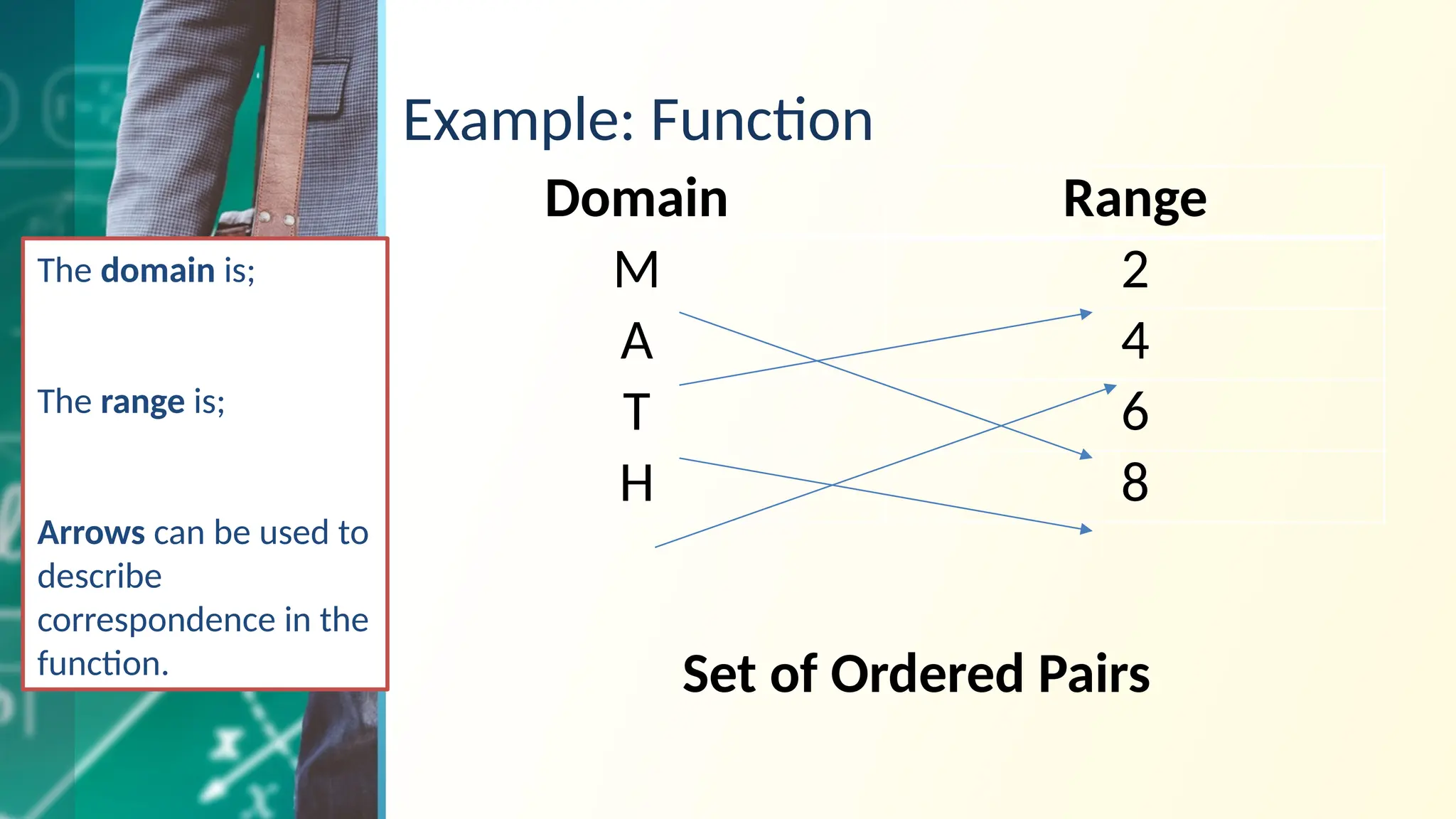
Example: Function
Domain Range
M 2
A 4
T 6
H 8
Set of Ordered Pairs
The domain is;
The range is;
Arrows can be used to
describe
correspondence in the
function.
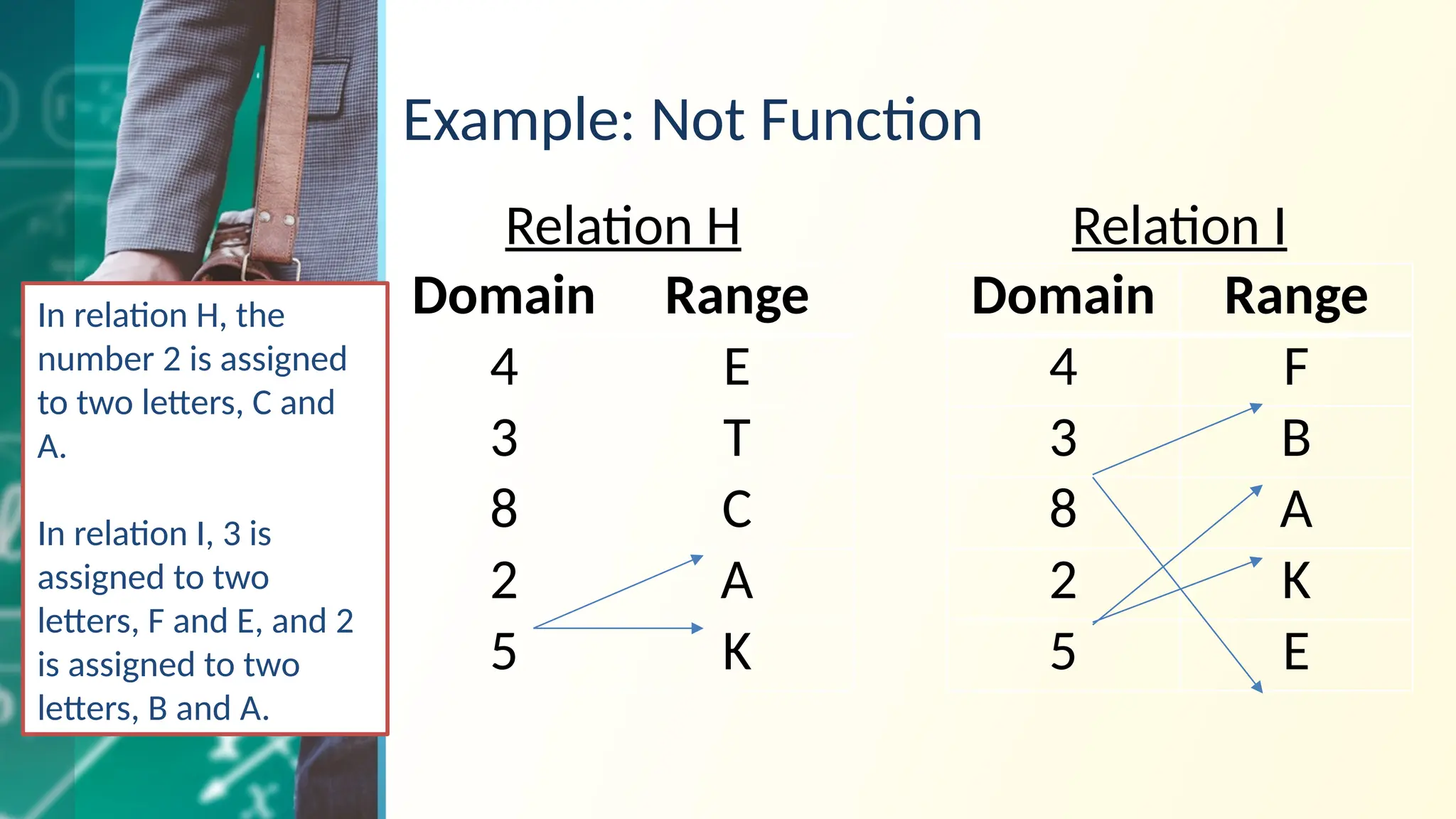
Example: Not Function
Domain Range
4 E
3 T
8 C
2 A
5 K
Domain Range
4 F
3 B
8 A
2 K
5 E
Relation H Relation I
In relation H, the
number 2 is assigned
to two letters, C and
A.
In relation I, 3 is
assigned to two
letters, F and E, and 2
is assigned to two
letters, B and A.
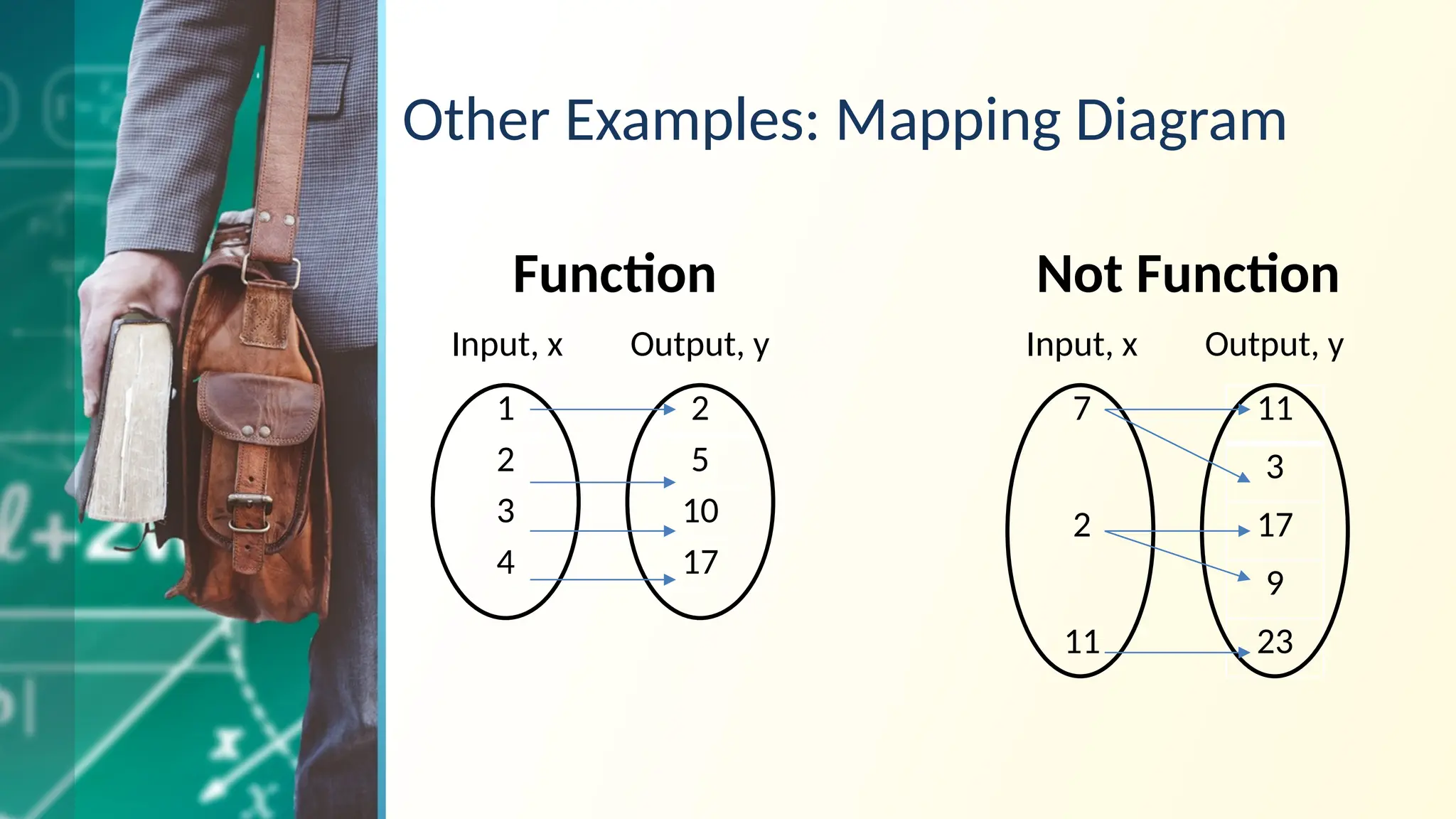
Other Examples: Mapping Diagram
1
2
3
4
2
5
10
17
Input, x Output, y
7
2
11
11
3
17
9
23
Input, x Output, y
Function Not Function
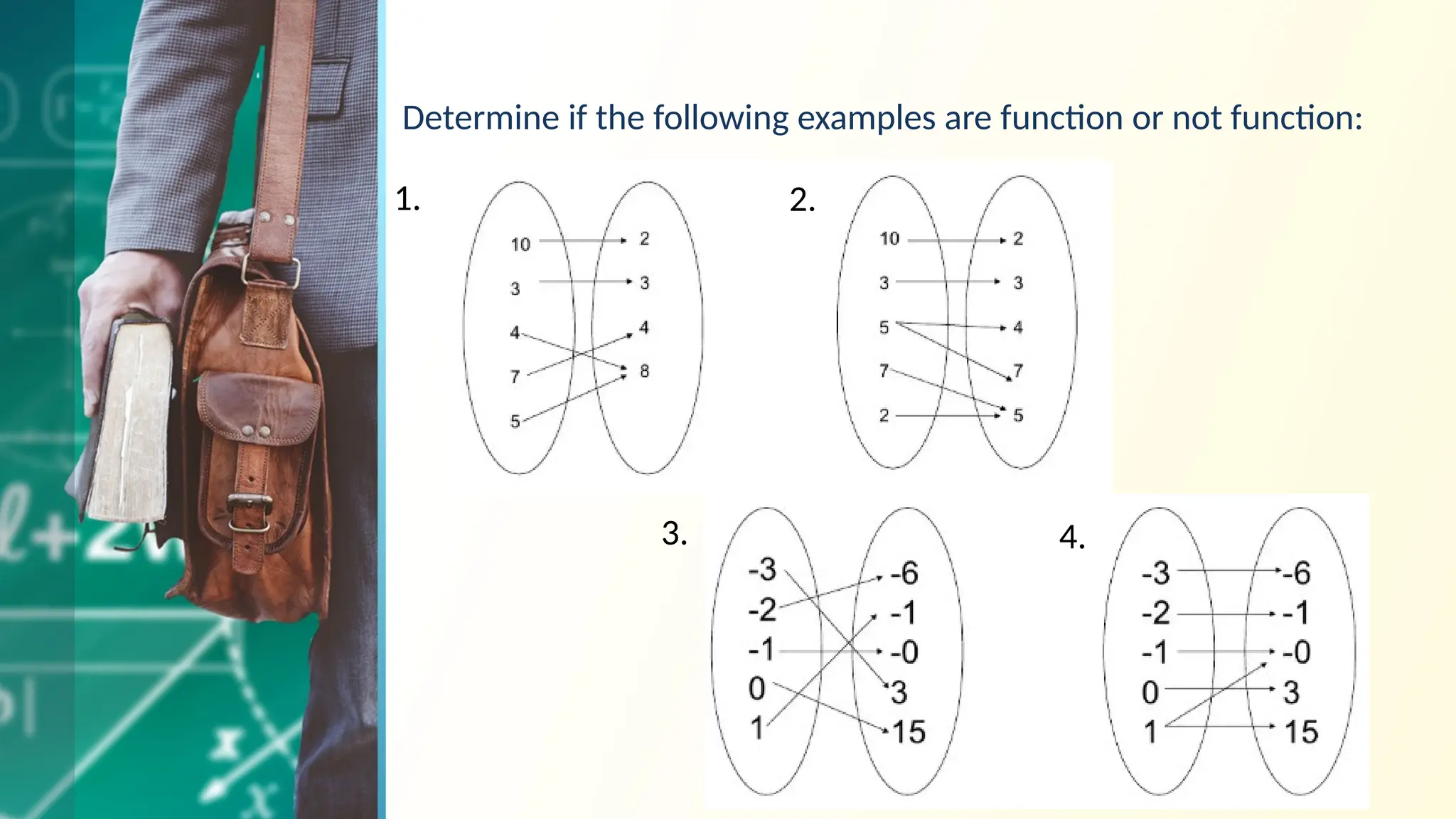
Determine if the following examples are function or not function:
1. 2.
3. 4.
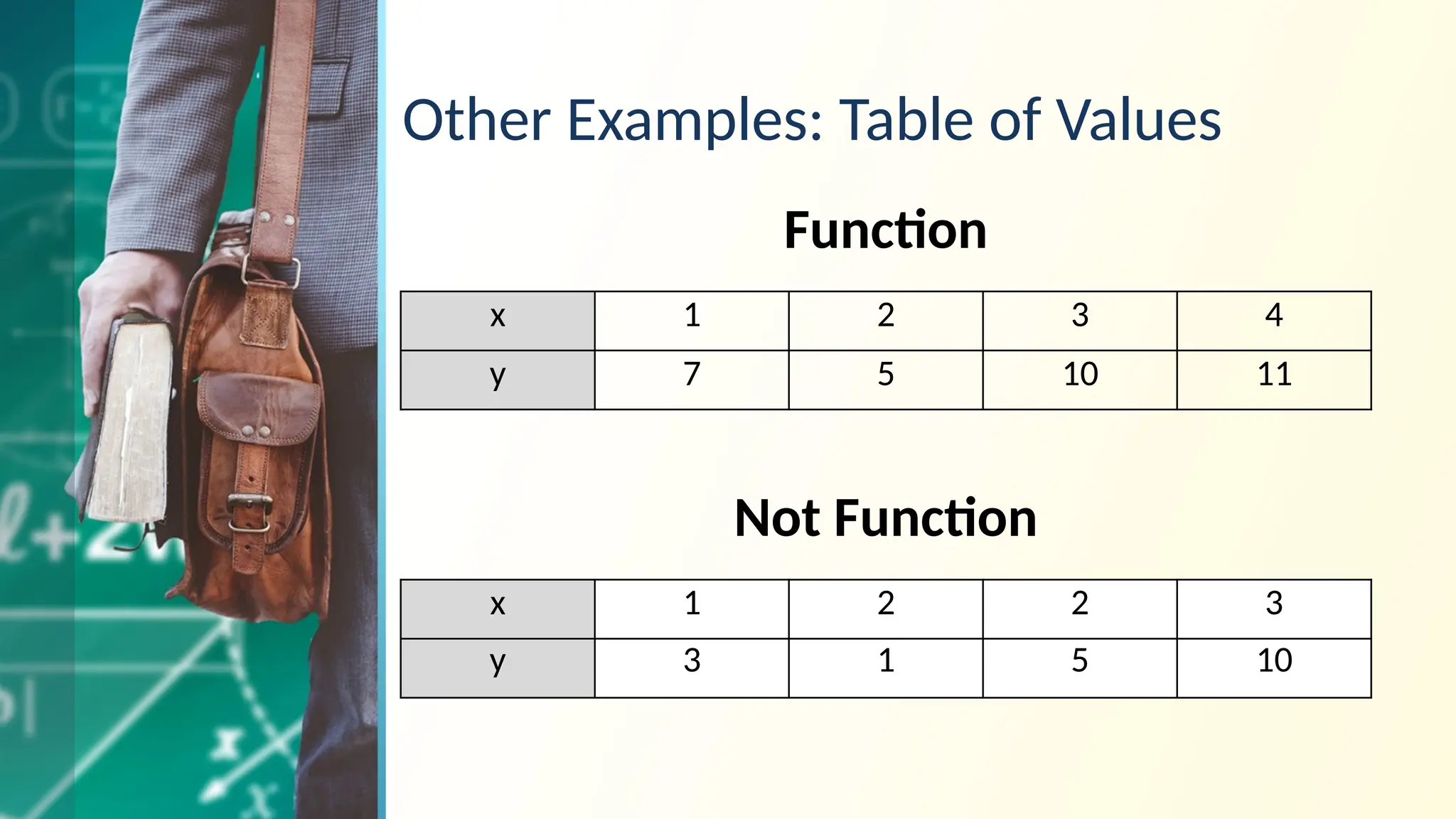
Other Examples: Table of Values
x 1 2 3 4
y 7 5 10 11
x 1 2 2 3
y 3 1 5 10
Function
Not Function
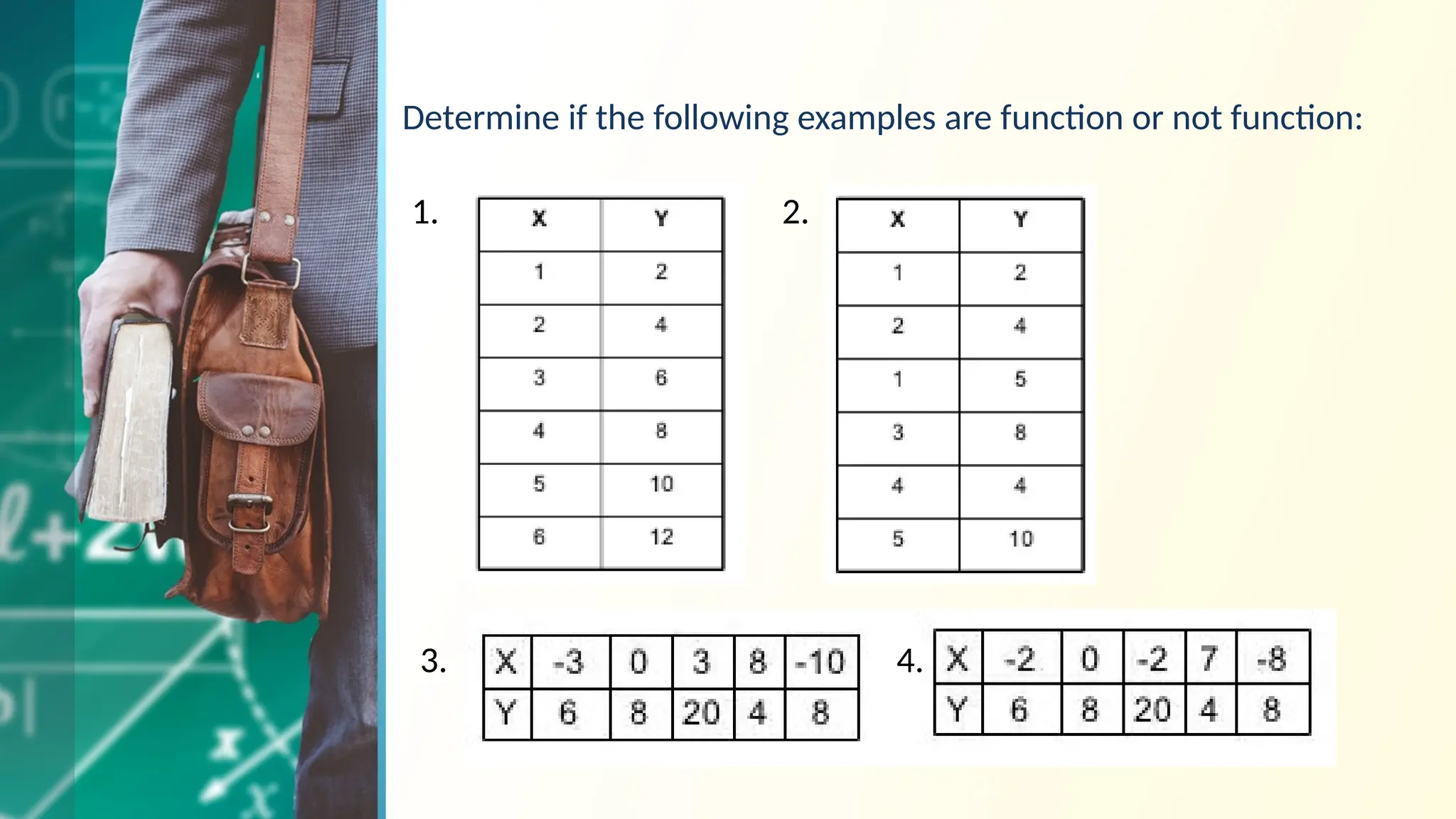
Determine if the following examples are function or not function:
1. 2.
3. 4.
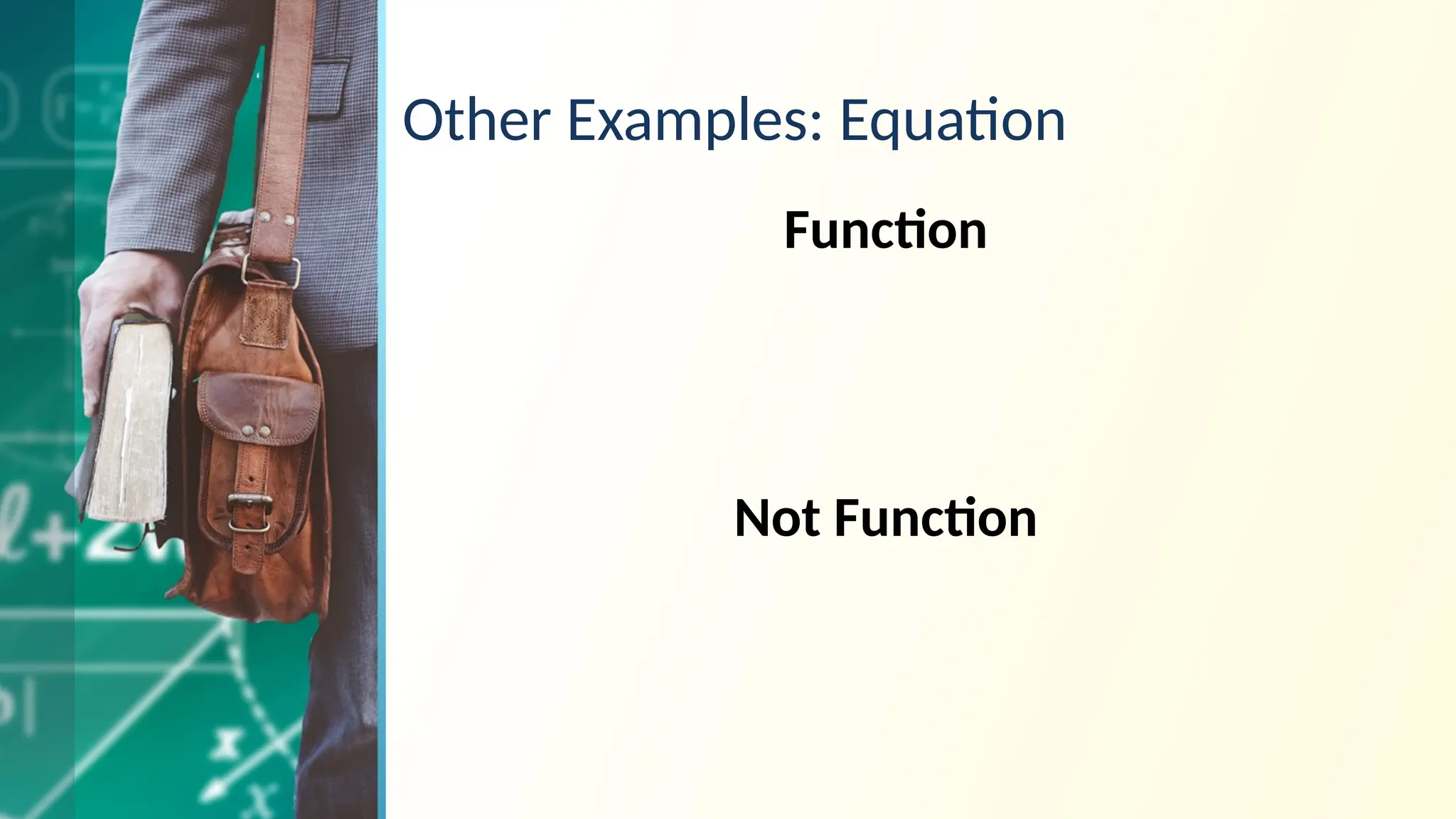
Other Examples: Equation
Function
Not Function
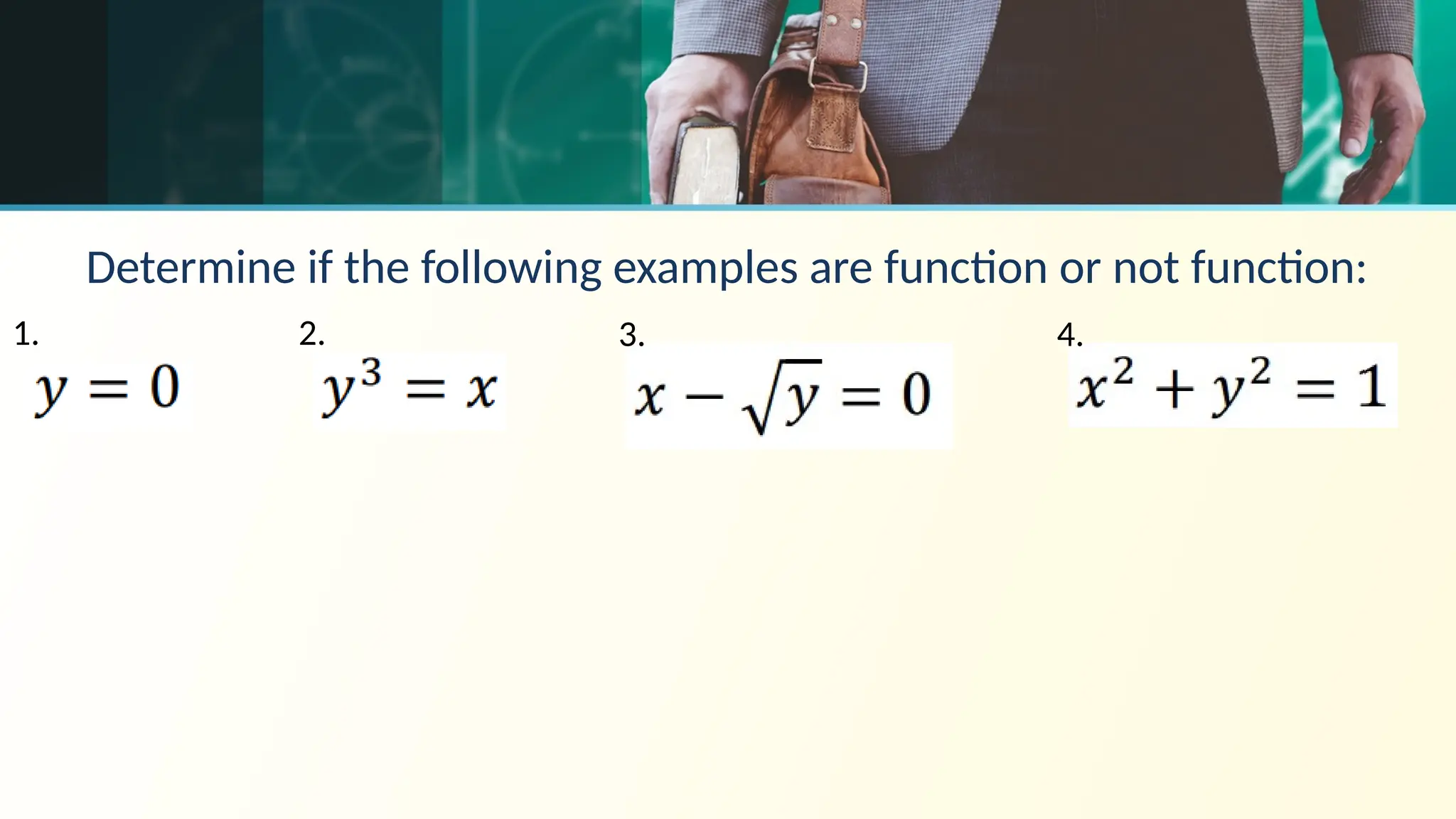
Determine if the following examples are function or not function:
1. 2. 3. 4.
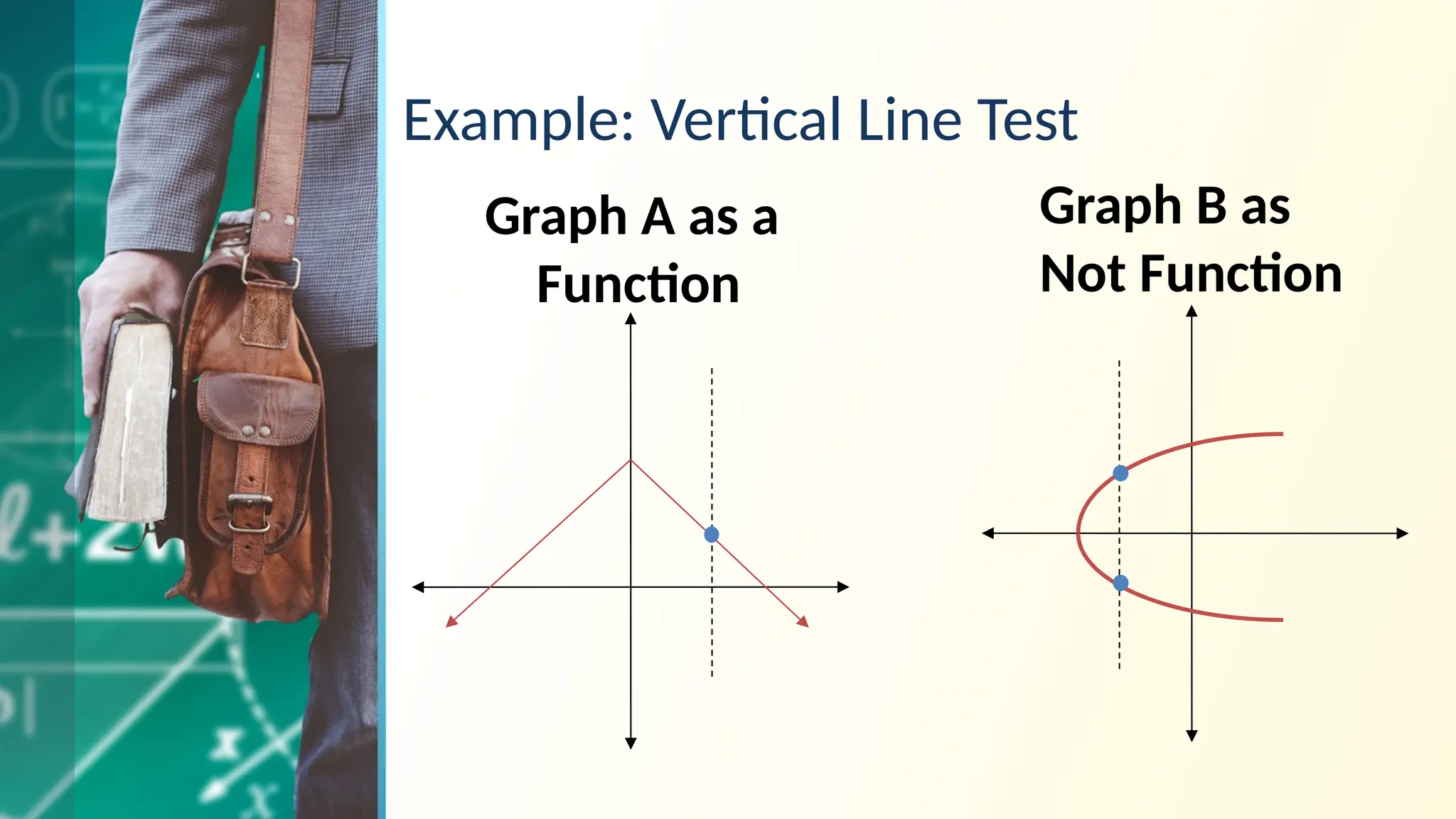
Vertical Line Test
• A graph represents a function if and
only if no vertical line intersects the
graph in more one point.
Example: Vertical Line Test
Graph A as a
Function
Graph B as
Not Function
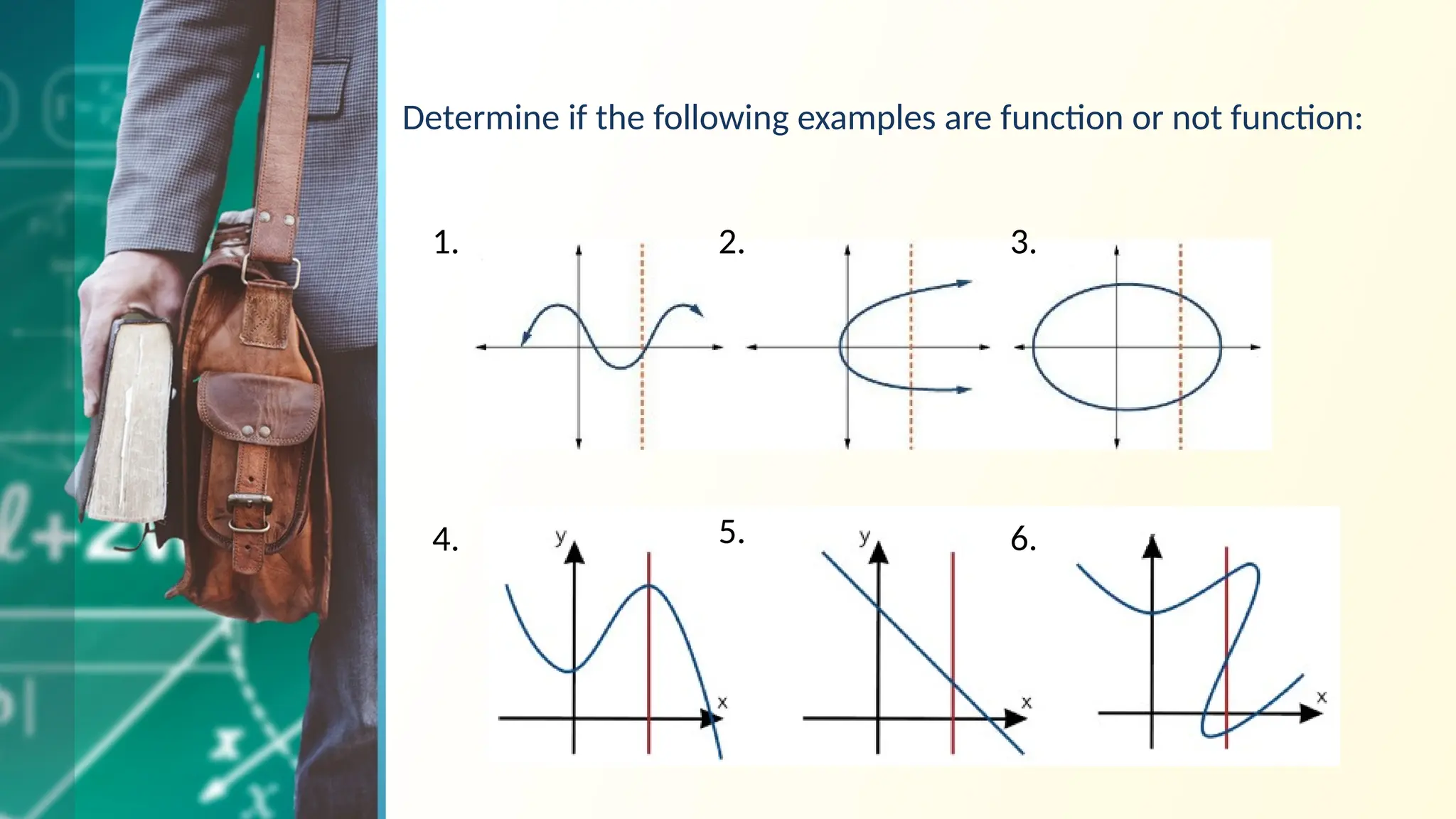
Determine if the following examples are function or not function:
6.
5.
4.
3.
2.
1.
Types of Function
1. Linear Function
2. Quadratic Function
3. Constant Function
4. Identity Function
5. Absolute Value Function
6. Piecewise or Compound Function
7. One-to-One Function
Linear Function
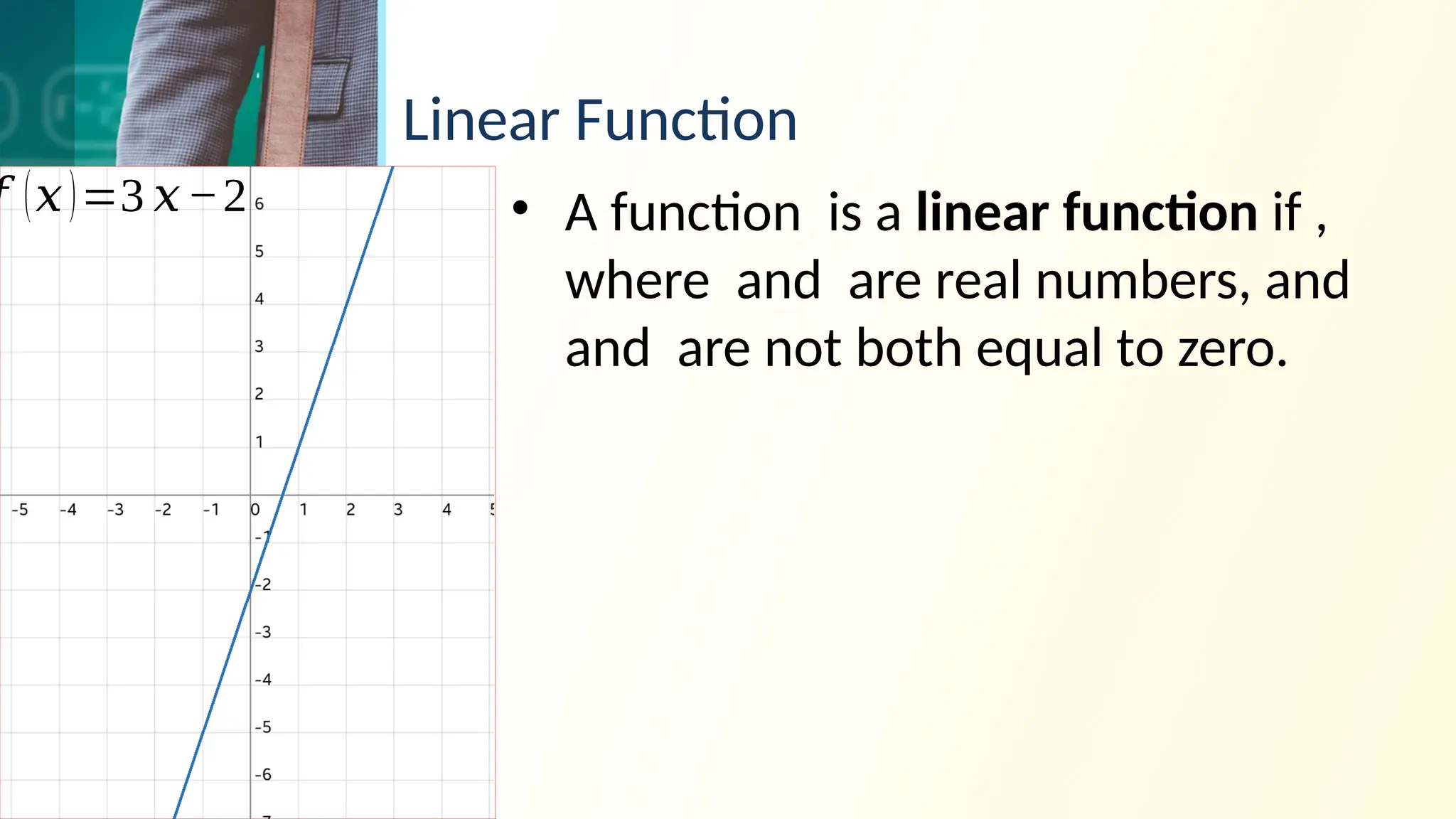
• A function is a linear function if ,
where and are real numbers, and
and are not both equal to zero.
𝑓 (𝑥)=3 𝑥−2
Quadratic Function
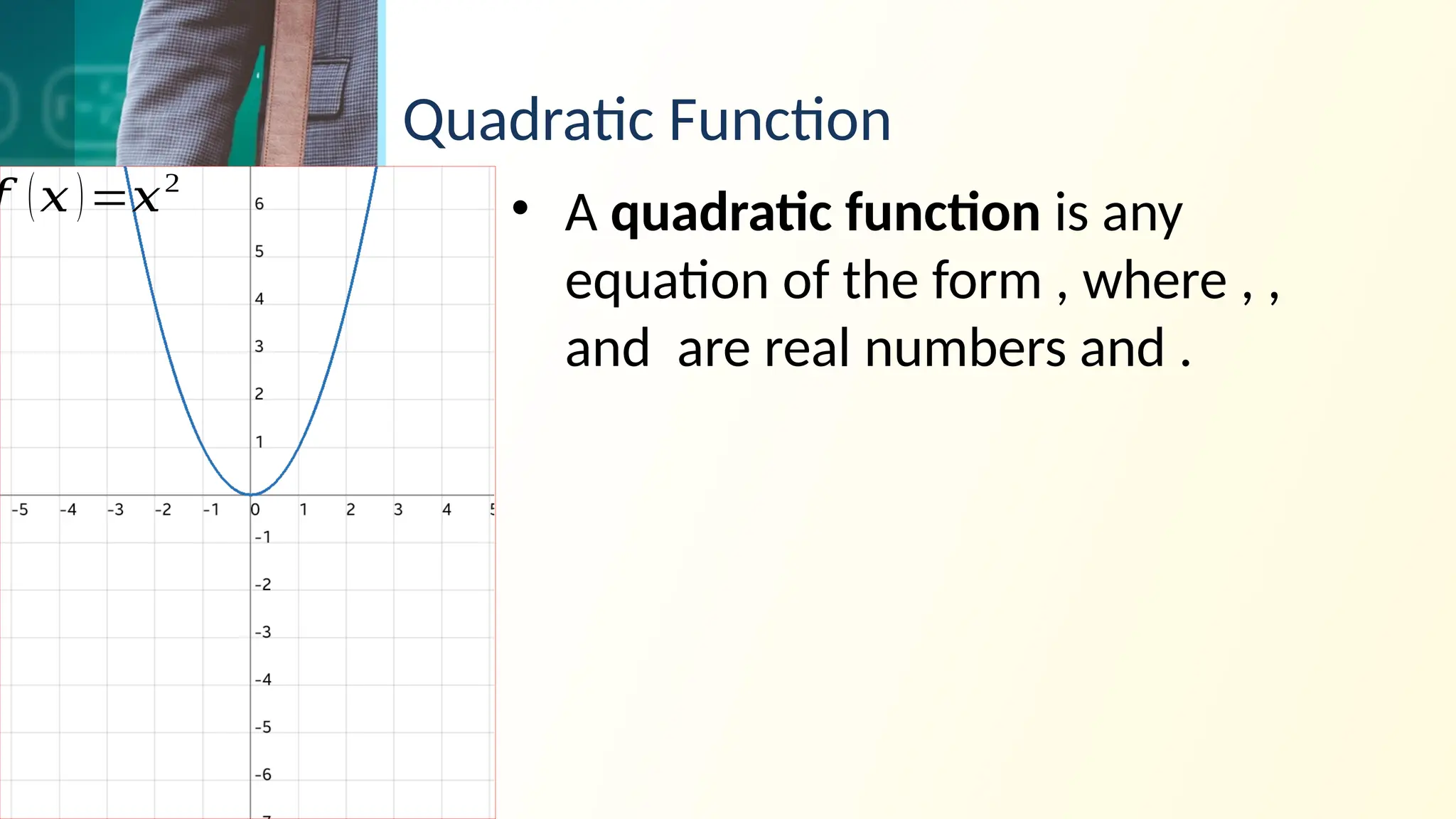
• A quadratic function is any
equation of the form , where , ,
and are real numbers and .
𝑓 (𝑥)=𝑥2
Constant Function
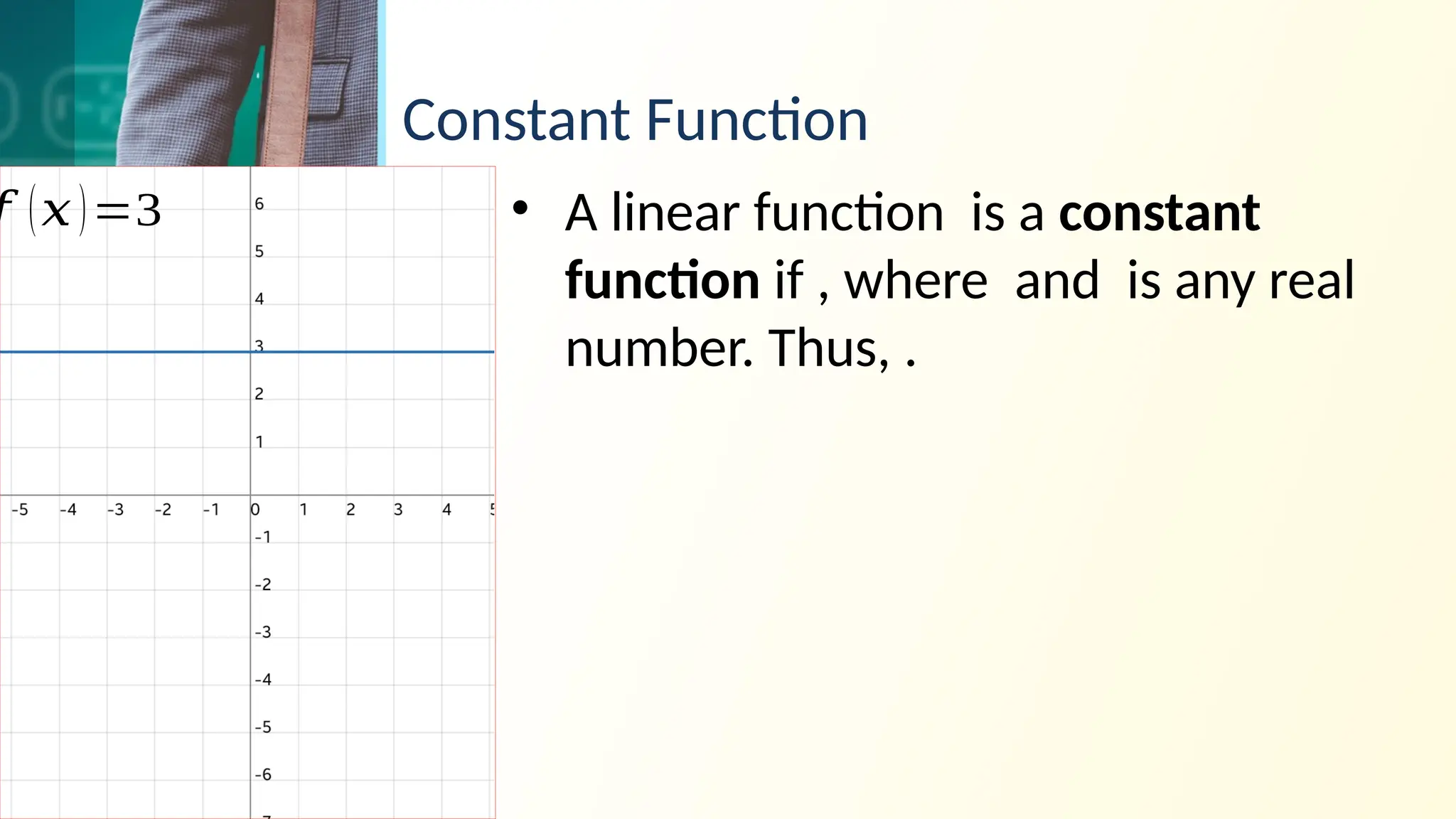
• A linear function is a constant
function if , where and is any real
number. Thus, .
𝑓 (𝑥)=3
Identity Function
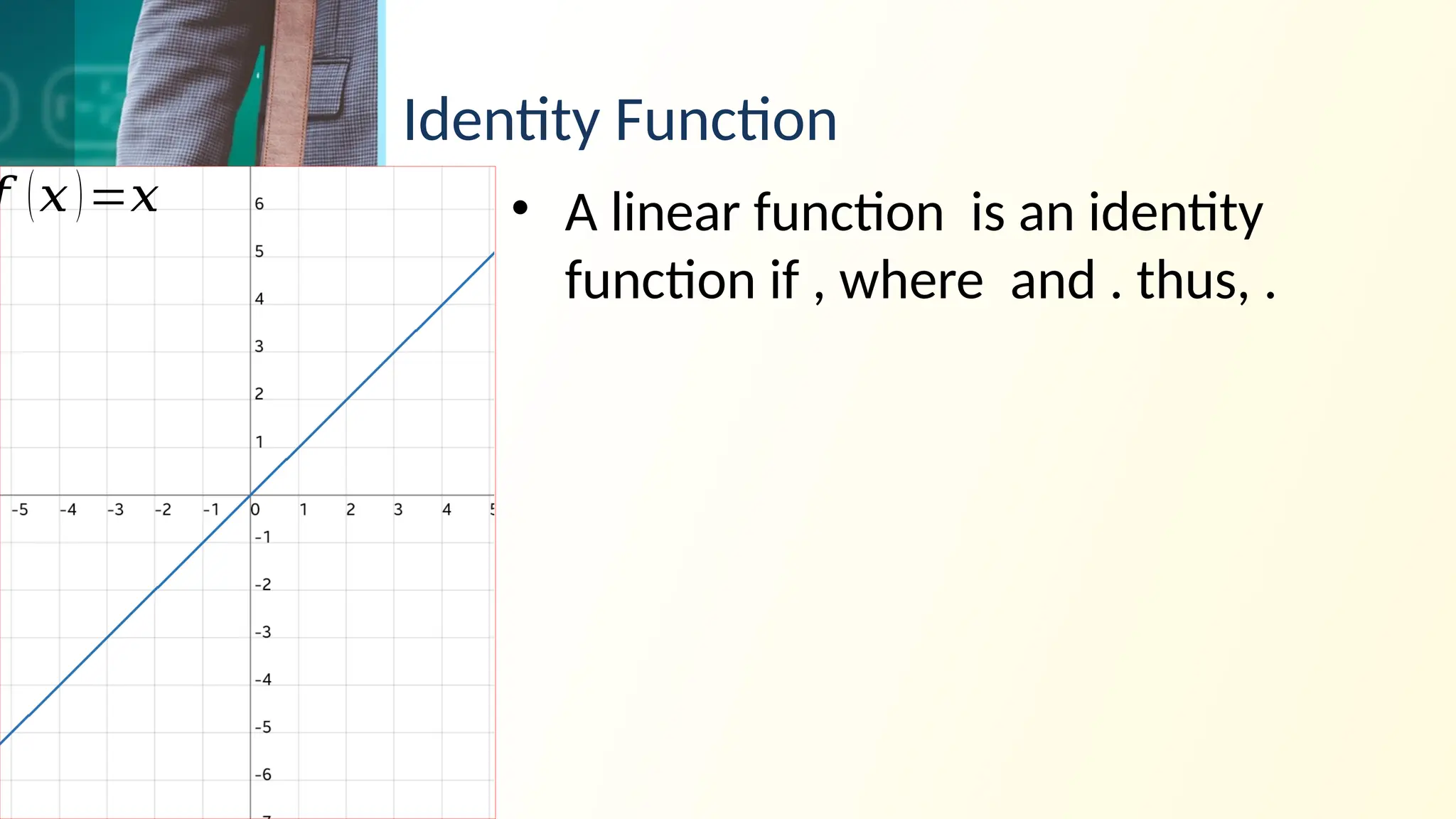
• A linear function is an identity
function if , where and . thus, .
𝑓 (𝑥)=𝑥
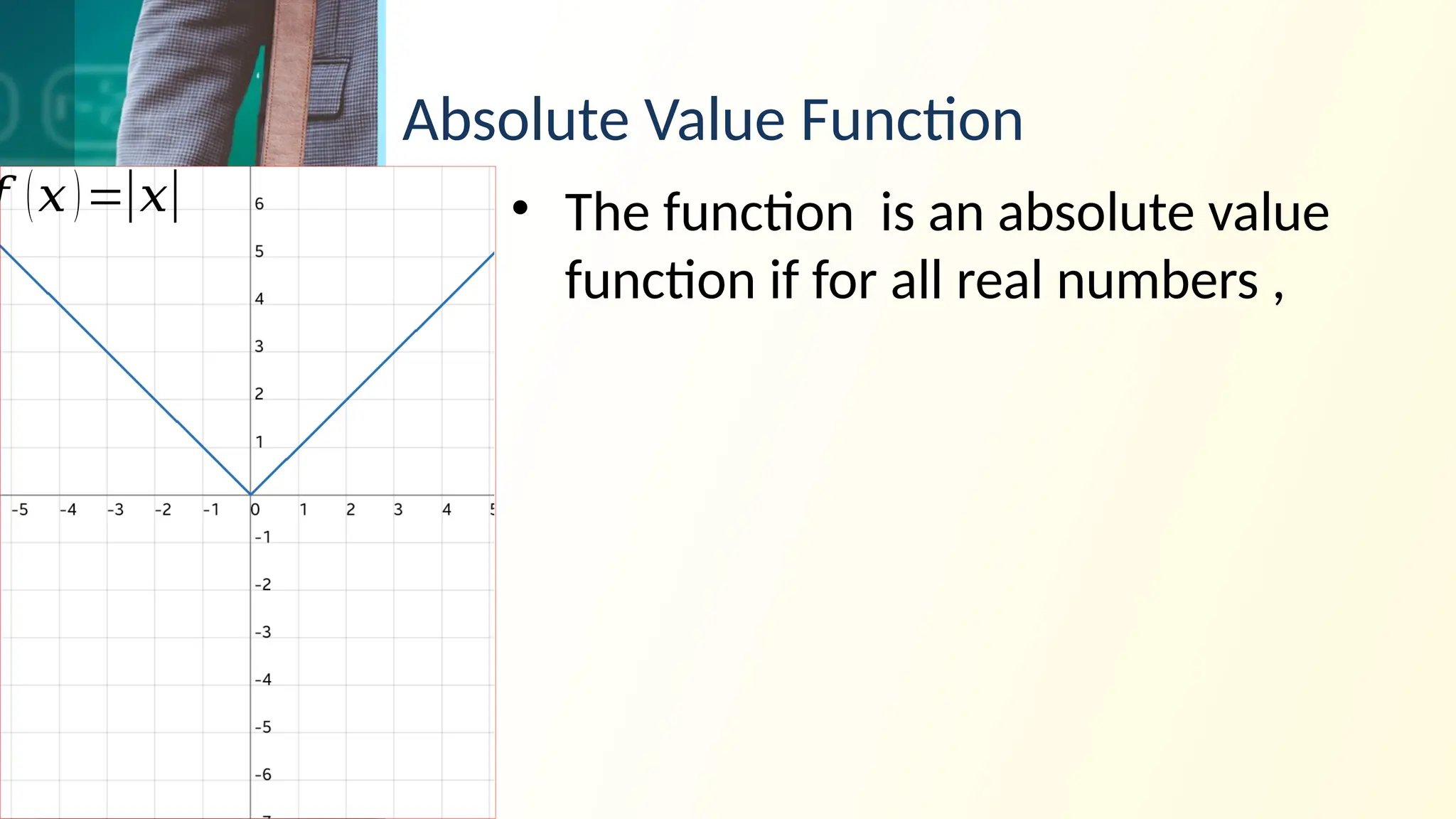
Absolute Value Function
• The function is an absolute value
function if for all real numbers ,
𝑓 (𝑥)=|𝑥|
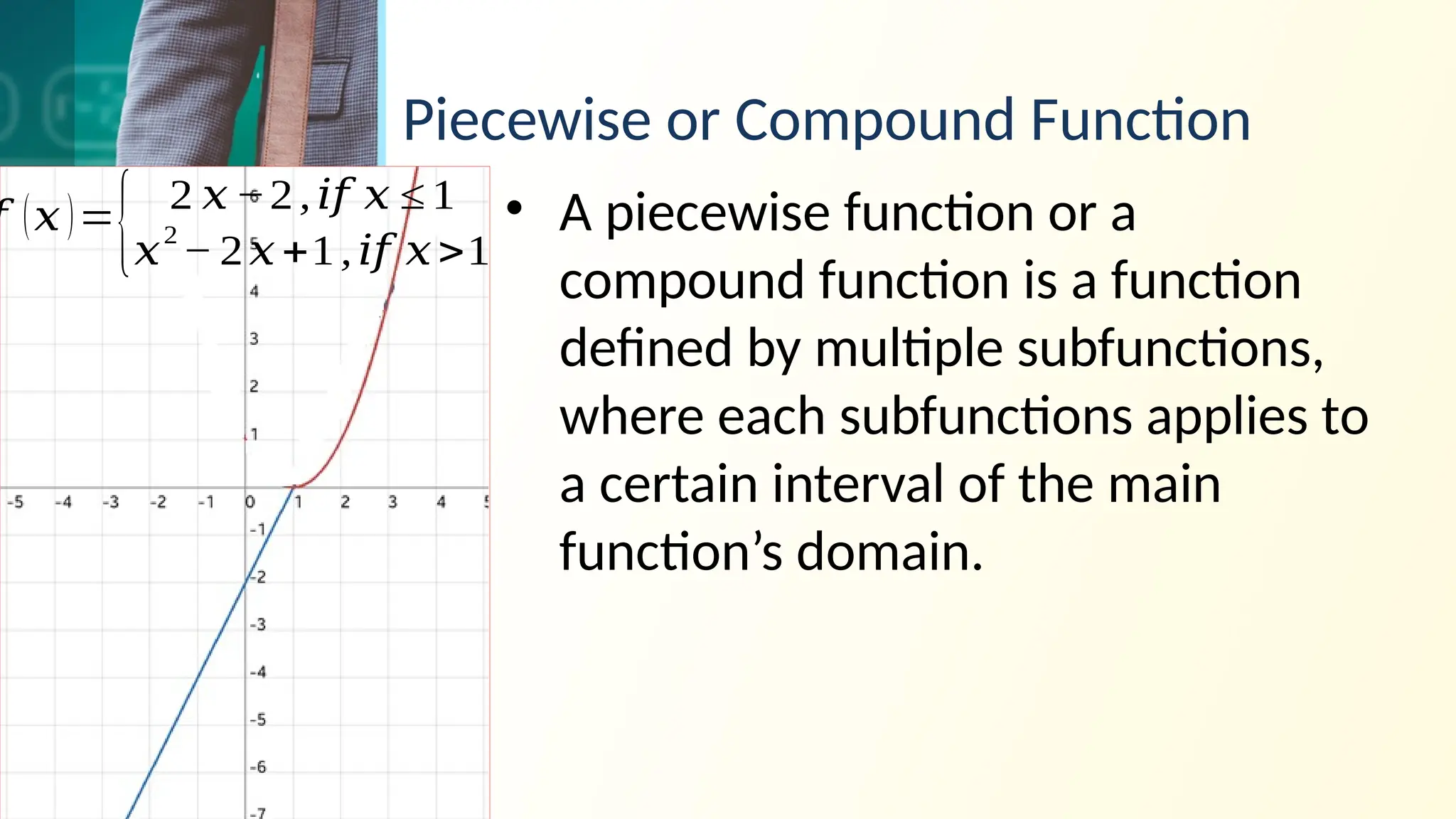
Piecewise or Compound Function
• A piecewise function or a
compound function is a function
defined by multiple subfunctions,
where each subfunctions applies to
a certain interval of the main
function’s domain.
𝑓 (𝑥)=
{ 2 𝑥−2,𝑖𝑓 𝑥 ≤ 1
𝑥
2
− 2𝑥+1,𝑖𝑓 𝑥>1
One-to-One Function
• A one-to-one function is a function in
which for each value of in the range
of , there is just one value in the
domain of such that .
• In other words, is one-to-one if
implies .
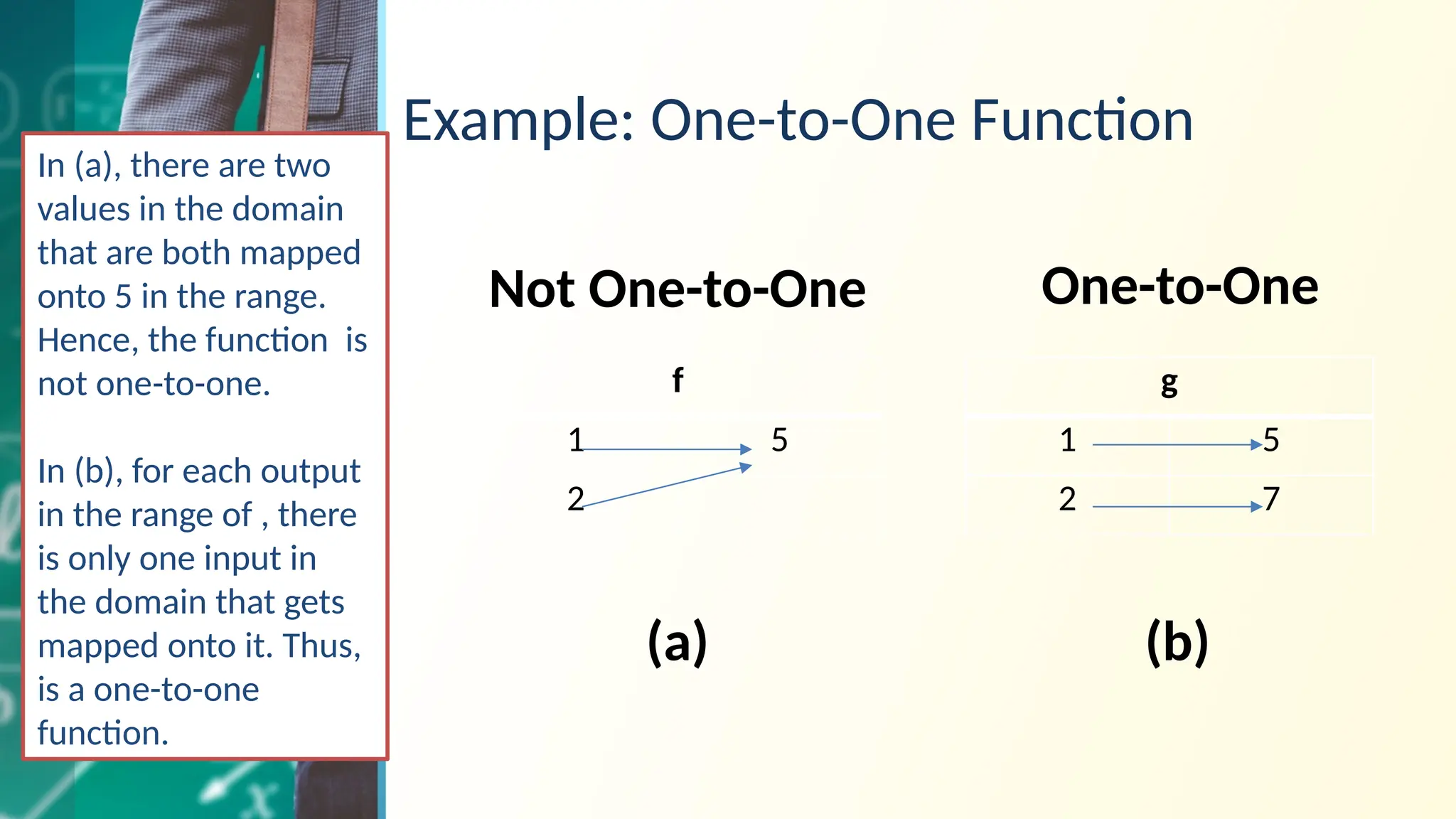
Example: One-to-One Function
f
1 5
2
g
1 5
2 7
Not One-to-One One-to-One
(a) (b)
In (a), there are two
values in the domain
that are both mapped
onto 5 in the range.
Hence, the function is
not one-to-one.
In (b), for each output
in the range of , there
is only one input in
the domain that gets
mapped onto it. Thus,
is a one-to-one
function.
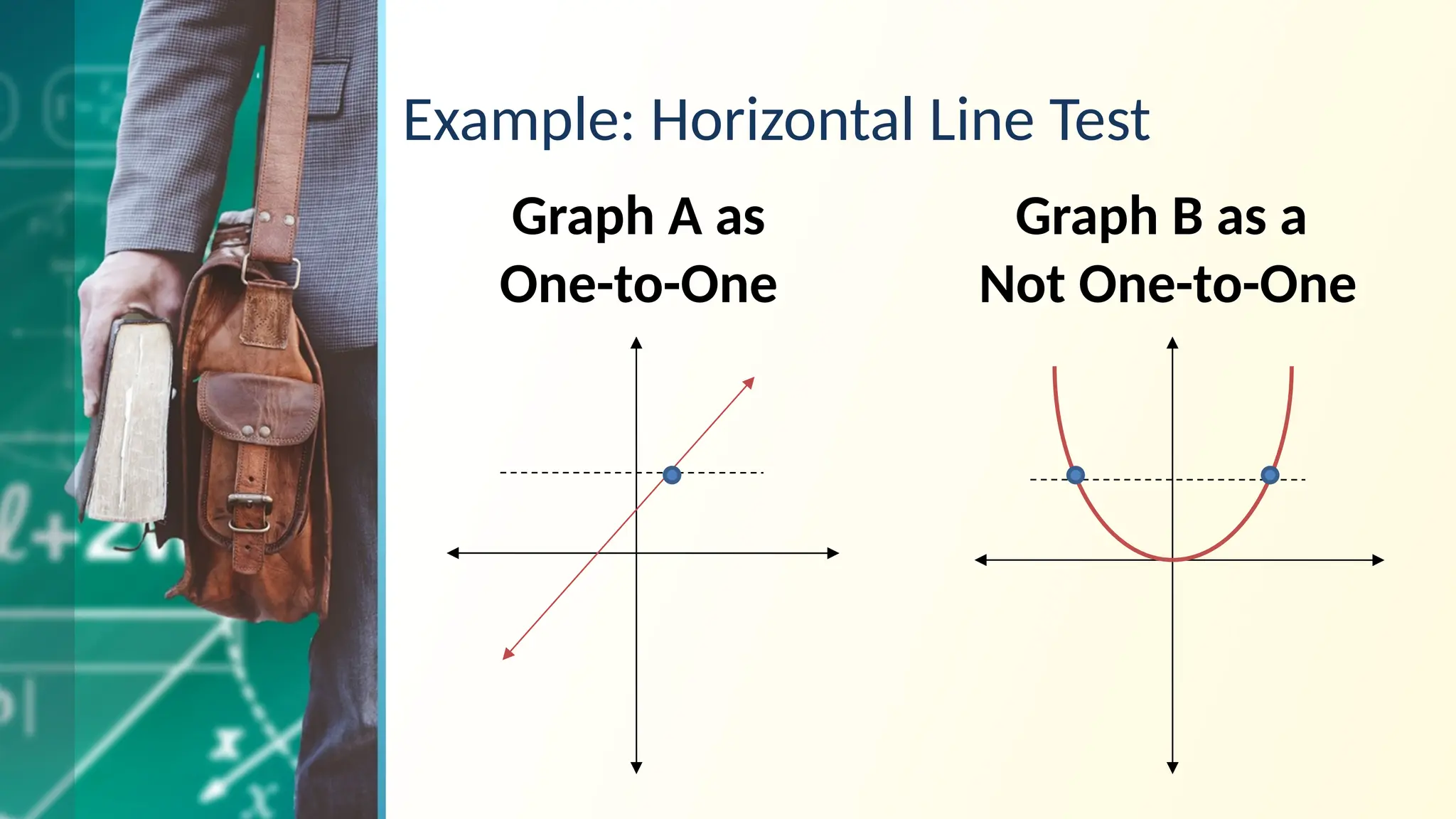
Horizontal Line Test
• a function is one-to-one if no
horizontal line intersects its graph more
than once.
Example: Horizontal Line Test
Graph A as
One-to-One
Graph B as a
Not One-to-One
Next Lesson:
• Chapter 1, Lesson 1.2:
Evaluation of Functions
Reference:
• Oronce, Orlando A. General
Mathematics: First Edition. Rex
Bookstore, Inc., 2016
Thank
You!

General_Mathematics_Chapter_1_(Part1)_Lesson_1.1_Representation_of_Functions.pptx

  • 1.
  • 2.
    Teacher: Ericko P.Alegria, LPT Course: Bachelor of Science in Computer Engineering Continuous Professor’s Education (CPE) LET Passer: September 29, 2019 Major: Mathematics (secondary)
  • 3.
    Objectives: • Represent real-lifesituations using functions, including piecewise function; and • Represent real-life situation using one- to-one functions.
  • 4.
    Relation • A relationis a set of ordered pairs. • The domain of a relation is the set of first coordinates. • The range is the set of second coordinates.
  • 5.
    Example: Relation Letter Number M6 A 2 T 8 H 4 Set of Ordered Pairs The domain is; The range is;
  • 6.
    Function • A functionis a relation in which each element of the domain corresponds to exactly one element of the range. • The domain can be called inputs. • The range can be called outputs.
  • 7.
    Example: Function Domain Range M2 A 4 T 6 H 8 Set of Ordered Pairs The domain is; The range is; Arrows can be used to describe correspondence in the function.
  • 8.
    Example: Not Function DomainRange 4 E 3 T 8 C 2 A 5 K Domain Range 4 F 3 B 8 A 2 K 5 E Relation H Relation I In relation H, the number 2 is assigned to two letters, C and A. In relation I, 3 is assigned to two letters, F and E, and 2 is assigned to two letters, B and A.
  • 9.
    Other Examples: MappingDiagram 1 2 3 4 2 5 10 17 Input, x Output, y 7 2 11 11 3 17 9 23 Input, x Output, y Function Not Function
  • 10.
    Determine if thefollowing examples are function or not function: 1. 2. 3. 4.
  • 11.
    Other Examples: Tableof Values x 1 2 3 4 y 7 5 10 11 x 1 2 2 3 y 3 1 5 10 Function Not Function
  • 12.
    Determine if thefollowing examples are function or not function: 1. 2. 3. 4.
  • 13.
  • 14.
    Determine if thefollowing examples are function or not function: 1. 2. 3. 4.
  • 15.
    Vertical Line Test •A graph represents a function if and only if no vertical line intersects the graph in more one point.
  • 16.
    Example: Vertical LineTest Graph A as a Function Graph B as Not Function
  • 17.
    Determine if thefollowing examples are function or not function: 6. 5. 4. 3. 2. 1.
  • 18.
    Types of Function 1.Linear Function 2. Quadratic Function 3. Constant Function 4. Identity Function 5. Absolute Value Function 6. Piecewise or Compound Function 7. One-to-One Function
  • 19.
    Linear Function • Afunction is a linear function if , where and are real numbers, and and are not both equal to zero. 𝑓 (𝑥)=3 𝑥−2
  • 20.
    Quadratic Function • Aquadratic function is any equation of the form , where , , and are real numbers and . 𝑓 (𝑥)=𝑥2
  • 21.
    Constant Function • Alinear function is a constant function if , where and is any real number. Thus, . 𝑓 (𝑥)=3
  • 22.
    Identity Function • Alinear function is an identity function if , where and . thus, . 𝑓 (𝑥)=𝑥
  • 23.
    Absolute Value Function •The function is an absolute value function if for all real numbers , 𝑓 (𝑥)=|𝑥|
  • 24.
    Piecewise or CompoundFunction • A piecewise function or a compound function is a function defined by multiple subfunctions, where each subfunctions applies to a certain interval of the main function’s domain. 𝑓 (𝑥)= { 2 𝑥−2,𝑖𝑓 𝑥 ≤ 1 𝑥 2 − 2𝑥+1,𝑖𝑓 𝑥>1
  • 25.
    One-to-One Function • Aone-to-one function is a function in which for each value of in the range of , there is just one value in the domain of such that . • In other words, is one-to-one if implies .
  • 26.
    Example: One-to-One Function f 15 2 g 1 5 2 7 Not One-to-One One-to-One (a) (b) In (a), there are two values in the domain that are both mapped onto 5 in the range. Hence, the function is not one-to-one. In (b), for each output in the range of , there is only one input in the domain that gets mapped onto it. Thus, is a one-to-one function.
  • 27.
    Horizontal Line Test •a function is one-to-one if no horizontal line intersects its graph more than once.
  • 28.
    Example: Horizontal LineTest Graph A as One-to-One Graph B as a Not One-to-One
  • 29.
    Next Lesson: • Chapter1, Lesson 1.2: Evaluation of Functions
  • 30.
    Reference: • Oronce, OrlandoA. General Mathematics: First Edition. Rex Bookstore, Inc., 2016
  • 31.

Editor's Notes

  • #9 A function is a relation in which each element of the domain corresponds to exactly one element of the range.
  • #11 A function is a relation in which each element of the domain corresponds to exactly one element of the range.
  • #13 A function is a relation in which each element of the domain corresponds to exactly one element of the range.