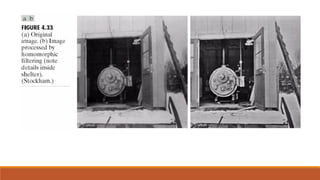
❖ The Homomorphic Filtering:
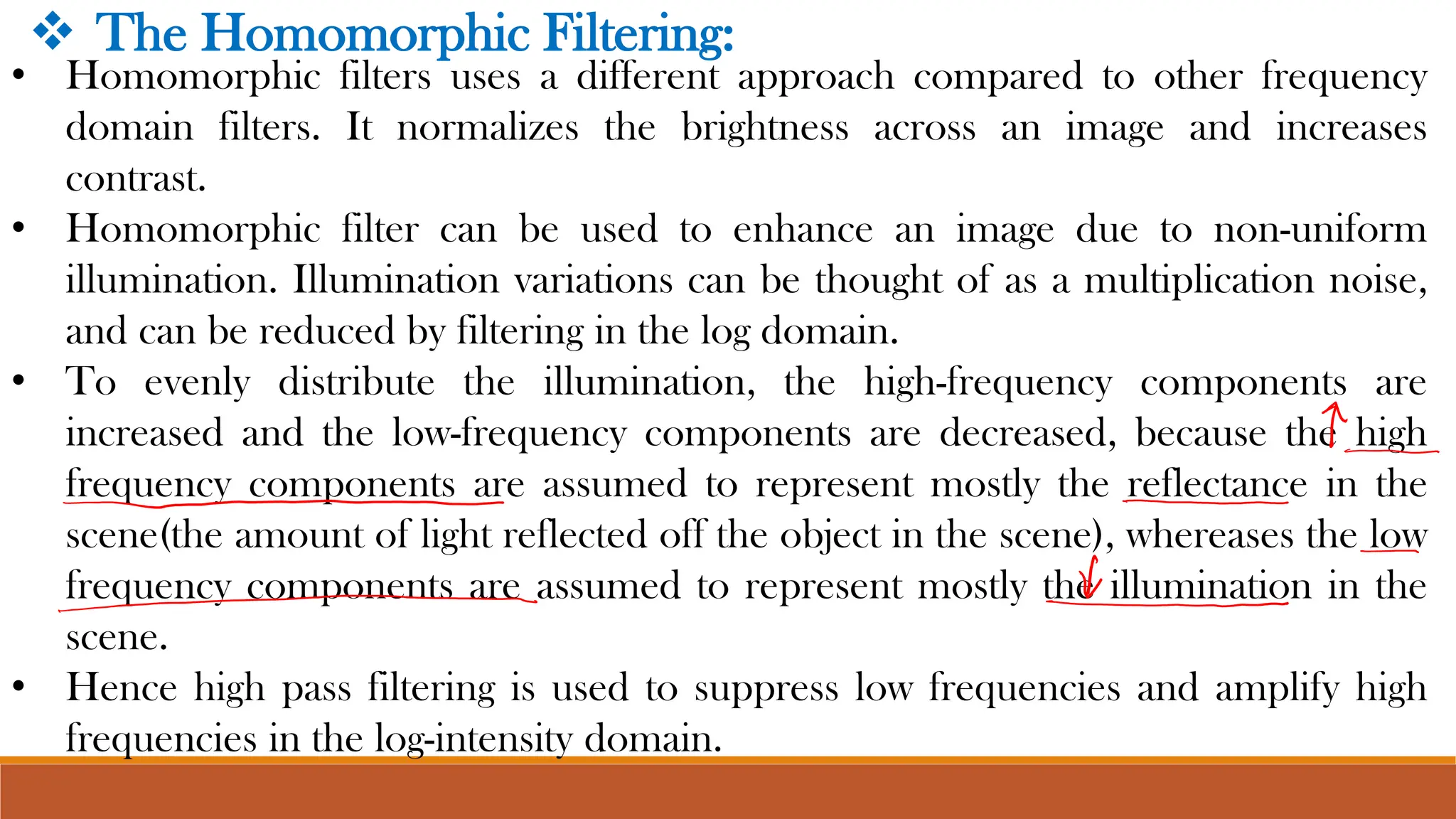
• Homomorphic filters uses a different approach compared to other frequency
domain filters. It normalizes the brightness across an image and increases
contrast.
• Homomorphic filter can be used to enhance an image due to non-uniform
illumination. Illumination variations can be thought of as a multiplication noise,
and can be reduced by filtering in the log domain.
• To evenly distribute the illumination, the high-frequency components are
increased and the low-frequency components are decreased, because the high
frequency components are assumed to represent mostly the reflectance in the
scene(the amount of light reflected off the object in the scene), whereases the low
frequency components are assumed to represent mostly the illumination in the
scene.
• Hence high pass filtering is used to suppress low frequencies and amplify high
frequencies in the log-intensity domain.
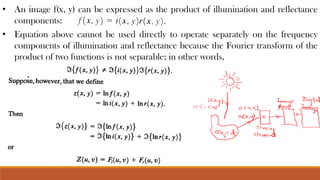
• An image f(x, y) can be expressed as the product of illumination and reflectance
components:
• Equation above cannot be used directly to operate separately on the frequency
components of illumination and reflectance because the Fourier transform of the
product of two functions is not separable; in other words,
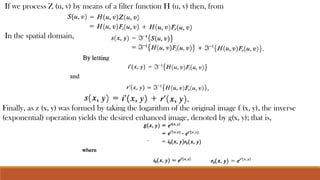
If we process Z (u, v) by means of a filter function H (u, v) then, from
In the spatial domain,
Finally, as z (x, y) was formed by taking the logarithm of the original image f (x, y), the inverse
(exponential) operation yields the desired enhanced image, denoted by g(x, y); that is,
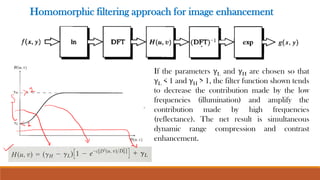
Homomorphic filtering approach for image enhancement
If the parameters γL and γH are chosen so that
γL < 1 and γH > 1, the filter function shown tends
to decrease the contribution made by the low
frequencies (illumination) and amplify the
contribution made by high frequencies
(reflectance). The net result is simultaneous
dynamic range compression and contrast
enhancement.
Module 2.6-Freq Domain-Homomorphic Filtering.pdf

Module 2.6-Freq Domain-Homomorphic Filtering.pdf

  • 1.
    ❖ The HomomorphicFiltering: • Homomorphic filters uses a different approach compared to other frequency domain filters. It normalizes the brightness across an image and increases contrast. • Homomorphic filter can be used to enhance an image due to non-uniform illumination. Illumination variations can be thought of as a multiplication noise, and can be reduced by filtering in the log domain. • To evenly distribute the illumination, the high-frequency components are increased and the low-frequency components are decreased, because the high frequency components are assumed to represent mostly the reflectance in the scene(the amount of light reflected off the object in the scene), whereases the low frequency components are assumed to represent mostly the illumination in the scene. • Hence high pass filtering is used to suppress low frequencies and amplify high frequencies in the log-intensity domain.
  • 2.
    • An imagef(x, y) can be expressed as the product of illumination and reflectance components: • Equation above cannot be used directly to operate separately on the frequency components of illumination and reflectance because the Fourier transform of the product of two functions is not separable; in other words,
  • 3.
    If we processZ (u, v) by means of a filter function H (u, v) then, from In the spatial domain, Finally, as z (x, y) was formed by taking the logarithm of the original image f (x, y), the inverse (exponential) operation yields the desired enhanced image, denoted by g(x, y); that is,
  • 4.
    Homomorphic filtering approachfor image enhancement If the parameters γL and γH are chosen so that γL < 1 and γH > 1, the filter function shown tends to decrease the contribution made by the low frequencies (illumination) and amplify the contribution made by high frequencies (reflectance). The net result is simultaneous dynamic range compression and contrast enhancement.