Module 3Module 3
Brain’s Building BlocksBrain’s Building Blocks
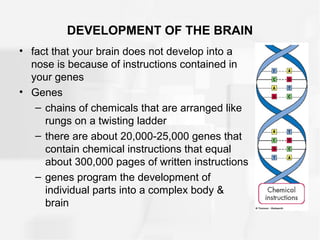
DEVELOPMENT OF THE BRAIN
• fact that your brain does not develop into a
nose is because of instructions contained in
your genes
• Genes
– chains of chemicals that are arranged like
rungs on a twisting ladder
– there are about 20,000-25,000 genes that
contain chemical instructions that equal
about 300,000 pages of written instructions
– genes program the development of
individual parts into a complex body &
brain
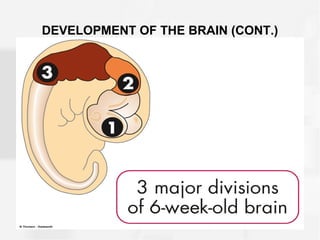
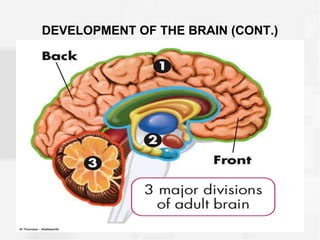
DEVELOPMENT OF THE BRAIN (CONT.)
STRUCTURE OF THE BRAIN
• Human brain:
– is shaped like a small wrinkled melon
– 1,350 grams (less than 3 pounds)
– pinkish-white color
– consistency of firm Jell-O
– Fueled by sugar (glucose)
– 1 trillion cells divided into
• glial cells
• neurons
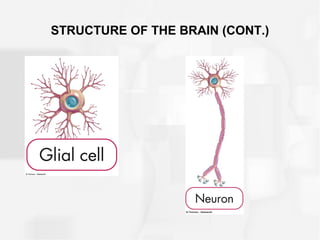
STRUCTURE OF THE BRAIN (CONT.)
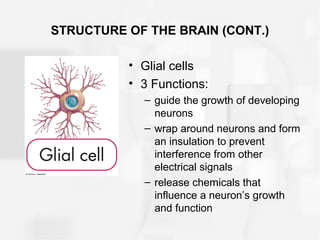
• Glial cells
• 3 Functions:
– guide the growth of developing
neurons
– wrap around neurons and form
an insulation to prevent
interference from other
electrical signals
– release chemicals that
influence a neuron’s growth
and function
STRUCTURE OF THE BRAIN (CONT.)
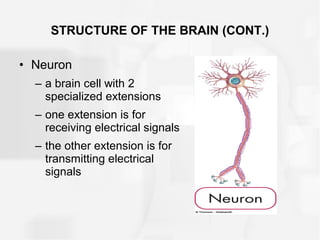
• Neuron
– a brain cell with 2
specialized extensions
– one extension is for
receiving electrical signals
– the other extension is for
transmitting electrical
signals
GROWTH OF NEW NEURONS
• Can a brain grow new neurons?
– canary brain
• can grow about 20,000 neurons a day during the
spring (learns new breeding song)
– primate and human brain
• researchers conclude that adult monkey and
human brains are capable of growing relatively
limited numbers of neurons throughout adulthood
• Some new neurons play important role in
continuing to learn and remember new things
(hippocampus)
GROWTH OF NEW NEURONS (CONT.)
• Repairing the Brain
– advances in stem research suggest the human brain
may be able to grow more neurons
– repair damages:
• accident
• disease
• Alzheimer’s
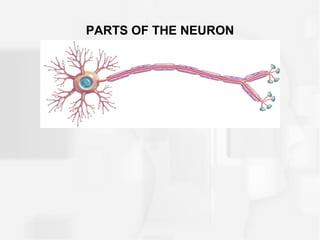
PARTS OF THE NEURON
PARTS OF THE NEURON
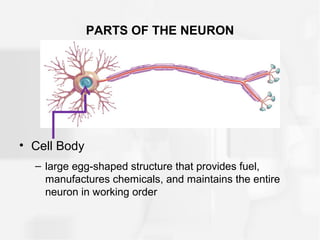
• Cell Body
– large egg-shaped structure that provides fuel,
manufactures chemicals, and maintains the entire
neuron in working order
PARTS OF THE NEURON
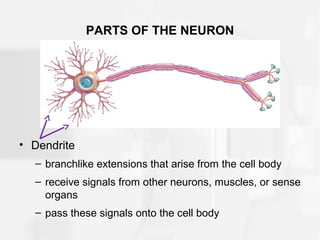
• Dendrite
– branchlike extensions that arise from the cell body
– receive signals from other neurons, muscles, or sense
organs
– pass these signals onto the cell body
PARTS OF THE NEURON
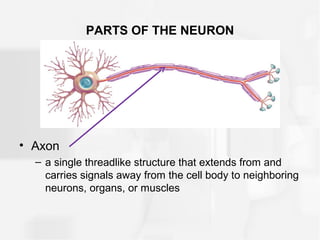
• Axon
– a single threadlike structure that extends from and
carries signals away from the cell body to neighboring
neurons, organs, or muscles
PARTS OF THE NEURON
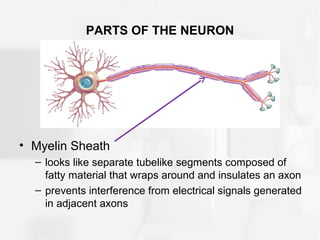
• Myelin Sheath
– looks like separate tubelike segments composed of
fatty material that wraps around and insulates an axon
– prevents interference from electrical signals generated
in adjacent axons
PARTS OF THE NEURON
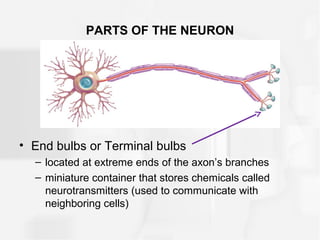
• End bulbs or Terminal bulbs
– located at extreme ends of the axon’s branches
– miniature container that stores chemicals called
neurotransmitters (used to communicate with
neighboring cells)
PARTS OF THE NEURON
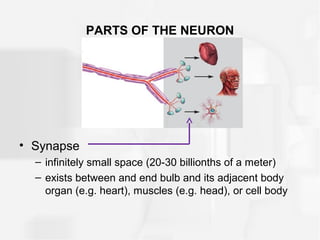
• Synapse
– infinitely small space (20-30 billionths of a meter)
– exists between and end bulb and its adjacent body
organ (e.g. heart), muscles (e.g. head), or cell body
ALZHEIMER’S DISEASE AND NEURONS
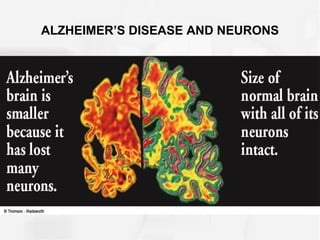
• Alzheimer’s disease
– excessive buildup of gluelike substances
– gradually destroy neurons
• Researchers recently discovered an experimental
vaccine that may help stop the buildup of these gluelike,
killer substances and they continue to search for other
interventions
ALZHEIMER’S DISEASE AND NEURONS
PERIPHERAL & CENTRAL NERVOUS SYSTEM
• Peripheral Nervous System (PNS)
– made up of nerves that are located throughout the
body, except in the brain & spinal cord
• Central Nervous System (CNS)
– made up of neurons located in the brain & spinal cord
PERIPHERAL & CENTRAL NERVOUS SYSTEM
(CONT.)
• Nerves
– stringlike bundles of axons and dendrites that come
from the spinal cord and are held together by
connective tissue
– carry information from the senses, skin, muscles, and
the body’s organs to and from the spinal cord
– nerves in the peripheral nervous system have the
ability to grow or reattach if severed or damaged
SENDING INFORMATION:
ACTION POTENTIAL SEQUENCE
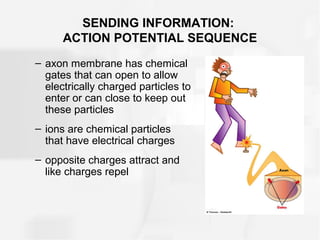
– axon membrane has chemical
gates that can open to allow
electrically charged particles to
enter or can close to keep out
these particles
– ions are chemical particles
that have electrical charges
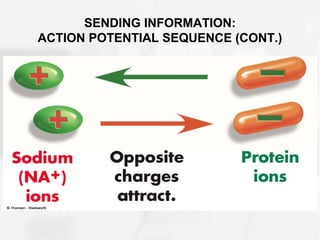
– opposite charges attract and
like charges repel
SENDING INFORMATION:
ACTION POTENTIAL SEQUENCE (CONT.)
SENDING INFORMATION:
ACTION POTENTIAL SEQUENCE (CONT.)
• Resting state
– the axon has a charge
– the charge results from the axon membrane
separating positive ions on the outside from negative
ions on the inside
SENDING INFORMATION:
ACTION POTENTIAL SEQUENCE (CONT.)
• Action potential
– tiny electric current that is generated when the
positive sodium ions rush inside the axon
– enormous increase of sodium ions inside the axon
causes the inside of the axon to reverse its charge
– inside becomes positive and outside becomes
negative
SENDING INFORMATION:
ACTION POTENTIAL SEQUENCE (CONT.)
SENDING INFORMATION:
NERVE IMPULSE
• Sending information
– action potential is a tiny electrical current that is
generated when the positive sodium ions rush inside
the axon
– the enormous increase of Na ions inside the axon
causes the inside to reverse its charge
– the inside becomes positive & the outside becomes
negative
SENDING INFORMATION:
NERVE IMPULSE (CONT.)
• All-or-None law
– if an action potential starts at the beginning of the
axon, the action potential will continue at the same
speed segment to segment to the very end of the
axon
• Nerve impulse
– nerve impulse is made up of 6 action potentials, with
the first occurring at the beginning of the axon
TRANSMITTERS
• A transmitter is a chemical messenger that transmits
information between nerves and body organs, such as
muscles and heart
• Excitatory and Inhibitory
– excitatory transmitters
• open chemical locks and turn on neurons
– inhibitory transmitters
• block chemical locks and turn off neurons
NEUROTRANSMITTER
• Neurotransmitters
– dozens of different chemicals that are made by
neurons and then used for communication between
neurons during the performance of mental or physical
activities
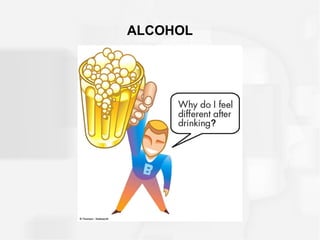
ALCOHOL
• Alcohol (ethyl alcohol)
– A psychoactive drug that is classified as a
depressant, which means that it depresses the
activity of the central nervous system
ALCOHOL
WHAT DOES ALCOHOL DO?
• Alcohol affects the brain by imitating a naturally
occurring neurotransmitter, GABA
• GABA Neurons
– GABA neurons have chemical locks that can be
opened by chemical keys in the form of the
neurotransmitter GABA
• GABA Keys
– alcohol molecules so closely resemble those of the
GABA neurotransmitter that alcohol can function like
GABA keys and open GABA receptors
– when GABA neurons are excited, they decrease
neural activity
WHAT DOES ALCOHOL DO? (CONT.)
• many people drink alcohol to feel less anxious and more
relaxed
• appears to be a biological link between alcohol and
anxiety
• deficiency in a specific brain protein is associated with
high anxiety and excessive alcohol use
NEW TRANSMITTERS
• Number of well-known neurotransmitters, such as
– Acetylcholine
– GABA
– Norepinephrine
– Epinephrine
– Dopamine
– Serotonin
NEW TRANSMITTERS (CONT.)
• New
– Endorphins (1970’s)
• painkiller similar to morphine
• decreases effects of pain during great bodily stress
– Anandamide (1990’s)
• similar to THC (active ingredient in marijuana)
– involved with
» memory
» motorcoordination
» emotions
NEW TRANSMITTERS (CONT.)
• Anandamide may help people regulate emotions, which
would help them to better deal with anxiety and stress
– Nitric oxide (mid-1990’s)
• may be involved in regulating aggressive and
impulsive behaviors
REFLEX
• Reflex
– unlearned, involuntary reaction to some stimulus
– neural connections underlying a reflex are prewired
by genetic instructions
REFLEX (CONT.)
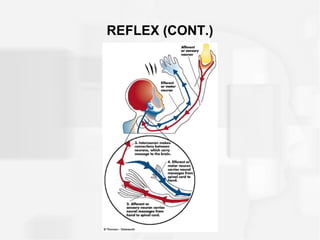
• Reflex sequence
– sensors
• sensors trigger neurons that start the withdrawal
effect
– afferent neurons
• carry information from the senses to the spinal
cord
REFLEX (CONT.)
– Interneuron
• relatively short neuron whose primary task
is making connections between other
neurons
– Efferent neuron
• carry information away from the spinal cord
to produce responses in various muscles
and organs throughout the body
REFLEX (CONT.)
PARKINSON’S DISEASE
• Parkinson’s Disease
– includes symptoms of tremors and shakes in the
limbs, a slowing of voluntary movements, muscle
stiffness, problems with balance and coordination and
feelings of depression
– as the disease progresses, patients develop a
shuffling walk and may suddenly freeze in space for
minutes or hours at a time
– Michael J. Fox
PARKINSON’S DISEASE (CONT.)
• Parkinson’s Disease
– it is caused by destruction of neurons that produce
dopamine
– L-dopa is a medication that boosts the levels of
dopamine in the brain
– eventually the drug causes involuntary jerky
movements
– after prolonged use, L-dopa’s beneficial effect may be
replaced by unwanted jerky movements
EXPERIMENTAL TREATMENTS
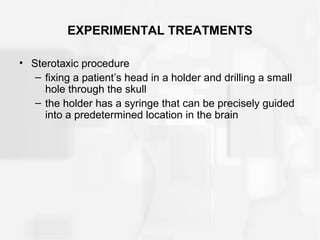
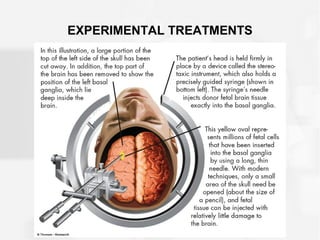
• Sterotaxic procedure
– fixing a patient’s head in a holder and drilling a small
hole through the skull
– the holder has a syringe that can be precisely guided
into a predetermined location in the brain
EXPERIMENTAL TREATMENTS
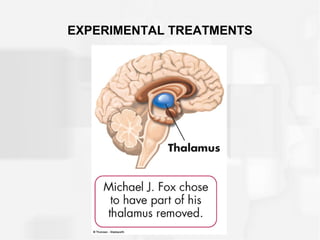
• Removing part of the brain
– Thalamotomy (Michael J. Fox)
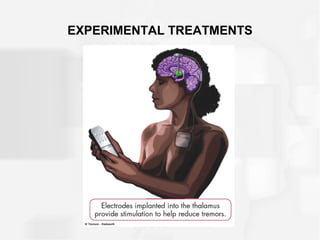
• Brain Stimulation
– electrodes placed into thalamus
– patient controls amount of stimulus
– helps reduce tremors
EXPERIMENTAL TREATMENTS

Module 03

  • 1.
    Module 3Module 3 Brain’sBuilding BlocksBrain’s Building Blocks
  • 2.
    DEVELOPMENT OF THEBRAIN • fact that your brain does not develop into a nose is because of instructions contained in your genes • Genes – chains of chemicals that are arranged like rungs on a twisting ladder – there are about 20,000-25,000 genes that contain chemical instructions that equal about 300,000 pages of written instructions – genes program the development of individual parts into a complex body & brain
  • 3.
    DEVELOPMENT OF THEBRAIN (CONT.)
  • 4.
    DEVELOPMENT OF THEBRAIN (CONT.)
  • 5.
    STRUCTURE OF THEBRAIN • Human brain: – is shaped like a small wrinkled melon – 1,350 grams (less than 3 pounds) – pinkish-white color – consistency of firm Jell-O – Fueled by sugar (glucose) – 1 trillion cells divided into • glial cells • neurons
  • 6.
    STRUCTURE OF THEBRAIN (CONT.)
  • 7.
    STRUCTURE OF THEBRAIN (CONT.) • Glial cells • 3 Functions: – guide the growth of developing neurons – wrap around neurons and form an insulation to prevent interference from other electrical signals – release chemicals that influence a neuron’s growth and function
  • 8.
    STRUCTURE OF THEBRAIN (CONT.) • Neuron – a brain cell with 2 specialized extensions – one extension is for receiving electrical signals – the other extension is for transmitting electrical signals
  • 9.
    GROWTH OF NEWNEURONS • Can a brain grow new neurons? – canary brain • can grow about 20,000 neurons a day during the spring (learns new breeding song) – primate and human brain • researchers conclude that adult monkey and human brains are capable of growing relatively limited numbers of neurons throughout adulthood • Some new neurons play important role in continuing to learn and remember new things (hippocampus)
  • 10.
    GROWTH OF NEWNEURONS (CONT.) • Repairing the Brain – advances in stem research suggest the human brain may be able to grow more neurons – repair damages: • accident • disease • Alzheimer’s
  • 11.
  • 12.
    PARTS OF THENEURON • Cell Body – large egg-shaped structure that provides fuel, manufactures chemicals, and maintains the entire neuron in working order
  • 13.
    PARTS OF THENEURON • Dendrite – branchlike extensions that arise from the cell body – receive signals from other neurons, muscles, or sense organs – pass these signals onto the cell body
  • 14.
    PARTS OF THENEURON • Axon – a single threadlike structure that extends from and carries signals away from the cell body to neighboring neurons, organs, or muscles
  • 15.
    PARTS OF THENEURON • Myelin Sheath – looks like separate tubelike segments composed of fatty material that wraps around and insulates an axon – prevents interference from electrical signals generated in adjacent axons
  • 16.
    PARTS OF THENEURON • End bulbs or Terminal bulbs – located at extreme ends of the axon’s branches – miniature container that stores chemicals called neurotransmitters (used to communicate with neighboring cells)
  • 17.
    PARTS OF THENEURON • Synapse – infinitely small space (20-30 billionths of a meter) – exists between and end bulb and its adjacent body organ (e.g. heart), muscles (e.g. head), or cell body
  • 18.
    ALZHEIMER’S DISEASE ANDNEURONS • Alzheimer’s disease – excessive buildup of gluelike substances – gradually destroy neurons • Researchers recently discovered an experimental vaccine that may help stop the buildup of these gluelike, killer substances and they continue to search for other interventions
  • 19.
  • 20.
    PERIPHERAL & CENTRALNERVOUS SYSTEM • Peripheral Nervous System (PNS) – made up of nerves that are located throughout the body, except in the brain & spinal cord • Central Nervous System (CNS) – made up of neurons located in the brain & spinal cord
  • 21.
    PERIPHERAL & CENTRALNERVOUS SYSTEM (CONT.) • Nerves – stringlike bundles of axons and dendrites that come from the spinal cord and are held together by connective tissue – carry information from the senses, skin, muscles, and the body’s organs to and from the spinal cord – nerves in the peripheral nervous system have the ability to grow or reattach if severed or damaged
  • 22.
    SENDING INFORMATION: ACTION POTENTIALSEQUENCE – axon membrane has chemical gates that can open to allow electrically charged particles to enter or can close to keep out these particles – ions are chemical particles that have electrical charges – opposite charges attract and like charges repel
  • 23.
  • 24.
    SENDING INFORMATION: ACTION POTENTIALSEQUENCE (CONT.) • Resting state – the axon has a charge – the charge results from the axon membrane separating positive ions on the outside from negative ions on the inside
  • 25.
    SENDING INFORMATION: ACTION POTENTIALSEQUENCE (CONT.) • Action potential – tiny electric current that is generated when the positive sodium ions rush inside the axon – enormous increase of sodium ions inside the axon causes the inside of the axon to reverse its charge – inside becomes positive and outside becomes negative
  • 26.
  • 27.
    SENDING INFORMATION: NERVE IMPULSE •Sending information – action potential is a tiny electrical current that is generated when the positive sodium ions rush inside the axon – the enormous increase of Na ions inside the axon causes the inside to reverse its charge – the inside becomes positive & the outside becomes negative
  • 28.
    SENDING INFORMATION: NERVE IMPULSE(CONT.) • All-or-None law – if an action potential starts at the beginning of the axon, the action potential will continue at the same speed segment to segment to the very end of the axon • Nerve impulse – nerve impulse is made up of 6 action potentials, with the first occurring at the beginning of the axon
  • 29.
    TRANSMITTERS • A transmitteris a chemical messenger that transmits information between nerves and body organs, such as muscles and heart • Excitatory and Inhibitory – excitatory transmitters • open chemical locks and turn on neurons – inhibitory transmitters • block chemical locks and turn off neurons
  • 30.
    NEUROTRANSMITTER • Neurotransmitters – dozensof different chemicals that are made by neurons and then used for communication between neurons during the performance of mental or physical activities
  • 31.
    ALCOHOL • Alcohol (ethylalcohol) – A psychoactive drug that is classified as a depressant, which means that it depresses the activity of the central nervous system
  • 32.
  • 33.
    WHAT DOES ALCOHOLDO? • Alcohol affects the brain by imitating a naturally occurring neurotransmitter, GABA • GABA Neurons – GABA neurons have chemical locks that can be opened by chemical keys in the form of the neurotransmitter GABA • GABA Keys – alcohol molecules so closely resemble those of the GABA neurotransmitter that alcohol can function like GABA keys and open GABA receptors – when GABA neurons are excited, they decrease neural activity
  • 34.
    WHAT DOES ALCOHOLDO? (CONT.) • many people drink alcohol to feel less anxious and more relaxed • appears to be a biological link between alcohol and anxiety • deficiency in a specific brain protein is associated with high anxiety and excessive alcohol use
  • 35.
    NEW TRANSMITTERS • Numberof well-known neurotransmitters, such as – Acetylcholine – GABA – Norepinephrine – Epinephrine – Dopamine – Serotonin
  • 36.
    NEW TRANSMITTERS (CONT.) •New – Endorphins (1970’s) • painkiller similar to morphine • decreases effects of pain during great bodily stress – Anandamide (1990’s) • similar to THC (active ingredient in marijuana) – involved with » memory » motorcoordination » emotions
  • 37.
    NEW TRANSMITTERS (CONT.) •Anandamide may help people regulate emotions, which would help them to better deal with anxiety and stress – Nitric oxide (mid-1990’s) • may be involved in regulating aggressive and impulsive behaviors
  • 38.
    REFLEX • Reflex – unlearned,involuntary reaction to some stimulus – neural connections underlying a reflex are prewired by genetic instructions
  • 39.
    REFLEX (CONT.) • Reflexsequence – sensors • sensors trigger neurons that start the withdrawal effect – afferent neurons • carry information from the senses to the spinal cord
  • 40.
    REFLEX (CONT.) – Interneuron •relatively short neuron whose primary task is making connections between other neurons – Efferent neuron • carry information away from the spinal cord to produce responses in various muscles and organs throughout the body
  • 41.
  • 42.
    PARKINSON’S DISEASE • Parkinson’sDisease – includes symptoms of tremors and shakes in the limbs, a slowing of voluntary movements, muscle stiffness, problems with balance and coordination and feelings of depression – as the disease progresses, patients develop a shuffling walk and may suddenly freeze in space for minutes or hours at a time – Michael J. Fox
  • 43.
    PARKINSON’S DISEASE (CONT.) •Parkinson’s Disease – it is caused by destruction of neurons that produce dopamine – L-dopa is a medication that boosts the levels of dopamine in the brain – eventually the drug causes involuntary jerky movements – after prolonged use, L-dopa’s beneficial effect may be replaced by unwanted jerky movements
  • 44.
    EXPERIMENTAL TREATMENTS • Sterotaxicprocedure – fixing a patient’s head in a holder and drilling a small hole through the skull – the holder has a syringe that can be precisely guided into a predetermined location in the brain
  • 45.
  • 46.
  • 47.
    EXPERIMENTAL TREATMENTS • Removingpart of the brain – Thalamotomy (Michael J. Fox) • Brain Stimulation – electrodes placed into thalamus – patient controls amount of stimulus – helps reduce tremors
  • 48.