International Research Journal of Engineering and Technology (IRJET) e-ISSN: 2395-0056
Volume: 09 Issue: 06 | June 2022 www.irjet.net p-ISSN: 2395-0072
© 2022, IRJET | Impact Factor value: 7.529 | ISO 9001:2008 Certified Journal | Page 986
MODIFIED CARRY SELECT ADDER WITH BKA AND MGDI TECHNIQUE
Aiswarya Rose Mathew1, Anchana Babu2, Milna M S3, Er. Ashly John4
1-3Students, Dept. of Electrical Engineering, Saintgits College of Engineering, Kerala, India
4Asst. professor, Saintgits College of Engineering, Kerala, India
---------------------------------------------------------------------***---------------------------------------------------------------------
Abstract -In the area of VLSI design, summing circuits
are one of the most widely used entities in processor data
path architecture. Therefore, the performance of a
processor is greatly influenced by the action of the resident
adders. With the advances in VLSI technology, research
works are emerging on designing architecture with low
power consumption, high speed, less area, or a combination
of them. The thing is no existing adders can fulfill all these 3
criteria. Here we are implementing a modified carry select
adder with Brent Kung adder using the modified gate
diffusion input technique. A carry select adder consists of
multiple pairs of Ripple carry adders which give it the most
complex design and longer computation time and thus the
performance of the CSA will dropdown. Hence, we replaced
RCA with BKA which is a parallel prefix adder that has the
best performance till now. So,with this replacement, the
performance of the CSA gets improved but the area
consumption and the power consumption will be increased.
For that, we are using the MGDI technology. MGDI is the
latest technique that reduces the number of transistors and
thereby the area and power consumption. Therefore, all
three criteria are satisfied in this modified CSA adder.
Key Words:CSA, BKA, MGDI, Parallel prefix adder,
Area, Power, Delay
1. INTRODUCTION
Adders are the fundamental building blocks of digital
circuit design. Adders are the elementary blocks in various
data processors, so if the adder is an inefficient one then it
will affect the overall performance of the processor.
Hence, the adder must be efficient and good in
performance. The three major parameters that affect the
performance of an adder are area, delay, and power. No
existing adders satisfy all these 3 criteria. Conventional
adders such as RCA, CLA, CSA, etc. are not much efficient to
meet the requirements of the new technology. Therefore,
in current technology, the parallel prefix adders are the
fastest adders with better performance. Even though chip
area and power consumption are less, high-speed addition
of large numbers is possible. Primitive carry select adder
consists of multiple pairs of RCAs which gives it a more
complex design and longer computation time, this makes
the CSA low in performance. Here we replace these RCAs
with BKAs which is a parallel prefix adder. To make the
adder area-efficient we introduce MGDI technology, which
effectively reduces the number of transistors.
1.1 Preliminary background
Parallel prefix adders are one of the most high-
performance adders with less design complexity. In a
parallel prefix adder, the computation of carry occurs
simultaneously. This parallel computation of carries
makes it fastest in its performance. There are three main
stages for the computation. They are the pre-processing
stage, carry generation stage, and post-processing stage.
In preprocessing, the computation of generate and
propagate signals of corresponding pairs of inputs occurs.
The equations of generate and propagate signals are given
below:
pi = ai ⊕ bi (1)
gi = ai . bi (2)
The carry generation stage includes the computation of
carries corresponding to each pairs of input bits. The
equation for carry generation is as follows:
pi : j = pi : k . pk-1 : j (3)
gi : j = gi : k + (pi : k . gk - 1 : j) (4)
The post-processing stage includes the computation of
the final sum bits. The equation for the post-processing
stage is as follows:
si = pi ⊕ ci-1 (5)
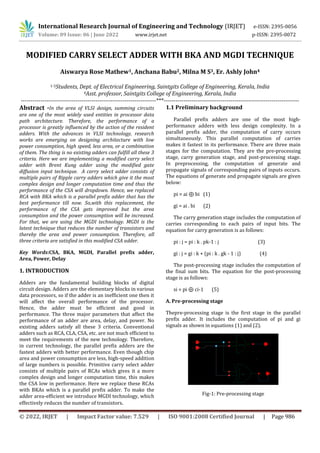
A. Pre-processing stage
Thepre-processing stage is the first stage in the parallel
prefix adder. It includes the computation of pi and gi
signals as shown in equations (1) and (2).
Fig-1: Pre-processing stage
International Research Journal of Engineering and Technology (IRJET) e-ISSN: 2395-0056
Volume: 09 Issue: 06 | June 2022 www.irjet.net p-ISSN: 2395-0072
© 2022, IRJET | Impact Factor value: 7.529 | ISO 9001:2008 Certified Journal | Page 987
B. Carry generation stage
In this stage, carry computation occurs. The carry signal
generated from one stage will proceed to the next stage
and this process continues for all other stages. The
equation for the computation is shown in equations (3)
and (4).
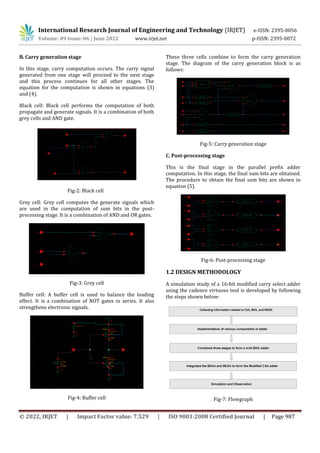
Black cell: Black cell performs the computation of both
propagate and generate signals. It is a combination of both
grey cells and AND gate.
Grey cell: Grey cell computes the generate signals which
are used in the computation of sum bits in the post-
processing stage. It is a combination of AND and OR gates.
Fig-3: Grey cell
Buffer cell: A buffer cell is used to balance the loading
effect. It is a combination of NOT gates in series. It also
strengthens electronic signals.
Fig-4: Buffer cell
These three cells combine to form the carry generation
stage. The diagram of the carry generation block is as
follows:
Fig-5: Carry generation stage
C. Post-processing stage
This is the final stage in the parallel prefix adder
computation. In this stage, the final sum bits are obtained.
The procedure to obtain the final sum bits are shown in
equation (5).
Fig-6: Post-processing stage
1.2 DESIGN METHODOLOGY
A simulation study of a 16-bit modified carry select adder
using the cadence virtuoso tool is developed by following
the steps shown below:
Fig-7: Flowgraph
Fig-2: Black cell
International Research Journal of Engineering and Technology (IRJET) e-ISSN: 2395-0056
Volume: 09 Issue: 06 | June 2022 www.irjet.net p-ISSN: 2395-0072
© 2022, IRJET | Impact Factor value: 7.529 | ISO 9001:2008 Certified Journal | Page 988
A. Basic logic gates
The basic logic gates are the fundamental building blocks
of any digital circuit. There are seven basic logic gates
among all of them we use the three logic gates such as
AND, OR, and XOR. All these gates are implemented using
the MGDI technique which in turn reduces the number of
transistors in each gate. Hence, the area consumed by each
gate will be less than the CMOS logic.
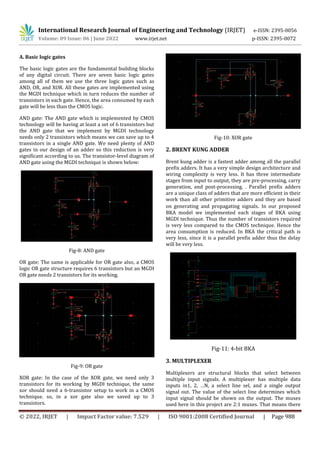
AND gate: The AND gate which is implemented by CMOS
technology will be having at least a set of 6 transistors but
the AND gate that we implement by MGDI technology
needs only 2 transistors which means we can save up to 4
transistors in a single AND gate. We need plenty of AND
gates in our design of an adder so this reduction is very
significant according to us. The transistor-level diagram of
AND gate using the MGDI technique is shown below:
Fig-8: AND gate
OR gate: The same is applicable for OR gate also, a CMOS
logic OR gate structure requires 6 transistors but an MGDI
OR gate needs 2 transistors for its working.
Fig-9: OR gate
XOR gate: In the case of the XOR gate, we need only 3
transistors for its working by MGDI technique, the same
xor should need a 6-transistor setup to work in a CMOS
technique. so, in a xor gate also we saved up to 3
transistors.
Fig-10: XOR gate
2. BRENT KUNG ADDER
Brent kung adder is a fastest adder among all the parallel
prefix adders. It has a very simple design architecture and
wiring complexity is very less. It has three intermediate
stages from input to output, they are pre-processing, carry
generation, and post-processing. . Parallel prefix adders
are a unique class of adders that are more efficient in their
work than all other primitive adders and they are based
on generating and propagating signals. In our proposed
BKA model we implemented each stages of BKA using
MGDI technique. Thus the number of transistors required
is very less compared to the CMOS technique. Hence the
area consumption is reduced. In BKA the critical path is
very less, since it is a parallel prefix adder thus the delay
will be very less.
Fig-11: 4-bit BKA
3. MULTIPLEXER
Multiplexers are structural blocks that select between
multiple input signals. A multiplexer has multiple data
inputs in1, 2, …N, a select line sel, and a single output
signal out. The value of the select line determines which
input signal should be shown on the output. The muxes
used here in this project are 2:1 muxes. That means there
International Research Journal of Engineering and Technology (IRJET) e-ISSN: 2395-0056
Volume: 09 Issue: 06 | June 2022 www.irjet.net p-ISSN: 2395-0072
© 2022, IRJET | Impact Factor value: 7.529 | ISO 9001:2008 Certified Journal | Page 989
will be two input signals to select between (in0 and in1)
and the select line will be a single bit. If the select line is 0,
then the output signal is in0. If the select line is 1, then the
output signal will be in1.In this project, we use the mux to
select the zero carry or one carry sum from the BKAs. Here
we use several pairs of muxes for this work. This is a very
significant step in the addition calculation of our modified
CSA. Mux will select the desired output from one of the
adders and will output it, which is the final sum output of
our modified CSA.
Fig-12: 2:1 Multiplexer
4. CARRY SELECT ADDER
Carry select adder is one of the oldest but still most
relevant basic adder. Its non linear dependency for the
calculation of the carry output makes it distinct and most
used principle in modern adders. CSA will calculate the
output for carry for all possible inputs ie; logic input 1 and
0. The calculation for possible input is done by using
adders. Multiplexer is used to select between the
generated possible outputs. Hence it is clear that CSA does
not have to wait to generate output, this makes this adder
one of the fastest adder.
5. PROPOSED ADDER
The modified carry select adder we implemented has
differences from the original carry select adder in 2 areas,
that are, RCAs are replaced with BKAs which are one of the
most high-performance adders existing. In carry select
adder always 2-bit RCAs are used but here we efficiently
used 4-bit BKAs. The second difference is in the usage of
multiplexers, multiplexers are placed in a different way in
the implementation. Carry Select Adder uses a pair of
Ripple Carry Adders (RCA) for Cin=0 and for Cin=l but as
we know the performance of RCAs is not that excellent
and RCAs create a much large delay for higher bit
calculations, so in this project, we replace these RCAs with
BKAs which is one of the most efficient and fastest parallel
prefix adders existing. But as we know by replacing RCAs
with BKAs we can only satisfy the performance need of
our new adder, our strategy is to form a new adder with
excellent power, performance, and area consumption. So,
we have to minimize the area consumption for that here
we use the MGDI technology or the modified gate diffusion
input technology. This technology is all about the
reduction of the number of transistors from the gate level.
By using just 2 transistors we can build each of the gates
which helps us in a great area reduction. So, by such a
reduction in the number of transistors, the power
consumption will also be significantly reduced and thus
we satisfied all the three factors for an efficient adder.
Fig 5.1. Modified Carry Select Adder
6. RESULT AND DISCUSSION
Conventional Carry Select Adder consists of ripple carry
adder. Brent Kung adder has reduced delay as compare to
ripple carry adder. We use tree structure from in Brent
Kung adder to increases the speed of arithmetic operation.
The project performs in EDA Tool, Cadence Virtuoso. One
of the three parameters, Area is also calculated in this tool.
The graphical representation of comparison of area in
conventional CMOS logic and by using MGDI technique is
shown in fig. 6.1
Fig 6.1: Comparison of area between CMOS and MGDI
technique in Cadence Virtuoso tool
0
500
1000
1500
CMOSMGDI
AREA
International Research Journal of Engineering and Technology (IRJET) e-ISSN: 2395-0056
Volume: 09 Issue: 06 | June 2022 www.irjet.net p-ISSN: 2395-0072
© 2022, IRJET | Impact Factor value: 7.529 | ISO 9001:2008 Certified Journal | Page 990
The result analysis shows that MGDI technique shows
better results than the conventional CMOS logic in terms
of area.
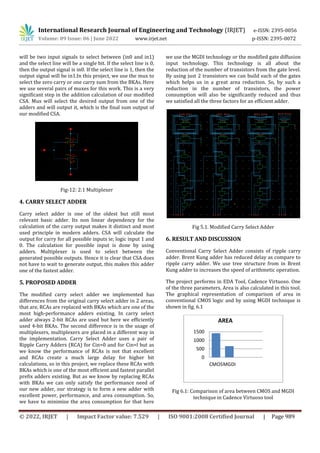
Power and delay is other design parameter. Power
consumption and delay of this circuit is calculated in
Cadence Virtuoso. . The graphical representation of
comparison of power consumption and delay in
conventional CSA and CSA with BKA is shown in fig 6.2.
The result analysis shows that CSA with BKA shows better
results than the conventional CSA in terms of Power
consumption and delay.
Fig 6.2: Comparison of power between CSA and modified
CSA in Cadence Virtuoso tool
Fig 6.3: Comparison of delay between CSA and modified
CSA in Cadence Virtuoso tool
6. CONCLUSIONS
IC design has always sought the best possible performance
on IC development in terms of speed, power consumption,
and area. This study paper found that incorporating the
MGDI technique in any design can reduce the area of the
circuit to a most satisfying extent. This work may also be
expanded to a larger number of bits. With the advent of
parallel prefix adder, the latency and power consumption
of various adder designs are lowered. Brent Kung adder is
chosen because parallel prefix adders produce quick
results. When compared to conventional CSA adder
architectures, the calculated results show that BKA Carry
Select Adder is better in terms of power consumption and
high speed, and can be used in various adder applications
such as multipliers, to execute different Digital Signal
Processing algorithms such as Finite Impulse Response,
Infinite Impulse Response, and so on.
REFERENCES
[1] Anas Zainal Abidin, Syed Abdul Mutalib Al Junid,
Khairul KhaiziMohd Sharif, Zulkifli Othman,
Muhammad AdibHaron “4-bit Brent Kung Parallel
Prefix Adder Simulation Study Using Silvaco EDA
Tools” DOI 10.5013/IJSSST
[2] Pappu P. Potdukhe, Vishal D. Jaiswal “Design of High
Speed Carry Select Adder Using Brent Kung Adder”
International Conference on Electrical, Electronics,
and Optimization Techniques (ICEEOT) – 2016
[3] G Tejaswini , V Jagannaveen , J V suman “Design of low
power ful adder using MGDI logic” European Journal
of Molecular & Clinical Medicine, ISSN 2515-8260
Volume 7, Issue 4, 2020
[4] Mr. Deepak Raj, Mrs. Sahana K Adyanthaya , Prof.
Praveen J, Prof. Raghavengra Rao R “Design and
Implementation of different types of efficient paral el
prefix adders” International Journal Of Innovative
Research In Electrical, Electronics, Instrumentation
And Control Engineering And National Conference on
advanced innovation in engineering and technology
(ncaiet-2015) alva’s institute of engineering and
technology, moodbidri vol. 3,special issue 1,april 2015
[5] P.B Natarajan, Samit Kumar Ghosh and R. Karthik “An
efficient carry select adder ” International Conference
on Electronics, Communication & Aerospace
Technology ICECA 2017
[6] Er. Aradhana Raju, Richi Patnaik, Ritto Kurian Babu,
PurabiMahato “Paral el Prefix Adders- A Comparative
Study For Fastest Response” 2016 International
Conference on Communication and Electronics
Systems, DOI: 10.1109/CESYS.2016.
[7] Basavoju Harish, Dr.K.Sivani, Dr.M.S.S.Rukmini
“Design and Performance Comparison among Various
types of Adder Topologies” Third International
Conference on Computing Methodologies and
Communication (ICCMC 2019)
25
17.83
CSA MODIFIED
CSA
POWER ( n watts)
4.584
3.73
CSA MODIFIED
CSA
DELAY (in µs )

MODIFIED CARRY SELECT ADDER WITH BKA AND MGDI TECHNIQUE

  • 1.
    International Research Journalof Engineering and Technology (IRJET) e-ISSN: 2395-0056 Volume: 09 Issue: 06 | June 2022 www.irjet.net p-ISSN: 2395-0072 © 2022, IRJET | Impact Factor value: 7.529 | ISO 9001:2008 Certified Journal | Page 986 MODIFIED CARRY SELECT ADDER WITH BKA AND MGDI TECHNIQUE Aiswarya Rose Mathew1, Anchana Babu2, Milna M S3, Er. Ashly John4 1-3Students, Dept. of Electrical Engineering, Saintgits College of Engineering, Kerala, India 4Asst. professor, Saintgits College of Engineering, Kerala, India ---------------------------------------------------------------------***--------------------------------------------------------------------- Abstract -In the area of VLSI design, summing circuits are one of the most widely used entities in processor data path architecture. Therefore, the performance of a processor is greatly influenced by the action of the resident adders. With the advances in VLSI technology, research works are emerging on designing architecture with low power consumption, high speed, less area, or a combination of them. The thing is no existing adders can fulfill all these 3 criteria. Here we are implementing a modified carry select adder with Brent Kung adder using the modified gate diffusion input technique. A carry select adder consists of multiple pairs of Ripple carry adders which give it the most complex design and longer computation time and thus the performance of the CSA will dropdown. Hence, we replaced RCA with BKA which is a parallel prefix adder that has the best performance till now. So,with this replacement, the performance of the CSA gets improved but the area consumption and the power consumption will be increased. For that, we are using the MGDI technology. MGDI is the latest technique that reduces the number of transistors and thereby the area and power consumption. Therefore, all three criteria are satisfied in this modified CSA adder. Key Words:CSA, BKA, MGDI, Parallel prefix adder, Area, Power, Delay 1. INTRODUCTION Adders are the fundamental building blocks of digital circuit design. Adders are the elementary blocks in various data processors, so if the adder is an inefficient one then it will affect the overall performance of the processor. Hence, the adder must be efficient and good in performance. The three major parameters that affect the performance of an adder are area, delay, and power. No existing adders satisfy all these 3 criteria. Conventional adders such as RCA, CLA, CSA, etc. are not much efficient to meet the requirements of the new technology. Therefore, in current technology, the parallel prefix adders are the fastest adders with better performance. Even though chip area and power consumption are less, high-speed addition of large numbers is possible. Primitive carry select adder consists of multiple pairs of RCAs which gives it a more complex design and longer computation time, this makes the CSA low in performance. Here we replace these RCAs with BKAs which is a parallel prefix adder. To make the adder area-efficient we introduce MGDI technology, which effectively reduces the number of transistors. 1.1 Preliminary background Parallel prefix adders are one of the most high- performance adders with less design complexity. In a parallel prefix adder, the computation of carry occurs simultaneously. This parallel computation of carries makes it fastest in its performance. There are three main stages for the computation. They are the pre-processing stage, carry generation stage, and post-processing stage. In preprocessing, the computation of generate and propagate signals of corresponding pairs of inputs occurs. The equations of generate and propagate signals are given below: pi = ai ⊕ bi (1) gi = ai . bi (2) The carry generation stage includes the computation of carries corresponding to each pairs of input bits. The equation for carry generation is as follows: pi : j = pi : k . pk-1 : j (3) gi : j = gi : k + (pi : k . gk - 1 : j) (4) The post-processing stage includes the computation of the final sum bits. The equation for the post-processing stage is as follows: si = pi ⊕ ci-1 (5) A. Pre-processing stage Thepre-processing stage is the first stage in the parallel prefix adder. It includes the computation of pi and gi signals as shown in equations (1) and (2). Fig-1: Pre-processing stage
  • 2.
    International Research Journalof Engineering and Technology (IRJET) e-ISSN: 2395-0056 Volume: 09 Issue: 06 | June 2022 www.irjet.net p-ISSN: 2395-0072 © 2022, IRJET | Impact Factor value: 7.529 | ISO 9001:2008 Certified Journal | Page 987 B. Carry generation stage In this stage, carry computation occurs. The carry signal generated from one stage will proceed to the next stage and this process continues for all other stages. The equation for the computation is shown in equations (3) and (4). Black cell: Black cell performs the computation of both propagate and generate signals. It is a combination of both grey cells and AND gate. Grey cell: Grey cell computes the generate signals which are used in the computation of sum bits in the post- processing stage. It is a combination of AND and OR gates. Fig-3: Grey cell Buffer cell: A buffer cell is used to balance the loading effect. It is a combination of NOT gates in series. It also strengthens electronic signals. Fig-4: Buffer cell These three cells combine to form the carry generation stage. The diagram of the carry generation block is as follows: Fig-5: Carry generation stage C. Post-processing stage This is the final stage in the parallel prefix adder computation. In this stage, the final sum bits are obtained. The procedure to obtain the final sum bits are shown in equation (5). Fig-6: Post-processing stage 1.2 DESIGN METHODOLOGY A simulation study of a 16-bit modified carry select adder using the cadence virtuoso tool is developed by following the steps shown below: Fig-7: Flowgraph Fig-2: Black cell
  • 3.
    International Research Journalof Engineering and Technology (IRJET) e-ISSN: 2395-0056 Volume: 09 Issue: 06 | June 2022 www.irjet.net p-ISSN: 2395-0072 © 2022, IRJET | Impact Factor value: 7.529 | ISO 9001:2008 Certified Journal | Page 988 A. Basic logic gates The basic logic gates are the fundamental building blocks of any digital circuit. There are seven basic logic gates among all of them we use the three logic gates such as AND, OR, and XOR. All these gates are implemented using the MGDI technique which in turn reduces the number of transistors in each gate. Hence, the area consumed by each gate will be less than the CMOS logic. AND gate: The AND gate which is implemented by CMOS technology will be having at least a set of 6 transistors but the AND gate that we implement by MGDI technology needs only 2 transistors which means we can save up to 4 transistors in a single AND gate. We need plenty of AND gates in our design of an adder so this reduction is very significant according to us. The transistor-level diagram of AND gate using the MGDI technique is shown below: Fig-8: AND gate OR gate: The same is applicable for OR gate also, a CMOS logic OR gate structure requires 6 transistors but an MGDI OR gate needs 2 transistors for its working. Fig-9: OR gate XOR gate: In the case of the XOR gate, we need only 3 transistors for its working by MGDI technique, the same xor should need a 6-transistor setup to work in a CMOS technique. so, in a xor gate also we saved up to 3 transistors. Fig-10: XOR gate 2. BRENT KUNG ADDER Brent kung adder is a fastest adder among all the parallel prefix adders. It has a very simple design architecture and wiring complexity is very less. It has three intermediate stages from input to output, they are pre-processing, carry generation, and post-processing. . Parallel prefix adders are a unique class of adders that are more efficient in their work than all other primitive adders and they are based on generating and propagating signals. In our proposed BKA model we implemented each stages of BKA using MGDI technique. Thus the number of transistors required is very less compared to the CMOS technique. Hence the area consumption is reduced. In BKA the critical path is very less, since it is a parallel prefix adder thus the delay will be very less. Fig-11: 4-bit BKA 3. MULTIPLEXER Multiplexers are structural blocks that select between multiple input signals. A multiplexer has multiple data inputs in1, 2, …N, a select line sel, and a single output signal out. The value of the select line determines which input signal should be shown on the output. The muxes used here in this project are 2:1 muxes. That means there
  • 4.
    International Research Journalof Engineering and Technology (IRJET) e-ISSN: 2395-0056 Volume: 09 Issue: 06 | June 2022 www.irjet.net p-ISSN: 2395-0072 © 2022, IRJET | Impact Factor value: 7.529 | ISO 9001:2008 Certified Journal | Page 989 will be two input signals to select between (in0 and in1) and the select line will be a single bit. If the select line is 0, then the output signal is in0. If the select line is 1, then the output signal will be in1.In this project, we use the mux to select the zero carry or one carry sum from the BKAs. Here we use several pairs of muxes for this work. This is a very significant step in the addition calculation of our modified CSA. Mux will select the desired output from one of the adders and will output it, which is the final sum output of our modified CSA. Fig-12: 2:1 Multiplexer 4. CARRY SELECT ADDER Carry select adder is one of the oldest but still most relevant basic adder. Its non linear dependency for the calculation of the carry output makes it distinct and most used principle in modern adders. CSA will calculate the output for carry for all possible inputs ie; logic input 1 and 0. The calculation for possible input is done by using adders. Multiplexer is used to select between the generated possible outputs. Hence it is clear that CSA does not have to wait to generate output, this makes this adder one of the fastest adder. 5. PROPOSED ADDER The modified carry select adder we implemented has differences from the original carry select adder in 2 areas, that are, RCAs are replaced with BKAs which are one of the most high-performance adders existing. In carry select adder always 2-bit RCAs are used but here we efficiently used 4-bit BKAs. The second difference is in the usage of multiplexers, multiplexers are placed in a different way in the implementation. Carry Select Adder uses a pair of Ripple Carry Adders (RCA) for Cin=0 and for Cin=l but as we know the performance of RCAs is not that excellent and RCAs create a much large delay for higher bit calculations, so in this project, we replace these RCAs with BKAs which is one of the most efficient and fastest parallel prefix adders existing. But as we know by replacing RCAs with BKAs we can only satisfy the performance need of our new adder, our strategy is to form a new adder with excellent power, performance, and area consumption. So, we have to minimize the area consumption for that here we use the MGDI technology or the modified gate diffusion input technology. This technology is all about the reduction of the number of transistors from the gate level. By using just 2 transistors we can build each of the gates which helps us in a great area reduction. So, by such a reduction in the number of transistors, the power consumption will also be significantly reduced and thus we satisfied all the three factors for an efficient adder. Fig 5.1. Modified Carry Select Adder 6. RESULT AND DISCUSSION Conventional Carry Select Adder consists of ripple carry adder. Brent Kung adder has reduced delay as compare to ripple carry adder. We use tree structure from in Brent Kung adder to increases the speed of arithmetic operation. The project performs in EDA Tool, Cadence Virtuoso. One of the three parameters, Area is also calculated in this tool. The graphical representation of comparison of area in conventional CMOS logic and by using MGDI technique is shown in fig. 6.1 Fig 6.1: Comparison of area between CMOS and MGDI technique in Cadence Virtuoso tool 0 500 1000 1500 CMOSMGDI AREA
  • 5.
    International Research Journalof Engineering and Technology (IRJET) e-ISSN: 2395-0056 Volume: 09 Issue: 06 | June 2022 www.irjet.net p-ISSN: 2395-0072 © 2022, IRJET | Impact Factor value: 7.529 | ISO 9001:2008 Certified Journal | Page 990 The result analysis shows that MGDI technique shows better results than the conventional CMOS logic in terms of area. Power and delay is other design parameter. Power consumption and delay of this circuit is calculated in Cadence Virtuoso. . The graphical representation of comparison of power consumption and delay in conventional CSA and CSA with BKA is shown in fig 6.2. The result analysis shows that CSA with BKA shows better results than the conventional CSA in terms of Power consumption and delay. Fig 6.2: Comparison of power between CSA and modified CSA in Cadence Virtuoso tool Fig 6.3: Comparison of delay between CSA and modified CSA in Cadence Virtuoso tool 6. CONCLUSIONS IC design has always sought the best possible performance on IC development in terms of speed, power consumption, and area. This study paper found that incorporating the MGDI technique in any design can reduce the area of the circuit to a most satisfying extent. This work may also be expanded to a larger number of bits. With the advent of parallel prefix adder, the latency and power consumption of various adder designs are lowered. Brent Kung adder is chosen because parallel prefix adders produce quick results. When compared to conventional CSA adder architectures, the calculated results show that BKA Carry Select Adder is better in terms of power consumption and high speed, and can be used in various adder applications such as multipliers, to execute different Digital Signal Processing algorithms such as Finite Impulse Response, Infinite Impulse Response, and so on. REFERENCES [1] Anas Zainal Abidin, Syed Abdul Mutalib Al Junid, Khairul KhaiziMohd Sharif, Zulkifli Othman, Muhammad AdibHaron “4-bit Brent Kung Parallel Prefix Adder Simulation Study Using Silvaco EDA Tools” DOI 10.5013/IJSSST [2] Pappu P. Potdukhe, Vishal D. Jaiswal “Design of High Speed Carry Select Adder Using Brent Kung Adder” International Conference on Electrical, Electronics, and Optimization Techniques (ICEEOT) – 2016 [3] G Tejaswini , V Jagannaveen , J V suman “Design of low power ful adder using MGDI logic” European Journal of Molecular & Clinical Medicine, ISSN 2515-8260 Volume 7, Issue 4, 2020 [4] Mr. Deepak Raj, Mrs. Sahana K Adyanthaya , Prof. Praveen J, Prof. Raghavengra Rao R “Design and Implementation of different types of efficient paral el prefix adders” International Journal Of Innovative Research In Electrical, Electronics, Instrumentation And Control Engineering And National Conference on advanced innovation in engineering and technology (ncaiet-2015) alva’s institute of engineering and technology, moodbidri vol. 3,special issue 1,april 2015 [5] P.B Natarajan, Samit Kumar Ghosh and R. Karthik “An efficient carry select adder ” International Conference on Electronics, Communication & Aerospace Technology ICECA 2017 [6] Er. Aradhana Raju, Richi Patnaik, Ritto Kurian Babu, PurabiMahato “Paral el Prefix Adders- A Comparative Study For Fastest Response” 2016 International Conference on Communication and Electronics Systems, DOI: 10.1109/CESYS.2016. [7] Basavoju Harish, Dr.K.Sivani, Dr.M.S.S.Rukmini “Design and Performance Comparison among Various types of Adder Topologies” Third International Conference on Computing Methodologies and Communication (ICCMC 2019) 25 17.83 CSA MODIFIED CSA POWER ( n watts) 4.584 3.73 CSA MODIFIED CSA DELAY (in µs )