TRANSPORATION OPTIONS FOR A LOW-
        CARBON FUTURE
            Thomas Cheney
              ENSC 302
ZERO CARBON TRANSPORTATION IN B.C SOUTH
WEST
•   Currently several electric railways in
    Greater Vancouver
•   1 Tramway (used intermittently)
•   Large Trolleybus fleet in Vancouver 
    Burnaby
•   Hydrogen fleet at Whistler
•   Private electric cars
•   Electric Bikes
•   Plug in Hybrids


                                             http://www.nowpublic.com
TROLLEYBUSES
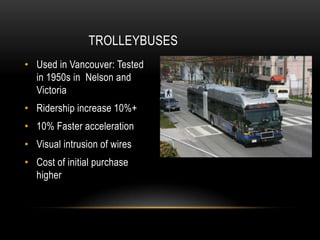
• Used in Vancouver: Tested
  in 1950s in Nelson and
  Victoria
• Ridership increase 10%+
• 10% Faster acceleration
• Visual intrusion of wires
• Cost of initial purchase
  higher
MORE TROLLEY BUSES
• 60% reduction in primary energy
  use
• Visible infrastructure, can anchor
  development like streetcar
• About $1-2 Million per one-way
  kilometer
• Can act as a low cost tram
  alternative
    • Quito, Ecuador

                                       T-bus
BUT WIRES ARE UGLY!
•   I don‟t think so
•   But Bombardier Primovecity uses
    inductive to bring charging under the
    road –inductive dynamic and
    stationary charging
•   Safe for Heart Pacemakers
•   Can recharge on the go, Need less
    infrastructure
•   Used in Ausburg,Germany for trams
•   Energy recovery by onboard batteries
•   Can be used for tramsbuscars


                                            Photo: Bombarier
OFF THE WIRE BUS OPTIONS

•   Proterra
     • Used in California
     • Fuel Cell Auxiliary Power Unit


•   Opbrid system
     • Tested in Umea, Sweden (Cold
       winters)
     • 5-7 minutes charging
     • 10-15 KM range
     • Diesel APU
TRAMS
•   Light railtram more cost effective
    than light metro such as Skytrain
•   Cost substantially dependent on
    depth of excavation of
    underground utilities
•   $12 Million per Mile in Portland
•   Rail for the Valley proposal
    connects Surrey with Abbotsford
    CMA and Chilliwack
     • Interurban Right of Way is
       incredibly cost-effective ($6
       million per km compared to
       Skytrain $100-140 million per
       km)                                Light Rail going through water feature in Houston,
                                          Texas
CARGO
•   Important to allow for development of
    economies of scale in manufacturing 
    recycling
•   Modern standard of living depends on
    having ability to ship goods. No such
    thing as local television manufacturing
•   Low-Carbon freight transport is
    needed
     • Trolleytruck
     • Efficiency
     • Electric Fuel Cell Rail                Photo: Prince George Railway and Forestry
                                              Museum Electric trains that once ran to Tumbler
     • Biofuels (gasp!)
                                              Ridge Coal Mines
POLICIES
•   Very High Fuel Tax on Trucks not running
    on electricity ($2-3 dollars per liter)
•   Long term phase-in of tax
•   Nationalization of railroad infrastructure to
    facilitate electrification and competition
•   Biofuel use should be discouraged
     •   Cap on consumption
     •   Strict sustainability criteria legislation
     •   Road tax for non-essential biofuel
         use (Highway Journeys over 200
         KM)                                          bccommunitynews.com
     •   Hydrogen fuel for most cases
TROLLEY TRUCKS
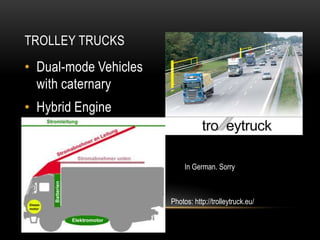
• Dual-mode Vehicles
  with caternary
• Hybrid Engine


                            In German. Sorry


                       Photos: http://trolleytruck.eu/
TROLLEYTRUCKS


            Photos: lLw Tech Magazine
CARGOCAP
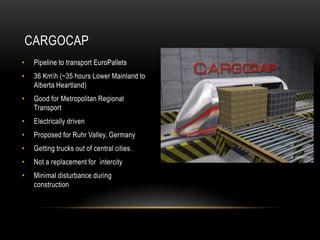
•    Pipeline to transport EuroPallets
•    36 Kmh (~35 hours Lower Mainland to
     Alberta Heartland)
•    Good for Metropolitan Regional
     Transport
•    Electrically driven
•    Proposed for Ruhr Valley, Germany
•    Getting trucks out of central cities.
•    Not a replacement for intercity
•    Minimal disturbance during
     construction
HYPERTRUCKS
• Fuel Efficiency of
  Trucks could be
  doubled to 12.5 mpg
  assuming no fuel
  switching.
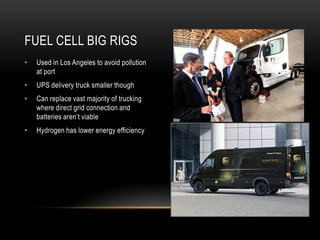
FUEL CELL BIG RIGS
•   Used in Los Angeles to avoid pollution
    at port
•   UPS delivery truck smaller though
•   Can replace vast majority of trucking
    where direct grid connection and
    batteries aren‟t viable
•   Hydrogen has lower energy efficiency
Highly efficient, light but safe cars are imperative to achieve a medium-term
sustainable energy future. Making cars light makes renewably fuels such as
electricity increasingly viable..


  CLEAN CARS
HYPERCAR -LIGHTWIEGHTING EFFECTS
• Light-weight but strong carbon
  fiber construction
• Carbon fibre expensive material,
  cheap to make into cars
• RMI modelled a Revolution SUV
  comparable to 2004 Audi Allroad
    • 58% fuel use reduction
    • 1.6% price increase over Audi
      Allroad
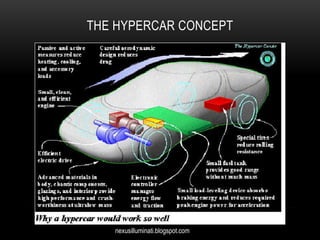
THE HYPERCAR CONCEPT


   nexusilluminati.blogspot.com
LIGHT WEIGHTING AND COST

• As VW notes, low-cost carbon-composite automotive
  structures could cut the weight of a car by 40% (most
  firms say 50–65%) and body parts by 70%, making this
  approach “cost effective even if the manufacturing
  costs per part are still expected to be higher” (Page 56,
  Winning the Oil Endgame)
• Making cars lightweight and efficient makes greener
  fuels such as hydrogen more economically and
  technically viable
HYBRID / FUEL-CELL
HYPERCAR
• 66 MPG  107 MPG
• 72%  83% reduction
  in fuel use for hybrid/
  fuel cell hybrid
• Light-weighting 2.4X
  improvement for
  1.6% cost increase
• 7.4% / 31.9% cost
  increase
RESISTANCE
• Bottom of car is source of
  most resistance!
• Low-resistance, but high
  traction tires
• Take home: cars can heat
  less air and pavement to fry
  the planet less
VEHICLE EFFICIENCY – HYPERCAR
ELECTRIC CARS
• Earliest Auto Technology
• Limited Range
• Recharging Times
• Cost of storage high
   • Batteries
                             Tea Anyone? In the Electric Horseless
   • Supercapacitors         Carriage, perhaps…
                             GM photo
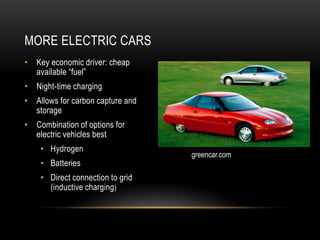
MORE ELECTRIC CARS
• Key economic driver: cheap
  available “fuel”
• Night-time charging
• Allows for carbon capture and
  storage
• Combination of options for
  electric vehicles best
    • Hydrogen
                                  greencar.com
    • Batteries
    • Direct connection to grid
      (inductive charging )
ydrogen is a carbon-free energy carrier
llowing a fuel infrastructure that is easily
onverted to renewable energy sources


        HYDROGEN CARS
HYDROGEN OPTIONS
•   Can be used to drive Cars, Buses,
    Ferries, Planes, Boats, Bikes, Airships
•   Fuel cell round trip efficiency at best
    45%
•   But storable
•   Good for many applications except
    small planes
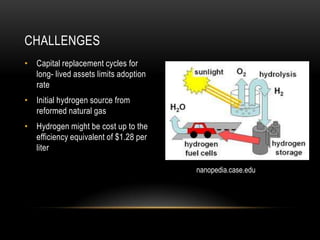
CHALLENGES
• Capital replacement cycles for
  long- lived assets limits adoption
  rate
• Initial hydrogen source from
  reformed natural gas
• Hydrogen might be cost up to the
  efficiency equivalent of $1.28 per
  liter

                                       nanopedia.case.edu
WILL HYDROGEN EVER BE AFFORDABLE?
• 2/3rd reduction in pricey
  platinum use
• Current cost of $225 per
  KW of fuel cell „engine‟
  system
• Hydrogen Fuel Cells 2.5
  times more efficient than
  Internal Combustion Engine
• 2015 Target
•   h2carblog                  Photo: Toyota Motor Sales, U.S.A., Inc.
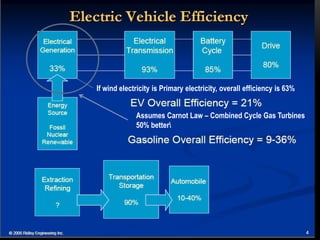
126 Kwh/ 100 mi
Vs.
30 Kwh/ 100 mi
If wind electricity is Primary electricity, overall efficiency is 63%


             Assumes Carnot Law – Combined Cycle Gas Turbines
             50% better
70% more reasonable

Not comparable due to the use of wind resources
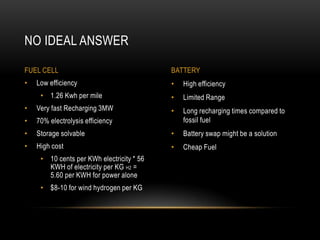
NO IDEAL ANSWER

FUEL CELL                                  BATTERY
•   Low efficiency                         •   High efficiency
     • 1.26 Kwh per mile                   •   Limited Range
•   Very fast Recharging 3MW               •   Long recharging times compared to
•   70% electrolysis efficiency                fossil fuel
•   Storage solvable                       •   Battery swap might be a solution
•   High cost                              •   Cheap Fuel
     • 10 cents per KWh electricity * 56
       KWH of electricity per KG H2 =
       5.60 per KWH for power alone
     • $8-10 for wind hydrogen per KG
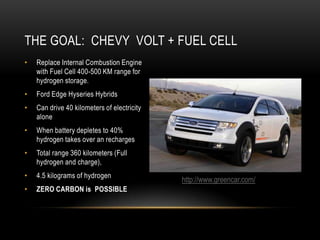
THE GOAL: CHEVY VOLT + FUEL CELL
•   Replace Internal Combustion Engine
    with Fuel Cell 400-500 KM range for
    hydrogen storage.
•   Ford Edge Hyseries Hybrids
•   Can drive 40 kilometers of electricity
    alone
•   When battery depletes to 40%
    hydrogen takes over an recharges
•   Total range 360 kilometers (Full
    hydrogen and charge),
•   4.5 kilograms of hydrogen
                                             http://www.greencar.com/
•   ZERO CARBON is POSSIBLE
WHAT ABOUT HYDROGEN STATIONS AND
PIPELINES?
•   Rocky Mountain Institute notes that
    hydrogen can be produced from
    natural gas in decentralized fashion
•   Halving of carbon dioxide emissions
    per unit of hydrogen produced from
    natural gas
•   Decentralized reformation is the most
    cost effective.
•   In longer-term converting natural gas
    pipelines could be an option
•   Hydrogen could be used to power fuel
    cells to drive resistance heaters and
    heat pumps when there is insufficient
    wind and high heat demand               Photo: Ecofriend
BIOENERGY
•   Generally considered to be carbon-
    neutral… but complex accounting due to
    increasing carbon storage at advanced
    ages
•   Opportunity of not storing in carbon
•   Biomass CCS (Azar et al, 2008)
•   BC Forest 12 Mt(dry).yr
     20% of fossil fuel could be displaced by
     forest residuals
     191 PJ/year in BC from forest waste


•   Cellulosic Biomass potential in             Photo: ESAGOR flickr‟s photostream
    Alberta– 380 to 420 petajoules
FUEL OPTIONS
Lots of issues with biofuels
Focus on BTL
•   Diesel
•   Kerosene
• DME
DME FOR LOGGING  SOME MARINE

                                                             Energy - Industry      0.55
                                                             Transport - Cars       0.25
                                                             Transport - Trucks      1.5
                                                             Transport - Marine      0.1
                                                             Transport - Aviation   0.08


http://www.me.umn.edu/centers/cdr/reports/E3_Kittelson.pdf
DME BEST LAND USE EFFICIENCY
BIO-METHANE FROM WOOD
•    Wood is gasified, cooled, cleaned to remove tars, chlorine and other contaminants
•    Syngas conversion to SNG with catalysts (Large-Scale)
•    Total efficiency of Wood to Methane Energy is around 50-75%


                                                                               Photo: ECN
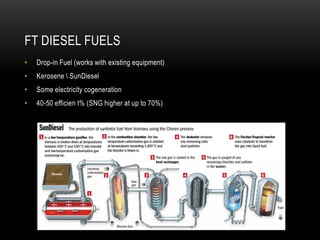
FT DIESEL FUELS
•   Drop-in Fuel (works with existing equipment)
•   Kerosene  SunDiesel
•   Some electricity cogeneration
•   40-50 efficien t% (SNG higher at up to 70%)
BIOENERGY: LIMITED RESOURCE
•   Not enough bioenergy to meet all of
    BCs and Alberta‟s needs need
•   Bioenergy does have large production
    potential 100-200 EJ per year
     • Limited in Canada due to cold
       climate
•   We should remember that trees and in
    particular functioning forest
    ecosystems have a variety of values
•   Deadwood is extremely important for
    biodiversity
•   REMBEMBER THE WOOD DUCKS!              rivermud.blogspot.com
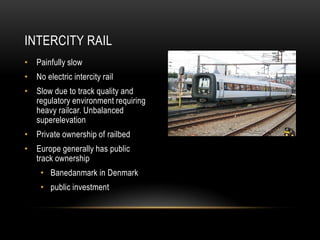
INTERCITY RAIL
• Painfully slow
• No electric intercity rail
• Slow due to track quality and
  regulatory environment requiring
  heavy railcar. Unbalanced
  superelevation
• Private ownership of railbed
• Europe generally has public
  track ownership
     • Banedanmark in Denmark
     • public investment
TRAINS
• Advance control systems to
  allow safe operation at
  higher speeds to
  encourage modal shift
• Electric Caternary on
  mainlines
• Hydrogen hybrids on
  remainder of network
                               http://en.wikipedia.org/
DEUTSCH BAHN DMU (DIESEL MULTIPLE UNIT)
DIESEL TRAINS
• 25% less CO2 than flying
• Low load factor + outdated
  safety regulations
• 90% of the time in idle
• But better than trucks
• Greyhound is better
  energy wise 


                               en.wikipedia.com
ELECTRIC TRAINS
•   Great Power
•   Great Speed
•   75% Breaking energy recovery on
    equipped trains
•   A wonderfully efficient and pleasant
    way to get around
•   On the right the Pagatag my favourite
    thing in the world when I was 4.


                                            Photo: Anders Lagerås
AVIATION
• 70% fuel intensity reduction
    • Double-bubble
• Hydrogen long-term
• Biofuels may be an option
    • FT fuels from cellulose
    • Gasification + bioreactors
    • FT fuels drop-in
    • Perhaps 80% CO2 reduction
                                    en.wikipedia.org
    • Lower cruising altitudes to
      reduce Non-CO2 forces

Low Carbon Transportation

  • 1.
    TRANSPORATION OPTIONS FORA LOW- CARBON FUTURE Thomas Cheney ENSC 302
  • 2.
    ZERO CARBON TRANSPORTATIONIN B.C SOUTH WEST • Currently several electric railways in Greater Vancouver • 1 Tramway (used intermittently) • Large Trolleybus fleet in Vancouver Burnaby • Hydrogen fleet at Whistler • Private electric cars • Electric Bikes • Plug in Hybrids http://www.nowpublic.com
  • 3.
    TROLLEYBUSES • Used inVancouver: Tested in 1950s in Nelson and Victoria • Ridership increase 10%+ • 10% Faster acceleration • Visual intrusion of wires • Cost of initial purchase higher
  • 4.
    MORE TROLLEY BUSES •60% reduction in primary energy use • Visible infrastructure, can anchor development like streetcar • About $1-2 Million per one-way kilometer • Can act as a low cost tram alternative • Quito, Ecuador T-bus
  • 5.
    BUT WIRES AREUGLY! • I don‟t think so • But Bombardier Primovecity uses inductive to bring charging under the road –inductive dynamic and stationary charging • Safe for Heart Pacemakers • Can recharge on the go, Need less infrastructure • Used in Ausburg,Germany for trams • Energy recovery by onboard batteries • Can be used for tramsbuscars Photo: Bombarier
  • 6.
    OFF THE WIREBUS OPTIONS • Proterra • Used in California • Fuel Cell Auxiliary Power Unit • Opbrid system • Tested in Umea, Sweden (Cold winters) • 5-7 minutes charging • 10-15 KM range • Diesel APU
  • 7.
    TRAMS • Light railtram more cost effective than light metro such as Skytrain • Cost substantially dependent on depth of excavation of underground utilities • $12 Million per Mile in Portland • Rail for the Valley proposal connects Surrey with Abbotsford CMA and Chilliwack • Interurban Right of Way is incredibly cost-effective ($6 million per km compared to Skytrain $100-140 million per km) Light Rail going through water feature in Houston, Texas
  • 8.
    CARGO • Important to allow for development of economies of scale in manufacturing recycling • Modern standard of living depends on having ability to ship goods. No such thing as local television manufacturing • Low-Carbon freight transport is needed • Trolleytruck • Efficiency • Electric Fuel Cell Rail Photo: Prince George Railway and Forestry Museum Electric trains that once ran to Tumbler • Biofuels (gasp!) Ridge Coal Mines
  • 9.
    POLICIES • Very High Fuel Tax on Trucks not running on electricity ($2-3 dollars per liter) • Long term phase-in of tax • Nationalization of railroad infrastructure to facilitate electrification and competition • Biofuel use should be discouraged • Cap on consumption • Strict sustainability criteria legislation • Road tax for non-essential biofuel use (Highway Journeys over 200 KM) bccommunitynews.com • Hydrogen fuel for most cases
  • 10.
    TROLLEY TRUCKS • Dual-modeVehicles with caternary • Hybrid Engine In German. Sorry Photos: http://trolleytruck.eu/
  • 11.
    TROLLEYTRUCKS Photos: lLw Tech Magazine
  • 12.
    CARGOCAP • Pipeline to transport EuroPallets • 36 Kmh (~35 hours Lower Mainland to Alberta Heartland) • Good for Metropolitan Regional Transport • Electrically driven • Proposed for Ruhr Valley, Germany • Getting trucks out of central cities. • Not a replacement for intercity • Minimal disturbance during construction
  • 13.
    HYPERTRUCKS • Fuel Efficiencyof Trucks could be doubled to 12.5 mpg assuming no fuel switching.
  • 14.
    FUEL CELL BIGRIGS • Used in Los Angeles to avoid pollution at port • UPS delivery truck smaller though • Can replace vast majority of trucking where direct grid connection and batteries aren‟t viable • Hydrogen has lower energy efficiency
  • 15.
    Highly efficient, lightbut safe cars are imperative to achieve a medium-term sustainable energy future. Making cars light makes renewably fuels such as electricity increasingly viable.. CLEAN CARS
  • 16.
    HYPERCAR -LIGHTWIEGHTING EFFECTS •Light-weight but strong carbon fiber construction • Carbon fibre expensive material, cheap to make into cars • RMI modelled a Revolution SUV comparable to 2004 Audi Allroad • 58% fuel use reduction • 1.6% price increase over Audi Allroad
  • 17.
    THE HYPERCAR CONCEPT nexusilluminati.blogspot.com
  • 18.
    LIGHT WEIGHTING ANDCOST • As VW notes, low-cost carbon-composite automotive structures could cut the weight of a car by 40% (most firms say 50–65%) and body parts by 70%, making this approach “cost effective even if the manufacturing costs per part are still expected to be higher” (Page 56, Winning the Oil Endgame) • Making cars lightweight and efficient makes greener fuels such as hydrogen more economically and technically viable
  • 19.
    HYBRID / FUEL-CELL HYPERCAR •66 MPG 107 MPG • 72% 83% reduction in fuel use for hybrid/ fuel cell hybrid • Light-weighting 2.4X improvement for 1.6% cost increase • 7.4% / 31.9% cost increase
  • 20.
    RESISTANCE • Bottom ofcar is source of most resistance! • Low-resistance, but high traction tires • Take home: cars can heat less air and pavement to fry the planet less
  • 21.
  • 22.
    ELECTRIC CARS • EarliestAuto Technology • Limited Range • Recharging Times • Cost of storage high • Batteries Tea Anyone? In the Electric Horseless • Supercapacitors Carriage, perhaps… GM photo
  • 23.
    MORE ELECTRIC CARS •Key economic driver: cheap available “fuel” • Night-time charging • Allows for carbon capture and storage • Combination of options for electric vehicles best • Hydrogen greencar.com • Batteries • Direct connection to grid (inductive charging )
  • 24.
    ydrogen is acarbon-free energy carrier llowing a fuel infrastructure that is easily onverted to renewable energy sources HYDROGEN CARS
  • 25.
    HYDROGEN OPTIONS • Can be used to drive Cars, Buses, Ferries, Planes, Boats, Bikes, Airships • Fuel cell round trip efficiency at best 45% • But storable • Good for many applications except small planes
  • 26.
    CHALLENGES • Capital replacementcycles for long- lived assets limits adoption rate • Initial hydrogen source from reformed natural gas • Hydrogen might be cost up to the efficiency equivalent of $1.28 per liter nanopedia.case.edu
  • 27.
    WILL HYDROGEN EVERBE AFFORDABLE? • 2/3rd reduction in pricey platinum use • Current cost of $225 per KW of fuel cell „engine‟ system • Hydrogen Fuel Cells 2.5 times more efficient than Internal Combustion Engine • 2015 Target • h2carblog Photo: Toyota Motor Sales, U.S.A., Inc.
  • 28.
    126 Kwh/ 100mi Vs. 30 Kwh/ 100 mi
  • 29.
    If wind electricityis Primary electricity, overall efficiency is 63% Assumes Carnot Law – Combined Cycle Gas Turbines 50% better
  • 30.
    70% more reasonable Notcomparable due to the use of wind resources
  • 31.
    NO IDEAL ANSWER FUELCELL BATTERY • Low efficiency • High efficiency • 1.26 Kwh per mile • Limited Range • Very fast Recharging 3MW • Long recharging times compared to • 70% electrolysis efficiency fossil fuel • Storage solvable • Battery swap might be a solution • High cost • Cheap Fuel • 10 cents per KWh electricity * 56 KWH of electricity per KG H2 = 5.60 per KWH for power alone • $8-10 for wind hydrogen per KG
  • 32.
    THE GOAL: CHEVYVOLT + FUEL CELL • Replace Internal Combustion Engine with Fuel Cell 400-500 KM range for hydrogen storage. • Ford Edge Hyseries Hybrids • Can drive 40 kilometers of electricity alone • When battery depletes to 40% hydrogen takes over an recharges • Total range 360 kilometers (Full hydrogen and charge), • 4.5 kilograms of hydrogen http://www.greencar.com/ • ZERO CARBON is POSSIBLE
  • 33.
    WHAT ABOUT HYDROGENSTATIONS AND PIPELINES? • Rocky Mountain Institute notes that hydrogen can be produced from natural gas in decentralized fashion • Halving of carbon dioxide emissions per unit of hydrogen produced from natural gas • Decentralized reformation is the most cost effective. • In longer-term converting natural gas pipelines could be an option • Hydrogen could be used to power fuel cells to drive resistance heaters and heat pumps when there is insufficient wind and high heat demand Photo: Ecofriend
  • 34.
    BIOENERGY • Generally considered to be carbon- neutral… but complex accounting due to increasing carbon storage at advanced ages • Opportunity of not storing in carbon • Biomass CCS (Azar et al, 2008) • BC Forest 12 Mt(dry).yr 20% of fossil fuel could be displaced by forest residuals 191 PJ/year in BC from forest waste • Cellulosic Biomass potential in Photo: ESAGOR flickr‟s photostream Alberta– 380 to 420 petajoules
  • 35.
    FUEL OPTIONS Lots ofissues with biofuels Focus on BTL • Diesel • Kerosene • DME
  • 36.
    DME FOR LOGGING SOME MARINE Energy - Industry 0.55 Transport - Cars 0.25 Transport - Trucks 1.5 Transport - Marine 0.1 Transport - Aviation 0.08 http://www.me.umn.edu/centers/cdr/reports/E3_Kittelson.pdf
  • 37.
    DME BEST LANDUSE EFFICIENCY
  • 38.
    BIO-METHANE FROM WOOD • Wood is gasified, cooled, cleaned to remove tars, chlorine and other contaminants • Syngas conversion to SNG with catalysts (Large-Scale) • Total efficiency of Wood to Methane Energy is around 50-75% Photo: ECN
  • 39.
    FT DIESEL FUELS • Drop-in Fuel (works with existing equipment) • Kerosene SunDiesel • Some electricity cogeneration • 40-50 efficien t% (SNG higher at up to 70%)
  • 40.
    BIOENERGY: LIMITED RESOURCE • Not enough bioenergy to meet all of BCs and Alberta‟s needs need • Bioenergy does have large production potential 100-200 EJ per year • Limited in Canada due to cold climate • We should remember that trees and in particular functioning forest ecosystems have a variety of values • Deadwood is extremely important for biodiversity • REMBEMBER THE WOOD DUCKS! rivermud.blogspot.com
  • 41.
    INTERCITY RAIL • Painfullyslow • No electric intercity rail • Slow due to track quality and regulatory environment requiring heavy railcar. Unbalanced superelevation • Private ownership of railbed • Europe generally has public track ownership • Banedanmark in Denmark • public investment
  • 42.
    TRAINS • Advance controlsystems to allow safe operation at higher speeds to encourage modal shift • Electric Caternary on mainlines • Hydrogen hybrids on remainder of network http://en.wikipedia.org/
  • 43.
    DEUTSCH BAHN DMU(DIESEL MULTIPLE UNIT)
  • 44.
    DIESEL TRAINS • 25%less CO2 than flying • Low load factor + outdated safety regulations • 90% of the time in idle • But better than trucks • Greyhound is better energy wise  en.wikipedia.com
  • 45.
    ELECTRIC TRAINS • Great Power • Great Speed • 75% Breaking energy recovery on equipped trains • A wonderfully efficient and pleasant way to get around • On the right the Pagatag my favourite thing in the world when I was 4. Photo: Anders Lagerås
  • 46.
    AVIATION • 70% fuelintensity reduction • Double-bubble • Hydrogen long-term • Biofuels may be an option • FT fuels from cellulose • Gasification + bioreactors • FT fuels drop-in • Perhaps 80% CO2 reduction en.wikipedia.org • Lower cruising altitudes to reduce Non-CO2 forces

Editor's Notes

  • #8 r
  • #26 h2carblog.com
  • #35 http://eipa.alberta.ca/media/40721/aeri%20bio-energy%20final%20report.pdf