Culture Presentation by Alejandro SANCHEZ For History & Culture Patricia BOU
Culture Culture is those deep, common, unstated experiences which members of a given group share, which they communicate without knowing, and which form the backdrop against which all other events are judged. Edward T. Hall (1966)‏
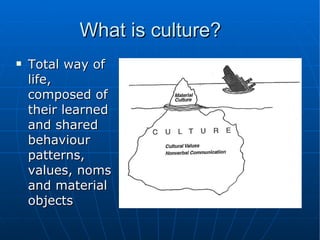
What is culture? Total way of life, composed of their learned and shared behaviour patterns, values, noms and material objects
Several concepts Co-culture (or sub-culture): a set of shared cultural meanings held by a system  within a larger system.  Cultural Artifacts:  material objects produced by a culture.
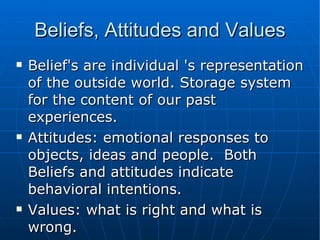
Beliefs, Attitudes and Values Belief's are individual 's representation of the outside world. Storage system for the content of our past experiences. Attitudes: emotional responses to objects, ideas and people.  Both Beliefs and attitudes indicate behavioral intentions. Values: what is right and what is wrong.
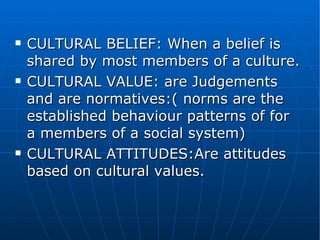
CULTURAL BELIEF: When a belief is shared by most members of a culture. CULTURAL VALUE: are Judgements and are normatives:( norms are the established behaviour patterns of for a members of a social system)‏ CULTURAL ATTITUDES:Are attitudes based on cultural values.
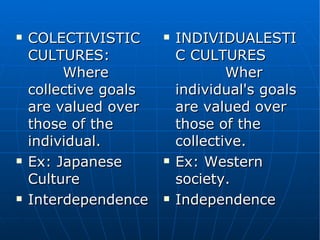
COLECTIVISTIC CULTURES:  Where collective goals are valued over those of the individual. Ex: Japanese Culture Interdependence INDIVIDUALESTIC CULTURES  Wher individual's goals are valued over those of the collective. Ex: Western society. Independence
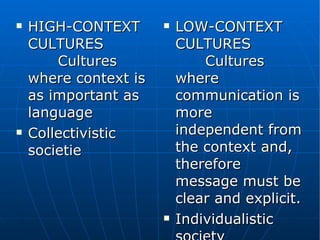
HIGH-CONTEXT CULTURES  Cultures where context is as important as language Collectivistic societie LOW-CONTEXT CULTURES  Cultures where communication is more independent from the context and, therefore message must be clear and explicit. Individualistic society
CULTURAL CLASH  Conflict that occurs between two or more cultures when they dissagree about a certain value. CULTURAL DIFFERENCES  Intercultural communication is the exchange of information between individuals who are unlikely different CULTURAL IDENTIFICATION  Degree to which individuals consider themselves to be representatives of a particular culture. CULTURAL MARKERS  LANGUAGE AND CULTURAL IDENTIFICATION
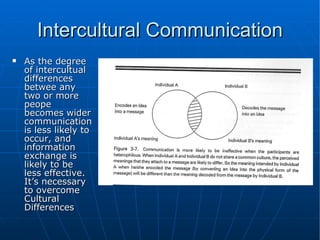
Intercultural Communication As the degree of intercultual differences betwee any two or more peope becomes wider communication is less likely to occur, and information  exchange is likely to be less effective. It’s necessary to overcome Cultural Differences

Culture2 Pps

  • 1.
    Culture Presentation byAlejandro SANCHEZ For History & Culture Patricia BOU
  • 2.
    Culture Culture isthose deep, common, unstated experiences which members of a given group share, which they communicate without knowing, and which form the backdrop against which all other events are judged. Edward T. Hall (1966)‏
  • 3.
    What is culture?Total way of life, composed of their learned and shared behaviour patterns, values, noms and material objects
  • 4.
    Several concepts Co-culture(or sub-culture): a set of shared cultural meanings held by a system within a larger system. Cultural Artifacts: material objects produced by a culture.
  • 5.
    Beliefs, Attitudes andValues Belief's are individual 's representation of the outside world. Storage system for the content of our past experiences. Attitudes: emotional responses to objects, ideas and people. Both Beliefs and attitudes indicate behavioral intentions. Values: what is right and what is wrong.
  • 6.
    CULTURAL BELIEF: Whena belief is shared by most members of a culture. CULTURAL VALUE: are Judgements and are normatives:( norms are the established behaviour patterns of for a members of a social system)‏ CULTURAL ATTITUDES:Are attitudes based on cultural values.
  • 7.
    COLECTIVISTIC CULTURES: Where collective goals are valued over those of the individual. Ex: Japanese Culture Interdependence INDIVIDUALESTIC CULTURES Wher individual's goals are valued over those of the collective. Ex: Western society. Independence
  • 8.
    HIGH-CONTEXT CULTURES Cultures where context is as important as language Collectivistic societie LOW-CONTEXT CULTURES Cultures where communication is more independent from the context and, therefore message must be clear and explicit. Individualistic society
  • 9.
    CULTURAL CLASH Conflict that occurs between two or more cultures when they dissagree about a certain value. CULTURAL DIFFERENCES Intercultural communication is the exchange of information between individuals who are unlikely different CULTURAL IDENTIFICATION Degree to which individuals consider themselves to be representatives of a particular culture. CULTURAL MARKERS LANGUAGE AND CULTURAL IDENTIFICATION
  • 10.
    Intercultural Communication Asthe degree of intercultual differences betwee any two or more peope becomes wider communication is less likely to occur, and information exchange is likely to be less effective. It’s necessary to overcome Cultural Differences