Modern Surfaces
Denise Scott Brown, Las Vegas (1966)
Suburban space, being automobile space, is not defined
by enclosing walls and floors (…). In fact, space is not
the most important constituent of suburban form.
Communication across space is more important.
Denise Scott Brown, Learning from Pop (1971)
The sign for the Motel Monticello, a silhouette of an
enormous Chippendale highboy, is visible on the
highway before the motel itself.This architecture of
styles and signs is anti-spatial; it is an architecture of
communication over space.
Robert Venturi, Denise Scott Brown and Steven Izrnour, Learning from Las
Vegas (1972)
Venice Architecture Biennale: La Strada Novissima (1980)
Frank Gehry, Disney Concert Hall (1987-2003)
NOX, Fresh Water Pavilion (1997)
Peter Cook, Kunsthaus Graz (2003)
MVRDV, Markthal Rotterdam (2014)
In visual terms, the twentieth century of the western
hemisphere will be remembered as the century in which
content yielded to form, text to image, depth to façade,
and Sein to Schein.
Janet Ward, Weimar Surfaces (2001)
Modern Surfaces
Palace of Electricity, Universal Exhibition Paris (1900)
The urge to ornament one’s face and everything within
reach is the start of plastic art. It is the baby talk of
painting. All art is erotic. (…) But the man of our day
who, in response to an inner urge, smears the walls with
erotic symbols is a criminal or a degenerate. (…) I have
made the following discovery and I pass it on to the
world: The evolution of culture is synonymous with the
removal of ornament from utilitarian objects. (…) We have
fought our way through to freedom from ornament. See,
the time is nigh, fulfilment awaits us. Soon the streets of
the city will glisten like white walls. Like Zion, the holy
city, the capital of heaven.Then fulfilment will be come.
Adolf Loos, Ornament and Crime (1908)
Adolf Loos, Müller House (1930)
Müller House Raumplan
Le Corbusier, Letter to Madame Meyer (1925)
Sergei Eisenstein, Sequences Diagram for Alexander Nevsky (1930s)
Adolf Loos, Müller House (1930)
Adolf Loos, Baker House (1927)
Josephine Baker (1927)
Adolf Loos, Baker House (1927)
I. No Longer a Façade but a House
II. No Longer a House but Shaped Space
III. No Longer Shaped Space but Designed Reality
Adolf Behne, The Modern Functional Building (1926)
In the recent past the art of building sank into
sentimental decorative conceptions of the aesthete,
whose goal was the outward display of motives,
ornaments, and profiles taken mostly from past cultures,
which were without essential importance to the body of
the building.The building became depreciated as a
carrier of superficial, dead decoration, instead of being a
living organism.
Walter Gropius, International Architecture (1925)
Walter Gropius, Monumentale Kunst und Industriebau Lichtbildervortrag (1911)
Le Corbusier, Toward an Architecture (1923)
Left: Le Corbusier, Villa Schwob as published in L’Esprit Nouveau; Right: Villa Schwob, detail of the deleted pergola (1916-17)
Le Corbusier, Toward an Architecture (1923)
Architecture being the masterly, correct and magnificent
play of masses brought together in light, the task of the
architect is to vitalise the surfaces which clothe these
masses, but in such a way that these surfaces do not
become parasitical, eating up the mass and absorbing it
to their own advantage.
Le Corbusier, Toward a New Architecture (1923)
Le Corbusier, Weissenhof-Siedlung Houses 14 and 15 (1927)
Ludwig Mies van der Rohe, Weissenhof-Siedlung House 1 (1927)
Bruno Taut & Martin Wagner, Hufeisensiedlung (1925-31)
Left: Cremer & Wolffenstein, Berliner Tageblatt Building (1901) Right: Erich Mendelsohn, Mossehaus (1921-23)
H. Abeking, Modernization: The House-Owner Gieselmann before and after the renovation of his facade (1929)
The position of an epoch occupies in the historical
process can be determined more strikingly from an
analysis of its inconspicuous surface-level expression
than from that epoch’s judgments about itself. Since
these judgments are expressions of the tendencies of a
particular era, they do not offer conclusive testimony
about its overall constitution.The surface-level
expressions, however, by virtue of their unconscious
nature, provide unmediated access to the fundamental
substance of the state of things.
Siegfried Kracauer, The Mass Ornament (1927)
Ludwig Mies van der Rohe, Friedrichstraße Skyscraper (1921)
Competition proposals by: Hugo Häring, Hans Poelzig, Hans & Wassili Luckhardt, and Hans Scharoun (1921)
Ludwig Mies van der Rohe, Friedrichstraße Skyscraper (1921)
Ludwig Mies van der Rohe, Friedrichstraße Skyscraper, opaque and transparent versions (1921)
Ludwig Mies van der Rohe, Glass Skyscraper (1922)
Left: Mies van der Rohe, Glass Skyscraper (1922) Right: X-Ray of Chameleon Cristatus (1896)
Joseph Paxton, Crystal Palace for the first International Exhibition in London (1851)
Joseph Paxton, Crystal Palace (1851)
World exhibitions glorify the exchange value of the
commodity.They create a framework in which its use
value recedes into the background.They open a
phantasmagoria which a person enters in order to be
distracted.The entertainment industry makes this easier
by elevating the person to the level of the commodity.
He surrenders to its manipulations while enjoying his
alienation from himself and others.
Walter Benjamin, The Arcades Project (1927-40)
Etienne Gaspard Robertson, Phantasmagoria at the Cour des Capucines (1797)
Joseph Paxton, Crystal Palace for the first International Exhibition in London (1851)
Palais de l'Industrie for the International Exhibition in Paris (1855)
Galerie des Machines for the International Exhibition in Paris (1889)
Bernard Sehring,Tietz Department Store (1900)
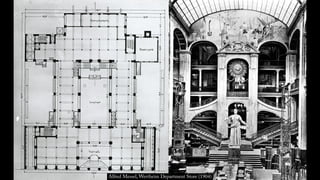
Alfred Messel, Wertheim Department Store (1904)
Display window, Berlin (1929)
(…) I refer to what could be termed the shop-window
quality of things (…).The production of goods under the
regime of free competition and the normal
predominance of supply over demand leads to goods
having to show a tempting exterior as well as utility. (…)
The striving to make the merely useful visually
stimulating (…) comes from the struggle to render the
graceless graceful for consumers.
Georg Simmel, Berliner Gewerbeaustellung (1896)
Peter Behrens, Brochure Cover for A.E.G. Metal Filament lamps (1913)
Pieter Oud, Café de Unie (1925)
Fremont Street, Las Vegas (1920s)
Palace of Electricity, Universal Exhibition Paris (1900)
Osram electric adornement during the Berlin in Light Week (1928)
Jazz Band in Berlin's Zoo (1928)
Times Square (1923)
Oscar Nitzchke, Maison de la Publicité (1934-36)
Giacomo Matté Trucco, Lingotto (1915-30)
George Grosz, Dedicated to Oskar Panizza (1917-18)
(…) rocket fires of moving electric advertisements
dividing up and down, disappearing and exploding over
the thousands of cars and the merry rush of people.
Erich Mendelsohn, America. An Architect’s Pictures Book (1926)
Erich Mendelsohn, America. An Architect’s Pictures Book (1925)
Nothing appeals more readily to modern man than
picture. He wants to understand, but quickly, clearly,
without a lot of furrowing of brows and mysticism. And
with all this the world is mysterious as never before,
impenetrable and full of daring possibilities.
Erich Mendelsohn, Letter to Luise Mendelsohn (1927)
Erich Mendelsohn, Remodelling of the facade of the Herpich Store, Berlin (1924)
Erich Mendelsohn, Schocken Department Store, Stuttgart (1926-28)
Erich Mendelsohn, Petersdorff Department Store, Wroclaw (1927)
Erich Mendelsohn, Schocken Department Store, Chemintz (1928-29)
The surfaces (of buildings) must be bright and smooth
(so that shadows from a ledge do not interfere with the
light) and large (so that light can assert itself in peace
admits all the agitation of its surroundings). For even
here it is not the construction, but light that matters
most. (The building) functions not as a building, i.e., as a
spatial-physical creation, but only as a phenomenon of
immaterial surfaces, whose substance nobody thinks of.
Walter Riezler, Licht und Architektur (1928)

Modern surfaces

  • 1.
  • 2.
    Denise Scott Brown,Las Vegas (1966)
  • 3.
    Denise Scott Brown,Las Vegas (1966)
  • 4.
    Suburban space, beingautomobile space, is not defined by enclosing walls and floors (…). In fact, space is not the most important constituent of suburban form. Communication across space is more important. Denise Scott Brown, Learning from Pop (1971)
  • 5.
    The sign forthe Motel Monticello, a silhouette of an enormous Chippendale highboy, is visible on the highway before the motel itself.This architecture of styles and signs is anti-spatial; it is an architecture of communication over space. Robert Venturi, Denise Scott Brown and Steven Izrnour, Learning from Las Vegas (1972)
  • 6.
    Venice Architecture Biennale:La Strada Novissima (1980)
  • 7.
    Frank Gehry, DisneyConcert Hall (1987-2003)
  • 8.
    NOX, Fresh WaterPavilion (1997)
  • 9.
  • 10.
  • 11.
    In visual terms,the twentieth century of the western hemisphere will be remembered as the century in which content yielded to form, text to image, depth to façade, and Sein to Schein. Janet Ward, Weimar Surfaces (2001)
  • 12.
  • 13.
    Palace of Electricity,Universal Exhibition Paris (1900)
  • 14.
    The urge toornament one’s face and everything within reach is the start of plastic art. It is the baby talk of painting. All art is erotic. (…) But the man of our day who, in response to an inner urge, smears the walls with erotic symbols is a criminal or a degenerate. (…) I have made the following discovery and I pass it on to the world: The evolution of culture is synonymous with the removal of ornament from utilitarian objects. (…) We have fought our way through to freedom from ornament. See, the time is nigh, fulfilment awaits us. Soon the streets of the city will glisten like white walls. Like Zion, the holy city, the capital of heaven.Then fulfilment will be come. Adolf Loos, Ornament and Crime (1908)
  • 15.
    Adolf Loos, MüllerHouse (1930)
  • 16.
    Adolf Loos, MüllerHouse (1930)
  • 17.
  • 18.
    Le Corbusier, Letterto Madame Meyer (1925)
  • 19.
    Sergei Eisenstein, SequencesDiagram for Alexander Nevsky (1930s)
  • 20.
    Adolf Loos, MüllerHouse (1930)
  • 21.
    Adolf Loos, MüllerHouse (1930)
  • 22.
    Adolf Loos, BakerHouse (1927)
  • 23.
  • 24.
    Adolf Loos, BakerHouse (1927)
  • 26.
    I. No Longera Façade but a House II. No Longer a House but Shaped Space III. No Longer Shaped Space but Designed Reality Adolf Behne, The Modern Functional Building (1926)
  • 28.
    In the recentpast the art of building sank into sentimental decorative conceptions of the aesthete, whose goal was the outward display of motives, ornaments, and profiles taken mostly from past cultures, which were without essential importance to the body of the building.The building became depreciated as a carrier of superficial, dead decoration, instead of being a living organism. Walter Gropius, International Architecture (1925)
  • 29.
    Walter Gropius, InternationalArchitecture (1925)
  • 30.
    Walter Gropius, InternationalArchitecture (1925)
  • 31.
    Walter Gropius, InternationalArchitecture (1925)
  • 32.
    Walter Gropius, MonumentaleKunst und Industriebau Lichtbildervortrag (1911)
  • 35.
    Le Corbusier, Towardan Architecture (1923)
  • 36.
    Le Corbusier, Towardan Architecture (1923)
  • 38.
    Left: Le Corbusier,Villa Schwob as published in L’Esprit Nouveau; Right: Villa Schwob, detail of the deleted pergola (1916-17)
  • 39.
    Le Corbusier, Towardan Architecture (1923)
  • 40.
    Architecture being themasterly, correct and magnificent play of masses brought together in light, the task of the architect is to vitalise the surfaces which clothe these masses, but in such a way that these surfaces do not become parasitical, eating up the mass and absorbing it to their own advantage. Le Corbusier, Toward a New Architecture (1923)
  • 41.
    Le Corbusier, Weissenhof-SiedlungHouses 14 and 15 (1927)
  • 43.
    Ludwig Mies vander Rohe, Weissenhof-Siedlung House 1 (1927)
  • 44.
    Bruno Taut &Martin Wagner, Hufeisensiedlung (1925-31)
  • 45.
    Left: Cremer &Wolffenstein, Berliner Tageblatt Building (1901) Right: Erich Mendelsohn, Mossehaus (1921-23)
  • 46.
    H. Abeking, Modernization:The House-Owner Gieselmann before and after the renovation of his facade (1929)
  • 47.
    The position ofan epoch occupies in the historical process can be determined more strikingly from an analysis of its inconspicuous surface-level expression than from that epoch’s judgments about itself. Since these judgments are expressions of the tendencies of a particular era, they do not offer conclusive testimony about its overall constitution.The surface-level expressions, however, by virtue of their unconscious nature, provide unmediated access to the fundamental substance of the state of things. Siegfried Kracauer, The Mass Ornament (1927)
  • 48.
    Ludwig Mies vander Rohe, Friedrichstraße Skyscraper (1921)
  • 49.
    Competition proposals by:Hugo Häring, Hans Poelzig, Hans & Wassili Luckhardt, and Hans Scharoun (1921)
  • 50.
    Ludwig Mies vander Rohe, Friedrichstraße Skyscraper (1921)
  • 51.
    Ludwig Mies vander Rohe, Friedrichstraße Skyscraper, opaque and transparent versions (1921)
  • 52.
    Ludwig Mies vander Rohe, Glass Skyscraper (1922)
  • 53.
    Ludwig Mies vander Rohe, Glass Skyscraper (1922)
  • 54.
    Left: Mies vander Rohe, Glass Skyscraper (1922) Right: X-Ray of Chameleon Cristatus (1896)
  • 55.
    Joseph Paxton, CrystalPalace for the first International Exhibition in London (1851)
  • 56.
  • 57.
    World exhibitions glorifythe exchange value of the commodity.They create a framework in which its use value recedes into the background.They open a phantasmagoria which a person enters in order to be distracted.The entertainment industry makes this easier by elevating the person to the level of the commodity. He surrenders to its manipulations while enjoying his alienation from himself and others. Walter Benjamin, The Arcades Project (1927-40)
  • 58.
    Etienne Gaspard Robertson,Phantasmagoria at the Cour des Capucines (1797)
  • 59.
    Joseph Paxton, CrystalPalace for the first International Exhibition in London (1851)
  • 60.
    Palais de l'Industriefor the International Exhibition in Paris (1855)
  • 61.
    Galerie des Machinesfor the International Exhibition in Paris (1889)
  • 62.
  • 63.
    Alfred Messel, WertheimDepartment Store (1904)
  • 64.
    Alfred Messel, WertheimDepartment Store (1904)
  • 65.
  • 66.
    (…) I referto what could be termed the shop-window quality of things (…).The production of goods under the regime of free competition and the normal predominance of supply over demand leads to goods having to show a tempting exterior as well as utility. (…) The striving to make the merely useful visually stimulating (…) comes from the struggle to render the graceless graceful for consumers. Georg Simmel, Berliner Gewerbeaustellung (1896)
  • 67.
    Peter Behrens, BrochureCover for A.E.G. Metal Filament lamps (1913)
  • 69.
    Pieter Oud, Caféde Unie (1925)
  • 70.
    Fremont Street, LasVegas (1920s)
  • 71.
    Palace of Electricity,Universal Exhibition Paris (1900)
  • 72.
    Osram electric adornementduring the Berlin in Light Week (1928)
  • 73.
    Jazz Band inBerlin's Zoo (1928)
  • 74.
  • 75.
    Oscar Nitzchke, Maisonde la Publicité (1934-36)
  • 76.
    Oscar Nitzchke, Maisonde la Publicité (1934-36)
  • 77.
    Oscar Nitzchke, Maisonde la Publicité (1934-36)
  • 78.
    Giacomo Matté Trucco,Lingotto (1915-30)
  • 79.
    George Grosz, Dedicatedto Oskar Panizza (1917-18)
  • 80.
    (…) rocket firesof moving electric advertisements dividing up and down, disappearing and exploding over the thousands of cars and the merry rush of people. Erich Mendelsohn, America. An Architect’s Pictures Book (1926)
  • 82.
    Erich Mendelsohn, America.An Architect’s Pictures Book (1925)
  • 83.
    Erich Mendelsohn, America.An Architect’s Pictures Book (1925)
  • 85.
    Nothing appeals morereadily to modern man than picture. He wants to understand, but quickly, clearly, without a lot of furrowing of brows and mysticism. And with all this the world is mysterious as never before, impenetrable and full of daring possibilities. Erich Mendelsohn, Letter to Luise Mendelsohn (1927)
  • 86.
    Erich Mendelsohn, Remodellingof the facade of the Herpich Store, Berlin (1924)
  • 87.
    Erich Mendelsohn, SchockenDepartment Store, Stuttgart (1926-28)
  • 88.
    Erich Mendelsohn, PetersdorffDepartment Store, Wroclaw (1927)
  • 89.
    Erich Mendelsohn, SchockenDepartment Store, Chemintz (1928-29)
  • 90.
    The surfaces (ofbuildings) must be bright and smooth (so that shadows from a ledge do not interfere with the light) and large (so that light can assert itself in peace admits all the agitation of its surroundings). For even here it is not the construction, but light that matters most. (The building) functions not as a building, i.e., as a spatial-physical creation, but only as a phenomenon of immaterial surfaces, whose substance nobody thinks of. Walter Riezler, Licht und Architektur (1928)