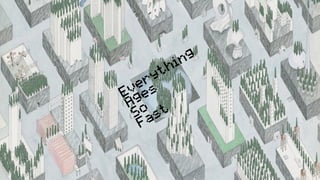
Everything
Ages
So
Fast
theory (n.)
1590s, "conception, mental scheme," from Late Latin
theoria (Jerome), from Greek theōria
"contemplation, speculation; a looking at,
viewing; a sight, show, spectacle, things
looked at," from theōrein "to consider, speculate, look
at," from theōros "spectator," from thea "a view" (see
theater) + horan "to see," which is possibly from PIE
root *wer- (3) "to perceive."
Online Etymology Dictionary
1) The way in which human perception is organised - the
medium in which it occurs - is conditioned not only by
nature but by history. Walter Benjamin
2) Technology creates the framing that defines our
relationship to our environment, and invisibly guides our
experiences of it. Martin Heidegger
3) Every new technology creates a new environment that
totally changes the content of our perception. New
media are new environments. Saturating environments
are invisible, but artists can make us aware of them.
Marshall McLuhan
4) Buildings are conceived and transformed through media
rather than simply represented in the media.
Furthermore, architecture is itself from the beginning a
form of media. Beatriz Colomina
Left: Early movable printing press (1568); Right: Sebastiano Serlio, Synoptic table of the orders (1537)
Smartphone and Apps (2007)
1. Avoid personal use
2. Think in terms of editorial project
3. Be synthetic
4. Revert to visual language
5. Build up your community
For each technology in infrastructure space, to
distinguish between what the organisation
is saying and what it is doing (…) is to read the
difference between a declared intent and an underlying
disposition.
Keller Easterling, Extrastatecraft (2014)
How is
architecture
made public?
How is
architecture
represented?
How is
architecture
designed?
How is
architecture
inhabited?
Into the
Universe of
Social Media
Digital culture and its ever-changing environment
(…) need to be examined as a set of discursive
practices, with their own conventions and norms
that tend to fragilize and disturb well-
established categories and values. (…) Digital
culture is made up of communication and information
exchange modes that displace, redefine, and reshape
knowledge into new forms, formats and the methods
for acquiring and transmitting such knowledge.
Milad Doueihi, Digital Cultures (2011)
How is
architecture
represented?
How is
architecture
designed?
How is
architecture
inhabited?
Into the
Universe of
Social Media
How is
architecture
made public?
Eric Kessels, 24H in Photos (2011)
Aby Warburg, Atlas Mnemosyne (1929)
Jeff Kaplon, Subtilitas
Andrew Kovacs, Archive of Affinities
Davide Trabucco, Confórmi
Facebook network visualisation
Fabrizio Gallanti & Francesca Insulza, FIG Projects
Daniel Tudor Munteanu, OfHouses
Bianca Felicori, Forgotten Architecture
Documents are not an accessorial element of social
reality, but rather (in the various forms that they can
assume) its condition of possibility, insofar as they
ensure the fixation of individual and collective
memory.
Maurizio Ferraris, Perspectives on Documentality (2012)
Beniamino Servino, Moscow. The Zuev Club (2020)
Carmelo Baglivo, Tempio Moderno (2018)
If the public follows my activity all the time, then I do
not need to present it with any product. The process
is already the product. Balzac’s unknown artist
who could never finish his masterpiece would have no
problem under these new conditions—documentation
of his efforts would comprise this masterpiece and he
would become famous. Documentation of the
act of working on an artwork is already an
artwork. With the internet, time became space
indeed—and it is the visible space of permanent
surveillance.
Botis Groys, Entering the Flow: Museum between Archive and Gesamtkunstwerk (2013)
Fake Industries Architectural Agonism, OE House (2014)
Point Supreme, Roman Villa (2016)
It is no longer a matter of elaborating a form on the
basis of a raw material but working with objects
that are already in circulation on the
cultural market, which is to say, objects already
informed by other objects. Notions of originality
(being at the origin of) and even of creation (making
something from nothing) are slowly blurred in this
new cultural landscape marked by the twin figures
of the DJ and the programmer, both of whom
have the task of selecting cultural objects and inserting
them into new contexts.
Nicolas Bourriaud, Postproduction. Culture as Screenplay: How Art Reprograms the World
(2002)
Andrew Kovacs, Chicago Model (2017)
Steven Spielberg, Ready Player One (2018)
Mark Foster Gage, Helsinki Guggenheim Museum (2014)
Epic Games, Fortnite (2017)
OMA, Galleria (2020)
Space Popular, The Glass Chain (2017)
Thomas Ruff, jpeg ny02 (2004)
Flip Dujardin, Untitled #6 (2012)
Philipp Schaerer, Buildbauten (2007-2009)
Frank Gehry, Guggenheim Bilbao (1997)
BIG, The Spiral (2016)
Foster & Partners, The Tulip (2019)
Stefano Boeri Architetti, Bosco Verticale (2014)
Stefano Boeri Architetti, Smart Forest City Cancun (2020)
Davide Tommaso Ferrando, The Globe of the Captive City (2020)
René Magritte, The Treachery of Images (1929)
Moma Propaganda, Everything Ages Fast campaign for Maximidia (2010)
Everything Ages So Fast

Everything Ages So Fast

  • 1.
  • 2.
    theory (n.) 1590s, "conception,mental scheme," from Late Latin theoria (Jerome), from Greek theōria "contemplation, speculation; a looking at, viewing; a sight, show, spectacle, things looked at," from theōrein "to consider, speculate, look at," from theōros "spectator," from thea "a view" (see theater) + horan "to see," which is possibly from PIE root *wer- (3) "to perceive." Online Etymology Dictionary
  • 3.
    1) The wayin which human perception is organised - the medium in which it occurs - is conditioned not only by nature but by history. Walter Benjamin 2) Technology creates the framing that defines our relationship to our environment, and invisibly guides our experiences of it. Martin Heidegger 3) Every new technology creates a new environment that totally changes the content of our perception. New media are new environments. Saturating environments are invisible, but artists can make us aware of them. Marshall McLuhan 4) Buildings are conceived and transformed through media rather than simply represented in the media. Furthermore, architecture is itself from the beginning a form of media. Beatriz Colomina
  • 4.
    Left: Early movableprinting press (1568); Right: Sebastiano Serlio, Synoptic table of the orders (1537)
  • 5.
  • 10.
    1. Avoid personaluse 2. Think in terms of editorial project 3. Be synthetic 4. Revert to visual language 5. Build up your community
  • 11.
    For each technologyin infrastructure space, to distinguish between what the organisation is saying and what it is doing (…) is to read the difference between a declared intent and an underlying disposition. Keller Easterling, Extrastatecraft (2014)
  • 12.
    How is architecture made public? Howis architecture represented? How is architecture designed? How is architecture inhabited? Into the Universe of Social Media
  • 13.
    Digital culture andits ever-changing environment (…) need to be examined as a set of discursive practices, with their own conventions and norms that tend to fragilize and disturb well- established categories and values. (…) Digital culture is made up of communication and information exchange modes that displace, redefine, and reshape knowledge into new forms, formats and the methods for acquiring and transmitting such knowledge. Milad Doueihi, Digital Cultures (2011)
  • 14.
    How is architecture represented? How is architecture designed? Howis architecture inhabited? Into the Universe of Social Media How is architecture made public?
  • 15.
    Eric Kessels, 24Hin Photos (2011)
  • 16.
    Aby Warburg, AtlasMnemosyne (1929)
  • 17.
  • 18.
  • 19.
  • 20.
  • 21.
    Fabrizio Gallanti &Francesca Insulza, FIG Projects
  • 22.
  • 23.
  • 24.
    Documents are notan accessorial element of social reality, but rather (in the various forms that they can assume) its condition of possibility, insofar as they ensure the fixation of individual and collective memory. Maurizio Ferraris, Perspectives on Documentality (2012)
  • 25.
    Beniamino Servino, Moscow.The Zuev Club (2020)
  • 26.
  • 27.
    If the publicfollows my activity all the time, then I do not need to present it with any product. The process is already the product. Balzac’s unknown artist who could never finish his masterpiece would have no problem under these new conditions—documentation of his efforts would comprise this masterpiece and he would become famous. Documentation of the act of working on an artwork is already an artwork. With the internet, time became space indeed—and it is the visible space of permanent surveillance. Botis Groys, Entering the Flow: Museum between Archive and Gesamtkunstwerk (2013)
  • 28.
    Fake Industries ArchitecturalAgonism, OE House (2014)
  • 29.
  • 30.
    It is nolonger a matter of elaborating a form on the basis of a raw material but working with objects that are already in circulation on the cultural market, which is to say, objects already informed by other objects. Notions of originality (being at the origin of) and even of creation (making something from nothing) are slowly blurred in this new cultural landscape marked by the twin figures of the DJ and the programmer, both of whom have the task of selecting cultural objects and inserting them into new contexts. Nicolas Bourriaud, Postproduction. Culture as Screenplay: How Art Reprograms the World (2002)
  • 31.
  • 32.
    Steven Spielberg, ReadyPlayer One (2018)
  • 33.
    Mark Foster Gage,Helsinki Guggenheim Museum (2014)
  • 34.
  • 35.
  • 36.
    Space Popular, TheGlass Chain (2017)
  • 37.
    Thomas Ruff, jpegny02 (2004)
  • 40.
  • 41.
  • 42.
  • 43.
  • 44.
    Foster & Partners,The Tulip (2019)
  • 45.
    Stefano Boeri Architetti,Bosco Verticale (2014)
  • 46.
    Stefano Boeri Architetti,Smart Forest City Cancun (2020)
  • 47.
    Davide Tommaso Ferrando,The Globe of the Captive City (2020)
  • 48.
    René Magritte, TheTreachery of Images (1929)
  • 49.
    Moma Propaganda, EverythingAges Fast campaign for Maximidia (2010)