The Modern Kitchen

Equipment and Hydrocolloids
Contents
• Modern cooking tools
   –   Thermomix
   –   Paco jet
   –   Smoke gun
   –   Vacuum packer
   –   Water bath & immersion calculator
   –   Anti griddle
   –   Centrifuge
   –   Rotary evaporator
   –   Liquid Nitrogen
   –   Transglutaminase

• Hydrocolloids
   – Important characteristics of Gels
   – Considerations when using Hydrocolloids
   – Hydrocolloid properties
New Kitchen Equipment
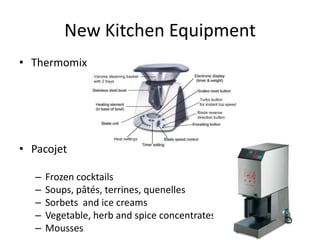
• Thermomix


• Pacojet

   –   Frozen cocktails
   –   Soups, pâtés, terrines, quenelles
   –   Sorbets and ice creams
   –   Vegetable, herb and spice concentrates
   –   Mousses
New Kitchen Equipment
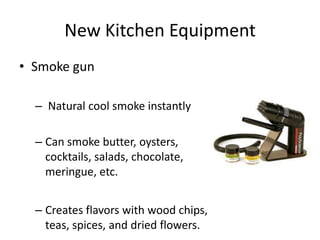
• Smoke gun

  – Natural cool smoke instantly

  – Can smoke butter, oysters,
    cocktails, salads, chocolate,
    meringue, etc.


  – Creates flavors with wood chips,
    teas, spices, and dried flowers.
New Kitchen Equipment
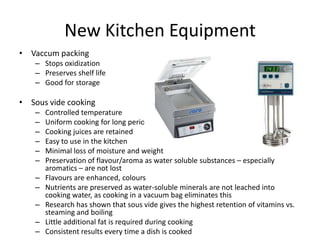
• Vaccum packing
   – Stops oxidization
   – Preserves shelf life
   – Good for storage

• Sous vide cooking
   –   Controlled temperature
   –   Uniform cooking for long periods
   –   Cooking juices are retained
   –   Easy to use in the kitchen
   –   Minimal loss of moisture and weight
   –   Preservation of flavour/aroma as water soluble substances – especially
       aromatics – are not lost
   –   Flavours are enhanced, colours
   –   Nutrients are preserved as water-soluble minerals are not leached into
       cooking water, as cooking in a vacuum bag eliminates this
   –   Research has shown that sous vide gives the highest retention of vitamins vs.
       steaming and boiling
   –   Little additional fat is required during cooking
   –   Consistent results every time a dish is cooked
New Kitchen Equipment
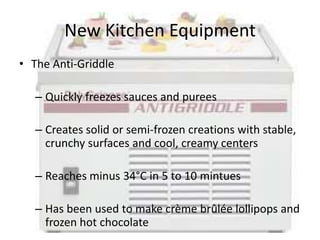
• The Anti-Griddle

   – Quickly freezes sauces and purees

   – Creates solid or semi-frozen creations with stable,
     crunchy surfaces and cool, creamy centers

   – Reaches minus 34°C in 5 to 10 mintues

   – Has been used to make crème brûlée lollipops and
     frozen hot chocolate
New Kitchen Equipment
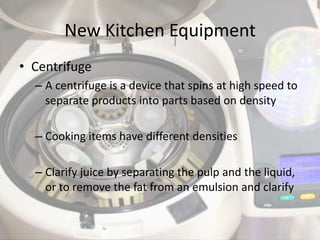
• Centrifuge
  – A centrifuge is a device that spins at high speed to
    separate products into parts based on density

  – Cooking items have different densities

  – Clarify juice by separating the pulp and the liquid,
    or to remove the fat from an emulsion and clarify
New Kitchen Equipment
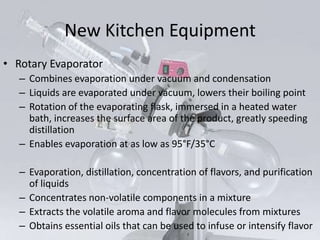
• Rotary Evaporator
   – Combines evaporation under vacuum and condensation
   – Liquids are evaporated under vacuum, lowers their boiling point
   – Rotation of the evaporating flask, immersed in a heated water
     bath, increases the surface area of the product, greatly speeding
     distillation
   – Enables evaporation at as low as 95°F/35°C

   – Evaporation, distillation, concentration of flavors, and purification
     of liquids
   – Concentrates non-volatile components in a mixture
   – Extracts the volatile aroma and flavor molecules from mixtures
   – Obtains essential oils that can be used to infuse or intensify flavor
Liquid Nitrogen
• Liquid Nitrogen
   – Instant freezing
   – Reduces ice crystal formation
   – Negative 196 degrees Celsius
   – Despite its coldness, it has only 15% more cooling power than the
      same amount of ice at 0 Celsius, as its not as dense

• Uses:
   – Making ice cream in a kitchen aid
   – Chill liquids without diluting them
   – Freeze the unfreezable (e.g. alcohol, olive oil)
   – Chilling glasses
   – Blow smoke
   – ‘Cryo-poachinh’
   – Powders, crystals and frozen drops
Transglutaminase
• Naturally occurring enzyme in plants, animals, and bacteria
• Meat glue is an enzyme that acts on the amino acids causing
  bonds to form that helps the meat stick together
   –   Make uniform portions that cook evenly, look good, and reduce waste
   –   Bind meat mixtures like sausages without casings
   –   Make novel meat combinations like lamb and scallops
   –   Produce special effects like meat noodles, meat and vegetable pasta


 How to test meat glue: a) Rub a lot of meat glue into a piece of raw chicken; b) if it just
  smells like chicken your glue is no good; c) If it smells like wet dog you're good to go!
Hydrocolloids
• Hydrocolloids are classified as either thickening
  or gelling agents

• Hydrocolloids are ingredients that control water
  in a recipe

• Many hydrocolloids are derived from natural
  sources, such as seaweed, seeds, roots, tree sap,
  fruit peels, etc

• Some modern but still all-natural hydrocolloids
  produced by bacteria
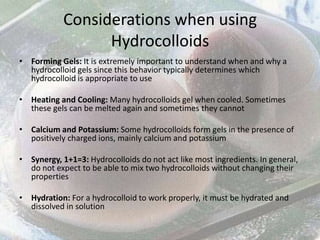
Important Characteristics of Gels
• Thermo-reversible/Irreversible: Thermo-reversible gels melt
  when heated to a high enough temperature. Thermo-
  irreversible gels will not melt when heated.

• Tendency for Syneresis: Syneresis occurs when liquid weeps
  out of a gel over time, as happens in custards.

• Freeze-thaw stability: Gels that may be frozen and thawed
  repeatedly are called freeze-thaw stable
Important Characteristics of Gels
• Clarity: The addition of some hydrocolloids yield gels that
  are more transparent than others

• Flavor release: describes how well a gel expresses the
  flavorings with which it has been made. Flavor release is
  determined by many gel texture properties

• Shear reversibility: Shear is a force in which parallel
  objects move in opposite directions in a “sliding” motion
Important Characteristics of Gels

– Shear thinning: Most hydrocolloids tend to get thinner as they are
  sheared

– Yield point: Some hydrocolloids act like a gel when standing still and
  liquefy instantly under shear

– Fluid gels: Hydrocolloids can also form fluid gels. Fluid gels have the
  properties of both a fluid and a gel
Considerations when using
                  Hydrocolloids
• Forming Gels: It is extremely important to understand when and why a
  hydrocolloid gels since this behavior typically determines which
  hydrocolloid is appropriate to use

• Heating and Cooling: Many hydrocolloids gel when cooled. Sometimes
  these gels can be melted again and sometimes they cannot

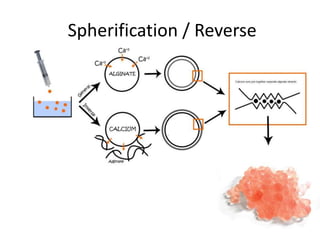
• Calcium and Potassium: Some hydrocolloids form gels in the presence of
  positively charged ions, mainly calcium and potassium

• Synergy, 1+1=3: Hydrocolloids do not act like most ingredients. In general,
  do not expect to be able to mix two hydrocolloids without changing their
  properties

• Hydration: For a hydrocolloid to work properly, it must be hydrated and
  dissolved in solution
Popular Hydrocolloids
•   Flour and Corn flour
•   Gelatine
•   Soduim Alginate
•   Xanthan Gum
•   Gellan Gum
•   Carrageenan (Kappa / Iota)
•   AgarAgar
•   Lecithin
•   Methylcellulose
•   Maltodextrin
Culinary Examples
Spherification / Reverse
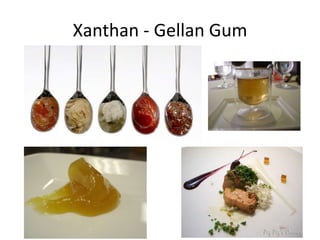
Xanthan - Gellan Gum
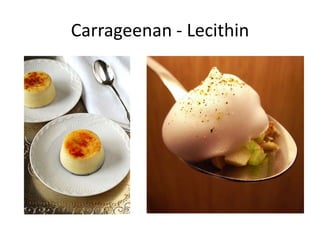
Carrageenan - Lecithin
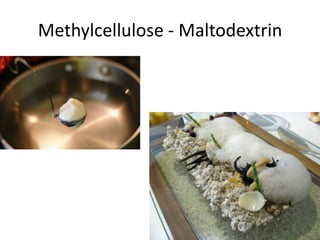
Methylcellulose - Maltodextrin

Modern cooking introduction

  • 1.
  • 2.
    Contents • Modern cookingtools – Thermomix – Paco jet – Smoke gun – Vacuum packer – Water bath & immersion calculator – Anti griddle – Centrifuge – Rotary evaporator – Liquid Nitrogen – Transglutaminase • Hydrocolloids – Important characteristics of Gels – Considerations when using Hydrocolloids – Hydrocolloid properties
  • 3.
    New Kitchen Equipment •Thermomix • Pacojet – Frozen cocktails – Soups, pâtés, terrines, quenelles – Sorbets and ice creams – Vegetable, herb and spice concentrates – Mousses
  • 4.
    New Kitchen Equipment •Smoke gun – Natural cool smoke instantly – Can smoke butter, oysters, cocktails, salads, chocolate, meringue, etc. – Creates flavors with wood chips, teas, spices, and dried flowers.
  • 5.
    New Kitchen Equipment •Vaccum packing – Stops oxidization – Preserves shelf life – Good for storage • Sous vide cooking – Controlled temperature – Uniform cooking for long periods – Cooking juices are retained – Easy to use in the kitchen – Minimal loss of moisture and weight – Preservation of flavour/aroma as water soluble substances – especially aromatics – are not lost – Flavours are enhanced, colours – Nutrients are preserved as water-soluble minerals are not leached into cooking water, as cooking in a vacuum bag eliminates this – Research has shown that sous vide gives the highest retention of vitamins vs. steaming and boiling – Little additional fat is required during cooking – Consistent results every time a dish is cooked
  • 6.
    New Kitchen Equipment •The Anti-Griddle – Quickly freezes sauces and purees – Creates solid or semi-frozen creations with stable, crunchy surfaces and cool, creamy centers – Reaches minus 34°C in 5 to 10 mintues – Has been used to make crème brûlée lollipops and frozen hot chocolate
  • 7.
    New Kitchen Equipment •Centrifuge – A centrifuge is a device that spins at high speed to separate products into parts based on density – Cooking items have different densities – Clarify juice by separating the pulp and the liquid, or to remove the fat from an emulsion and clarify
  • 8.
    New Kitchen Equipment •Rotary Evaporator – Combines evaporation under vacuum and condensation – Liquids are evaporated under vacuum, lowers their boiling point – Rotation of the evaporating flask, immersed in a heated water bath, increases the surface area of the product, greatly speeding distillation – Enables evaporation at as low as 95°F/35°C – Evaporation, distillation, concentration of flavors, and purification of liquids – Concentrates non-volatile components in a mixture – Extracts the volatile aroma and flavor molecules from mixtures – Obtains essential oils that can be used to infuse or intensify flavor
  • 9.
    Liquid Nitrogen • LiquidNitrogen – Instant freezing – Reduces ice crystal formation – Negative 196 degrees Celsius – Despite its coldness, it has only 15% more cooling power than the same amount of ice at 0 Celsius, as its not as dense • Uses: – Making ice cream in a kitchen aid – Chill liquids without diluting them – Freeze the unfreezable (e.g. alcohol, olive oil) – Chilling glasses – Blow smoke – ‘Cryo-poachinh’ – Powders, crystals and frozen drops
  • 10.
    Transglutaminase • Naturally occurringenzyme in plants, animals, and bacteria • Meat glue is an enzyme that acts on the amino acids causing bonds to form that helps the meat stick together – Make uniform portions that cook evenly, look good, and reduce waste – Bind meat mixtures like sausages without casings – Make novel meat combinations like lamb and scallops – Produce special effects like meat noodles, meat and vegetable pasta How to test meat glue: a) Rub a lot of meat glue into a piece of raw chicken; b) if it just smells like chicken your glue is no good; c) If it smells like wet dog you're good to go!
  • 11.
    Hydrocolloids • Hydrocolloids areclassified as either thickening or gelling agents • Hydrocolloids are ingredients that control water in a recipe • Many hydrocolloids are derived from natural sources, such as seaweed, seeds, roots, tree sap, fruit peels, etc • Some modern but still all-natural hydrocolloids produced by bacteria
  • 12.
    Important Characteristics ofGels • Thermo-reversible/Irreversible: Thermo-reversible gels melt when heated to a high enough temperature. Thermo- irreversible gels will not melt when heated. • Tendency for Syneresis: Syneresis occurs when liquid weeps out of a gel over time, as happens in custards. • Freeze-thaw stability: Gels that may be frozen and thawed repeatedly are called freeze-thaw stable
  • 13.
    Important Characteristics ofGels • Clarity: The addition of some hydrocolloids yield gels that are more transparent than others • Flavor release: describes how well a gel expresses the flavorings with which it has been made. Flavor release is determined by many gel texture properties • Shear reversibility: Shear is a force in which parallel objects move in opposite directions in a “sliding” motion
  • 14.
    Important Characteristics ofGels – Shear thinning: Most hydrocolloids tend to get thinner as they are sheared – Yield point: Some hydrocolloids act like a gel when standing still and liquefy instantly under shear – Fluid gels: Hydrocolloids can also form fluid gels. Fluid gels have the properties of both a fluid and a gel
  • 15.
    Considerations when using Hydrocolloids • Forming Gels: It is extremely important to understand when and why a hydrocolloid gels since this behavior typically determines which hydrocolloid is appropriate to use • Heating and Cooling: Many hydrocolloids gel when cooled. Sometimes these gels can be melted again and sometimes they cannot • Calcium and Potassium: Some hydrocolloids form gels in the presence of positively charged ions, mainly calcium and potassium • Synergy, 1+1=3: Hydrocolloids do not act like most ingredients. In general, do not expect to be able to mix two hydrocolloids without changing their properties • Hydration: For a hydrocolloid to work properly, it must be hydrated and dissolved in solution
  • 16.
    Popular Hydrocolloids • Flour and Corn flour • Gelatine • Soduim Alginate • Xanthan Gum • Gellan Gum • Carrageenan (Kappa / Iota) • AgarAgar • Lecithin • Methylcellulose • Maltodextrin
  • 17.
  • 18.
  • 19.
  • 20.
  • 21.

Editor's Notes

  • #8 Goulash separated into 8 layers by density, water, oil, tomato paste, peppercorns etc..By spinning liquids in a centrifuge u get a pseudo gravitational effect (which can be around 40,000 times that of normal gravity) Top layer – pea brothBottom layer – peasaw dust, starch and other solids, little flavourMiddle layer – pea butter, pectin etc (not fat otherwise it would be on top)
  • #9 Chemistry students are familiar with the rotary evaporator — a piece of lab equipment that removes solvents from a mixture of compounds through evaporation and condensation. The rotovap is designed for low-temperature distilling, so ingredients don’t have to be excessively heated during the process.Which is useful for cooking purposes. Rotovap distillation can separate food compounds from one another without altering them, unlike standard distillation. rotary evaporators can separate desirable from undesirable flavors—drawing off the rich aromatics of a chili pepper, for instance, while leaving behind capsaicin, which lends peppers their heat, In the kitchen, the device has been used to concentrate flavors and extract aromas by separating different flavor molecules. For instance, you can get the purest and freshest flavor from an orange by removing the water from the fruit.
  • #12 When a hydrocolloid is dissolved in water, the water gathers around and is attracted to the sugar units, forming a layer of water with restricted movement. It is this ability to organize and control water that gives hydrocolloids their ability to thicken and gel
  • #13 Agar is prone to syneresis; water can be expelled merely by pressing on it. Some gels only experience syneresis after long periods of time. Many gels that are ruined by freezing (see freeze-thaw stability, below) tend to weep when thawed. Within a given hydrocolloid system, harder gels tend to weep more than softer ones.Many gels begin to degrade after freezing; only one freeze-thaw cycle is advised. When an unstable gel is frozen and later thawed, its texture and structural may be compromised by the physical changes. To offset this effect and promote freeze-thaw stability, a second thickening hydrocolloid may be added to the gel system.Flavor release is determined by many gel texture properties. Gelatin, for example, is considered to have excellent flavor release mainly because it melts in the mouth, whereas alginate is said to have poor flavor release because it tends to lock up flavors.
  • #14 Stirring produces a shear, as does blending. Very fast blenders are called high-shear blenders. A shear-reversible gel will reform after it has been broken by a shear force. Most gels are not shear reversible.
  • #15 Agar fluid gels can look like hair gel on the plate but feel like a smooth, creamy sauce in the mouth. Gellan can make a fluid gel that diners will experience like a soup but that will suspend large particles as if it were solid.
  • #19 27sec to 15mins
  • #20 27sec to 15mins