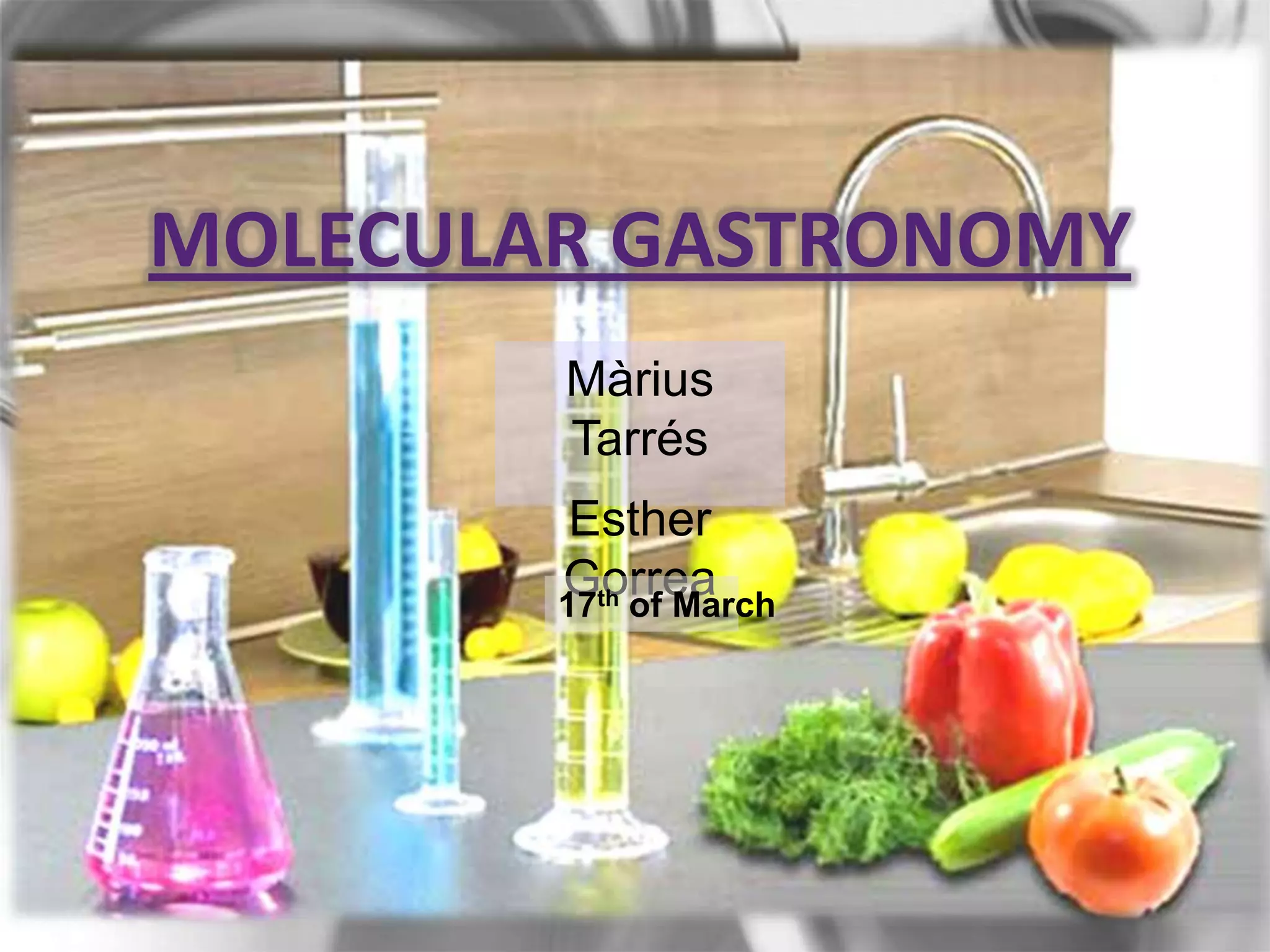
MOLECULAR GASTRONOMYMàrius TarrésEsther Gorrea17th of March
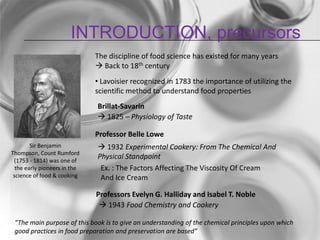
INTRODUCTION, precursors The discipline of food science has existed for many years Back to 18th century Lavoisier recognized in 1783 the importance of utilizing the scientific method to understand food propertiesBrillat-Savarin 1825 – Physiology of TasteProfessor Belle LoweSir Benjamin Thompson, Count Rumford (1753 - 1814) was one of the early pioneers in the science of food & cooking 1932 Experimental Cookery: From The Chemical And Physical Standpoint Ex. : The Factors Affecting The Viscosity Of Cream And Ice CreamProfessors Evelyn G. Halliday and Isabel T. Noble 1943 Food Chemistry and Cookery“The main purpose of this book is to give an understanding of the chemical principles upon which good practices in food preparation and preservation are based”
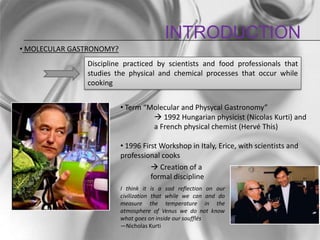
INTRODUCTION MOLECULAR GASTRONOMY?Discipline practiced by scientists and food professionals that studies the physical and chemical processes that occur while cooking Term “Molecular and Physycal Gastronomy” 1992 Hungarian physicist (Nicolas Kurti) and 	 a French physical chemist (Hervé This) 1996 First Workshop in Italy, Erice, with scientists and professional cooks  Creation of a formal disciplineI think it is a sad reflection on our civilization that while we can and do measure the temperature in the atmosphere of Venus we do not know what goes on inside our soufflés—Nicholas Kurti
Molecular gastronomyDeveloped in countries as France, Spain, Italy, Canada and Finland. Many chefs: Grant Achatz, Ferran Adrià, Jose Andres, Sat Bains, Richard Blais, Marcel Vigneron, Heston Blumenthal, Sean Brock, Homaro Cantu, Michael Carlson, Wylie Dufresne,Pierre Gagnaire, Will Goldfarb, Adam Melonas, Randy Rucker, Kevin Sousa, Sean Wilkinson, and Laurent Gras.Objectives and programm:	1- Model «culinary definitions»	2- Collect and test «culinary precisions»	3- Explore (scientifically) the artistic component of cooking	4- Explore (scientifically) social phenomena linked to cookingBasic role: Bridging the gap between culinary art and science
Myths debunked You need to add salt to water when cooking green vegetables
 Searing meat seals in the juices
 The cooking time for roast meat depends on the weight
 When cooking meat stock you must start with cold water (while false, most cooks who use tap water avoid hot water, because hot water pipes may or may not have minor mineral deposits, which give an unpleasant flavor)TECHNIQUES, TOOLS, AND INGREDIENTSCarbon dioxide source  bubbles and  foams
Liquid nitrogen (-196ºC) flash freezing and shattering
Maltodextrin can turn a high-fat liquid into a powder
Enzymes
Centrifuge
Food dehydrator
Lecithin   emulsifier and non-stick agent
Hydrocolloids   thickening agents, gelling agents, emulsifying agents, and stabilizers, sometimes needed for foams
Spherification  a caviar-like effect

Molecular gastronomy

  • 1.
  • 2.
    INTRODUCTION, precursors Thediscipline of food science has existed for many years Back to 18th century Lavoisier recognized in 1783 the importance of utilizing the scientific method to understand food propertiesBrillat-Savarin 1825 – Physiology of TasteProfessor Belle LoweSir Benjamin Thompson, Count Rumford (1753 - 1814) was one of the early pioneers in the science of food & cooking 1932 Experimental Cookery: From The Chemical And Physical Standpoint Ex. : The Factors Affecting The Viscosity Of Cream And Ice CreamProfessors Evelyn G. Halliday and Isabel T. Noble 1943 Food Chemistry and Cookery“The main purpose of this book is to give an understanding of the chemical principles upon which good practices in food preparation and preservation are based”
  • 3.
    INTRODUCTION MOLECULAR GASTRONOMY?Disciplinepracticed by scientists and food professionals that studies the physical and chemical processes that occur while cooking Term “Molecular and Physycal Gastronomy” 1992 Hungarian physicist (Nicolas Kurti) and a French physical chemist (Hervé This) 1996 First Workshop in Italy, Erice, with scientists and professional cooks  Creation of a formal disciplineI think it is a sad reflection on our civilization that while we can and do measure the temperature in the atmosphere of Venus we do not know what goes on inside our soufflés—Nicholas Kurti
  • 4.
    Molecular gastronomyDeveloped incountries as France, Spain, Italy, Canada and Finland. Many chefs: Grant Achatz, Ferran Adrià, Jose Andres, Sat Bains, Richard Blais, Marcel Vigneron, Heston Blumenthal, Sean Brock, Homaro Cantu, Michael Carlson, Wylie Dufresne,Pierre Gagnaire, Will Goldfarb, Adam Melonas, Randy Rucker, Kevin Sousa, Sean Wilkinson, and Laurent Gras.Objectives and programm: 1- Model «culinary definitions» 2- Collect and test «culinary precisions» 3- Explore (scientifically) the artistic component of cooking 4- Explore (scientifically) social phenomena linked to cookingBasic role: Bridging the gap between culinary art and science
  • 5.
    Myths debunked Youneed to add salt to water when cooking green vegetables
  • 6.
  • 7.
    The cookingtime for roast meat depends on the weight
  • 8.
    When cookingmeat stock you must start with cold water (while false, most cooks who use tap water avoid hot water, because hot water pipes may or may not have minor mineral deposits, which give an unpleasant flavor)TECHNIQUES, TOOLS, AND INGREDIENTSCarbon dioxide source  bubbles and  foams
  • 9.
    Liquid nitrogen (-196ºC)flash freezing and shattering
  • 10.
    Maltodextrin can turn ahigh-fat liquid into a powder
  • 11.
  • 12.
  • 13.
  • 14.
  • 15.
    Hydrocolloids   thickening agents, gellingagents, emulsifying agents, and stabilizers, sometimes needed for foams
  • 16.