Modelling Viscoelastic material for
Building structure
PRESENTED BY
DIGVIJAY GAIKWAD
Content
 Introduction
 Vibration isolator
 What is viscoelastic material
 Damper configuration
 Case study on VE for Building structure – Twin tower
 Other uses
 References
Introduction
 Visco-elastic (VE) dampers have been successfully incorporated in a number of tall
buildings as a viable energy dissipating system to reduce wind and earthquake induced
motion of building structures.
 This type of damper dissipates the building's mechanical energy by converting it into
heat and improving the overall performance of dynamically sensitive structures.
 So main purpose of using VE damper to reduce the effect of earthquake vibration,
protect building from wind and cyclone and comfort for building occupants.
 The twin towers of the World Trade Center Buildings in New York City and the
Columbia Sea First Building in Seattle in Washington are among the first buildings
which benefited from the installation of VE dampers.
What is Viscoelastic material (VE)
 The material which exhibits viscous and elastic properties when undergoing
deformation i.e. have properties of both solid and fluid and comes in their original
shape after certain time of period.
 Solid maintain shape, liquid contain shape of container under gravity
 Model with spring (solid component) and dashpots (liquid component)
 For example Living tissues and polymer exhibits viscoelastic behavior
 So this VE damper work as vibration isolator in building structure
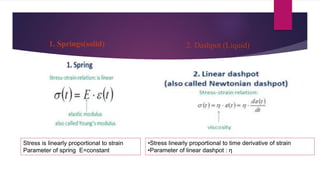
2. Dashpot (Liquid)1. Springs(solid)
Stress is linearly proportional to strain
Parameter of spring E=constant
•Stress linearly proportional to time derivative of strain
•Parameter of linear dashpot : η
Vibration Isolator
 Vibration are produced in mechanical system having unbalanced masses or forces. This vibrations are directly
transmitted to supports or foundation on which system is mounted.
 This transmission of vibration to the foundation is undesirable hence, it is necessary to isolate the system from
foundation. This is called as vibration isolation
 This undesirable effect can be reduced by using vibration isolation material like spring, rubber pads, this vibration
isolation is obtain by placing isolator material between vibrating body and supporting structure
 There are two method of vibration isolation,
1. Passive vibration isolation – does not required external power supply ( VE comes under this method )
2. Active vibration isolation – required external power supply
Literature review
Sr. No. Author Major Contribution
1 Bo-Wun Huang et. al. (2016) FEA analysis of VE damper for Normal mode analysis and seismic
response analysis.
2 B. Samali et. al. (2014) Identified the factors affecting the performance and design of VE
damper.
3 Jenn-Shin Hawang (2015) Experimental study over simple RC building structure And VE Damper
RC building structure.
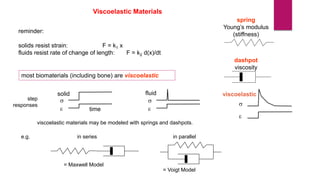
Viscoelastic Materials
reminder:
solids resist strain: F = k1 x
fluids resist rate of change of length: F = k2 d(x)/dt
spring
Young’s modulus
(stiffness)
dashpot
viscosity
most biomaterials (including bone) are viscoelastic
e
s
time
solid
e
s
fluid
e
s
viscoelastic
step
responses
viscoelastic materials may be modeled with springs and dashpots.
e.g. in series
= Maxwell Model
in parallel
= Voigt Model
Maxwell Model Voigt Model
s
e
spring
expands
dashpot
expands
spring
contracts
response
(constant
stress)
s
e
dashpot acts
as strut
acts as
spring
dashpot
relaxes
e
s
dashpot
acts as strut
acts as
spring
dashpot
relaxes
= stress
relaxation
curve
e
s
dashpot
acts as strut zero
stress
response
(constant
strain)
= damper
or low pass filter
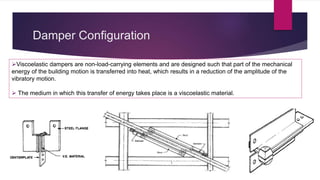
Damper Configuration
Viscoelastic dampers are non-load-carrying elements and are designed such that part of the mechanical
energy of the building motion is transferred into heat, which results in a reduction of the amplitude of the
vibratory motion.
 The medium in which this transfer of energy takes place is a viscoelastic material.
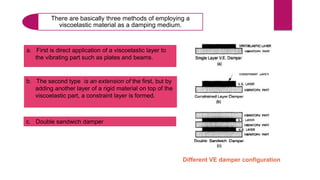
a. First is direct application of a viscoelastic layer to
the vibrating part such as plates and beams.
There are basically three methods of employing a
viscoelastic material as a damping medium.
Different VE damper configuration
b. The second type is an extension of the first, but by
adding another layer of a rigid material on top of the
viscoelastic part, a constraint layer is formed.
c. Double sandwich damper
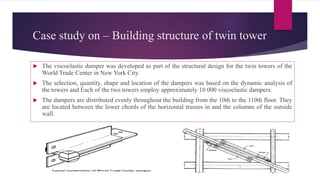
Case study on – Building structure of twin tower
 The viscoelastic damper was developed as part of the structural design for the twin towers of the
World Trade Center in New York City.
 The selection, quantity, shape and location of the dampers was based on the dynamic analysis of
the towers and Each of the two towers employ approximately 10 000 viscoelastic dampers.
 The dampers are distributed evenly throughout the building from the 10th to the 110th floor. They
are located between the lower chords of the horizontal trusses in and the columns of the outside
wall.
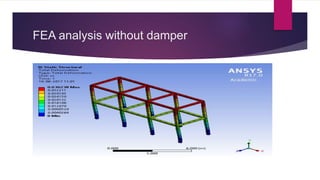
FEA analysis without damper
FEA analysis with damper
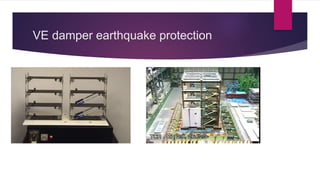
VE damper earthquake protection
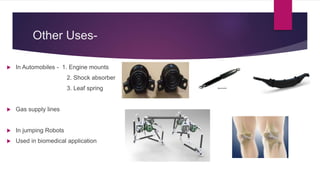
Other Uses-
 In Automobiles - 1. Engine mounts
2. Shock absorber
3. Leaf spring
 Gas supply lines
 In jumping Robots
 Used in biomedical application
References
 C. Qin,W. Liu, and W.He, “Seismic response analysis of isolated nuclear power plants with friction damper
isolation system,” AASRI Procedia, vol. 7, pp. 26–31, 2015.
 J. Pan, Y. Xu, F. Jin, and C. Zhang, “A unified approach for long-term behavior and seismic response of AAR-
affected concrete dams,” Soil Dynamics and Earthquake Engineering, vol. 63, pp. 193–202, 2014
 R. Steinbuch, “Bionic optimization of the earthquake resistance of high buildings by tuned mass dampers,” Journal
of Bionic Engineering, vol. 8, no. 3, pp. 335–344, 2016.
 Bo-Wun Huang, Jao Kauang, Seismic analysis of a Viscoelastic damping isolator, vol 2015, article id 280625, 2015
 B.Samali, K.C. Kwok, Use of viscoelastic damper in reducing wind and earth quake imduced motion of building
structures, vol 17, No. 9, pp 639-654, 2014

Modelling Visco-elastic material for Building structure

  • 1.
    Modelling Viscoelastic materialfor Building structure PRESENTED BY DIGVIJAY GAIKWAD
  • 2.
    Content  Introduction  Vibrationisolator  What is viscoelastic material  Damper configuration  Case study on VE for Building structure – Twin tower  Other uses  References
  • 3.
    Introduction  Visco-elastic (VE)dampers have been successfully incorporated in a number of tall buildings as a viable energy dissipating system to reduce wind and earthquake induced motion of building structures.  This type of damper dissipates the building's mechanical energy by converting it into heat and improving the overall performance of dynamically sensitive structures.  So main purpose of using VE damper to reduce the effect of earthquake vibration, protect building from wind and cyclone and comfort for building occupants.  The twin towers of the World Trade Center Buildings in New York City and the Columbia Sea First Building in Seattle in Washington are among the first buildings which benefited from the installation of VE dampers.
  • 4.
    What is Viscoelasticmaterial (VE)  The material which exhibits viscous and elastic properties when undergoing deformation i.e. have properties of both solid and fluid and comes in their original shape after certain time of period.  Solid maintain shape, liquid contain shape of container under gravity  Model with spring (solid component) and dashpots (liquid component)  For example Living tissues and polymer exhibits viscoelastic behavior  So this VE damper work as vibration isolator in building structure
  • 5.
    2. Dashpot (Liquid)1.Springs(solid) Stress is linearly proportional to strain Parameter of spring E=constant •Stress linearly proportional to time derivative of strain •Parameter of linear dashpot : η
  • 6.
    Vibration Isolator  Vibrationare produced in mechanical system having unbalanced masses or forces. This vibrations are directly transmitted to supports or foundation on which system is mounted.  This transmission of vibration to the foundation is undesirable hence, it is necessary to isolate the system from foundation. This is called as vibration isolation  This undesirable effect can be reduced by using vibration isolation material like spring, rubber pads, this vibration isolation is obtain by placing isolator material between vibrating body and supporting structure  There are two method of vibration isolation, 1. Passive vibration isolation – does not required external power supply ( VE comes under this method ) 2. Active vibration isolation – required external power supply
  • 7.
    Literature review Sr. No.Author Major Contribution 1 Bo-Wun Huang et. al. (2016) FEA analysis of VE damper for Normal mode analysis and seismic response analysis. 2 B. Samali et. al. (2014) Identified the factors affecting the performance and design of VE damper. 3 Jenn-Shin Hawang (2015) Experimental study over simple RC building structure And VE Damper RC building structure.
  • 8.
    Viscoelastic Materials reminder: solids resiststrain: F = k1 x fluids resist rate of change of length: F = k2 d(x)/dt spring Young’s modulus (stiffness) dashpot viscosity most biomaterials (including bone) are viscoelastic e s time solid e s fluid e s viscoelastic step responses viscoelastic materials may be modeled with springs and dashpots. e.g. in series = Maxwell Model in parallel = Voigt Model
  • 9.
    Maxwell Model VoigtModel s e spring expands dashpot expands spring contracts response (constant stress) s e dashpot acts as strut acts as spring dashpot relaxes e s dashpot acts as strut acts as spring dashpot relaxes = stress relaxation curve e s dashpot acts as strut zero stress response (constant strain) = damper or low pass filter
  • 10.
    Damper Configuration Viscoelastic dampersare non-load-carrying elements and are designed such that part of the mechanical energy of the building motion is transferred into heat, which results in a reduction of the amplitude of the vibratory motion.  The medium in which this transfer of energy takes place is a viscoelastic material.
  • 11.
    a. First isdirect application of a viscoelastic layer to the vibrating part such as plates and beams. There are basically three methods of employing a viscoelastic material as a damping medium. Different VE damper configuration b. The second type is an extension of the first, but by adding another layer of a rigid material on top of the viscoelastic part, a constraint layer is formed. c. Double sandwich damper
  • 12.
    Case study on– Building structure of twin tower  The viscoelastic damper was developed as part of the structural design for the twin towers of the World Trade Center in New York City.  The selection, quantity, shape and location of the dampers was based on the dynamic analysis of the towers and Each of the two towers employ approximately 10 000 viscoelastic dampers.  The dampers are distributed evenly throughout the building from the 10th to the 110th floor. They are located between the lower chords of the horizontal trusses in and the columns of the outside wall.
  • 13.
  • 14.
  • 15.
  • 16.
  • 17.
    Other Uses-  InAutomobiles - 1. Engine mounts 2. Shock absorber 3. Leaf spring  Gas supply lines  In jumping Robots  Used in biomedical application
  • 18.
    References  C. Qin,W.Liu, and W.He, “Seismic response analysis of isolated nuclear power plants with friction damper isolation system,” AASRI Procedia, vol. 7, pp. 26–31, 2015.  J. Pan, Y. Xu, F. Jin, and C. Zhang, “A unified approach for long-term behavior and seismic response of AAR- affected concrete dams,” Soil Dynamics and Earthquake Engineering, vol. 63, pp. 193–202, 2014  R. Steinbuch, “Bionic optimization of the earthquake resistance of high buildings by tuned mass dampers,” Journal of Bionic Engineering, vol. 8, no. 3, pp. 335–344, 2016.  Bo-Wun Huang, Jao Kauang, Seismic analysis of a Viscoelastic damping isolator, vol 2015, article id 280625, 2015  B.Samali, K.C. Kwok, Use of viscoelastic damper in reducing wind and earth quake imduced motion of building structures, vol 17, No. 9, pp 639-654, 2014