J. Appl. Environ. Biol. Sci., 6(11S)47-52, 2016
© 2016, TextRoad Publication
ISSN: 2090-4274
Journal of Applied Environmental
and Biological Sciences
www.textroad.com
Corresponding Author: Sritharan Sangaran, Petronas Chemical Olefins (M) Sdn Bhd, Kertih, Terengganu, Malaysia,
E-mail: sritharan_sangaran@petronas.com.my
Modelling of Training Simulator for Steam Cracker Operators
Sritharan Sangaran1, 2
, Saharudin Haron2
1
Petronas Chemical Olefins (M) Sdn Bhd, Kertih, Terengganu, Malaysia
2
Faculty of Chemical Engineering, Universiti Teknologi Malaysia, Skudai, Johor, Malaysia
Received: July 22, 2016
Accepted: September24,2016
ABSTRACT
The process models for an operator training system are developed to the level required for training needs. This
paper outlines how modelling standards and practices implemented in creating the Operator Training Simulator
(OTS). The model serves as the “virtual plant” for the OTS. Designing the simulator requires collaboration with
dynamic simulation software. The need of training simulator within engineering is well recognized. It became
necessity or need in an industry. It plays various roles, from fulfilling the requirement in front end task up to
furnishing the needed areas in back end task. In a petrochemical plant especially in steam crackers, training
operators to operate plant safely and consistent is a need. Need of simulation that can represent the real world
scenario is a mandatory to give a valuable training experience and loss of billions dollars can be avoided.
KEYWORDS: Steam Crackers, Training Simulators, Chemical Plant, Operators.
INTRODUCTION
Petronas Chemicals Olefins Chemicals (M) Sdn. Bhd. (PCOSB) is an ethylene cracker located in Kertih,
Malaysia. The plant received ethane and propane gas from a Petronas Gas Processing Plant. In petrochemical
industry, ethylene and propylene are also a major raw material [1] to produce varies grade of plastics. In this
industry, a self-customized dynamic simulation is preferred since commercial simulators employed for training
purposes focus more on ‘fidelity’ and not the facilities which will aid the training process.
A dynamic simulation model of the Steam crackers was developed for the use of an ethylene plant in
Kertih, Terengganu, Malaysia. The model was developed using a Dynamic Simulation Software. This software
incorporates dynamic behavior of cracker process and provides a comprehensive dynamic training.
Dynamic simulation allows the group of scenarios from which it is potential to monitor the process of
decision making, to conduct analysis and assessments of systems and to recommend solutions to improve
performance [2].
Simulators are designed and built to provide highly realistic process [3]. Simulators teach employee
(operators) how to operate the plant with confidence and skill [4]. The training simulators must fulfil the needs
of panel man and field man too [5].The panel man and field man are trained by using real time events. Operator
Training Simulators (OTS) are beneficial for educating employee action when faced with unplanned events,
educating panel man and field man faster, and succeeding quicker cracker start-ups [6]. Operator training plan is
crucial step to reduce the monetary as well as the risk of operating the plant. Plant abnormalities and unplanned
events should be avoided. A worldwide survey shows that in United State alone, almost $10 billion are lost
annually because of plant unplanned events [7].
As chemical (ethylene) plants and process controller become more sophisticated, more effective solution is
needed to maintain successful daily operation. Industry studies of the 170 largest industries shown that the
damage losses over the last 30 years in the hydrocarbon processing industry have shown that 28% are due to
operational error or plant upsets [8]. Operational error due to lack of training and not capable of handling plant
upsets result in the largest average dollar loss of all accident causes [9].
METHODOLOGY
This paper outlines how modelling standards and practices implemented. The model serves as the “virtual
plant” for the OTS. As this research requires management approval, need to prepare the documentation of
Business Opportunity Plan (business justification) and e-MOC (Engineering Management of Change). Once the
management agrees, a project teams consist of project leader, an automation engineer, a process engineer,
training coordinator and experience operators to design, test and accept the functionality of the simulator need to
be formed. Designing the simulator requires vendor for the dynamic simulation software and their license to
operate the machine. Vendors for software are informed and feedbacks from them are taken. Based on the
capability and feedbacks, management selects the vendor after the completion of bidding activity. Once the
vendor has been awarded, the actual work for the project starts. Flow charts below are the methodology to
47
Sangaran and Haron, 2016
complete this project successfully.
Training of panel man and field man is considered as a very important activity in the chemical industry
[10]. The operator training simulator (OTS) is a substitute to train operators without actually jeopardizing the
plant and personnel.
Once the process model developed as in Figure 1, then few testing will be done to test the behaviour of the
model meets the plant data according to planned step. Start up and shutdown task will be performed to verify the
behaviour of the model. Parameters such as temperature, pressure and flow at steady state compare to plant data
must match as per setting. For OTS purpose, all the control logics and tripping logic are implemented before it is
handover to users. It is crucial to understand the dynamic response of the model by varying the conditions under
which the plant is operated.
Figure 1:OTS flow
Planning and Scheduling
During the project planning and scheduling, the agreement between the vendor and the project team is
finalized. The details discussion is on the project milestones, execution plan and project organization.
Data Collection
During the project initial meeting, the heat and material balance (HMB) data sheet for the plant is verified
using plant design case one based on raw material feed where ethane feed will be 75 ton per hour (tph) and
propane will be 35 tph.
Mark Up Plant and Instrument Drawings
The scopes of the model are justified to meet the training purpose. There will not be any utilities such as
flare headers, fuel gas headers, nitrogen and others will be modelled. All the external programmable logic
controls such as Bently Nevada (vibration monitoring tools) and Woodward system (compressors anti surge
control tool) will not be modelled due to no license purchased from the respective vendors to run the model. All
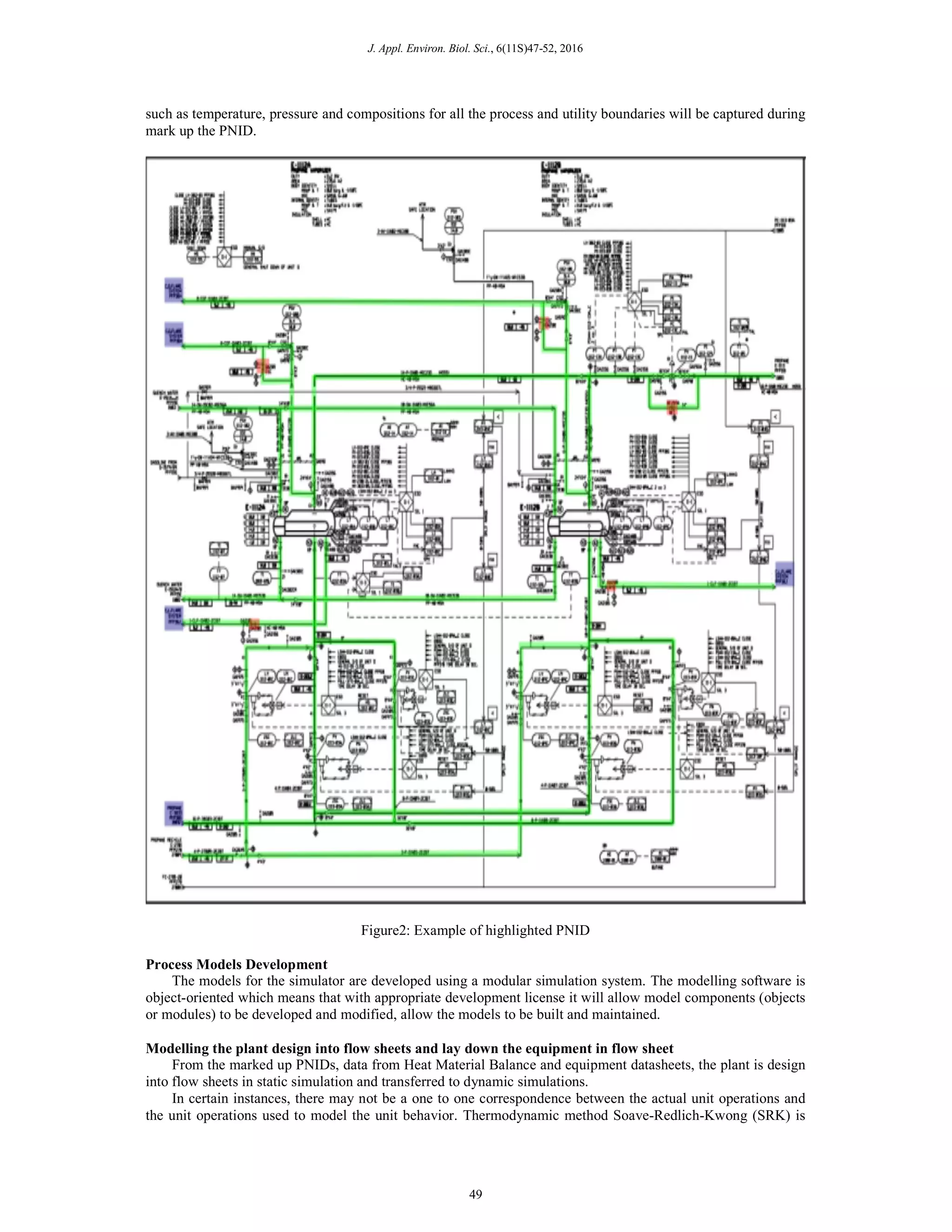
the Plant and Instrument Drawings (PNID) are highlighted before translate into flow sheets. The total
boundaries of the system are verified. OTS model is defined within fixed inlet and outlet boundaries. Conditions
48
J. Appl. Environ. Biol. Sci., 6(11S)47-52, 2016
such as temperature, pressure and compositions for all the process and utility boundaries will be captured during
mark up the PNID.
Figure2: Example of highlighted PNID
Process Models Development
The models for the simulator are developed using a modular simulation system. The modelling software is
object-oriented which means that with appropriate development license it will allow model components (objects
or modules) to be developed and modified, allow the models to be built and maintained.
Modelling the plant design into flow sheets and lay down the equipment in flow sheet
From the marked up PNIDs, data from Heat Material Balance and equipment datasheets, the plant is design
into flow sheets in static simulation and transferred to dynamic simulations.
In certain instances, there may not be a one to one correspondence between the actual unit operations and
the unit operations used to model the unit behavior. Thermodynamic method Soave-Redlich-Kwong (SRK) is
49
Sangaran and Haron, 2016
used for the model. The Soave-Redlich-Kwong equation of state is a modification of the Redlich-Kwong, which
is based on the van der Waals equation. The SRK is suitable for all light hydrocarbon processes such as natural
gas processing and light ends processing in refinery gas plants. The form of the SRK equation of state can be
written as [11]:
(1)
Figure 3: OTS architecture
Figure 4: OTS process steady state out
50
J. Appl. Environ. Biol. Sci., 6(11S)47-52, 2016
Model Acceptance Test (MAT)
After the completion of modelling of the plant into the flow sheets, verifications of these flow sheets
required which was performed during Model Acceptance Test (MAT). The MAT was specified on design of the
virtual plant but without any complex control loop. The experienced operator needed as they understand the
plant behaviour in detail. The test is conducted for almost a month to justify the modelling as built plant. All
findings are recorded and if possible solved at that particular time.
DCS and ESD Integration
The DCS and ESD integration was basically done by copying all the data from Foxboro system (actual
plant) and transfer to simulation through vendor software links.
Functional and Factory Acceptance Test (FAT)
After the modelling acceptance test completed, the entire punch list verified and solved. The controllers,
emergency shutdown and basic control system are added up to the models. The overall flow sheets are
integrated into virtual plant Distributed Control System (DCS) for testing before the Factory Acceptance Test
(FAT) done. The FAT was performed in Singapore for 3 weeks by project team with vendor as per MAT steps
but in more details. At this time, the testing was on simulation machine and on virtual DCS. All the findings will
be recorded and verified.
RESULTS AND DISCUSSION
A Survey: Experience versus New Operators
Table 1: Comparison of experience and new operators for handling events using training simulators
Table 1 shows the comparison of the test conducted on experience operators and new operators for handling
different scenarios or event in training simulations. It indicates big gaps in duration even though after the new
operators are taught the way to handle the scenarios. The duration only can be improved with more exposure
and practice with Training Simulators rather than learn through real experience. The ethylene product volume
lost is calculated in tonnage. Once the losses are multiplied with the likelihood of the operator might handle the
issue, total losses are calculated. Estimated, in a year, new operator without proper training can cause losses
around 2360 Metric Ton (MT) of ethylene which will cause around USD 3 million a year. The cost of money
and life is higher in occurrences of safety incidents.
CONCLUSION
The operator training simulators in the chemical industry reported in the open literature since 1990 and till to
date, are still a topic of interest as it is being successfully in use in many chemical industries. In ethylene plant, a
process operator’s job is varied, including complex decision making and critical job aspects than others [12].
A self-customised simulation is preferred since commercial simulators employed for training purposes
focus more on ‘fidelity’ and not the facilities which will aid the training process [12]. A proper own customised
simulators are preferred in many organization to fulfil their entire major and minor requirement. Another major
issue why a proper training should be given to operators is not because of monetary issue but because of safety
issues. Over the years, many cases being reported that cause peoples’ life.
ACKNOWLEDGEMENT
We would like to thank Petronas Chemical Olefins (M) Sdn. Bhd. for funding the project, Ministry of
Higher Education (MOE) for providing financial assistance for our research and University Teknologi of
Malaysia (UTM) for giving us opportunity to do the research.
Occasion Experience Boardman (Hour) New Boardman (Hour) Total Tonnage
1. Start-up CGC 3 8 275
2. Start-up reactor 4 8 220
3. Feed in furnace 0.5 1.5 450
4. Start-up light separation 8 16 440
5. Control of DMDS and CO 1 2 375
6. Control of hydro reactor to avoid trip and break
thru
1 2 225
7. Plant load increase 1 2 375
Total 18.5 39.5 2360
51
Sangaran and Haron, 2016
REFERENCES
1. Meisong Y., 2000. Simulation and optimization of an ethylene plant, Phd thesis,Texas Tech University.
2. Amaro, C., R. Requião and M. Embiruçu, 2011. Dynamic Modeling of a Deethanizer Column in a Natural
Gas Processing Plant.In the Proceedings of the 2011 International Conference on Modeling, Simulation and
Control, pp: 12-16.
3. Guddeti, R. and O. Olwagen, 2010. An Operator Training Simulator (OTS) for a SUPERFLEX(TM)
Unit.Retrieved from http://www.aiche.org/academy/videos/conference-presentations/operator-training-
simulator-ots-superflextm-unit.
4. GSE Systems, 2015. EnVision™ E-learning and universal simulation:Operator training solutions for oil and
gas production, NGL (gas plant) and LNG facilities, refineries andpetrochemical facilities, power plants and
technical colleges. Retrieved from http://www.gses.com/envision.
5. Nazir, S. and D. Manca, 2015. How a Plant Simulator Can Improve Industrial Safety. Process Safety
Progress, 34 (3): 237-243.
6. Siminovich, C. and S. Joao, 2014. Dynamic Operator Training Simulators for Sulphuric Acid, Phosphoric
Acid, and DAP Production Units. Procedia Engineering, 83: 215-224.
7. Roe, A., J. Mason and J. Alamo, 2010. The Role of Simulator Technology in Operator Training Programs.
Control Engineering, 57(9): P1-P3.
8. Morgan, S.W., S.P. Sendelbach and W.B.Stewart, 1994. Improve Process Training With Dynamic
Simulation. Hydrocarbon Processing (United States), 73(4): 51-66.
9. Yang, S.H., L. Yang and C.H. He, 2001. Improve Safety of Industrial Processes Using Dynamic Operator
Training Simulators. Process Safety and Environmental Protection, 79(6): 329-338.
10. Patle, D.S., Z. Ahmad and G.P. Rangaiah, 2014. Operator Training Simulators in the Chemical Industry:
Review, Issues, and Future Directions. Reviews in Chemical Engineering, 30(2): 199-216.
11. Daimler N. Justo-García, Fernando García-Sánchez, Néstor L. Díaz-Ramírez, Enrique Díaz-Herrera,2010.
Modeling of Three-Phase Vapor-Liquid-Liquid Equilibria for a Natural-Gas System Rich in Nitrogen with
the SRK and PC-SAFT EoS. Fluid Phase Equilibria, 298 (1): 92-96.
12. Shepherd, A., 1986. Issues in the Training of Process Operators. International Journal of Industrial
Ergonomics, 1(1):49-64.
52

Modelling of Training Simulator for Steam Cracker Operators

  • 1.
    J. Appl. Environ.Biol. Sci., 6(11S)47-52, 2016 © 2016, TextRoad Publication ISSN: 2090-4274 Journal of Applied Environmental and Biological Sciences www.textroad.com Corresponding Author: Sritharan Sangaran, Petronas Chemical Olefins (M) Sdn Bhd, Kertih, Terengganu, Malaysia, E-mail: sritharan_sangaran@petronas.com.my Modelling of Training Simulator for Steam Cracker Operators Sritharan Sangaran1, 2 , Saharudin Haron2 1 Petronas Chemical Olefins (M) Sdn Bhd, Kertih, Terengganu, Malaysia 2 Faculty of Chemical Engineering, Universiti Teknologi Malaysia, Skudai, Johor, Malaysia Received: July 22, 2016 Accepted: September24,2016 ABSTRACT The process models for an operator training system are developed to the level required for training needs. This paper outlines how modelling standards and practices implemented in creating the Operator Training Simulator (OTS). The model serves as the “virtual plant” for the OTS. Designing the simulator requires collaboration with dynamic simulation software. The need of training simulator within engineering is well recognized. It became necessity or need in an industry. It plays various roles, from fulfilling the requirement in front end task up to furnishing the needed areas in back end task. In a petrochemical plant especially in steam crackers, training operators to operate plant safely and consistent is a need. Need of simulation that can represent the real world scenario is a mandatory to give a valuable training experience and loss of billions dollars can be avoided. KEYWORDS: Steam Crackers, Training Simulators, Chemical Plant, Operators. INTRODUCTION Petronas Chemicals Olefins Chemicals (M) Sdn. Bhd. (PCOSB) is an ethylene cracker located in Kertih, Malaysia. The plant received ethane and propane gas from a Petronas Gas Processing Plant. In petrochemical industry, ethylene and propylene are also a major raw material [1] to produce varies grade of plastics. In this industry, a self-customized dynamic simulation is preferred since commercial simulators employed for training purposes focus more on ‘fidelity’ and not the facilities which will aid the training process. A dynamic simulation model of the Steam crackers was developed for the use of an ethylene plant in Kertih, Terengganu, Malaysia. The model was developed using a Dynamic Simulation Software. This software incorporates dynamic behavior of cracker process and provides a comprehensive dynamic training. Dynamic simulation allows the group of scenarios from which it is potential to monitor the process of decision making, to conduct analysis and assessments of systems and to recommend solutions to improve performance [2]. Simulators are designed and built to provide highly realistic process [3]. Simulators teach employee (operators) how to operate the plant with confidence and skill [4]. The training simulators must fulfil the needs of panel man and field man too [5].The panel man and field man are trained by using real time events. Operator Training Simulators (OTS) are beneficial for educating employee action when faced with unplanned events, educating panel man and field man faster, and succeeding quicker cracker start-ups [6]. Operator training plan is crucial step to reduce the monetary as well as the risk of operating the plant. Plant abnormalities and unplanned events should be avoided. A worldwide survey shows that in United State alone, almost $10 billion are lost annually because of plant unplanned events [7]. As chemical (ethylene) plants and process controller become more sophisticated, more effective solution is needed to maintain successful daily operation. Industry studies of the 170 largest industries shown that the damage losses over the last 30 years in the hydrocarbon processing industry have shown that 28% are due to operational error or plant upsets [8]. Operational error due to lack of training and not capable of handling plant upsets result in the largest average dollar loss of all accident causes [9]. METHODOLOGY This paper outlines how modelling standards and practices implemented. The model serves as the “virtual plant” for the OTS. As this research requires management approval, need to prepare the documentation of Business Opportunity Plan (business justification) and e-MOC (Engineering Management of Change). Once the management agrees, a project teams consist of project leader, an automation engineer, a process engineer, training coordinator and experience operators to design, test and accept the functionality of the simulator need to be formed. Designing the simulator requires vendor for the dynamic simulation software and their license to operate the machine. Vendors for software are informed and feedbacks from them are taken. Based on the capability and feedbacks, management selects the vendor after the completion of bidding activity. Once the vendor has been awarded, the actual work for the project starts. Flow charts below are the methodology to 47
  • 2.
    Sangaran and Haron,2016 complete this project successfully. Training of panel man and field man is considered as a very important activity in the chemical industry [10]. The operator training simulator (OTS) is a substitute to train operators without actually jeopardizing the plant and personnel. Once the process model developed as in Figure 1, then few testing will be done to test the behaviour of the model meets the plant data according to planned step. Start up and shutdown task will be performed to verify the behaviour of the model. Parameters such as temperature, pressure and flow at steady state compare to plant data must match as per setting. For OTS purpose, all the control logics and tripping logic are implemented before it is handover to users. It is crucial to understand the dynamic response of the model by varying the conditions under which the plant is operated. Figure 1:OTS flow Planning and Scheduling During the project planning and scheduling, the agreement between the vendor and the project team is finalized. The details discussion is on the project milestones, execution plan and project organization. Data Collection During the project initial meeting, the heat and material balance (HMB) data sheet for the plant is verified using plant design case one based on raw material feed where ethane feed will be 75 ton per hour (tph) and propane will be 35 tph. Mark Up Plant and Instrument Drawings The scopes of the model are justified to meet the training purpose. There will not be any utilities such as flare headers, fuel gas headers, nitrogen and others will be modelled. All the external programmable logic controls such as Bently Nevada (vibration monitoring tools) and Woodward system (compressors anti surge control tool) will not be modelled due to no license purchased from the respective vendors to run the model. All the Plant and Instrument Drawings (PNID) are highlighted before translate into flow sheets. The total boundaries of the system are verified. OTS model is defined within fixed inlet and outlet boundaries. Conditions 48
  • 3.
    J. Appl. Environ.Biol. Sci., 6(11S)47-52, 2016 such as temperature, pressure and compositions for all the process and utility boundaries will be captured during mark up the PNID. Figure2: Example of highlighted PNID Process Models Development The models for the simulator are developed using a modular simulation system. The modelling software is object-oriented which means that with appropriate development license it will allow model components (objects or modules) to be developed and modified, allow the models to be built and maintained. Modelling the plant design into flow sheets and lay down the equipment in flow sheet From the marked up PNIDs, data from Heat Material Balance and equipment datasheets, the plant is design into flow sheets in static simulation and transferred to dynamic simulations. In certain instances, there may not be a one to one correspondence between the actual unit operations and the unit operations used to model the unit behavior. Thermodynamic method Soave-Redlich-Kwong (SRK) is 49
  • 4.
    Sangaran and Haron,2016 used for the model. The Soave-Redlich-Kwong equation of state is a modification of the Redlich-Kwong, which is based on the van der Waals equation. The SRK is suitable for all light hydrocarbon processes such as natural gas processing and light ends processing in refinery gas plants. The form of the SRK equation of state can be written as [11]: (1) Figure 3: OTS architecture Figure 4: OTS process steady state out 50
  • 5.
    J. Appl. Environ.Biol. Sci., 6(11S)47-52, 2016 Model Acceptance Test (MAT) After the completion of modelling of the plant into the flow sheets, verifications of these flow sheets required which was performed during Model Acceptance Test (MAT). The MAT was specified on design of the virtual plant but without any complex control loop. The experienced operator needed as they understand the plant behaviour in detail. The test is conducted for almost a month to justify the modelling as built plant. All findings are recorded and if possible solved at that particular time. DCS and ESD Integration The DCS and ESD integration was basically done by copying all the data from Foxboro system (actual plant) and transfer to simulation through vendor software links. Functional and Factory Acceptance Test (FAT) After the modelling acceptance test completed, the entire punch list verified and solved. The controllers, emergency shutdown and basic control system are added up to the models. The overall flow sheets are integrated into virtual plant Distributed Control System (DCS) for testing before the Factory Acceptance Test (FAT) done. The FAT was performed in Singapore for 3 weeks by project team with vendor as per MAT steps but in more details. At this time, the testing was on simulation machine and on virtual DCS. All the findings will be recorded and verified. RESULTS AND DISCUSSION A Survey: Experience versus New Operators Table 1: Comparison of experience and new operators for handling events using training simulators Table 1 shows the comparison of the test conducted on experience operators and new operators for handling different scenarios or event in training simulations. It indicates big gaps in duration even though after the new operators are taught the way to handle the scenarios. The duration only can be improved with more exposure and practice with Training Simulators rather than learn through real experience. The ethylene product volume lost is calculated in tonnage. Once the losses are multiplied with the likelihood of the operator might handle the issue, total losses are calculated. Estimated, in a year, new operator without proper training can cause losses around 2360 Metric Ton (MT) of ethylene which will cause around USD 3 million a year. The cost of money and life is higher in occurrences of safety incidents. CONCLUSION The operator training simulators in the chemical industry reported in the open literature since 1990 and till to date, are still a topic of interest as it is being successfully in use in many chemical industries. In ethylene plant, a process operator’s job is varied, including complex decision making and critical job aspects than others [12]. A self-customised simulation is preferred since commercial simulators employed for training purposes focus more on ‘fidelity’ and not the facilities which will aid the training process [12]. A proper own customised simulators are preferred in many organization to fulfil their entire major and minor requirement. Another major issue why a proper training should be given to operators is not because of monetary issue but because of safety issues. Over the years, many cases being reported that cause peoples’ life. ACKNOWLEDGEMENT We would like to thank Petronas Chemical Olefins (M) Sdn. Bhd. for funding the project, Ministry of Higher Education (MOE) for providing financial assistance for our research and University Teknologi of Malaysia (UTM) for giving us opportunity to do the research. Occasion Experience Boardman (Hour) New Boardman (Hour) Total Tonnage 1. Start-up CGC 3 8 275 2. Start-up reactor 4 8 220 3. Feed in furnace 0.5 1.5 450 4. Start-up light separation 8 16 440 5. Control of DMDS and CO 1 2 375 6. Control of hydro reactor to avoid trip and break thru 1 2 225 7. Plant load increase 1 2 375 Total 18.5 39.5 2360 51
  • 6.
    Sangaran and Haron,2016 REFERENCES 1. Meisong Y., 2000. Simulation and optimization of an ethylene plant, Phd thesis,Texas Tech University. 2. Amaro, C., R. Requião and M. Embiruçu, 2011. Dynamic Modeling of a Deethanizer Column in a Natural Gas Processing Plant.In the Proceedings of the 2011 International Conference on Modeling, Simulation and Control, pp: 12-16. 3. Guddeti, R. and O. Olwagen, 2010. An Operator Training Simulator (OTS) for a SUPERFLEX(TM) Unit.Retrieved from http://www.aiche.org/academy/videos/conference-presentations/operator-training- simulator-ots-superflextm-unit. 4. GSE Systems, 2015. EnVision™ E-learning and universal simulation:Operator training solutions for oil and gas production, NGL (gas plant) and LNG facilities, refineries andpetrochemical facilities, power plants and technical colleges. Retrieved from http://www.gses.com/envision. 5. Nazir, S. and D. Manca, 2015. How a Plant Simulator Can Improve Industrial Safety. Process Safety Progress, 34 (3): 237-243. 6. Siminovich, C. and S. Joao, 2014. Dynamic Operator Training Simulators for Sulphuric Acid, Phosphoric Acid, and DAP Production Units. Procedia Engineering, 83: 215-224. 7. Roe, A., J. Mason and J. Alamo, 2010. The Role of Simulator Technology in Operator Training Programs. Control Engineering, 57(9): P1-P3. 8. Morgan, S.W., S.P. Sendelbach and W.B.Stewart, 1994. Improve Process Training With Dynamic Simulation. Hydrocarbon Processing (United States), 73(4): 51-66. 9. Yang, S.H., L. Yang and C.H. He, 2001. Improve Safety of Industrial Processes Using Dynamic Operator Training Simulators. Process Safety and Environmental Protection, 79(6): 329-338. 10. Patle, D.S., Z. Ahmad and G.P. Rangaiah, 2014. Operator Training Simulators in the Chemical Industry: Review, Issues, and Future Directions. Reviews in Chemical Engineering, 30(2): 199-216. 11. Daimler N. Justo-García, Fernando García-Sánchez, Néstor L. Díaz-Ramírez, Enrique Díaz-Herrera,2010. Modeling of Three-Phase Vapor-Liquid-Liquid Equilibria for a Natural-Gas System Rich in Nitrogen with the SRK and PC-SAFT EoS. Fluid Phase Equilibria, 298 (1): 92-96. 12. Shepherd, A., 1986. Issues in the Training of Process Operators. International Journal of Industrial Ergonomics, 1(1):49-64. 52