Modeling an Integrated
System for Obesity and
Weight Management
David Gilding
Public Health Information and Intelligence
Nottinghamshire County Council
Anne Pridgeon, Policy lead
Nottinghamshire County Council
SIMUL8 Corporation | SIMUL8.com | info@SIMUL8.com
1 800 547 6024 | +44 141 552 6888
Presenters
David Gilding
Public Health Information and Intelligence
Nottinghamshire County Council
David.Gilding@nottscc.gov.uk
Claire Cordeaux
Executive Director, Healthcare
SIMUL8 Corporation
Claire.C@SIMUL8.com
SIMUL8 Corporation | SIMUL8.com | info@SIMUL8.com
Housekeeping
• Audio
• Q and A
• Recording available on
simul8healthcare.com
Nottinghamshire County
4
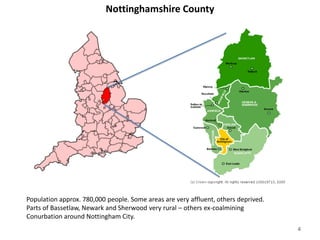
Population approx. 780,000 people. Some areas are very affluent, others deprived.
Parts of Bassetlaw, Newark and Sherwood very rural – others ex-coalmining
Conurbation around Nottingham City.
The National Health Service & Public health
Background
• Prior to 2013, obesity and weight management was the responsibility
of Primary Care Trusts (PCTs)
• These were NHS organisations who commissioned – not provided –
care
• The local Public Health system was part of PCTs
• In April 2013, local Public Health transferred to local Government
5
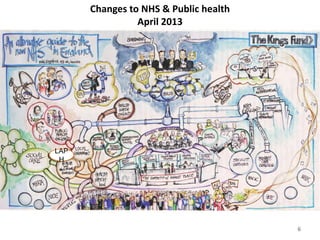
Changes to NHS & Public health
April 2013
6
LAP
H
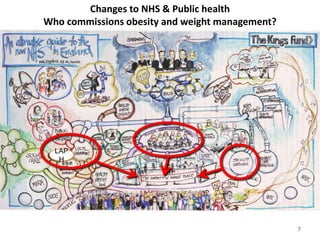
Changes to NHS & Public health
Who commissions obesity and weight management?
7
LAP
H
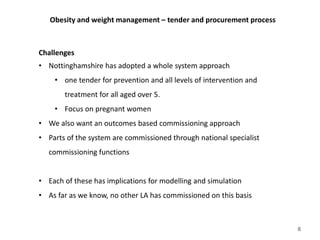
Obesity and weight management – tender and procurement process
Challenges
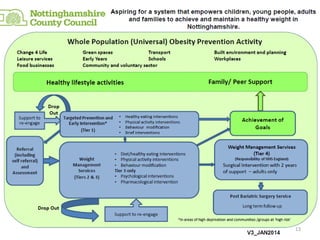
• Nottinghamshire has adopted a whole system approach
• one tender for prevention and all levels of intervention and
treatment for all aged over 5.
• Focus on pregnant women
• We also want an outcomes based commissioning approach
• Parts of the system are commissioned through national specialist
commissioning functions
• Each of these has implications for modelling and simulation
• As far as we know, no other LA has commissioned on this basis
8
Obesity and weight management – tender and procurement process
9
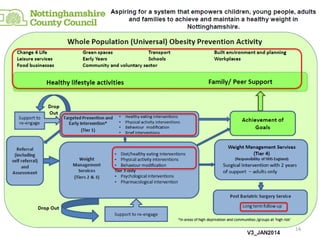
A whole system approach
Obesity and weight management – tender and procurement process
10
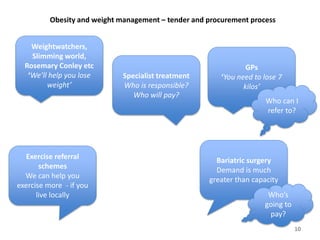
Weightwatchers,
Slimming world,
Rosemary Conley etc
‘We’ll help you lose
weight’
GPs
‘You need to lose 7
kilos’
Who can I
refer to?
Exercise referral
schemes
We can help you
exercise more - if you
live locally
Bariatric surgery
Demand is much
greater than capacity
Who’s
going to
pay?
Specialist treatment
Who is responsible?
Who will pay?
Obesity and weight management – tender and procurement process
11
Weightwatchers,
Slimming world,
Rosemary Conley etc
‘We’ll help you lose
weight’
GPs
‘You need to lose 7
kilos’
Who can I
refer to?
Exercise referral
schemes
We can help you
exercise more - if you
live locally
Bariatric surgery
Demand is much
greater than capacity
Who’s
going to
pay?
Specialist treatment
Who is responsible?
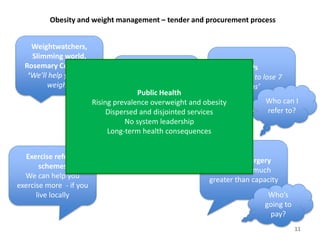
Who will pay?Public Health
Rising prevalence overweight and obesity
Dispersed and disjointed services
No system leadership
Long-term health consequences
Obesity and weight management – tender and procurement process
12
Weightwatchers,
Slimming world,
Rosemary Conley etc
‘We’ll help you lose
weight’
GPs
‘You need to lose 7
kilos’
Who can I
refer to?
Exercise referral
schemes
We can help you
exercise more - if you
live locally
Bariatric surgery
Demand is much
greater than capacity
Who’s
going to
pay?
Specialist treatment
Who is responsible?
Who will pay?
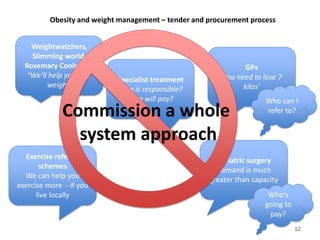
Commission a whole
system approach
13
14
Modelling challenges
• Estimate need
• Children aged 5 to 17, adults aged 18 or older, pregnant women
• Build a NICE compliant model
• How to commission affordable numbers of clients, given no precedent
for this pathway
• Clients are likely to be in the system for up to 2,3,4 years;
• how will this affect provider stability, payments and cashflow
(provider and commissioner)
• arrangements at end of contract
• How might successful, sustained weight loss by individuals affect
prevalence of overweight/ obesity in Nottinghamshire?
15
Obesity and weight management – tender and procurement process
16
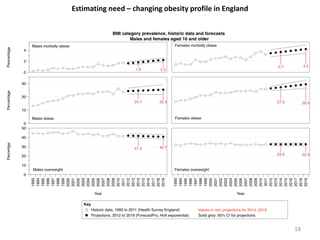
Estimating need
Estimating need
• We don’t have counts of obese and overweight people
• Need to estimate from national and regional surveys and estimates
• This is even harder when talking about health need as one
part of obesity & overweight
• We need an overall idea of scale
17
Estimating need – changing obesity profile in England
18
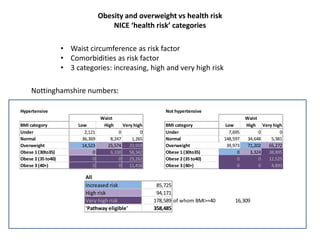
Hypertensive Not hypertensive
BMI category Low High Very high BMI category Low High Very high
Under 2,121 0 0 Under 7,695 0 0
Normal 36,369 8,247 1,265 Normal 148,597 34,648 5,381
Overweight 14,523 25,574 22,918 Overweight 39,973 71,202 65,272
Obese 1 (30to35) 0 6,338 58,342 Obese 1 (30to35) 0 3,324 38,895
Obese 2 (35 to40) 0 0 23,262 Obese 2 (35 to40) 0 0 12,525
Obese 3 (40+) 0 0 11,416 Obese 3 (40+) 0 0 4,893
Waist Waist
All
Increased risk 85,725
High risk 94,171
Very high risk 178,589 of whom BMI>=40 16,309
'Pathway eligible' 358,485
Obesity and overweight vs health risk
NICE ‘health risk’ categories
• Waist circumference as risk factor
• Comorbidities as risk factor
• 3 categories: increasing, high and very high risk
Nottinghamshire numbers:
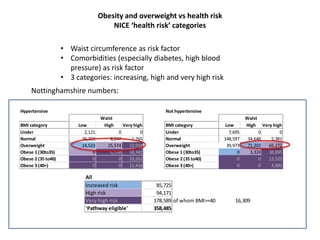
Hypertensive Not hypertensive
BMI category Low High Very high BMI category Low High Very high
Under 2,121 0 0 Under 7,695 0 0
Normal 36,369 8,247 1,265 Normal 148,597 34,648 5,381
Overweight 14,523 25,574 22,918 Overweight 39,973 71,202 65,272
Obese 1 (30to35) 0 6,338 58,342 Obese 1 (30to35) 0 3,324 38,895
Obese 2 (35 to40) 0 0 23,262 Obese 2 (35 to40) 0 0 12,525
Obese 3 (40+) 0 0 11,416 Obese 3 (40+) 0 0 4,893
Waist Waist
All
Increased risk 85,725
High risk 94,171
Very high risk 178,589 of whom BMI>=40 16,309
'Pathway eligible' 358,485
Obesity and overweight vs health risk
NICE ‘health risk’ categories
• Waist circumference as risk factor
• Comorbidities (especially diabetes, high blood
pressure) as risk factor
• 3 categories: increasing, high and very high risk
Nottinghamshire numbers:
Obesity and weight management – tender and procurement process
21
Modelling
hypothetical pathway (s)
Obesity and weight management – modelling challenges
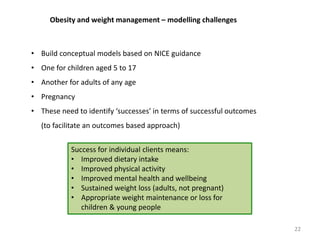
• Build conceptual models based on NICE guidance
• One for children aged 5 to 17
• Another for adults of any age
• Pregnancy
• These need to identify ‘successes’ in terms of successful outcomes
(to facilitate an outcomes based approach)
22
Success for individual clients means:
• Improved dietary intake
• Improved physical activity
• Improved mental health and wellbeing
• Sustained weight loss (adults, not pregnant)
• Appropriate weight maintenance or loss for
children & young people
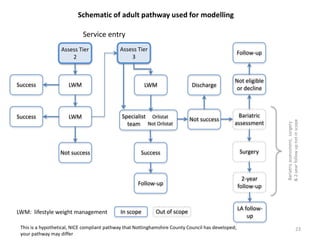
LWM: lifestyle weight management
Assess Tier
2
Assess Tier
3
LWMSuccess
LWMSuccess
LWM
Not success
Specialist
team
Orlistat
Not Orlistat
Success
Follow-up
Not success
Discharge
Bariatric
assessment
Not eligible
or decline
Follow-up
Surgery
2-year
follow-up
LA follow-
up
Bariatricassessment,surgery
&2-yearfollowupnotinscope
Service entry
In scope Out of scope
Schematic of adult pathway used for modelling
This is a hypothetical, NICE compliant pathway that Nottinghamshire County Council has developed;
your pathway may differ
23
Simulation of the pathway
24
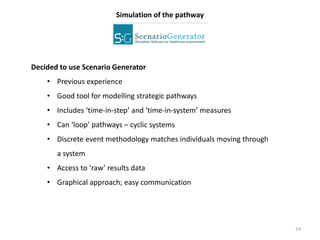
Decided to use Scenario Generator
• Previous experience
• Good tool for modelling strategic pathways
• Includes ‘time-in-step’ and ‘time-in-system’ measures
• Can ‘loop’ pathways – cyclic systems
• Discrete event methodology matches individuals moving through
a system
• Access to ‘raw’ results data
• Graphical approach; easy communication
25
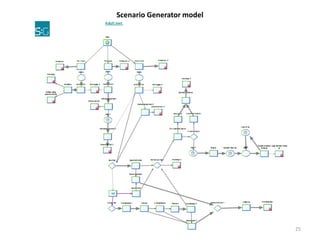
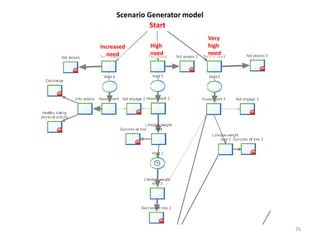
Scenario Generator model
26
Scenario Generator model
Start
Very
high
need
High
need
Increased
need
27
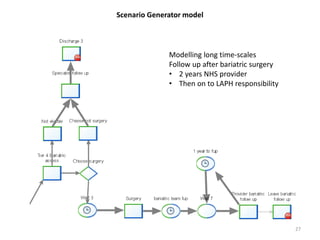
Scenario Generator model
Modelling long time-scales
Follow up after bariatric surgery
• 2 years NHS provider
• Then on to LAPH responsibility
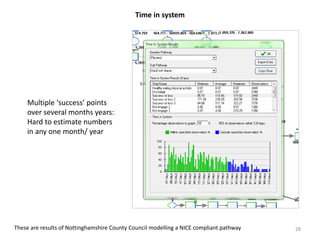
Time in system
These are results of Nottinghamshire County Council modelling a NICE compliant pathway 28
Multiple ‘success’ points
over several months years:
Hard to estimate numbers
in any one month/ year
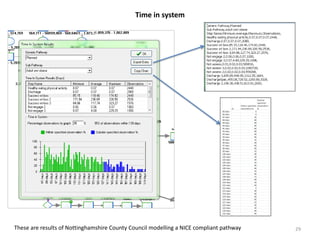
Time in system
These are results of Nottinghamshire County Council modelling a NICE compliant pathway 29
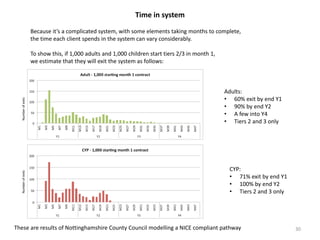
Time in system
Because it’s a complicated system, with some elements taking months to complete,
the time each client spends in the system can vary considerably.
To show this, if 1,000 adults and 1,000 children start tiers 2/3 in month 1,
we estimate that they will exit the system as follows:
Adults:
• 60% exit by end Y1
• 90% by end Y2
• A few into Y4
• Tiers 2 and 3 only
CYP:
• 71% exit by end Y1
• 100% by end Y2
• Tiers 2 and 3 only
These are results of Nottinghamshire County Council modelling a NICE compliant pathway
NumberofexitsNumberofexits
30
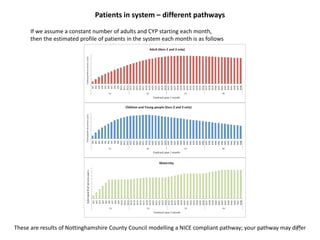
Patients in system – different pathways
If we assume a constant number of adults and CYP starting each month,
then the estimated profile of patients in the system each month is as follows
These are results of Nottinghamshire County Council modelling a NICE compliant pathway; your pathway may differ31
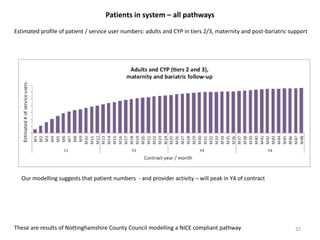
Patients in system – all pathways
Estimated profile of patient / service user numbers: adults and CYP in tiers 2/3, maternity and post-bariatric support
These are results of Nottinghamshire County Council modelling a NICE compliant pathway
Our modelling suggests that patient numbers - and provider activity – will peak in Y4 of contract
32
Conclusions
33
• Successful tender awarded in December
• Service live from April 2015
• Assurance for commissioners
• Provider appreciates the detailed modelling
• Volumes flow over long-term
• Anticipate end-of-contract effects
• Shared risk: ‘all models are useful, no models are right’
• Scenario Generator was a useful tool in the modelling process
• But we expect available resources far outstripped by demand…
SIMUL8 Corporation | SIMUL8.com | info@SIMUL8.com
QUESTIONS
Please forward any topics you would like to
see covered to claire.c@SIMUL8.com
Continue the discussion on SIMUL8 in
Health – LinkedIn Group

Modeling an Integrated System for Obesity & Weight Management

  • 1.
    Modeling an Integrated Systemfor Obesity and Weight Management David Gilding Public Health Information and Intelligence Nottinghamshire County Council Anne Pridgeon, Policy lead Nottinghamshire County Council
  • 2.
    SIMUL8 Corporation |SIMUL8.com | info@SIMUL8.com 1 800 547 6024 | +44 141 552 6888 Presenters David Gilding Public Health Information and Intelligence Nottinghamshire County Council David.Gilding@nottscc.gov.uk Claire Cordeaux Executive Director, Healthcare SIMUL8 Corporation Claire.C@SIMUL8.com
  • 3.
    SIMUL8 Corporation |SIMUL8.com | info@SIMUL8.com Housekeeping • Audio • Q and A • Recording available on simul8healthcare.com
  • 4.
    Nottinghamshire County 4 Population approx.780,000 people. Some areas are very affluent, others deprived. Parts of Bassetlaw, Newark and Sherwood very rural – others ex-coalmining Conurbation around Nottingham City.
  • 5.
    The National HealthService & Public health Background • Prior to 2013, obesity and weight management was the responsibility of Primary Care Trusts (PCTs) • These were NHS organisations who commissioned – not provided – care • The local Public Health system was part of PCTs • In April 2013, local Public Health transferred to local Government 5
  • 6.
    Changes to NHS& Public health April 2013 6 LAP H
  • 7.
    Changes to NHS& Public health Who commissions obesity and weight management? 7 LAP H
  • 8.
    Obesity and weightmanagement – tender and procurement process Challenges • Nottinghamshire has adopted a whole system approach • one tender for prevention and all levels of intervention and treatment for all aged over 5. • Focus on pregnant women • We also want an outcomes based commissioning approach • Parts of the system are commissioned through national specialist commissioning functions • Each of these has implications for modelling and simulation • As far as we know, no other LA has commissioned on this basis 8
  • 9.
    Obesity and weightmanagement – tender and procurement process 9 A whole system approach
  • 10.
    Obesity and weightmanagement – tender and procurement process 10 Weightwatchers, Slimming world, Rosemary Conley etc ‘We’ll help you lose weight’ GPs ‘You need to lose 7 kilos’ Who can I refer to? Exercise referral schemes We can help you exercise more - if you live locally Bariatric surgery Demand is much greater than capacity Who’s going to pay? Specialist treatment Who is responsible? Who will pay?
  • 11.
    Obesity and weightmanagement – tender and procurement process 11 Weightwatchers, Slimming world, Rosemary Conley etc ‘We’ll help you lose weight’ GPs ‘You need to lose 7 kilos’ Who can I refer to? Exercise referral schemes We can help you exercise more - if you live locally Bariatric surgery Demand is much greater than capacity Who’s going to pay? Specialist treatment Who is responsible? Who will pay?Public Health Rising prevalence overweight and obesity Dispersed and disjointed services No system leadership Long-term health consequences
  • 12.
    Obesity and weightmanagement – tender and procurement process 12 Weightwatchers, Slimming world, Rosemary Conley etc ‘We’ll help you lose weight’ GPs ‘You need to lose 7 kilos’ Who can I refer to? Exercise referral schemes We can help you exercise more - if you live locally Bariatric surgery Demand is much greater than capacity Who’s going to pay? Specialist treatment Who is responsible? Who will pay? Commission a whole system approach
  • 13.
  • 14.
  • 15.
    Modelling challenges • Estimateneed • Children aged 5 to 17, adults aged 18 or older, pregnant women • Build a NICE compliant model • How to commission affordable numbers of clients, given no precedent for this pathway • Clients are likely to be in the system for up to 2,3,4 years; • how will this affect provider stability, payments and cashflow (provider and commissioner) • arrangements at end of contract • How might successful, sustained weight loss by individuals affect prevalence of overweight/ obesity in Nottinghamshire? 15
  • 16.
    Obesity and weightmanagement – tender and procurement process 16 Estimating need
  • 17.
    Estimating need • Wedon’t have counts of obese and overweight people • Need to estimate from national and regional surveys and estimates • This is even harder when talking about health need as one part of obesity & overweight • We need an overall idea of scale 17
  • 18.
    Estimating need –changing obesity profile in England 18
  • 19.
    Hypertensive Not hypertensive BMIcategory Low High Very high BMI category Low High Very high Under 2,121 0 0 Under 7,695 0 0 Normal 36,369 8,247 1,265 Normal 148,597 34,648 5,381 Overweight 14,523 25,574 22,918 Overweight 39,973 71,202 65,272 Obese 1 (30to35) 0 6,338 58,342 Obese 1 (30to35) 0 3,324 38,895 Obese 2 (35 to40) 0 0 23,262 Obese 2 (35 to40) 0 0 12,525 Obese 3 (40+) 0 0 11,416 Obese 3 (40+) 0 0 4,893 Waist Waist All Increased risk 85,725 High risk 94,171 Very high risk 178,589 of whom BMI>=40 16,309 'Pathway eligible' 358,485 Obesity and overweight vs health risk NICE ‘health risk’ categories • Waist circumference as risk factor • Comorbidities as risk factor • 3 categories: increasing, high and very high risk Nottinghamshire numbers:
  • 20.
    Hypertensive Not hypertensive BMIcategory Low High Very high BMI category Low High Very high Under 2,121 0 0 Under 7,695 0 0 Normal 36,369 8,247 1,265 Normal 148,597 34,648 5,381 Overweight 14,523 25,574 22,918 Overweight 39,973 71,202 65,272 Obese 1 (30to35) 0 6,338 58,342 Obese 1 (30to35) 0 3,324 38,895 Obese 2 (35 to40) 0 0 23,262 Obese 2 (35 to40) 0 0 12,525 Obese 3 (40+) 0 0 11,416 Obese 3 (40+) 0 0 4,893 Waist Waist All Increased risk 85,725 High risk 94,171 Very high risk 178,589 of whom BMI>=40 16,309 'Pathway eligible' 358,485 Obesity and overweight vs health risk NICE ‘health risk’ categories • Waist circumference as risk factor • Comorbidities (especially diabetes, high blood pressure) as risk factor • 3 categories: increasing, high and very high risk Nottinghamshire numbers:
  • 21.
    Obesity and weightmanagement – tender and procurement process 21 Modelling hypothetical pathway (s)
  • 22.
    Obesity and weightmanagement – modelling challenges • Build conceptual models based on NICE guidance • One for children aged 5 to 17 • Another for adults of any age • Pregnancy • These need to identify ‘successes’ in terms of successful outcomes (to facilitate an outcomes based approach) 22 Success for individual clients means: • Improved dietary intake • Improved physical activity • Improved mental health and wellbeing • Sustained weight loss (adults, not pregnant) • Appropriate weight maintenance or loss for children & young people
  • 23.
    LWM: lifestyle weightmanagement Assess Tier 2 Assess Tier 3 LWMSuccess LWMSuccess LWM Not success Specialist team Orlistat Not Orlistat Success Follow-up Not success Discharge Bariatric assessment Not eligible or decline Follow-up Surgery 2-year follow-up LA follow- up Bariatricassessment,surgery &2-yearfollowupnotinscope Service entry In scope Out of scope Schematic of adult pathway used for modelling This is a hypothetical, NICE compliant pathway that Nottinghamshire County Council has developed; your pathway may differ 23
  • 24.
    Simulation of thepathway 24 Decided to use Scenario Generator • Previous experience • Good tool for modelling strategic pathways • Includes ‘time-in-step’ and ‘time-in-system’ measures • Can ‘loop’ pathways – cyclic systems • Discrete event methodology matches individuals moving through a system • Access to ‘raw’ results data • Graphical approach; easy communication
  • 25.
  • 26.
  • 27.
    27 Scenario Generator model Modellinglong time-scales Follow up after bariatric surgery • 2 years NHS provider • Then on to LAPH responsibility
  • 28.
    Time in system Theseare results of Nottinghamshire County Council modelling a NICE compliant pathway 28 Multiple ‘success’ points over several months years: Hard to estimate numbers in any one month/ year
  • 29.
    Time in system Theseare results of Nottinghamshire County Council modelling a NICE compliant pathway 29
  • 30.
    Time in system Becauseit’s a complicated system, with some elements taking months to complete, the time each client spends in the system can vary considerably. To show this, if 1,000 adults and 1,000 children start tiers 2/3 in month 1, we estimate that they will exit the system as follows: Adults: • 60% exit by end Y1 • 90% by end Y2 • A few into Y4 • Tiers 2 and 3 only CYP: • 71% exit by end Y1 • 100% by end Y2 • Tiers 2 and 3 only These are results of Nottinghamshire County Council modelling a NICE compliant pathway NumberofexitsNumberofexits 30
  • 31.
    Patients in system– different pathways If we assume a constant number of adults and CYP starting each month, then the estimated profile of patients in the system each month is as follows These are results of Nottinghamshire County Council modelling a NICE compliant pathway; your pathway may differ31
  • 32.
    Patients in system– all pathways Estimated profile of patient / service user numbers: adults and CYP in tiers 2/3, maternity and post-bariatric support These are results of Nottinghamshire County Council modelling a NICE compliant pathway Our modelling suggests that patient numbers - and provider activity – will peak in Y4 of contract 32
  • 33.
    Conclusions 33 • Successful tenderawarded in December • Service live from April 2015 • Assurance for commissioners • Provider appreciates the detailed modelling • Volumes flow over long-term • Anticipate end-of-contract effects • Shared risk: ‘all models are useful, no models are right’ • Scenario Generator was a useful tool in the modelling process • But we expect available resources far outstripped by demand…
  • 34.
    SIMUL8 Corporation |SIMUL8.com | info@SIMUL8.com QUESTIONS Please forward any topics you would like to see covered to claire.c@SIMUL8.com Continue the discussion on SIMUL8 in Health – LinkedIn Group