OCCUSIM
Supporting eye care in a complex
world
Pathway Communications Ltd
Eren Demir David Southern
Director
Pathway Communications
Ltd
Associate Professor
Hertfordshire University
Director
Pathway Communications
Ltd
What OCCUSIM does
OCCUSIM models
intravitreal pathway
using computer
software enabling the
trust to see what will
happen if they invest
in new ways of doing
things
Increase the number of patients treated
Help more patients get
the treatment they
desperately need
What OCCUSIM does
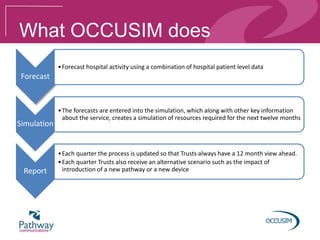
Forecast
•Forecast hospital activity using a combination of hospital patient level data
Simulation
•The forecasts are entered into the simulation, which along with other key information
about the service, creates a simulation of resources required for the next twelve months
Report
•Each quarter the process is updated so that Trusts always have a 12 month view ahead.
•Each quarter Trusts also receive an alternative scenario such as the impact of
introduction of a new pathway or a new device
Forecasting – making sure your trust is
always aware of the challenges ahead
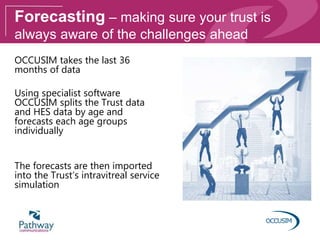
OCCUSIM takes the last 36
months of data
Using specialist software
OCCUSIM splits the Trust data
and HES data by age and
forecasts each age groups
individually
The forecasts are then imported
into the Trust’s intravitreal service
simulation
Simulation goes beyond forecasting
OCCUSIM takes key
information about the Trust’s
intravitreal service and creates
a virtual copy of the service
It uses the Trust’s data to
simulate the next twelve
months activity one patient at
a time
The information is collated
each quarterly to provide the
Trust’s unique report
Simulation – Scenario planning
What happens if…
• If you change to treat and
extend pathway?
• You adopt a new surgical
method?
• You invest in a new device?
Each quarter OCCUSIM will run
one of these or similar scenarios
for the Trust.
The Trust can also run additional
scenarios at any time.
Trusts can constantly improve their
service by testing and
implementing changes that will
enable them to treat more patients
Use OCCUSIM - Virtual clinics
Example based on real data - Hospital A
• Hospital A has around 40,000 attendances a year
of which 10,000 use intravitreal services
• According to Hospital A’s data they have 3,474
‘non discharged’ patients who have been in the
service for the last 24 months
• Of these 3,474 patients 970 patients have not been
treated for the last two years but have been
followed up in the last six months
• We tested the virtual service by removing the 970
patients from the system and then increasing the
number of new patients by 25%
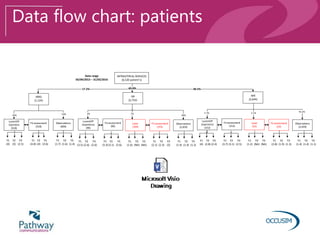
Data flow chart: patients
INTRAVITREAL SERVICES
(6,520 patient’s)
AMD
(1,124)
DR
(2,752)
LucentOP
injections
(518)
Observations
(606)
LucentOP
(injections)
(99)
FU assessment
(99)
Observations
(2,459)
4%
Laser
(194)
46%
FU assessment
(518)
54%
FU assessment
(155)
7%
89%
MR
(2,644)
LucentOP
(injections)
(152)
FU assessment
(152)
Observations
(2,439)
5.7%
Laser
(53)
FU assessment
(53)
2.1%
92.2%
42.3%
Y1
(4)
Y2
(3)
Y3
(2.5)
Y1
(4.8)
Y2
(4)
Y3
(3.6)
Y1
(1.7)
Y2
(1.6)
Y3
(1.4)
17.2% 40.5%
Y1
(3.5)
Y2
(2.6)
Y3
(2.6)
Y1
(3.3)
Y2
(3.1)
Y3
(3.6)
Y1
(1.6)
Y2
(NA)
Y3
(NA)
Y1
(2.1)
Y2
(2.3)
Y3
(2)
Y1
(1.4)
Y2
(1.4)
Y3
(1.2)
Y1
(4)
Y2
(2.8)
Y3
(2.4)
Y1
(3.7)
Y2
(3.1)
Y3
(2.5)
Y1
(1.2)
Y2
(NA)
Y3
(NA)
Y1
(2.8)
Y2
(1.9)
Y3
(1.3)
Y1
(1.4)
Y2
(1.4)
Y3
(1.1)
Date range
03/04/2013 – 31/03/2016
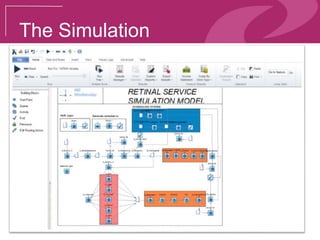
The Simulation
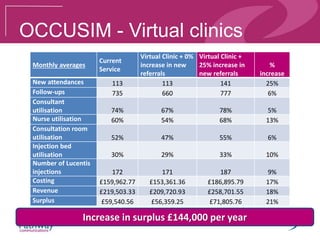
OCCUSIM - Virtual clinics
Monthly averages
Current
Service
Virtual Clinic + 0%
increase in new
referrals
Virtual Clinic +
25% increase in
new referrals
%
increase
New attendances 113 113 141 25%
Follow-ups 735 660 777 6%
Consultant
utilisation 74% 67% 78% 5%
Nurse utilisation 60% 54% 68% 13%
Consultation room
utilisation 52% 47% 55% 6%
Injection bed
utilisation 30% 29% 33% 10%
Number of Lucentis
injections 172 171 187 9%
Costing £159,962.77 £153,361.36 £186,895.79 17%
Revenue £219,503.33 £209,720.93 £258,701.55 18%
Surplus £59,540.56 £56,359.25 £71,805.76 21%
Increase in surplus £144,000 per year
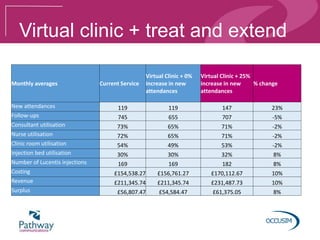
Virtual clinic + treat and extend
Monthly averages Current Service
Virtual Clinic + 0%
increase in new
attendances
Virtual Clinic + 25%
increase in new
attendances
% change
New attendances 119 119 147 23%
Follow-ups 745 655 707 -5%
Consultant utilisation 73% 65% 71% -2%
Nurse utilisation 72% 65% 71% -2%
Clinic room utilisation 54% 49% 53% -2%
Injection bed utilisation 30% 30% 32% 8%
Number of Lucentis injections 169 169 182 8%
Costing £154,538.27 £156,761.27 £170,112.67 10%
Revenue £211,345.74 £211,345.74 £231,487.73 10%
Surplus £56,807.47 £54,584.47 £61,375.05 8%
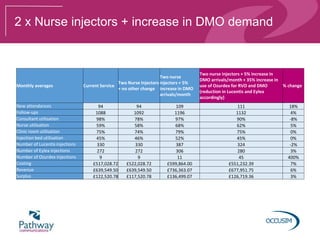
2 x Nurse injectors + increase in DMO demand
Monthly averages Current Service
Two Nurse Injectors
+ no other change
Two nurse
injectors + 5%
increase in DMO
arrivals/month
Two nurse injectors + 5% increase in
DMO arrivals/month + 35% increase in
use of Ozurdex for RVO and DMO
(reduction in Lucentis and Eylea
accordingly)
% change
New attendances 94 94 109 111 18%
Follow-ups 1088 1092 1196 1132 4%
Consultant utilisation 98% 78% 97% 90% -8%
Nurse utilisation 59% 58% 68% 62% 5%
Clinic room utilisation 75% 74% 79% 75% 0%
Injection bed utilisation 45% 46% 52% 45% 0%
Number of Lucentis injections 330 330 387 324 -2%
Number of Eylea injections 272 272 306 280 3%
Number of Ozurdex injections 9 9 11 45 400%
Costing £517,028.72 £522,028.72 £599,864.00 £551,232.39 7%
Revenue £639,549.50 £639,549.50 £736,363.07 £677,951.75 6%
Surplus £122,520.78 £117,520.78 £136,499.07 £126,719.36 3%
Pathway Communications
Specialists in healthcare analytics and
patient pathway simulations
OCCUSIM
Supporting eye care in a complex
world
enquiries@pathwaycommunications.co.uk
www.pathwaycommunications.co.uk
Thank you for joining us
The webinar recording is available
on SIMUL8Healthcare.com
Continue the discussion:
SIMUL8 in Health

Improving Eye Care Outpatient Services with Simulation

  • 1.
    OCCUSIM Supporting eye carein a complex world
  • 2.
    Pathway Communications Ltd ErenDemir David Southern Director Pathway Communications Ltd Associate Professor Hertfordshire University Director Pathway Communications Ltd
  • 3.
    What OCCUSIM does OCCUSIMmodels intravitreal pathway using computer software enabling the trust to see what will happen if they invest in new ways of doing things
  • 4.
    Increase the numberof patients treated Help more patients get the treatment they desperately need
  • 5.
    What OCCUSIM does Forecast •Forecasthospital activity using a combination of hospital patient level data Simulation •The forecasts are entered into the simulation, which along with other key information about the service, creates a simulation of resources required for the next twelve months Report •Each quarter the process is updated so that Trusts always have a 12 month view ahead. •Each quarter Trusts also receive an alternative scenario such as the impact of introduction of a new pathway or a new device
  • 6.
    Forecasting – makingsure your trust is always aware of the challenges ahead OCCUSIM takes the last 36 months of data Using specialist software OCCUSIM splits the Trust data and HES data by age and forecasts each age groups individually The forecasts are then imported into the Trust’s intravitreal service simulation
  • 7.
    Simulation goes beyondforecasting OCCUSIM takes key information about the Trust’s intravitreal service and creates a virtual copy of the service It uses the Trust’s data to simulate the next twelve months activity one patient at a time The information is collated each quarterly to provide the Trust’s unique report
  • 8.
    Simulation – Scenarioplanning What happens if… • If you change to treat and extend pathway? • You adopt a new surgical method? • You invest in a new device? Each quarter OCCUSIM will run one of these or similar scenarios for the Trust. The Trust can also run additional scenarios at any time. Trusts can constantly improve their service by testing and implementing changes that will enable them to treat more patients
  • 9.
    Use OCCUSIM -Virtual clinics Example based on real data - Hospital A • Hospital A has around 40,000 attendances a year of which 10,000 use intravitreal services • According to Hospital A’s data they have 3,474 ‘non discharged’ patients who have been in the service for the last 24 months • Of these 3,474 patients 970 patients have not been treated for the last two years but have been followed up in the last six months • We tested the virtual service by removing the 970 patients from the system and then increasing the number of new patients by 25%
  • 10.
    Data flow chart:patients INTRAVITREAL SERVICES (6,520 patient’s) AMD (1,124) DR (2,752) LucentOP injections (518) Observations (606) LucentOP (injections) (99) FU assessment (99) Observations (2,459) 4% Laser (194) 46% FU assessment (518) 54% FU assessment (155) 7% 89% MR (2,644) LucentOP (injections) (152) FU assessment (152) Observations (2,439) 5.7% Laser (53) FU assessment (53) 2.1% 92.2% 42.3% Y1 (4) Y2 (3) Y3 (2.5) Y1 (4.8) Y2 (4) Y3 (3.6) Y1 (1.7) Y2 (1.6) Y3 (1.4) 17.2% 40.5% Y1 (3.5) Y2 (2.6) Y3 (2.6) Y1 (3.3) Y2 (3.1) Y3 (3.6) Y1 (1.6) Y2 (NA) Y3 (NA) Y1 (2.1) Y2 (2.3) Y3 (2) Y1 (1.4) Y2 (1.4) Y3 (1.2) Y1 (4) Y2 (2.8) Y3 (2.4) Y1 (3.7) Y2 (3.1) Y3 (2.5) Y1 (1.2) Y2 (NA) Y3 (NA) Y1 (2.8) Y2 (1.9) Y3 (1.3) Y1 (1.4) Y2 (1.4) Y3 (1.1) Date range 03/04/2013 – 31/03/2016
  • 11.
  • 12.
    OCCUSIM - Virtualclinics Monthly averages Current Service Virtual Clinic + 0% increase in new referrals Virtual Clinic + 25% increase in new referrals % increase New attendances 113 113 141 25% Follow-ups 735 660 777 6% Consultant utilisation 74% 67% 78% 5% Nurse utilisation 60% 54% 68% 13% Consultation room utilisation 52% 47% 55% 6% Injection bed utilisation 30% 29% 33% 10% Number of Lucentis injections 172 171 187 9% Costing £159,962.77 £153,361.36 £186,895.79 17% Revenue £219,503.33 £209,720.93 £258,701.55 18% Surplus £59,540.56 £56,359.25 £71,805.76 21% Increase in surplus £144,000 per year
  • 13.
    Virtual clinic +treat and extend Monthly averages Current Service Virtual Clinic + 0% increase in new attendances Virtual Clinic + 25% increase in new attendances % change New attendances 119 119 147 23% Follow-ups 745 655 707 -5% Consultant utilisation 73% 65% 71% -2% Nurse utilisation 72% 65% 71% -2% Clinic room utilisation 54% 49% 53% -2% Injection bed utilisation 30% 30% 32% 8% Number of Lucentis injections 169 169 182 8% Costing £154,538.27 £156,761.27 £170,112.67 10% Revenue £211,345.74 £211,345.74 £231,487.73 10% Surplus £56,807.47 £54,584.47 £61,375.05 8%
  • 15.
    2 x Nurseinjectors + increase in DMO demand Monthly averages Current Service Two Nurse Injectors + no other change Two nurse injectors + 5% increase in DMO arrivals/month Two nurse injectors + 5% increase in DMO arrivals/month + 35% increase in use of Ozurdex for RVO and DMO (reduction in Lucentis and Eylea accordingly) % change New attendances 94 94 109 111 18% Follow-ups 1088 1092 1196 1132 4% Consultant utilisation 98% 78% 97% 90% -8% Nurse utilisation 59% 58% 68% 62% 5% Clinic room utilisation 75% 74% 79% 75% 0% Injection bed utilisation 45% 46% 52% 45% 0% Number of Lucentis injections 330 330 387 324 -2% Number of Eylea injections 272 272 306 280 3% Number of Ozurdex injections 9 9 11 45 400% Costing £517,028.72 £522,028.72 £599,864.00 £551,232.39 7% Revenue £639,549.50 £639,549.50 £736,363.07 £677,951.75 6% Surplus £122,520.78 £117,520.78 £136,499.07 £126,719.36 3%
  • 16.
    Pathway Communications Specialists inhealthcare analytics and patient pathway simulations
  • 17.
    OCCUSIM Supporting eye carein a complex world enquiries@pathwaycommunications.co.uk www.pathwaycommunications.co.uk
  • 18.
    Thank you forjoining us The webinar recording is available on SIMUL8Healthcare.com Continue the discussion: SIMUL8 in Health