Discrete event simulation model for
planning Level 2
“step-down” bed needs using NEMS
Felipe Rodrigues1, Greg Zaric1, David Stanford2
(Judy Kojlak3, Fran Priestap3, Claudio Martin3 )
1 Ivey Business School @ Western University
2 Department of Statistical and Actuarial Sciences @ Western University
3 LHSC
Ivey International Centre for Health Innovation (IICHI)
Ontario Trillium Scholarship (OTS)
Universidade Federal do Paraná (UFPR)
7/10/2017 - Simul8 Webinar 2017 1
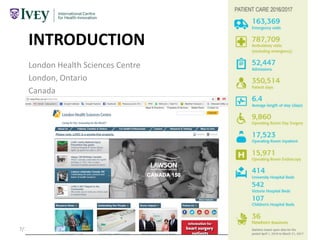
INTRODUCTION
London Health Sciences Centre
London, Ontario
Canada
7/10/2017 2
Definitions
• MSICU: Medical Surgical Intensive Care Unit
• NEMS (Miranda et al. 1997):
– “Nine Equivalents of nursing Manpower use Score”
– Therapeutic intervention index to measure
nursing workload: 56 point scale
7/10/2017 3
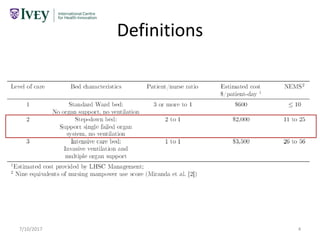
Definitions
7/10/2017 4
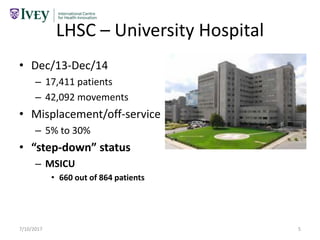
LHSC – University Hospital
• Dec/13-Dec/14
– 17,411 patients
– 42,092 movements
• Misplacement/off-service
– 5% to 30%
• “step-down” status
– MSICU
• 660 out of 864 patients
7/10/2017 5
Research questions
• What is the benefit of a “step-down” unit?
– Patient Flow
– Throughput
– Length-of-stays
– Costs
• For UH:
– What are the UH’s L2 bed needs? How efficient can
they be?
• Can NEMS scores provide a useful step-down rule
in estimating L2 needs?
7/10/2017 6
Challenges
• No previous history of medicine L2
• Seasonality, patient heterogeneity
• Patient’s health and death probability change
over time
• Step-downs & bounce-backs, congestion
• Off-service
• Costs
7/10/2017 7
METHODS AND MODEL
7/10/2017 8
DES Model Overview
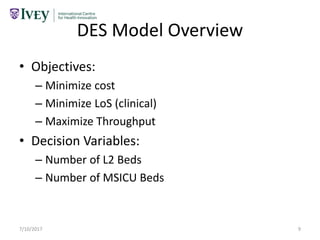
• Objectives:
– Minimize cost
– Minimize LoS (clinical)
– Maximize Throughput
• Decision Variables:
– Number of L2 Beds
– Number of MSICU Beds
7/10/2017 9
DES Model Overview
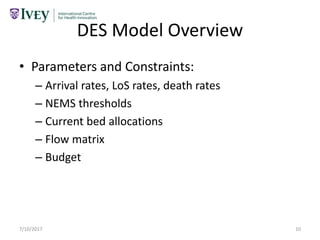
• Parameters and Constraints:
– Arrival rates, LoS rates, death rates
– NEMS thresholds
– Current bed allocations
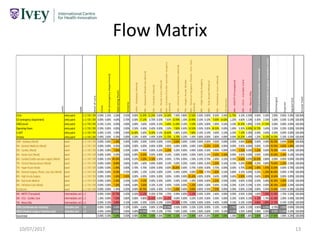
– Flow matrix
– Budget
7/10/2017 10
Data
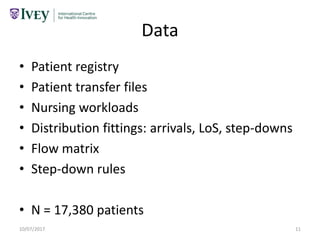
• Patient registry
• Patient transfer files
• Nursing workloads
• Distribution fittings: arrivals, LoS, step-downs
• Flow matrix
• Step-down rules
• N = 17,380 patients
10/07/2017 11
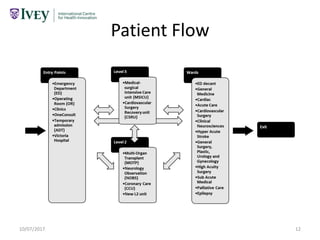
Patient Flow
10/07/2017 12
Flow Matrix
10/07/2017 13
units
type
levelofcare
Clinic
ED(emergencyDepartment)
OperatingRoom
Victoria
10th-Epilepsy(Ward)
4th-GeneralMedicine(Ward)
5th-Cardiac(Ward)
6th-AcuteCare(Ward)
6th-Cardiac/Cardiovascularsurgery
(Ward)
7th-ClinicalNeurosciences(Ward)
7th-HyperAcuteStroke
8th-GeneralSurgery,Plastic,Uro,Gyn
(Ward)
8th-HighAcuitySurgery
8th-SubAcuteMedical
9th-PalliativeCare(Ward)
EDDecant
4th-MOTP(Transplant)
5th-CCU-CardiacCare
7th-NeuroObs
CSRU(cardiovascularrecovery)
MSCU(medicalsurgeryintensivecare)
Discharged
Expired
SignedOut
GrandTotal
Clinic entry point L-1 / ER / OR 0.00% 2.10% 3.20% 0.50% 0.00% 13.30% 15.20% 0.00% 14.30% 7.40% 0.80% 12.50% 0.30% 0.00% 8.50% 0.30% 11.70% 6.10% 0.30% 0.00% 0.30% 2.90% 0.00% 0.30% 100.00%
ED (emergency Department) entry point L-1 / ER / OR 0.00% 0.00% 4.60% 0.70% 0.00% 17.10% 6.70% 0.50% 7.60% 10.90% 1.30% 10.90% 0.10% 0.10% 9.00% 14.60% 1.20% 4.60% 1.10% 0.30% 2.50% 5.60% 0.50% 0.10% 100.00%
ONEConsult entry point L-1 / ER / OR 0.10% 0.10% 0.00% 0.00% 0.00% 3.60% 4.60% 0.10% 5.40% 11.00% 0.10% 5.50% 0.20% 0.00% 5.00% 0.10% 3.10% 39.30% 1.80% 2.50% 17.50% 0.00% 0.00% 0.00% 100.00%
Operating Room entry point L-1 / ER / OR 0.30% 0.00% 0.00% 0.00% 0.50% 0.40% 0.40% 0.00% 1.50% 7.80% 0.00% 14.50% 3.50% 0.00% 34.50% 0.00% 1.60% 0.30% 6.90% 18.70% 3.40% 5.50% 0.20% 0.00% 100.00%
U-ADT entry point L-1 / ER / OR 6.40% 0.10% 5.90% 0.00% 16.00% 5.60% 8.30% 0.10% 24.60% 5.80% 0.20% 7.80% 0.10% 0.10% 4.00% 0.10% 6.50% 7.10% 0.30% 0.40% 0.60% 0.00% 0.00% 0.00% 100.00%
Victoria entry point L-1 / ER / OR 0.40% 2.60% 0.20% 0.00% 0.20% 0.40% 3.40% 0.00% 11.70% 6.70% 0.20% 1.40% 0.00% 0.00% 2.80% 0.00% 0.60% 19.20% 1.40% 1.20% 8.10% 34.20% 5.10% 0.20% 100.00%
10th - Epilepsy (Ward) ward L-1 / ER / OR 0.00% 0.00% 1.40% 0.00% 0.00% 0.00% 0.00% 0.00% 0.30% 0.60% 0.00% 0.00% 0.00% 0.00% 0.00% 0.00% 0.00% 0.00% 0.60% 0.00% 0.00% 96.50% 0.00% 0.60% 100.00%
4th - General Medicine (Ward) ward L-1 / ER / OR 0.00% 0.00% 0.00% 0.00% 0.00% 0.00% 0.00% 0.00% 0.00% 0.00% 0.00% 0.00% 0.00% 0.20% 0.20% 0.00% 0.00% 0.00% 0.00% 0.00% 0.10% 93.90% 4.60% 1.00% 100.00%
5th - Cardiac (Ward) ward L-1 / ER / OR 0.30% 0.00% 7.00% 0.30% 0.00% 1.40% 0.00% 0.20% 3.20% 0.20% 0.00% 0.40% 0.00% 0.50% 0.90% 0.00% 0.00% 3.50% 0.00% 3.20% 0.60% 76.50% 1.60% 0.20% 100.00%
6th - Acute Care (Ward) ward L-1 / ER / OR 0.00% 0.00% 0.00% 0.00% 0.00% 0.20% 0.00% 0.00% 0.10% 0.00% 0.00% 0.00% 0.00% 0.10% 0.30% 0.30% 0.00% 0.00% 0.00% 0.00% 0.00% 95.60% 3.30% 0.10% 100.00%
6th - Cardiac/Cardio vascular surgery (Ward) ward L-1 / ER / OR 0.00% 0.10% 49.30% 0.40% 0.10% 3.20% 3.10% 0.30% 0.00% 0.70% 0.00% 1.50% 0.10% 0.70% 2.00% 0.10% 0.50% 6.60% 0.00% 30.50% 0.80% 0.00% 0.00% 0.00% 100.00%
7th - Clinical Neurosciences (Ward) ward L-1 / ER / OR 0.00% 0.00% 8.80% 0.60% 0.30% 1.60% 0.00% 0.00% 0.10% 0.00% 0.20% 0.60% 0.00% 0.20% 2.20% 0.10% 0.10% 0.20% 4.90% 0.20% 0.80% 76.60% 2.20% 0.30% 100.00%
7th - Hyper Acute Stroke ward L-1 / ER / OR 0.00% 0.00% 1.40% 0.00% 0.70% 0.70% 0.00% 0.00% 0.00% 68.80% 0.00% 0.70% 0.00% 0.00% 0.70% 0.00% 0.00% 0.70% 2.20% 1.40% 1.40% 20.60% 0.00% 0.70% 100.00%
8th - General Surgery, Plastic, Uro, Gyn (Ward) ward L-1 / ER / OR 0.00% 0.00% 8.50% 0.70% 0.00% 1.10% 0.20% 0.00% 0.20% 0.40% 0.00% 0.00% 1.70% 0.70% 1.80% 0.10% 0.80% 0.10% 0.00% 0.20% 1.30% 80.60% 0.90% 0.70% 100.00%
8th - High Acuity Surgery ward L-1 / ER / OR 0.00% 0.00% 1.60% 0.90% 0.00% 0.00% 0.00% 0.00% 0.00% 0.00% 0.00% 81.40% 0.00% 0.00% 0.60% 0.00% 0.60% 0.90% 0.00% 0.60% 2.80% 10.60% 0.00% 0.00% 100.00%
8th - Sub Acute Medical ward L-1 / ER / OR 0.00% 0.00% 2.30% 0.50% 0.00% 4.10% 0.00% 0.50% 0.00% 0.00% 0.50% 1.40% 0.00% 0.00% 3.20% 0.50% 0.00% 0.00% 0.50% 0.50% 0.00% 82.30% 3.20% 0.50% 100.00%
9th - Palliative Care (Ward) ward L-1 / ER / OR 0.00% 0.00% 7.20% 0.40% 0.00% 3.60% 0.10% 0.10% 0.40% 0.60% 0.00% 1.20% 0.00% 1.00% 0.00% 0.10% 0.20% 0.20% 0.10% 0.10% 0.40% 80.50% 3.60% 0.20% 100.00%
ED Decant ward L-1 / ER / OR 0.00% 0.00% 1.30% 0.20% 0.00% 45.70% 3.60% 4.30% 4.70% 5.00% 0.00% 9.80% 0.00% 0.50% 7.50% 0.00% 0.30% 0.00% 0.10% 0.00% 0.20% 15.60% 0.90% 0.30% 100.00%
4th - MOTP (Transplant) intermediate unit L-2 0.00% 0.00% 10.70% 0.20% 0.20% 13.10% 0.30% 0.70% 1.70% 0.90% 0.00% 6.10% 0.30% 0.20% 2.60% 0.00% 0.00% 0.50% 0.20% 1.60% 5.90% 52.90% 1.70% 0.20% 100.00%
5th - CCU - Cardiac Care intermediate unit L-2 1.30% 0.00% 7.50% 0.80% 0.00% 0.80% 20.40% 0.00% 16.30% 0.60% 0.00% 0.20% 0.10% 0.00% 0.30% 0.00% 0.20% 0.00% 0.10% 4.10% 1.70% 43.20% 2.00% 0.40% 100.00%
7th - Neuro Obs intermediate unit L-2 0.00% 0.10% 5.80% 0.10% 0.40% 0.30% 0.00% 0.10% 0.00% 71.50% 0.70% 0.00% 0.00% 0.00% 0.40% 0.00% 0.10% 0.10% 0.00% 0.80% 3.80% 15.70% 0.10% 0.00% 100.00%
CSRU (cardiovascular recovery) intensive care L-3 0.00% 0.00% 4.40% 0.10% 0.00% 0.60% 0.00% 0.10% 82.70% 0.50% 0.00% 0.10% 0.20% 0.00% 0.10% 0.00% 1.70% 1.60% 0.10% 0.00% 4.10% 0.70% 3.00% 0.00% 100.00%
MSCU (medical surgery intensive care) intensive care L-3 0.00% 0.00% 8.60% 0.90% 0.00% 16.50% 1.70% 0.10% 0.70% 7.00% 0.30% 6.90% 2.90% 0.00% 2.30% 0.10% 8.10% 3.50% 6.80% 2.00% 0.00% 9.40% 22.00% 0.20% 100.00%
Grand total 0.40% 0.10% 5.00% 0.30% 0.90% 6.70% 3.00% 0.30% 7.30% 6.10% 0.30% 6.40% 0.80% 0.20% 8.00% 3.00% 1.30% 3.00% 1.80% 3.80% 2.20% 37.00% 1.90% 0.20% 100.00%
7/10/2017 14
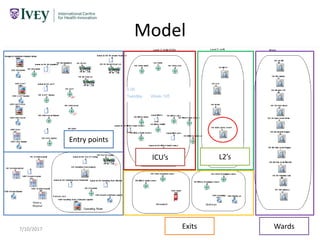
Model
Entry points
ICU’s
Exits
L2’s
Wards
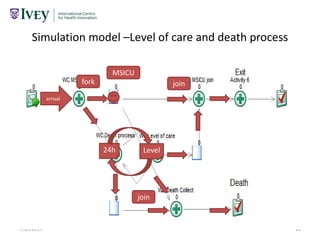
Simulation model –Level of care and death process
7/10/2017 15
arrival
fork
MSICU
24h Level
join
join
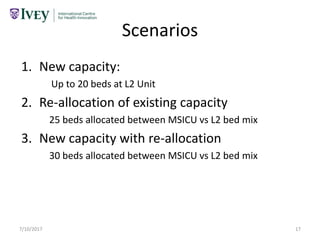
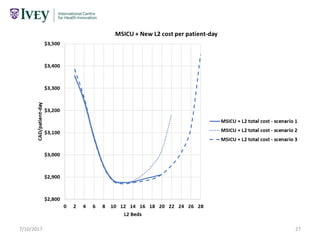
Scenarios
1. New capacity:
Up to 20 beds at L2 Unit
2. Re-allocation of existing capacity
25 beds allocated between MSICU vs L2 bed mix
3. New capacity with re-allocation
30 beds allocated between MSICU vs L2 bed mix
7/10/2017 17
MODEL VALIDATION
7/10/2017 18
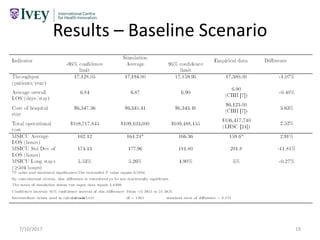
Results – Baseline Scenario
7/10/2017 19
SCENARIO ANALYSIS
7/10/2017 20
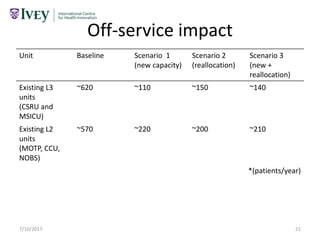
Off-service impact
7/10/2017 21
Unit Baseline Scenario 1

(new capacity)
Scenario 2
(reallocation)
Scenario 3
(new +
reallocation)
Existing L3
units
(CSRU and
MSICU)
~620 ~110 ~150 ~140
Existing L2
units
(MOTP, CCU,
NOBS)
~570 ~220 ~200 ~210
*(patients/year)
7/10/2017 22
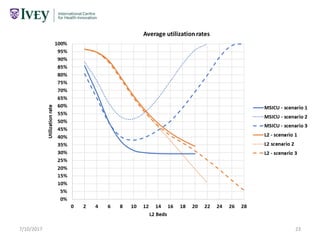
7/10/2017 23
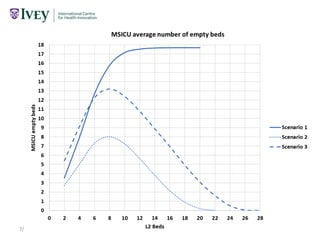
7/10/2017 24
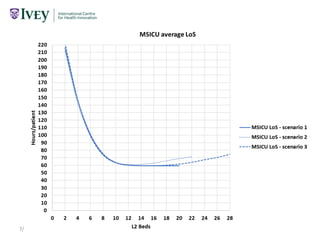
7/10/2017 25
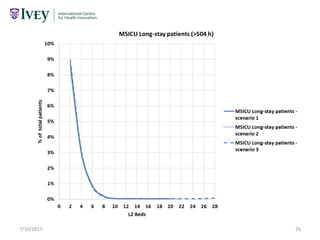
7/10/2017 26
7/10/2017 27
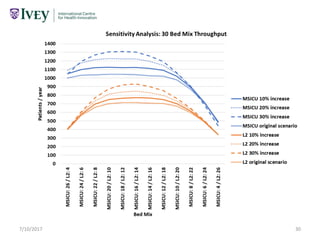
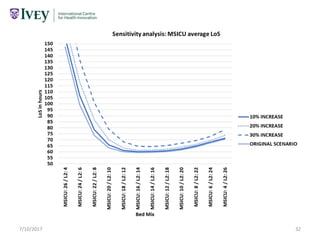
SENSITIVITY ANALYSIS
7/10/2017 28
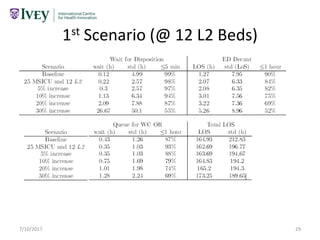
1st Scenario (@ 12 L2 Beds)
7/10/2017 29
7/10/2017 30
7/10/2017 32
7/10/2017 34
7/10/2017 35
Summary
CONCLUSIONS AND EXTENSIONS
7/10/2017 36
Conclusions
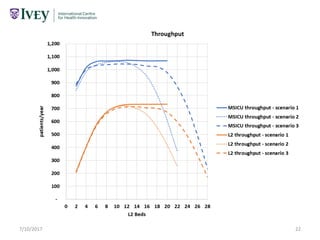
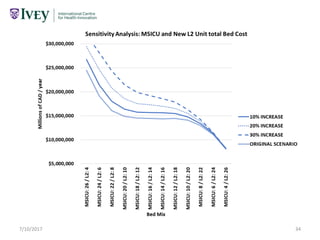
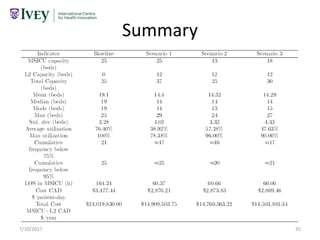
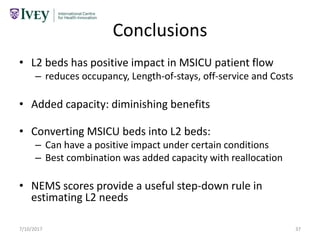
• L2 beds has positive impact in MSICU patient flow
– reduces occupancy, Length-of-stays, off-service and Costs
• Added capacity: diminishing benefits
• Converting MSICU beds into L2 beds:
– Can have a positive impact under certain conditions
– Best combination was added capacity with reallocation
• NEMS scores provide a useful step-down rule in
estimating L2 needs
7/10/2017 37
Next steps
• New simulations:
– Victoria Hospital
– Dedicated long-stay beds
• MSICU LoS Forecasting model incorporating:
– NEMS measurements
• Analytical model incorporating:
– Bounce-backs
– off-service
– NEMS measurements
7/10/2017 38
10/07/2017 39
Thank you!
Questions, comments?
frodrigues.phd@ivey.ca
Picture: Piotrek Angiel
Mount Assiniboine, AB 2015

Releasing ICU bed capacity using simulation

  • 1.
    Discrete event simulationmodel for planning Level 2 “step-down” bed needs using NEMS Felipe Rodrigues1, Greg Zaric1, David Stanford2 (Judy Kojlak3, Fran Priestap3, Claudio Martin3 ) 1 Ivey Business School @ Western University 2 Department of Statistical and Actuarial Sciences @ Western University 3 LHSC Ivey International Centre for Health Innovation (IICHI) Ontario Trillium Scholarship (OTS) Universidade Federal do Paraná (UFPR) 7/10/2017 - Simul8 Webinar 2017 1
  • 2.
    INTRODUCTION London Health SciencesCentre London, Ontario Canada 7/10/2017 2
  • 3.
    Definitions • MSICU: MedicalSurgical Intensive Care Unit • NEMS (Miranda et al. 1997): – “Nine Equivalents of nursing Manpower use Score” – Therapeutic intervention index to measure nursing workload: 56 point scale 7/10/2017 3
  • 4.
  • 5.
    LHSC – UniversityHospital • Dec/13-Dec/14 – 17,411 patients – 42,092 movements • Misplacement/off-service – 5% to 30% • “step-down” status – MSICU • 660 out of 864 patients 7/10/2017 5
  • 6.
    Research questions • Whatis the benefit of a “step-down” unit? – Patient Flow – Throughput – Length-of-stays – Costs • For UH: – What are the UH’s L2 bed needs? How efficient can they be? • Can NEMS scores provide a useful step-down rule in estimating L2 needs? 7/10/2017 6
  • 7.
    Challenges • No previoushistory of medicine L2 • Seasonality, patient heterogeneity • Patient’s health and death probability change over time • Step-downs & bounce-backs, congestion • Off-service • Costs 7/10/2017 7
  • 8.
  • 9.
    DES Model Overview •Objectives: – Minimize cost – Minimize LoS (clinical) – Maximize Throughput • Decision Variables: – Number of L2 Beds – Number of MSICU Beds 7/10/2017 9
  • 10.
    DES Model Overview •Parameters and Constraints: – Arrival rates, LoS rates, death rates – NEMS thresholds – Current bed allocations – Flow matrix – Budget 7/10/2017 10
  • 11.
    Data • Patient registry •Patient transfer files • Nursing workloads • Distribution fittings: arrivals, LoS, step-downs • Flow matrix • Step-down rules • N = 17,380 patients 10/07/2017 11
  • 12.
  • 13.
    Flow Matrix 10/07/2017 13 units type levelofcare Clinic ED(emergencyDepartment) OperatingRoom Victoria 10th-Epilepsy(Ward) 4th-GeneralMedicine(Ward) 5th-Cardiac(Ward) 6th-AcuteCare(Ward) 6th-Cardiac/Cardiovascularsurgery (Ward) 7th-ClinicalNeurosciences(Ward) 7th-HyperAcuteStroke 8th-GeneralSurgery,Plastic,Uro,Gyn (Ward) 8th-HighAcuitySurgery 8th-SubAcuteMedical 9th-PalliativeCare(Ward) EDDecant 4th-MOTP(Transplant) 5th-CCU-CardiacCare 7th-NeuroObs CSRU(cardiovascularrecovery) MSCU(medicalsurgeryintensivecare) Discharged Expired SignedOut GrandTotal Clinicentry point L-1 / ER / OR 0.00% 2.10% 3.20% 0.50% 0.00% 13.30% 15.20% 0.00% 14.30% 7.40% 0.80% 12.50% 0.30% 0.00% 8.50% 0.30% 11.70% 6.10% 0.30% 0.00% 0.30% 2.90% 0.00% 0.30% 100.00% ED (emergency Department) entry point L-1 / ER / OR 0.00% 0.00% 4.60% 0.70% 0.00% 17.10% 6.70% 0.50% 7.60% 10.90% 1.30% 10.90% 0.10% 0.10% 9.00% 14.60% 1.20% 4.60% 1.10% 0.30% 2.50% 5.60% 0.50% 0.10% 100.00% ONEConsult entry point L-1 / ER / OR 0.10% 0.10% 0.00% 0.00% 0.00% 3.60% 4.60% 0.10% 5.40% 11.00% 0.10% 5.50% 0.20% 0.00% 5.00% 0.10% 3.10% 39.30% 1.80% 2.50% 17.50% 0.00% 0.00% 0.00% 100.00% Operating Room entry point L-1 / ER / OR 0.30% 0.00% 0.00% 0.00% 0.50% 0.40% 0.40% 0.00% 1.50% 7.80% 0.00% 14.50% 3.50% 0.00% 34.50% 0.00% 1.60% 0.30% 6.90% 18.70% 3.40% 5.50% 0.20% 0.00% 100.00% U-ADT entry point L-1 / ER / OR 6.40% 0.10% 5.90% 0.00% 16.00% 5.60% 8.30% 0.10% 24.60% 5.80% 0.20% 7.80% 0.10% 0.10% 4.00% 0.10% 6.50% 7.10% 0.30% 0.40% 0.60% 0.00% 0.00% 0.00% 100.00% Victoria entry point L-1 / ER / OR 0.40% 2.60% 0.20% 0.00% 0.20% 0.40% 3.40% 0.00% 11.70% 6.70% 0.20% 1.40% 0.00% 0.00% 2.80% 0.00% 0.60% 19.20% 1.40% 1.20% 8.10% 34.20% 5.10% 0.20% 100.00% 10th - Epilepsy (Ward) ward L-1 / ER / OR 0.00% 0.00% 1.40% 0.00% 0.00% 0.00% 0.00% 0.00% 0.30% 0.60% 0.00% 0.00% 0.00% 0.00% 0.00% 0.00% 0.00% 0.00% 0.60% 0.00% 0.00% 96.50% 0.00% 0.60% 100.00% 4th - General Medicine (Ward) ward L-1 / ER / OR 0.00% 0.00% 0.00% 0.00% 0.00% 0.00% 0.00% 0.00% 0.00% 0.00% 0.00% 0.00% 0.00% 0.20% 0.20% 0.00% 0.00% 0.00% 0.00% 0.00% 0.10% 93.90% 4.60% 1.00% 100.00% 5th - Cardiac (Ward) ward L-1 / ER / OR 0.30% 0.00% 7.00% 0.30% 0.00% 1.40% 0.00% 0.20% 3.20% 0.20% 0.00% 0.40% 0.00% 0.50% 0.90% 0.00% 0.00% 3.50% 0.00% 3.20% 0.60% 76.50% 1.60% 0.20% 100.00% 6th - Acute Care (Ward) ward L-1 / ER / OR 0.00% 0.00% 0.00% 0.00% 0.00% 0.20% 0.00% 0.00% 0.10% 0.00% 0.00% 0.00% 0.00% 0.10% 0.30% 0.30% 0.00% 0.00% 0.00% 0.00% 0.00% 95.60% 3.30% 0.10% 100.00% 6th - Cardiac/Cardio vascular surgery (Ward) ward L-1 / ER / OR 0.00% 0.10% 49.30% 0.40% 0.10% 3.20% 3.10% 0.30% 0.00% 0.70% 0.00% 1.50% 0.10% 0.70% 2.00% 0.10% 0.50% 6.60% 0.00% 30.50% 0.80% 0.00% 0.00% 0.00% 100.00% 7th - Clinical Neurosciences (Ward) ward L-1 / ER / OR 0.00% 0.00% 8.80% 0.60% 0.30% 1.60% 0.00% 0.00% 0.10% 0.00% 0.20% 0.60% 0.00% 0.20% 2.20% 0.10% 0.10% 0.20% 4.90% 0.20% 0.80% 76.60% 2.20% 0.30% 100.00% 7th - Hyper Acute Stroke ward L-1 / ER / OR 0.00% 0.00% 1.40% 0.00% 0.70% 0.70% 0.00% 0.00% 0.00% 68.80% 0.00% 0.70% 0.00% 0.00% 0.70% 0.00% 0.00% 0.70% 2.20% 1.40% 1.40% 20.60% 0.00% 0.70% 100.00% 8th - General Surgery, Plastic, Uro, Gyn (Ward) ward L-1 / ER / OR 0.00% 0.00% 8.50% 0.70% 0.00% 1.10% 0.20% 0.00% 0.20% 0.40% 0.00% 0.00% 1.70% 0.70% 1.80% 0.10% 0.80% 0.10% 0.00% 0.20% 1.30% 80.60% 0.90% 0.70% 100.00% 8th - High Acuity Surgery ward L-1 / ER / OR 0.00% 0.00% 1.60% 0.90% 0.00% 0.00% 0.00% 0.00% 0.00% 0.00% 0.00% 81.40% 0.00% 0.00% 0.60% 0.00% 0.60% 0.90% 0.00% 0.60% 2.80% 10.60% 0.00% 0.00% 100.00% 8th - Sub Acute Medical ward L-1 / ER / OR 0.00% 0.00% 2.30% 0.50% 0.00% 4.10% 0.00% 0.50% 0.00% 0.00% 0.50% 1.40% 0.00% 0.00% 3.20% 0.50% 0.00% 0.00% 0.50% 0.50% 0.00% 82.30% 3.20% 0.50% 100.00% 9th - Palliative Care (Ward) ward L-1 / ER / OR 0.00% 0.00% 7.20% 0.40% 0.00% 3.60% 0.10% 0.10% 0.40% 0.60% 0.00% 1.20% 0.00% 1.00% 0.00% 0.10% 0.20% 0.20% 0.10% 0.10% 0.40% 80.50% 3.60% 0.20% 100.00% ED Decant ward L-1 / ER / OR 0.00% 0.00% 1.30% 0.20% 0.00% 45.70% 3.60% 4.30% 4.70% 5.00% 0.00% 9.80% 0.00% 0.50% 7.50% 0.00% 0.30% 0.00% 0.10% 0.00% 0.20% 15.60% 0.90% 0.30% 100.00% 4th - MOTP (Transplant) intermediate unit L-2 0.00% 0.00% 10.70% 0.20% 0.20% 13.10% 0.30% 0.70% 1.70% 0.90% 0.00% 6.10% 0.30% 0.20% 2.60% 0.00% 0.00% 0.50% 0.20% 1.60% 5.90% 52.90% 1.70% 0.20% 100.00% 5th - CCU - Cardiac Care intermediate unit L-2 1.30% 0.00% 7.50% 0.80% 0.00% 0.80% 20.40% 0.00% 16.30% 0.60% 0.00% 0.20% 0.10% 0.00% 0.30% 0.00% 0.20% 0.00% 0.10% 4.10% 1.70% 43.20% 2.00% 0.40% 100.00% 7th - Neuro Obs intermediate unit L-2 0.00% 0.10% 5.80% 0.10% 0.40% 0.30% 0.00% 0.10% 0.00% 71.50% 0.70% 0.00% 0.00% 0.00% 0.40% 0.00% 0.10% 0.10% 0.00% 0.80% 3.80% 15.70% 0.10% 0.00% 100.00% CSRU (cardiovascular recovery) intensive care L-3 0.00% 0.00% 4.40% 0.10% 0.00% 0.60% 0.00% 0.10% 82.70% 0.50% 0.00% 0.10% 0.20% 0.00% 0.10% 0.00% 1.70% 1.60% 0.10% 0.00% 4.10% 0.70% 3.00% 0.00% 100.00% MSCU (medical surgery intensive care) intensive care L-3 0.00% 0.00% 8.60% 0.90% 0.00% 16.50% 1.70% 0.10% 0.70% 7.00% 0.30% 6.90% 2.90% 0.00% 2.30% 0.10% 8.10% 3.50% 6.80% 2.00% 0.00% 9.40% 22.00% 0.20% 100.00% Grand total 0.40% 0.10% 5.00% 0.30% 0.90% 6.70% 3.00% 0.30% 7.30% 6.10% 0.30% 6.40% 0.80% 0.20% 8.00% 3.00% 1.30% 3.00% 1.80% 3.80% 2.20% 37.00% 1.90% 0.20% 100.00%
  • 14.
  • 15.
    Simulation model –Levelof care and death process 7/10/2017 15 arrival fork MSICU 24h Level join join
  • 16.
    Scenarios 1. New capacity: Upto 20 beds at L2 Unit 2. Re-allocation of existing capacity 25 beds allocated between MSICU vs L2 bed mix 3. New capacity with re-allocation 30 beds allocated between MSICU vs L2 bed mix 7/10/2017 17
  • 17.
  • 18.
    Results – BaselineScenario 7/10/2017 19
  • 19.
  • 20.
    Off-service impact 7/10/2017 21 UnitBaseline Scenario 1 (new capacity) Scenario 2 (reallocation) Scenario 3 (new + reallocation) Existing L3 units (CSRU and MSICU) ~620 ~110 ~150 ~140 Existing L2 units (MOTP, CCU, NOBS) ~570 ~220 ~200 ~210 *(patients/year)
  • 21.
  • 22.
  • 23.
  • 24.
  • 25.
  • 26.
  • 27.
  • 28.
    1st Scenario (@12 L2 Beds) 7/10/2017 29
  • 29.
  • 30.
  • 31.
  • 32.
  • 33.
  • 34.
    Conclusions • L2 bedshas positive impact in MSICU patient flow – reduces occupancy, Length-of-stays, off-service and Costs • Added capacity: diminishing benefits • Converting MSICU beds into L2 beds: – Can have a positive impact under certain conditions – Best combination was added capacity with reallocation • NEMS scores provide a useful step-down rule in estimating L2 needs 7/10/2017 37
  • 35.
    Next steps • Newsimulations: – Victoria Hospital – Dedicated long-stay beds • MSICU LoS Forecasting model incorporating: – NEMS measurements • Analytical model incorporating: – Bounce-backs – off-service – NEMS measurements 7/10/2017 38
  • 36.
    10/07/2017 39 Thank you! Questions,comments? frodrigues.phd@ivey.ca Picture: Piotrek Angiel Mount Assiniboine, AB 2015