
Dipartimento di Ingegneria e Scienze
Università degli Studi dell’Aquila
dell’Informazione e Matematica
Non-determinism and
bidirectional model
transformations
Alfonso Pierantonio
In spite of its relevance,
bidirectionality has rarely produced
anticipated benefits.
In spite of its relevance,
bidirectionality has rarely produced
anticipated benefits.
Why?
There have been several works analyzing
semantic issues and idiosyncrasies of
bidirectional model transformations
«The developer needs full control of what
the transformation does. [...] We claim that
determinism is necessary in order to ensure,
first, that developers will find tool behavior
predictable, and second, that organisations
will not be unacceptably “locked in” to the
tool they first use.»
P. Stevens. Bidirectional model transformations in QVT: semantic issues and open questions. SOSYM, 8,
2009.
Alfonso Pierantonio – 7th SATToSE, L’Aquila (Italy)
6
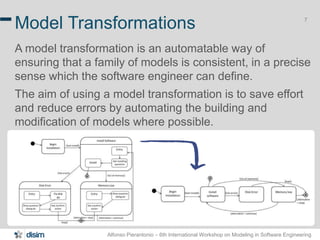
Model Transformations
A model transformation is an automatable way of
ensuring that a family of models is consistent, in a precise
sense which the software engineer can define.
The aim of using a model transformation is to save effort
and reduce errors by automating the building and
modification of models where possible.
Alfonso Pierantonio – 6th International Workshop on Modeling in Software Engineering
7
Model Transformations
A model transformation is an automatable way of
ensuring that a family of models is consistent, in a precise
sense which the software engineer can define.
The aim of using a model transformation is to save effort
and reduce errors by automating the building and
modification of models where possible.
Alfonso Pierantonio – 6th International Workshop on Modeling in Software Engineering
8
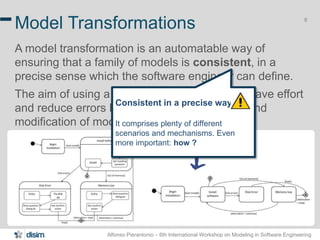
Model Transformations
A model transformation is an automatable way of
ensuring that a family of models is consistent, in a
precise sense which the software engineer can define.
The aim of using a model transformation is to save effort
and reduce errors by automating the building and
modification of models where possible.
Consistent in a precise way!
It comprises plenty of different
scenarios and mechanisms. Even
more important: how ?
Alfonso Pierantonio – 7th SATToSE, L’Aquila (Italy)
9
Bidirectionality
Bidirectionality is necessary whenever people are
working on more than one model and the models
must be kept consistent.
Alfonso Pierantonio – 7th SATToSE, L’Aquila (Italy)
10
Bidirectionality
Bidirectionality is necessary whenever people are
working on more than one model and the models
must be kept consistent.
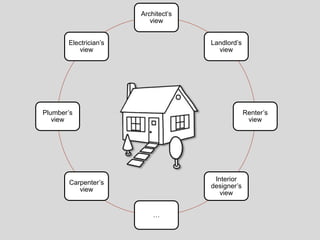
A system might need to be
described according to
multiple views
Architect’s
view
Landlord’s
view
Renter’s
view
Interior
designer’s
view
…
Carpenter’s
view
Plumber’s
view
Electrician’s
view
Alfonso Pierantonio – 7th SATToSE, L’Aquila (Italy)
13
Bidirectionality
The relevance of bidirectionality has been advocated
already in 2005 by OMG’s QVT standard, in particular
the QVT Relations (QVT-R) language.
Current approaches include also Triple Graph
Grammars (TGGs), SyncATL, JTL, and
GRoundTram.
Alfonso Pierantonio – 6th International Workshop on Modeling in Software Engineering
14
Bidirectionality
The relevance of bidirectionality has been advocated
already in 2005 by OMG’s QVT standard, in particular
the QVT Relations (QVT-R) language.
Current approaches include also Triple Graph
Grammars (TGGs), SyncATL, JTL, and
GRoundTram.
The QVT standard [1] is somewhat ambivalent about
whether it intends all bidirectional QVT transformations to be
bijective.
[1] OMG. MOF2.0 Query/View/Transformation (QVT) Adopted Specification. OMG document
ptc/05-11-01, available from http://www.omg.org (2005)
Let try to sort things out.
Alfonso Pierantonio – 7th SATToSE, L’Aquila (Italy)
16
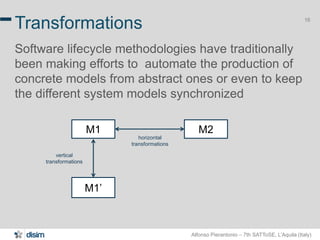
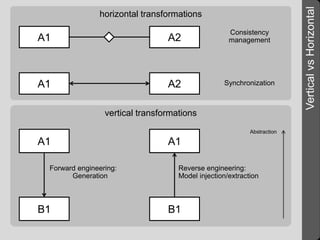
Transformations
Software lifecycle methodologies have traditionally
been making efforts to automate the production of
concrete models from abstract ones or even to keep
the different system models synchronized
M1 M2
M1’
horizontal
transformations
vertical
transformations
VerticalvsHorizontal
A1 A2
Consistency
management
A1 A2
Forward engineering:
Generation
A1
B1
Reverse engineering:
Model injection/extraction
A1
B1
Synchronization
horizontal transformations
vertical transformations
Abstraction
Alfonso Pierantonio – 6th International Workshop on Modeling in Software Engineering
18
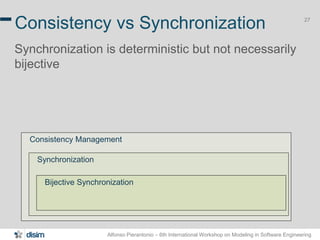
Consistency vs Synchronization
These two major model management mechanisms are
typically realized by means of (unidirectional and bidirectional)
transformations
Alfonso Pierantonio – 6th International Workshop on Modeling in Software Engineering
19
Consistency vs Synchronization
These two major model management mechanisms are
typically realized by means of (unidirectional and bidirectional)
transformations
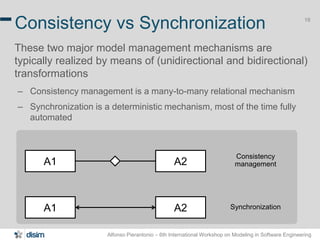
– Consistency management is a many-to-many relational mechanism
– Synchronization is a deterministic mechanism, most of the time fully
automated
A1 A2
Consistency
management
A1 A2 Synchronization
Alfonso Pierantonio – 6th International Workshop on Modeling in Software Engineering
20
Consistency vs Synchronization
These two major model management mechanisms are
typically realized by means of (unidirectional and bidirectional)
transformations
– Despite these are well established techniques there is still some
confusion and the latter is often used to explain or in place of the
former
Synchronization  Consistency
Alfonso Pierantonio – 6th International Workshop on Modeling in Software Engineering
21
Bidirectionality
The relevance of bidirectionality has been advocated
already in 2005 by OMG’s QVT standard, in particular
the QVT Relations (QVT-R) language.
Current approaches include also Triple Graph
Grammars (TGGs), SyncATL, JTL, and
GRoundTram.
The QVT standard [1] is somewhat ambivalent about
whether it intends all bidirectional QVT transformations to
be bijective.
[1] OMG. MOF2.0 Query/View/Transformation (QVT) Adopted Specification. OMG document
ptc/05-11-01, available from http://www.omg.org (2005)
Alfonso Pierantonio – 6th International Workshop on Modeling in Software Engineering
22
Consistency vs Synchronization
These two major model management mechanisms are
typically realized by means of (unidirectional and
bidirectional) transformations
– Despite these are well established techniques there is still some
confusion and the latter is often used to explain or in place of the
former
Synchronization  Consistency
How bidirectionality fits in this picture ?
Alfonso Pierantonio – 6th International Workshop on Modeling in Software Engineering
23
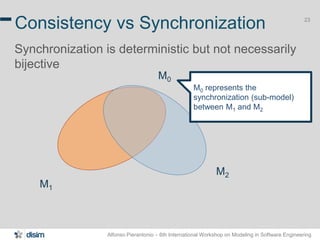
Consistency vs Synchronization
Synchronization is deterministic but not necessarily
bijective
M1
M2
M0
M0 represents the
synchronization (sub-model)
between M1 and M2
Alfonso Pierantonio – 6th International Workshop on Modeling in Software Engineering
24
Consistency vs Synchronization
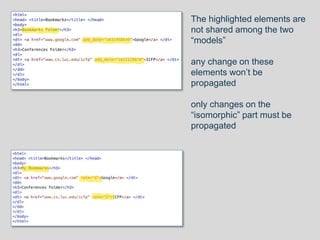
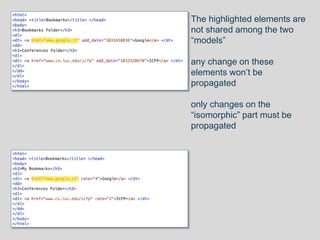
Consider the bookmarks synchronization between
different browsers (eg. Chrome, Safari, etc)
– Besides the obviously shared information, each browser
may have specific metadata which are not present in the
others
The highlighted elements are
not shared among the two
“models”
any change on these
elements won’t be
propagated
only changes on the
“isomorphic” part must be
propagated
The highlighted elements are
not shared among the two
“models”
any change on these
elements won’t be
propagated
only changes on the
“isomorphic” part must be
propagated
Alfonso Pierantonio – 6th International Workshop on Modeling in Software Engineering
27
Consistency vs Synchronization
Synchronization is deterministic but not necessarily
bijective
Consistency Management
Bijective Synchronization
Synchronization
«The developer needs full control of what
the transformation does. [...] We claim that
determinism is necessary in order to ensure,
first, that developers will find tool behavior
predictable, and second, that organisations
will not be unacceptably “locked in” to the
tool they first use.»
P. Stevens. Bidirectional model transformations in QVT: semantic issues and open questions. SOSYM, 8,
2009.
Alfonso Pierantonio – 7th SATToSE, L’Aquila (Italy)
29
Non-bijectivity
Most examples of bidirectional transformations are
non-bijective, therefore there may be multiple ways to
transform two models into a consistent state,
introducing uncertainty and non-determinism.
Alfonso Pierantonio – 6th International Workshop on Modeling in Software Engineering
30
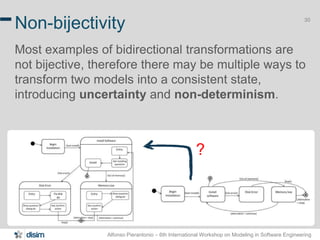
Non-bijectivity
Most examples of bidirectional transformations are
not bijective, therefore there may be multiple ways to
transform two models into a consistent state,
introducing uncertainty and non-determinism.
?
Alfonso Pierantonio – 7th SATToSE, L’Aquila (Italy)
31
Opaque semantics of bidirectionality
Existing bidirectional languages translate a non-
deterministic specification into an actual bidirectional
transformation procedure.
Alfonso Pierantonio – 7th SATToSE, L’Aquila (Italy)
32
Opaque semantics of bidirectionality
Existing bidirectional languages translate a non-
deterministic specification into an actual bidirectional
transformation procedure.
Consistency is enforced by imposing a specific
«update policy» determined by foreign and unknown
factors, ie. language implementation, heuristics, and
rule order.
Alfonso Pierantonio – 7th SATToSE, L’Aquila (Italy)
33
Opaque semantics of bidirectionality
Existing bidirectional languages translate a non-
deterministic specification into an actual bidirectional
transformation procedure.
Consistency is enforced by imposing a specific
«update policy» determined by foreign and unknown
factors, eg. language implementation, heuristics, and
rule order.
As a consequence, result is unpredictable and
developers have little or no control on the «update
policy».
Alfonso Pierantonio – 7th SATToSE, L’Aquila (Italy)
34
Solution
Developers must have full control via a clear
semantics in order to
– Managing the uncertainty: all admissible solutions must
be generated at once letting the designer choose the
desired one
– Define the update policy: an intentional (and general)
«update policy» is adopted and implemented at design-
time (cfr. [1])
[1] Zan Tao, Hugo Pacheco, and Zhenjiang Hu. "Writing bidirectional model transformations as
intentional updates." Companion Proceedings of the 36th International Conference on Software
Engineering. ACM, 2014.
Alfonso Pierantonio – 7th SATToSE, L’Aquila (Italy)
35
Solution
It is not always possible to define the update policy
because the available information at design-time is
not enough for defining the update policy
– The decision must then be deferred to the modeler who is
running the transformation by letting her traverse the
complete solution space
Alfonso Pierantonio – 7th SATToSE, L’Aquila (Italy)
36
Non-deterministic languages
Over the last yeast, new languages/semantics have
been proposed
– Janus Transformation Language (JTL)
– Alloy-based Semantics for QVT-R
They are able to produce more than one result.
Alfonso Pierantonio – 7th SATToSE, L’Aquila (Italy)
37
Janus Transformation Language (JTL)
JTL has formal semantics based on Answer Set
Programming (ASP) and therefore can be considered
a constraint-based approach.
ASP is a form of logic programming with non-
monotonic reasoning related to SAT. Several solvers
are available, eg. DLV.
JTL is embedded in a framework available on the
Eclipse platform and can be applied to Ecore
metamodels
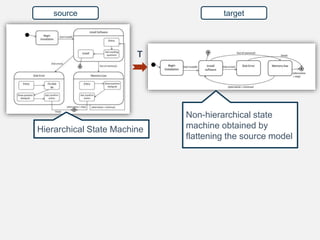
source target
T
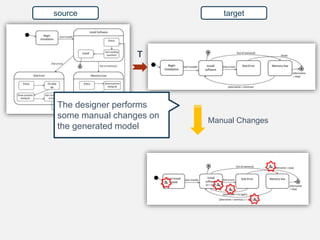
Manual Changes
Hierarchical State Machine
Non-hierarchical state
machine obtained by
flattening the source model
source target
T
Manual Changes
The designer performs
some manual changes on
the generated model
Alfonso Pierantonio – 7th SATToSE, L’Aquila (Italy)
40
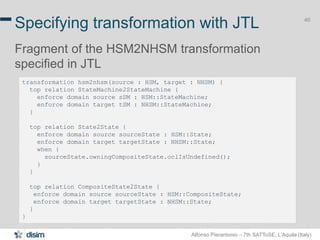
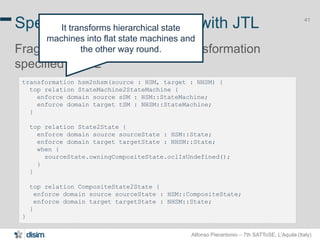
Specifying transformation with JTL
Fragment of the HSM2NHSM transformation
specified in JTL
40
transformation hsm2nhsm(source : HSM, target : NHSM) {
top relation StateMachine2StateMachine {
enforce domain source sSM : HSM::StateMachine;
enforce domain target tSM : NHSM::StateMachine;
}
top relation State2State {
enforce domain source sourceState : HSM::State;
enforce domain target targetState : NHSM::State;
when {
sourceState.owningCompositeState.oclIsUndefined();
}
}
top relation CompositeState2State {
enforce domain source sourceState : HSM::CompositeState;
enforce domain target targetState : NHSM::State;
}
}
Alfonso Pierantonio – 7th SATToSE, L’Aquila (Italy)
41
transformation hsm2nhsm(source : HSM, target : NHSM) {
top relation StateMachine2StateMachine {
enforce domain source sSM : HSM::StateMachine;
enforce domain target tSM : NHSM::StateMachine;
}
top relation State2State {
enforce domain source sourceState : HSM::State;
enforce domain target targetState : NHSM::State;
when {
sourceState.owningCompositeState.oclIsUndefined();
}
}
top relation CompositeState2State {
enforce domain source sourceState : HSM::CompositeState;
enforce domain target targetState : NHSM::State;
}
}
Specifying transformation with JTL
Fragment of the HSM2NHSM transformation
specified in JTL
41
It transforms hierarchical state
machines into flat state machines and
the other way round.
Alfonso Pierantonio – 7th SATToSE, L’Aquila (Italy)
42
transformation hsm2nhsm(source : HSM, target : NHSM) {
top relation StateMachine2StateMachine {
enforce domain source sSM : HSM::StateMachine;
enforce domain target tSM : NHSM::StateMachine;
}
top relation State2State {
enforce domain source sourceState : HSM::State;
enforce domain target targetState : NHSM::State;
when {
sourceState.owningCompositeState.oclIsUndefined();
}
}
top relation CompositeState2State {
enforce domain source sourceState : HSM::CompositeState;
enforce domain target targetState : NHSM::State;
}
}
Specifying transformation with JTL
Fragment of the HSM2NHSM transformation
specified in JTL
42
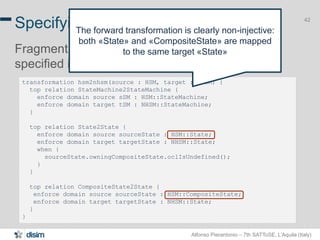
The forward transformation is clearly non-injective:
both «State» and «CompositeState» are mapped
to the same target «State»
Alfonso Pierantonio – 7th SATToSE, L’Aquila (Italy)
43
transformation hsm2nhsm(source : HSM, target : NHSM) {
top relation StateMachine2StateMachine {
enforce domain source sSM : HSM::StateMachine;
enforce domain target tSM : NHSM::StateMachine;
}
top relation State2State {
enforce domain source sourceState : HSM::State;
enforce domain target targetState : NHSM::State;
when {
sourceState.owningCompositeState.oclIsUndefined();
}
}
top relation CompositeState2State {
enforce domain source sourceState : HSM::CompositeState;
enforce domain target targetState : NHSM::State;
}
}
Specifying transformation with JTL
Fragment of the HSM2NHSM transformation
specified in JTL
43
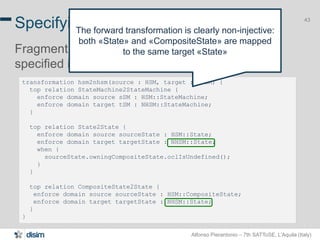
The forward transformation is clearly non-injective:
both «State» and «CompositeState» are mapped
to the same target «State»
Alfonso Pierantonio – 7th SATToSE, L’Aquila (Italy)
46
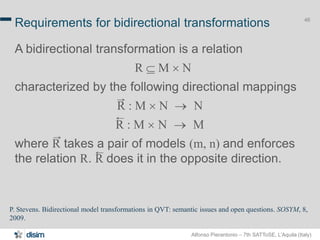
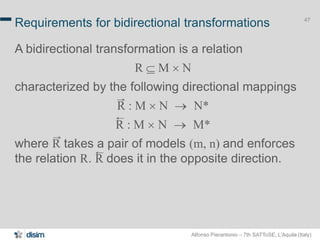
Requirements for bidirectional transformations
A bidirectional transformation is a relation
R  M ´ N
characterized by the following directional mappings
R : M ´ N  N*
R : M ´ N  M*
where R takes a pair of models (m, n) and enforces
the relation R. R does it in the opposite direction.
P. Stevens. Bidirectional model transformations in QVT: semantic issues and open questions. SOSYM, 8,
2009.
Alfonso Pierantonio – 7th SATToSE, L’Aquila (Italy)
47
Requirements for bidirectional transformations
A bidirectional transformation is a relation
R  M ´ N
characterized by the following directional mappings
R : M ´ N  N*
R : M ´ N  M*
where R takes a pair of models (m, n) and enforces
the relation R. R does it in the opposite direction.
Alfonso Pierantonio – 7th SATToSE, L’Aquila (Italy)
48
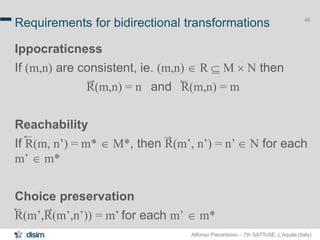
Requirements for bidirectional transformations
Ippocraticness
If (m,n) are consistent, ie. (m,n)  R  M ´ N then
R(m,n) = n and R(m,n) = m
Reachability
If R(m, n’) = m*  M*, then R(m’, n’) = n’  N for each
m’  m*
Choice preservation
R(m’,R(m’,n’)) = m’ for each m’  m*
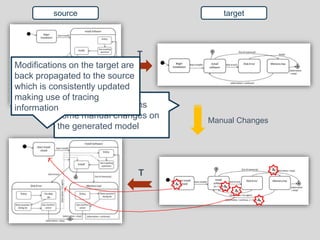
T
Manual Changes
T
The designer performs
some manual changes on
the generated model
Modifications on the target are
back propagated to the source
which is consistently updated
making use of tracing
information
source target
Alfonso Pierantonio – 7th SATToSE, L’Aquila (Italy)
55
Pragmatics
Dealing with medium-large size models poses many
pragmatic problems due to the combinatorial
explosion of the solution space.
Determining differences and commonalities among
the models by traversing and inspecting the solution
space is impractical.
An intensive representation of the solution space
generated by a JTL transformation is sought to
support traversal and inspection of the models
throughout the solution space.
Alfonso Pierantonio – 6th International Workshop on Modeling in Software Engineering
56
Uncertainty
Uncertainty is a consequence of non-determinism.
Our proposal is to represent the variability in the
solution space by means of models with uncertainty
in the sense of [2].
[2] Salay, R., Chechik, M., Horkoff, J., & Di Sandro, A. (2013). Managing requirements
uncertainty with partial models. Requirements Engineering, 18(2), 107-128.
Alfonso Pierantonio – 7th SATToSE, L’Aquila (Italy)
57
Uncertainty
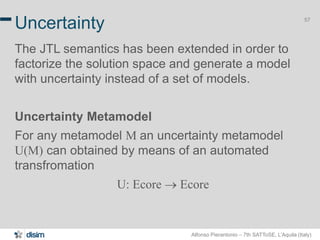
The JTL semantics has been extended in order to
factorize the solution space and generate a model
with uncertainty instead of a set of models.
Uncertainty Metamodel
For any metamodel M an uncertainty metamodel
U(M) can obtained by means of an automated
transfromation
U: Ecore  Ecore
Alfonso Pierantonio – 7th SATToSE, L’Aquila (Italy)
58
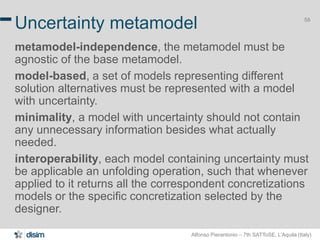
Uncertainty metamodel
metamodel-independence, the metamodel must be
agnostic of the base metamodel.
model-based, a set of models representing different
solution alternatives must be represented with a model
with uncertainty.
minimality, a model with uncertainty should not contain
any unnecessary information besides what actually
needed.
interoperability, each model containing uncertainty must
be applicable an unfolding operation, such that whenever
applied to it returns all the correspondent concretizations
models or the specific concretization selected by the
designer.
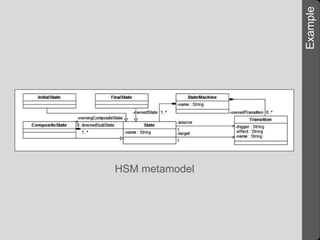
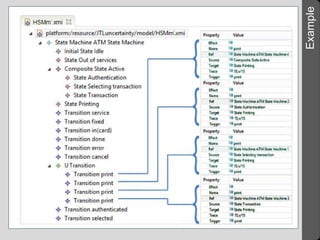
HSM metamodel
Example
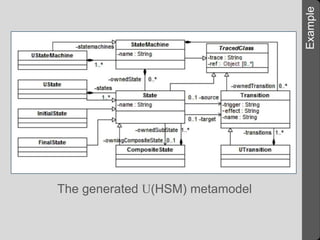
The generated U(HSM) metamodel
Example
Alfonso Pierantonio – 7th SATToSE, L’Aquila (Italy)
61
Operators
Once the uncertainty metamodel U(M) is
automatically defined starting from the base
metamodel M, interoperability between the base and
the uncertainty metamodels is necessary
– Concretization operator: takes a model with uncertainty
m* and returns the set of concretizations <m1 … mn>
– Refinement operator: takes a model with uncertainty m*
and a predicate p and returns the set of models m
satisfying the predicate
Alfonso Pierantonio – 7th SATToSE, L’Aquila (Italy)
62
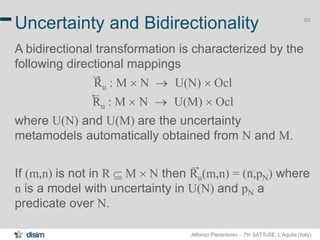
Uncertainty and Bidirectionality
A bidirectional transformation is characterized by the
following directional mappings
Ru : M ´ N  U(N) ´ Ocl
Ru : M ´ N  U(M) ´ Ocl
where U(N) and U(M) are the uncertainty
metamodels automatically obtained from N and M.
If (m,n) is not in R  M ´ N then Ru(m,n) = (n,pN) where
n is a model with uncertainty in U(N) and pN a
predicate over N.
Alfonso Pierantonio – 7th SATToSE, L’Aquila (Italy)
63
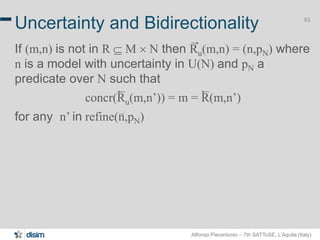
Uncertainty and Bidirectionality
If (m,n) is not in R  M ´ N then Ru(m,n) = (n,pN) where
n is a model with uncertainty in U(N) and pN a
predicate over N such that
concr(Ru(m,n’)) = m = R(m,n’)
for any n’ in refine(n,pN)
Example
Alfonso Pierantonio – 6th International Workshop on Modeling in Software Engineering
65
Conclusion
The JTL semantics has been refined in order to be
able to generate directly the model with uncertainty
semantically corresponding to the complete solution
space.
The approach is implemented on Eclipse/EMF.
In spite of its relevance,
bidirectionality has rarely produced
anticipated benefits
Why?
① Too many languages have
unpredictable behavior by addressing
non-determinism in a opaque way
① Requiring determinism is not always
possible, nevertheless this has been
fully accepted and enforced by the
scientific community
① Anthropologically computer scientists
tend to think that transformation
languages are niche Java
specializations
Thank you!

Non determinism and bidirectional model transformations

  • 1.
    Dipartimento di Ingegneriae Scienze Università degli Studi dell’Aquila dell’Informazione e Matematica Non-determinism and bidirectional model transformations Alfonso Pierantonio
  • 2.
    In spite ofits relevance, bidirectionality has rarely produced anticipated benefits.
  • 3.
    In spite ofits relevance, bidirectionality has rarely produced anticipated benefits. Why?
  • 4.
    There have beenseveral works analyzing semantic issues and idiosyncrasies of bidirectional model transformations
  • 5.
    «The developer needsfull control of what the transformation does. [...] We claim that determinism is necessary in order to ensure, first, that developers will find tool behavior predictable, and second, that organisations will not be unacceptably “locked in” to the tool they first use.» P. Stevens. Bidirectional model transformations in QVT: semantic issues and open questions. SOSYM, 8, 2009.
  • 6.
    Alfonso Pierantonio –7th SATToSE, L’Aquila (Italy) 6 Model Transformations A model transformation is an automatable way of ensuring that a family of models is consistent, in a precise sense which the software engineer can define. The aim of using a model transformation is to save effort and reduce errors by automating the building and modification of models where possible.
  • 7.
    Alfonso Pierantonio –6th International Workshop on Modeling in Software Engineering 7 Model Transformations A model transformation is an automatable way of ensuring that a family of models is consistent, in a precise sense which the software engineer can define. The aim of using a model transformation is to save effort and reduce errors by automating the building and modification of models where possible.
  • 8.
    Alfonso Pierantonio –6th International Workshop on Modeling in Software Engineering 8 Model Transformations A model transformation is an automatable way of ensuring that a family of models is consistent, in a precise sense which the software engineer can define. The aim of using a model transformation is to save effort and reduce errors by automating the building and modification of models where possible. Consistent in a precise way! It comprises plenty of different scenarios and mechanisms. Even more important: how ?
  • 9.
    Alfonso Pierantonio –7th SATToSE, L’Aquila (Italy) 9 Bidirectionality Bidirectionality is necessary whenever people are working on more than one model and the models must be kept consistent.
  • 10.
    Alfonso Pierantonio –7th SATToSE, L’Aquila (Italy) 10 Bidirectionality Bidirectionality is necessary whenever people are working on more than one model and the models must be kept consistent.
  • 11.
    A system mightneed to be described according to multiple views
  • 12.
  • 13.
    Alfonso Pierantonio –7th SATToSE, L’Aquila (Italy) 13 Bidirectionality The relevance of bidirectionality has been advocated already in 2005 by OMG’s QVT standard, in particular the QVT Relations (QVT-R) language. Current approaches include also Triple Graph Grammars (TGGs), SyncATL, JTL, and GRoundTram.
  • 14.
    Alfonso Pierantonio –6th International Workshop on Modeling in Software Engineering 14 Bidirectionality The relevance of bidirectionality has been advocated already in 2005 by OMG’s QVT standard, in particular the QVT Relations (QVT-R) language. Current approaches include also Triple Graph Grammars (TGGs), SyncATL, JTL, and GRoundTram. The QVT standard [1] is somewhat ambivalent about whether it intends all bidirectional QVT transformations to be bijective. [1] OMG. MOF2.0 Query/View/Transformation (QVT) Adopted Specification. OMG document ptc/05-11-01, available from http://www.omg.org (2005)
  • 15.
    Let try tosort things out.
  • 16.
    Alfonso Pierantonio –7th SATToSE, L’Aquila (Italy) 16 Transformations Software lifecycle methodologies have traditionally been making efforts to automate the production of concrete models from abstract ones or even to keep the different system models synchronized M1 M2 M1’ horizontal transformations vertical transformations
  • 17.
    VerticalvsHorizontal A1 A2 Consistency management A1 A2 Forwardengineering: Generation A1 B1 Reverse engineering: Model injection/extraction A1 B1 Synchronization horizontal transformations vertical transformations Abstraction
  • 18.
    Alfonso Pierantonio –6th International Workshop on Modeling in Software Engineering 18 Consistency vs Synchronization These two major model management mechanisms are typically realized by means of (unidirectional and bidirectional) transformations
  • 19.
    Alfonso Pierantonio –6th International Workshop on Modeling in Software Engineering 19 Consistency vs Synchronization These two major model management mechanisms are typically realized by means of (unidirectional and bidirectional) transformations – Consistency management is a many-to-many relational mechanism – Synchronization is a deterministic mechanism, most of the time fully automated A1 A2 Consistency management A1 A2 Synchronization
  • 20.
    Alfonso Pierantonio –6th International Workshop on Modeling in Software Engineering 20 Consistency vs Synchronization These two major model management mechanisms are typically realized by means of (unidirectional and bidirectional) transformations – Despite these are well established techniques there is still some confusion and the latter is often used to explain or in place of the former Synchronization  Consistency
  • 21.
    Alfonso Pierantonio –6th International Workshop on Modeling in Software Engineering 21 Bidirectionality The relevance of bidirectionality has been advocated already in 2005 by OMG’s QVT standard, in particular the QVT Relations (QVT-R) language. Current approaches include also Triple Graph Grammars (TGGs), SyncATL, JTL, and GRoundTram. The QVT standard [1] is somewhat ambivalent about whether it intends all bidirectional QVT transformations to be bijective. [1] OMG. MOF2.0 Query/View/Transformation (QVT) Adopted Specification. OMG document ptc/05-11-01, available from http://www.omg.org (2005)
  • 22.
    Alfonso Pierantonio –6th International Workshop on Modeling in Software Engineering 22 Consistency vs Synchronization These two major model management mechanisms are typically realized by means of (unidirectional and bidirectional) transformations – Despite these are well established techniques there is still some confusion and the latter is often used to explain or in place of the former Synchronization  Consistency How bidirectionality fits in this picture ?
  • 23.
    Alfonso Pierantonio –6th International Workshop on Modeling in Software Engineering 23 Consistency vs Synchronization Synchronization is deterministic but not necessarily bijective M1 M2 M0 M0 represents the synchronization (sub-model) between M1 and M2
  • 24.
    Alfonso Pierantonio –6th International Workshop on Modeling in Software Engineering 24 Consistency vs Synchronization Consider the bookmarks synchronization between different browsers (eg. Chrome, Safari, etc) – Besides the obviously shared information, each browser may have specific metadata which are not present in the others
  • 25.
    The highlighted elementsare not shared among the two “models” any change on these elements won’t be propagated only changes on the “isomorphic” part must be propagated
  • 26.
    The highlighted elementsare not shared among the two “models” any change on these elements won’t be propagated only changes on the “isomorphic” part must be propagated
  • 27.
    Alfonso Pierantonio –6th International Workshop on Modeling in Software Engineering 27 Consistency vs Synchronization Synchronization is deterministic but not necessarily bijective Consistency Management Bijective Synchronization Synchronization
  • 28.
    «The developer needsfull control of what the transformation does. [...] We claim that determinism is necessary in order to ensure, first, that developers will find tool behavior predictable, and second, that organisations will not be unacceptably “locked in” to the tool they first use.» P. Stevens. Bidirectional model transformations in QVT: semantic issues and open questions. SOSYM, 8, 2009.
  • 29.
    Alfonso Pierantonio –7th SATToSE, L’Aquila (Italy) 29 Non-bijectivity Most examples of bidirectional transformations are non-bijective, therefore there may be multiple ways to transform two models into a consistent state, introducing uncertainty and non-determinism.
  • 30.
    Alfonso Pierantonio –6th International Workshop on Modeling in Software Engineering 30 Non-bijectivity Most examples of bidirectional transformations are not bijective, therefore there may be multiple ways to transform two models into a consistent state, introducing uncertainty and non-determinism. ?
  • 31.
    Alfonso Pierantonio –7th SATToSE, L’Aquila (Italy) 31 Opaque semantics of bidirectionality Existing bidirectional languages translate a non- deterministic specification into an actual bidirectional transformation procedure.
  • 32.
    Alfonso Pierantonio –7th SATToSE, L’Aquila (Italy) 32 Opaque semantics of bidirectionality Existing bidirectional languages translate a non- deterministic specification into an actual bidirectional transformation procedure. Consistency is enforced by imposing a specific «update policy» determined by foreign and unknown factors, ie. language implementation, heuristics, and rule order.
  • 33.
    Alfonso Pierantonio –7th SATToSE, L’Aquila (Italy) 33 Opaque semantics of bidirectionality Existing bidirectional languages translate a non- deterministic specification into an actual bidirectional transformation procedure. Consistency is enforced by imposing a specific «update policy» determined by foreign and unknown factors, eg. language implementation, heuristics, and rule order. As a consequence, result is unpredictable and developers have little or no control on the «update policy».
  • 34.
    Alfonso Pierantonio –7th SATToSE, L’Aquila (Italy) 34 Solution Developers must have full control via a clear semantics in order to – Managing the uncertainty: all admissible solutions must be generated at once letting the designer choose the desired one – Define the update policy: an intentional (and general) «update policy» is adopted and implemented at design- time (cfr. [1]) [1] Zan Tao, Hugo Pacheco, and Zhenjiang Hu. "Writing bidirectional model transformations as intentional updates." Companion Proceedings of the 36th International Conference on Software Engineering. ACM, 2014.
  • 35.
    Alfonso Pierantonio –7th SATToSE, L’Aquila (Italy) 35 Solution It is not always possible to define the update policy because the available information at design-time is not enough for defining the update policy – The decision must then be deferred to the modeler who is running the transformation by letting her traverse the complete solution space
  • 36.
    Alfonso Pierantonio –7th SATToSE, L’Aquila (Italy) 36 Non-deterministic languages Over the last yeast, new languages/semantics have been proposed – Janus Transformation Language (JTL) – Alloy-based Semantics for QVT-R They are able to produce more than one result.
  • 37.
    Alfonso Pierantonio –7th SATToSE, L’Aquila (Italy) 37 Janus Transformation Language (JTL) JTL has formal semantics based on Answer Set Programming (ASP) and therefore can be considered a constraint-based approach. ASP is a form of logic programming with non- monotonic reasoning related to SAT. Several solvers are available, eg. DLV. JTL is embedded in a framework available on the Eclipse platform and can be applied to Ecore metamodels
  • 38.
    source target T Manual Changes HierarchicalState Machine Non-hierarchical state machine obtained by flattening the source model
  • 39.
    source target T Manual Changes Thedesigner performs some manual changes on the generated model
  • 40.
    Alfonso Pierantonio –7th SATToSE, L’Aquila (Italy) 40 Specifying transformation with JTL Fragment of the HSM2NHSM transformation specified in JTL 40 transformation hsm2nhsm(source : HSM, target : NHSM) { top relation StateMachine2StateMachine { enforce domain source sSM : HSM::StateMachine; enforce domain target tSM : NHSM::StateMachine; } top relation State2State { enforce domain source sourceState : HSM::State; enforce domain target targetState : NHSM::State; when { sourceState.owningCompositeState.oclIsUndefined(); } } top relation CompositeState2State { enforce domain source sourceState : HSM::CompositeState; enforce domain target targetState : NHSM::State; } }
  • 41.
    Alfonso Pierantonio –7th SATToSE, L’Aquila (Italy) 41 transformation hsm2nhsm(source : HSM, target : NHSM) { top relation StateMachine2StateMachine { enforce domain source sSM : HSM::StateMachine; enforce domain target tSM : NHSM::StateMachine; } top relation State2State { enforce domain source sourceState : HSM::State; enforce domain target targetState : NHSM::State; when { sourceState.owningCompositeState.oclIsUndefined(); } } top relation CompositeState2State { enforce domain source sourceState : HSM::CompositeState; enforce domain target targetState : NHSM::State; } } Specifying transformation with JTL Fragment of the HSM2NHSM transformation specified in JTL 41 It transforms hierarchical state machines into flat state machines and the other way round.
  • 42.
    Alfonso Pierantonio –7th SATToSE, L’Aquila (Italy) 42 transformation hsm2nhsm(source : HSM, target : NHSM) { top relation StateMachine2StateMachine { enforce domain source sSM : HSM::StateMachine; enforce domain target tSM : NHSM::StateMachine; } top relation State2State { enforce domain source sourceState : HSM::State; enforce domain target targetState : NHSM::State; when { sourceState.owningCompositeState.oclIsUndefined(); } } top relation CompositeState2State { enforce domain source sourceState : HSM::CompositeState; enforce domain target targetState : NHSM::State; } } Specifying transformation with JTL Fragment of the HSM2NHSM transformation specified in JTL 42 The forward transformation is clearly non-injective: both «State» and «CompositeState» are mapped to the same target «State»
  • 43.
    Alfonso Pierantonio –7th SATToSE, L’Aquila (Italy) 43 transformation hsm2nhsm(source : HSM, target : NHSM) { top relation StateMachine2StateMachine { enforce domain source sSM : HSM::StateMachine; enforce domain target tSM : NHSM::StateMachine; } top relation State2State { enforce domain source sourceState : HSM::State; enforce domain target targetState : NHSM::State; when { sourceState.owningCompositeState.oclIsUndefined(); } } top relation CompositeState2State { enforce domain source sourceState : HSM::CompositeState; enforce domain target targetState : NHSM::State; } } Specifying transformation with JTL Fragment of the HSM2NHSM transformation specified in JTL 43 The forward transformation is clearly non-injective: both «State» and «CompositeState» are mapped to the same target «State»
  • 44.
    Alfonso Pierantonio –7th SATToSE, L’Aquila (Italy) 46 Requirements for bidirectional transformations A bidirectional transformation is a relation R  M ´ N characterized by the following directional mappings R : M ´ N  N* R : M ´ N  M* where R takes a pair of models (m, n) and enforces the relation R. R does it in the opposite direction. P. Stevens. Bidirectional model transformations in QVT: semantic issues and open questions. SOSYM, 8, 2009.
  • 45.
    Alfonso Pierantonio –7th SATToSE, L’Aquila (Italy) 47 Requirements for bidirectional transformations A bidirectional transformation is a relation R  M ´ N characterized by the following directional mappings R : M ´ N  N* R : M ´ N  M* where R takes a pair of models (m, n) and enforces the relation R. R does it in the opposite direction.
  • 46.
    Alfonso Pierantonio –7th SATToSE, L’Aquila (Italy) 48 Requirements for bidirectional transformations Ippocraticness If (m,n) are consistent, ie. (m,n)  R  M ´ N then R(m,n) = n and R(m,n) = m Reachability If R(m, n’) = m*  M*, then R(m’, n’) = n’  N for each m’  m* Choice preservation R(m’,R(m’,n’)) = m’ for each m’  m*
  • 47.
    T Manual Changes T The designerperforms some manual changes on the generated model Modifications on the target are back propagated to the source which is consistently updated making use of tracing information source target
  • 48.
    Alfonso Pierantonio –7th SATToSE, L’Aquila (Italy) 55 Pragmatics Dealing with medium-large size models poses many pragmatic problems due to the combinatorial explosion of the solution space. Determining differences and commonalities among the models by traversing and inspecting the solution space is impractical. An intensive representation of the solution space generated by a JTL transformation is sought to support traversal and inspection of the models throughout the solution space.
  • 49.
    Alfonso Pierantonio –6th International Workshop on Modeling in Software Engineering 56 Uncertainty Uncertainty is a consequence of non-determinism. Our proposal is to represent the variability in the solution space by means of models with uncertainty in the sense of [2]. [2] Salay, R., Chechik, M., Horkoff, J., & Di Sandro, A. (2013). Managing requirements uncertainty with partial models. Requirements Engineering, 18(2), 107-128.
  • 50.
    Alfonso Pierantonio –7th SATToSE, L’Aquila (Italy) 57 Uncertainty The JTL semantics has been extended in order to factorize the solution space and generate a model with uncertainty instead of a set of models. Uncertainty Metamodel For any metamodel M an uncertainty metamodel U(M) can obtained by means of an automated transfromation U: Ecore  Ecore
  • 51.
    Alfonso Pierantonio –7th SATToSE, L’Aquila (Italy) 58 Uncertainty metamodel metamodel-independence, the metamodel must be agnostic of the base metamodel. model-based, a set of models representing different solution alternatives must be represented with a model with uncertainty. minimality, a model with uncertainty should not contain any unnecessary information besides what actually needed. interoperability, each model containing uncertainty must be applicable an unfolding operation, such that whenever applied to it returns all the correspondent concretizations models or the specific concretization selected by the designer.
  • 52.
  • 53.
    The generated U(HSM)metamodel Example
  • 54.
    Alfonso Pierantonio –7th SATToSE, L’Aquila (Italy) 61 Operators Once the uncertainty metamodel U(M) is automatically defined starting from the base metamodel M, interoperability between the base and the uncertainty metamodels is necessary – Concretization operator: takes a model with uncertainty m* and returns the set of concretizations <m1 … mn> – Refinement operator: takes a model with uncertainty m* and a predicate p and returns the set of models m satisfying the predicate
  • 55.
    Alfonso Pierantonio –7th SATToSE, L’Aquila (Italy) 62 Uncertainty and Bidirectionality A bidirectional transformation is characterized by the following directional mappings Ru : M ´ N  U(N) ´ Ocl Ru : M ´ N  U(M) ´ Ocl where U(N) and U(M) are the uncertainty metamodels automatically obtained from N and M. If (m,n) is not in R  M ´ N then Ru(m,n) = (n,pN) where n is a model with uncertainty in U(N) and pN a predicate over N.
  • 56.
    Alfonso Pierantonio –7th SATToSE, L’Aquila (Italy) 63 Uncertainty and Bidirectionality If (m,n) is not in R  M ´ N then Ru(m,n) = (n,pN) where n is a model with uncertainty in U(N) and pN a predicate over N such that concr(Ru(m,n’)) = m = R(m,n’) for any n’ in refine(n,pN)
  • 57.
  • 58.
    Alfonso Pierantonio –6th International Workshop on Modeling in Software Engineering 65 Conclusion The JTL semantics has been refined in order to be able to generate directly the model with uncertainty semantically corresponding to the complete solution space. The approach is implemented on Eclipse/EMF.
  • 59.
    In spite ofits relevance, bidirectionality has rarely produced anticipated benefits Why?
  • 60.
    ① Too manylanguages have unpredictable behavior by addressing non-determinism in a opaque way ① Requiring determinism is not always possible, nevertheless this has been fully accepted and enforced by the scientific community ① Anthropologically computer scientists tend to think that transformation languages are niche Java specializations
  • 61.