Made available under EPL 1.0
Optimized declarative transformation
First Eclipse QVTc results
Edward D. Willink
Willink Transformations Ltd
Eclipse Foundation
MMT Component co-Lead
OCL Project Lead
QVTd Project Lead
QVTo Committer
OMG (Model Driven Solutions)
OCL 2.3, 2.4, 2.5 RTF Chair
QVT 1.2, 1.3, 1.4 RTF Chair
BigMDE @ STAF 2016
8th July 2016
8-July-2016 First Eclipse QVTc results 2Made available under EPL 1.0
Overview
QVT Background
Eclipse QVTd architecture
Execution time
imperative/declarative
Intra-mapping optimization
Inter-mapping optimization
Eclipse QVTc results
Eclipse QVTc/QVTr status
Conclusion
8-July-2016 First Eclipse QVTc results 3Made available under EPL 1.0
QVT Background
Query/View/Transformation
2002: standard transformation language RFP
OMG specification - slow to mature
ATL took a pragmatic short cut
2005: Three language compromise
QVTo (Operational Mappings) - Imperative
2 1 good implementations : SmartQVT, Eclipse QVTo
QVTr (Relational) - Declarative, rich
2 0 poor implementations : ModelMorf, Medini QVT
QVTc (Core) - Declarative, simple
notional common core, no implementations
Eclipse QVTd: QVTc/QVTr editors
8-July-2016 First Eclipse QVTc results 4Made available under EPL 1.0
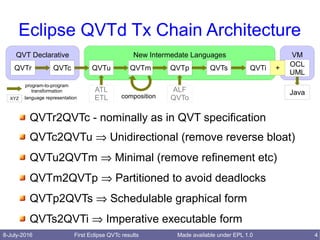
Eclipse QVTd Tx Chain Architecture
QVTr2QVTc - nominally as in QVT specification
QVTc2QVTu ⇒ Unidirectional (remove reverse bloat)
QVTu2QVTm ⇒ Minimal (remove refinement etc)
QVTm2QVTp ⇒ Partitioned to avoid deadlocks
QVTp2QVTs ⇒ Schedulable graphical form
QVTs2QVTi ⇒ Imperative executable form
VMNew Intermedate LanguagesQVT Declarative
QVTr QVTc QVTuQVTc QVTm QVTi
OCL
UML
ALF
QVTo
ATL
ETL composition
program-to-program
transformation
XYZ language representation
Java
QVTi +QVTp QVTs
8-July-2016 First Eclipse QVTc results 5Made available under EPL 1.0
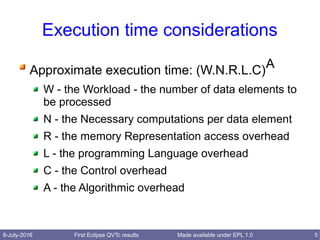
Execution time considerations
Approximate execution time: (W.N.R.L.C)
A
W - the Workload - the number of data elements to
be processed
N - the Necessary computations per data element
R - the memory Representation access overhead
L - the programming Language overhead
C - the Control overhead
A - the Algorithmic overhead
8-July-2016 First Eclipse QVTc results 6Made available under EPL 1.0
Imperative Transformations
Explicit control statements
Manual programming
hopefully good
may be bad
Tooling
hopefully good
may be bad
8-July-2016 First Eclipse QVTc results 7Made available under EPL 1.0
Declarative Transformations
No control statements
Manual programming
different approach, may be good/bad
Tooling
must discover a control strategy
hopefully good
may be VERY BAD
8-July-2016 First Eclipse QVTc results 8Made available under EPL 1.0
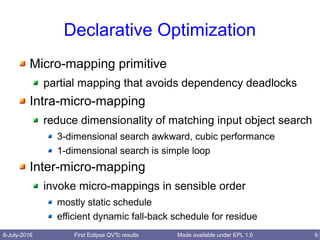
Naive Polling Schedule
Retry loop - loop until all work done
Mapping loop - loop over all possible mappings
Object loops - multi-dimensional loop for all object/argument pairings
Compatibility guard - if object/argument pairings are type compatible
Repetition guard - if this is not a repeated execution
Validity guard - if all input objects are ready
Execute mapping for given object/argument pairings
Create a memento of the successful execution
Works for any declarative transformation
Hideously inefficient - VERY VERY BAD
Optimization goal - a statically ordered schedule
8-July-2016 First Eclipse QVTc results 9Made available under EPL 1.0
Declarative Optimization
Micro-mapping primitive
partial mapping that avoids dependency deadlocks
Intra-micro-mapping
reduce dimensionality of matching input object search
3-dimensional search awkward, cubic performance
1-dimensional search is simple loop
Inter-micro-mapping
invoke micro-mappings in sensible order
mostly static schedule
efficient dynamic fall-back schedule for residue
8-July-2016 First Eclipse QVTc results 10Made available under EPL 1.0
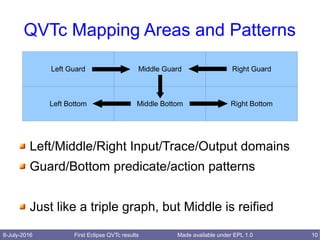
QVTc Mapping Areas and Patterns
Left/Middle/Right Input/Trace/Output domains
Guard/Bottom predicate/action patterns
Just like a triple graph, but Middle is reified
Left Guard Middle Guard Right GuardLeft Guard
Left Guard Middle Bottom Right BottomLeft Bottom
8-July-2016 First Eclipse QVTc results 11Made available under EPL 1.0
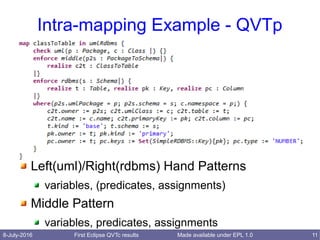
Intra-mapping Example - QVTp
Left(uml)/Right(rdbms) Hand Patterns
variables, (predicates, assignments)
Middle Pattern
variables, predicates, assignments
8-July-2016 First Eclipse QVTc results 12Made available under EPL 1.0
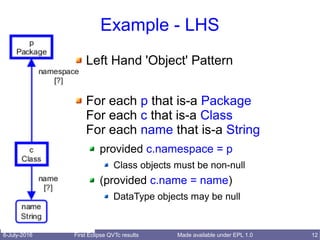
Example - LHS
Left Hand 'Object' Pattern
For each p that is-a Package
For each c that is-a Class
For each name that is-a String
provided c.namespace = p
Class objects must be non-null
(provided c.name = name)
DataType objects may be null
8-July-2016 First Eclipse QVTc results 13Made available under EPL 1.0
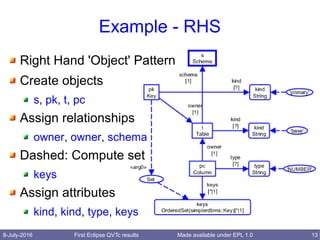
Example - RHS
Right Hand 'Object' Pattern
Create objects
s, pk, t, pc
Assign relationships
owner, owner, schema
Dashed: Compute set
keys
Assign attributes
kind, kind, type, keys
8-July-2016 First Eclipse QVTc results 14Made available under EPL 1.0
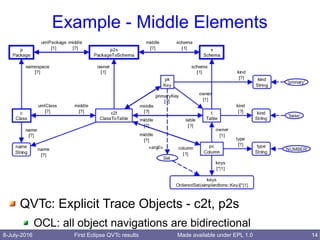
Example - Middle Elements
QVTc: Explicit Trace Objects - c2t, p2s
OCL: all object navigations are bidirectional
8-July-2016 First Eclipse QVTc results 15Made available under EPL 1.0
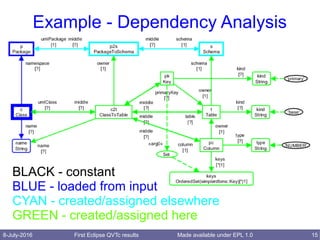
Example - Dependency Analysis
BLACK - constant
BLUE - loaded from input
CYAN - created/assigned elsewhere
GREEN - created/assigned here
8-July-2016 First Eclipse QVTc results 16Made available under EPL 1.0
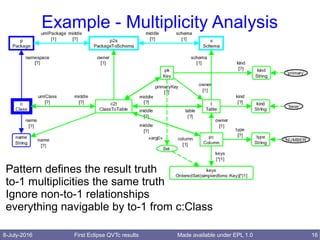
Example - Multiplicity Analysis
Pattern defines the result truth
to-1 multiplicities the same truth
Ignore non-to-1 relationships
everything navigable by to-1 from c:Class
8-July-2016 First Eclipse QVTc results 17Made available under EPL 1.0
Intra-Mapping Optimization
Example
naively 3-dimensional {Package, Class, String}
optimized 1-dimensional {Class} and 2 navigations
Empirical observation
about 90% of mappings can be single input
multi-input mappings have quadratic/worse execution
Work in progress
nearly all multi-input mappings can be reduced to
single input and local loops
only Cartesian problems need Cartesian execution
8-July-2016 First Eclipse QVTc results 18Made available under EPL 1.0
Inter-Mapping optimizations
Inter-mappings have simple dependency rule
CYAN elements must be produced elsewhere
elements are produced as GREEN elements
Global analysis: GREEN before CYAN
Complications
multiple GREEN producers
multiple CYAN consumers
consumption of derived types
8-July-2016 First Eclipse QVTc results 19Made available under EPL 1.0
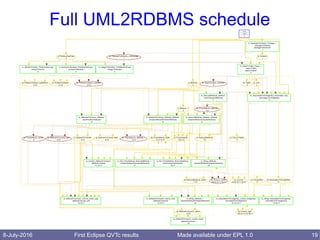
Full UML2RDBMS schedule
8-July-2016 First Eclipse QVTc results 20Made available under EPL 1.0
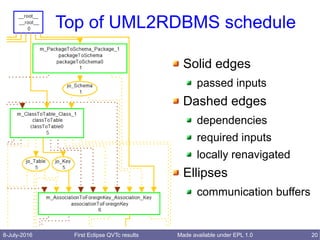
Top of UML2RDBMS schedule
Solid edges
passed inputs
Dashed edges
dependencies
required inputs
locally renavigated
Ellipses
communication buffers
8-July-2016 First Eclipse QVTc results 21Made available under EPL 1.0
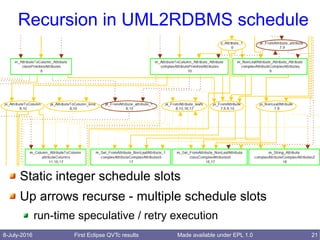
Recursion in UML2RDBMS schedule
Static integer schedule slots
Up arrows recurse - multiple schedule slots
run-time speculative / retry execution
8-July-2016 First Eclipse QVTc results 22Made available under EPL 1.0
UML2RDBMS overall
20 micro-mappings
15 reduced to single input - linear performance
5 with two inputs - quadratic performance
when associations in use
work in progress use local loops - linear wrt output
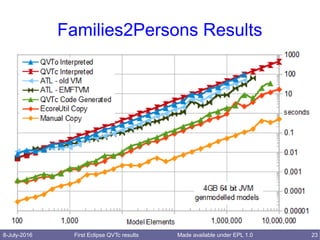
No point showing fixable quadratic performance
use Families2Persons - linear performance
Results
8-July-2016 First Eclipse QVTc results 23Made available under EPL 1.0
Families2Persons Results
8-July-2016 First Eclipse QVTc results 24Made available under EPL 1.0
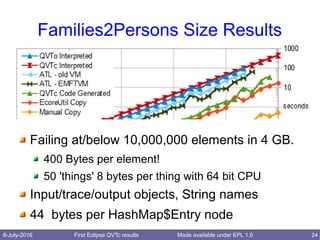
Families2Persons Size Results
Failing at/below 10,000,000 elements in 4 GB.
400 Bytes per element!
50 'things' 8 bytes per thing with 64 bit CPU
Input/trace/output objects, String names
44 bytes per HashMap$Entry node
8-July-2016 First Eclipse QVTc results 25Made available under EPL 1.0
Eclipse QVTd Status
0.12.0 (Mars - June 2015)
QVTi execution (code generated or interpreted)
0.13.0 (Neon - June 2016)
preliminary QVTc / QVTr execution
low quality - research only
no incremental / check / in-place facilities
no debugger
minimal documentation / examples
1.0.0 (Oxygen - June 2017)
first release functionality (? with UMLX ?)
8-July-2016 First Eclipse QVTc results 26Made available under EPL 1.0
Conclusion
First implementation of the QVTc specification.
First direct code generator for model
transformations.
Thirty fold speed-up.
Graph presentation of metamodel and
dependency analyses tames the naive
inefficiencies of a declarative schedule.
Many more optimizations to do, and ... QVTr.

Optimized declarative transformation First Eclipse QVTc results

  • 1.
    Made available underEPL 1.0 Optimized declarative transformation First Eclipse QVTc results Edward D. Willink Willink Transformations Ltd Eclipse Foundation MMT Component co-Lead OCL Project Lead QVTd Project Lead QVTo Committer OMG (Model Driven Solutions) OCL 2.3, 2.4, 2.5 RTF Chair QVT 1.2, 1.3, 1.4 RTF Chair BigMDE @ STAF 2016 8th July 2016
  • 2.
    8-July-2016 First EclipseQVTc results 2Made available under EPL 1.0 Overview QVT Background Eclipse QVTd architecture Execution time imperative/declarative Intra-mapping optimization Inter-mapping optimization Eclipse QVTc results Eclipse QVTc/QVTr status Conclusion
  • 3.
    8-July-2016 First EclipseQVTc results 3Made available under EPL 1.0 QVT Background Query/View/Transformation 2002: standard transformation language RFP OMG specification - slow to mature ATL took a pragmatic short cut 2005: Three language compromise QVTo (Operational Mappings) - Imperative 2 1 good implementations : SmartQVT, Eclipse QVTo QVTr (Relational) - Declarative, rich 2 0 poor implementations : ModelMorf, Medini QVT QVTc (Core) - Declarative, simple notional common core, no implementations Eclipse QVTd: QVTc/QVTr editors
  • 4.
    8-July-2016 First EclipseQVTc results 4Made available under EPL 1.0 Eclipse QVTd Tx Chain Architecture QVTr2QVTc - nominally as in QVT specification QVTc2QVTu ⇒ Unidirectional (remove reverse bloat) QVTu2QVTm ⇒ Minimal (remove refinement etc) QVTm2QVTp ⇒ Partitioned to avoid deadlocks QVTp2QVTs ⇒ Schedulable graphical form QVTs2QVTi ⇒ Imperative executable form VMNew Intermedate LanguagesQVT Declarative QVTr QVTc QVTuQVTc QVTm QVTi OCL UML ALF QVTo ATL ETL composition program-to-program transformation XYZ language representation Java QVTi +QVTp QVTs
  • 5.
    8-July-2016 First EclipseQVTc results 5Made available under EPL 1.0 Execution time considerations Approximate execution time: (W.N.R.L.C) A W - the Workload - the number of data elements to be processed N - the Necessary computations per data element R - the memory Representation access overhead L - the programming Language overhead C - the Control overhead A - the Algorithmic overhead
  • 6.
    8-July-2016 First EclipseQVTc results 6Made available under EPL 1.0 Imperative Transformations Explicit control statements Manual programming hopefully good may be bad Tooling hopefully good may be bad
  • 7.
    8-July-2016 First EclipseQVTc results 7Made available under EPL 1.0 Declarative Transformations No control statements Manual programming different approach, may be good/bad Tooling must discover a control strategy hopefully good may be VERY BAD
  • 8.
    8-July-2016 First EclipseQVTc results 8Made available under EPL 1.0 Naive Polling Schedule Retry loop - loop until all work done Mapping loop - loop over all possible mappings Object loops - multi-dimensional loop for all object/argument pairings Compatibility guard - if object/argument pairings are type compatible Repetition guard - if this is not a repeated execution Validity guard - if all input objects are ready Execute mapping for given object/argument pairings Create a memento of the successful execution Works for any declarative transformation Hideously inefficient - VERY VERY BAD Optimization goal - a statically ordered schedule
  • 9.
    8-July-2016 First EclipseQVTc results 9Made available under EPL 1.0 Declarative Optimization Micro-mapping primitive partial mapping that avoids dependency deadlocks Intra-micro-mapping reduce dimensionality of matching input object search 3-dimensional search awkward, cubic performance 1-dimensional search is simple loop Inter-micro-mapping invoke micro-mappings in sensible order mostly static schedule efficient dynamic fall-back schedule for residue
  • 10.
    8-July-2016 First EclipseQVTc results 10Made available under EPL 1.0 QVTc Mapping Areas and Patterns Left/Middle/Right Input/Trace/Output domains Guard/Bottom predicate/action patterns Just like a triple graph, but Middle is reified Left Guard Middle Guard Right GuardLeft Guard Left Guard Middle Bottom Right BottomLeft Bottom
  • 11.
    8-July-2016 First EclipseQVTc results 11Made available under EPL 1.0 Intra-mapping Example - QVTp Left(uml)/Right(rdbms) Hand Patterns variables, (predicates, assignments) Middle Pattern variables, predicates, assignments
  • 12.
    8-July-2016 First EclipseQVTc results 12Made available under EPL 1.0 Example - LHS Left Hand 'Object' Pattern For each p that is-a Package For each c that is-a Class For each name that is-a String provided c.namespace = p Class objects must be non-null (provided c.name = name) DataType objects may be null
  • 13.
    8-July-2016 First EclipseQVTc results 13Made available under EPL 1.0 Example - RHS Right Hand 'Object' Pattern Create objects s, pk, t, pc Assign relationships owner, owner, schema Dashed: Compute set keys Assign attributes kind, kind, type, keys
  • 14.
    8-July-2016 First EclipseQVTc results 14Made available under EPL 1.0 Example - Middle Elements QVTc: Explicit Trace Objects - c2t, p2s OCL: all object navigations are bidirectional
  • 15.
    8-July-2016 First EclipseQVTc results 15Made available under EPL 1.0 Example - Dependency Analysis BLACK - constant BLUE - loaded from input CYAN - created/assigned elsewhere GREEN - created/assigned here
  • 16.
    8-July-2016 First EclipseQVTc results 16Made available under EPL 1.0 Example - Multiplicity Analysis Pattern defines the result truth to-1 multiplicities the same truth Ignore non-to-1 relationships everything navigable by to-1 from c:Class
  • 17.
    8-July-2016 First EclipseQVTc results 17Made available under EPL 1.0 Intra-Mapping Optimization Example naively 3-dimensional {Package, Class, String} optimized 1-dimensional {Class} and 2 navigations Empirical observation about 90% of mappings can be single input multi-input mappings have quadratic/worse execution Work in progress nearly all multi-input mappings can be reduced to single input and local loops only Cartesian problems need Cartesian execution
  • 18.
    8-July-2016 First EclipseQVTc results 18Made available under EPL 1.0 Inter-Mapping optimizations Inter-mappings have simple dependency rule CYAN elements must be produced elsewhere elements are produced as GREEN elements Global analysis: GREEN before CYAN Complications multiple GREEN producers multiple CYAN consumers consumption of derived types
  • 19.
    8-July-2016 First EclipseQVTc results 19Made available under EPL 1.0 Full UML2RDBMS schedule
  • 20.
    8-July-2016 First EclipseQVTc results 20Made available under EPL 1.0 Top of UML2RDBMS schedule Solid edges passed inputs Dashed edges dependencies required inputs locally renavigated Ellipses communication buffers
  • 21.
    8-July-2016 First EclipseQVTc results 21Made available under EPL 1.0 Recursion in UML2RDBMS schedule Static integer schedule slots Up arrows recurse - multiple schedule slots run-time speculative / retry execution
  • 22.
    8-July-2016 First EclipseQVTc results 22Made available under EPL 1.0 UML2RDBMS overall 20 micro-mappings 15 reduced to single input - linear performance 5 with two inputs - quadratic performance when associations in use work in progress use local loops - linear wrt output No point showing fixable quadratic performance use Families2Persons - linear performance Results
  • 23.
    8-July-2016 First EclipseQVTc results 23Made available under EPL 1.0 Families2Persons Results
  • 24.
    8-July-2016 First EclipseQVTc results 24Made available under EPL 1.0 Families2Persons Size Results Failing at/below 10,000,000 elements in 4 GB. 400 Bytes per element! 50 'things' 8 bytes per thing with 64 bit CPU Input/trace/output objects, String names 44 bytes per HashMap$Entry node
  • 25.
    8-July-2016 First EclipseQVTc results 25Made available under EPL 1.0 Eclipse QVTd Status 0.12.0 (Mars - June 2015) QVTi execution (code generated or interpreted) 0.13.0 (Neon - June 2016) preliminary QVTc / QVTr execution low quality - research only no incremental / check / in-place facilities no debugger minimal documentation / examples 1.0.0 (Oxygen - June 2017) first release functionality (? with UMLX ?)
  • 26.
    8-July-2016 First EclipseQVTc results 26Made available under EPL 1.0 Conclusion First implementation of the QVTc specification. First direct code generator for model transformations. Thirty fold speed-up. Graph presentation of metamodel and dependency analyses tames the naive inefficiencies of a declarative schedule. Many more optimizations to do, and ... QVTr.