AI for Program Specifications Berkeley May 2025.pdf
1.
AI for ProgramSpecifications
Shuvendu Lahiri
Research in Software Engineering (RiSE),
Microsoft Research
1
Collaborators: Sarah Fakhoury, Saikat Chakraborty, Markus Kuppe, Shan Lu, Tahina Ramananandro, Nikhil Swamy, ….
Interns: George Sakkas, Aaditya Naik, Madeline Endres, Livia Sun, ….
Trusted AI-assisted
Programming Project
UC Berekeley (May 12, 2025)
2.
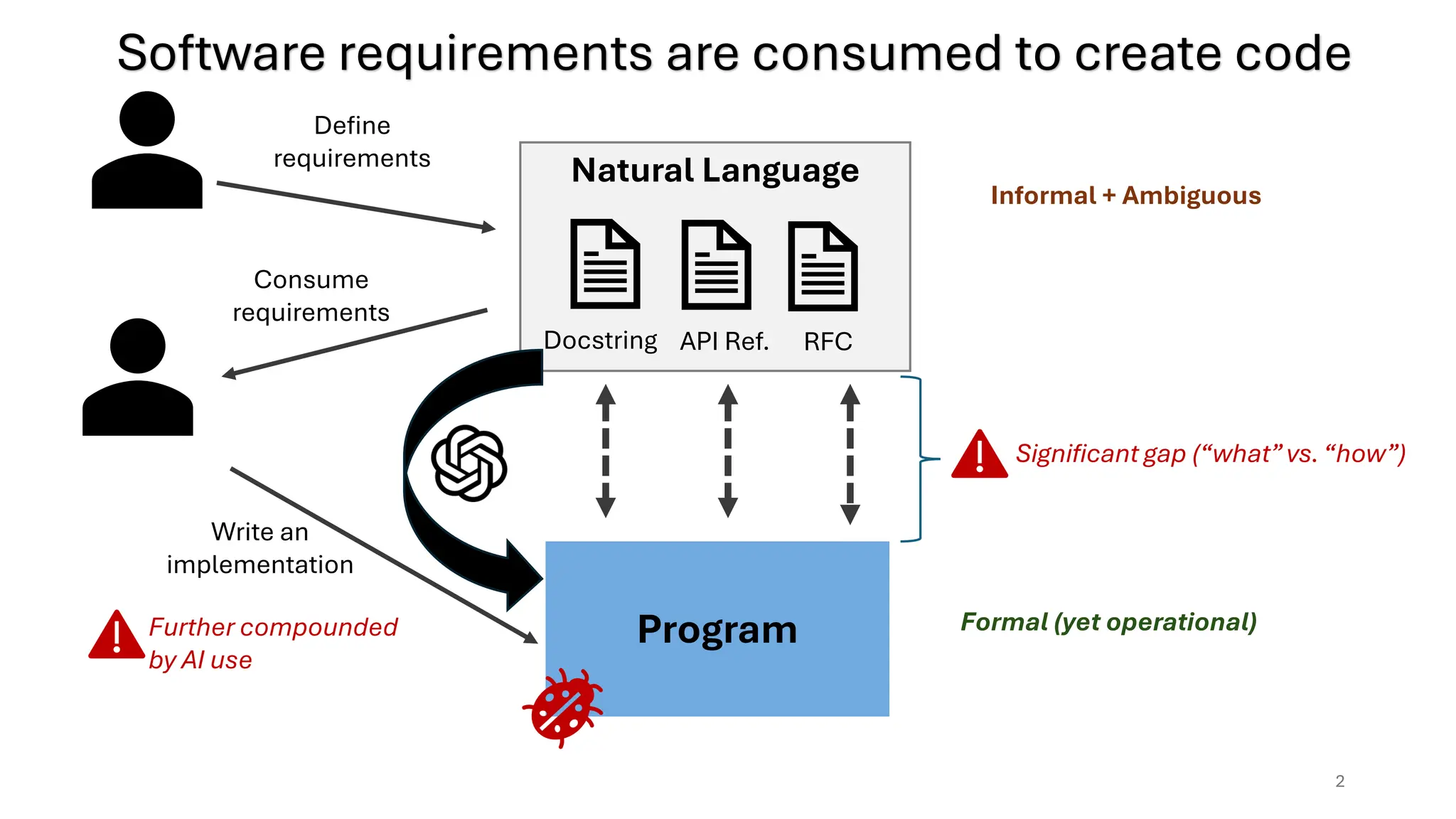
Natural Language
RFC
API Ref.
Docstring
Program
Informal+ Ambiguous
Further compounded
by AI use
Software requirements are consumed to create code
2
Formal (yet operational)
Significant gap (“what”vs. “how”)
Consume
requirements
Write an
implementation
Define
requirements
3.
Natural Language
RFC
API Ref.
Docstring
Program
Informal+ Ambiguous
Formal requirements (specifications) can reduce the gap
3
Formal (yet operational)
Specifications
Enforceable by PL/FM
(tests, formal verification, refinement)
Formal (declarative)
Smaller gap (both capture “what”)
Write an
implementation
Consume
requirements
Define
requirements
User-intent formalization
4.
User-intent formalization forprograms:
Research Questions
• Problem statement:
• Can we automatically evaluate the correctness of a formal (requirement)
specification given an informal natural language intent?
• Applications:
• What new applications can be enabled by user-intent formalization for
programs
4
5.
User-intent formalization (UIF)for programs
• Observation
• NL2Code progress has been spurred by establishment of benchmarks and
automated metrics [MBPP (Google), HumanEval (OpenAI), …]
• Driving progress in latest large language models (LLMs) as a core task
• Uses semantic based metric through tests for evaluating correctness of generated code
(not NLP/syntactic metrics such as BLEU etc.)
• Used in mainstream programming [GitHub Copilot, Cursor, CodeWhisperer, Tabnine, …]
5
• (Revised) Problem statement:
• Can we automatically evaluate the correctness of a formal (requirement) specification
given an informal natural language intent + a diverse set of (hidden) validation tests?
6.
Overview
• UIF formainstream languages (Python, Java), and use case
• Endres, Fakhoury, Chakraborty, Lahiri [FSE’24]
• UIF for verification-aware languages (Dafny, F*, Verus, …)
• Lahiri [FMCAD’24]
• Application to a specification model training (for Verus) [ICLR’25]
• UIF and interactive code-generation (TiCoder)
• Fakhoury, Naik, Sakkas, Chakraborty, Lahiri [TSE’24]
• UIF for verified parser generation from RFCs
• 3DGen: Fakhoury, Kuppe, Lahiri, Ramananandro, Swamy [ICSE’25]
-----
• Loopy: AI for proof (inductive specification) generation
• Kamath, Senthilnathan, Chakraborty, Deligiannis, Lahiri, Lal, Rastogi, Roy, Sharma
[FMCAD’24]
6
7.
UIF for mainstreamlanguages (Python, Java)
7
Can Large Language Models Transform Natural Language Intent into Formal Method Postconditions?
Endres, Fakhoury, Chakraborty, Lahiri FSE’24
https://github.com/microsoft/nl-2-postcond
8.
Formal Specifications inPython
8
UIF for mainstream languages (Python, Java)
[1,2,3,2,4] -> [1,3,4]
assert all(i in return_list for i in numbers if numbers.count(i) == 1)
9.
Problem formulation (ideal)
•Given
• NL description nl for a method m
• (hidden) reference implementation I
• Generate a postcondition S of m from nl
• Evaluation metrics (intuition)
• Soundness: I satisfies S
• Completeness: S discriminates I from any buggy implementations
9
10.
Problem formulation (basedon tests)
• Given
• NL description nl for a method m
• (hidden) reference implementation I + a set of input/output tests T
• Generate a postcondition S of m from nl
• Evaluation metrics (intuition)
• Test-set Soundness: S is consistent with I for each test t in T
• Test-set Completeness: S discriminates I from any buggy implementations on some
test t in T
0 if unsound
• Score =
|buggy mutants discriminated|/|mutants|
10
Evaluate on Defects4Jdataset of real-world bugs and fixes in mature Java
projects
We use GPT-4 to generate 10 postconditions and 10 preconditions for each
buggy function.
We consider two ablations (33,600 total GPT-4 calls)
• NL + Buggy Method Code + Relevant File Context
• NL + Relevant File Context
For each, we measure:
15
Correctness
Does the spec pass the
tests on correct code?
Bug-discriminating
If it is correct, does the
spec fail any of the tests
on buggy code?
Application: Can GPT-4 generated specifications
find real-world bugs?
15.
16
Defects4J results
Across ablations,65 bugs (12.5% of all bugs) are plausibly caught by
generated specifications
• We manually verify a subset of bug catching conditions
Complementary to prior assertion generation approaches TOGA [Dinella, Ryan,
Mytkowicz, Lahiri, ICSE’22] and Daikon [Ernst et al. ICSE’99]
• TOGA mostly finds expected exceptional bugs. TOGA can only tolerate bugs during
testing, and cannot prevent bugs in production.
• Daikon specs overfit the regression tests and bug-discriminating specs are unsound
16.
UIF for verification-awarelanguages
(Dafny, F*, Verus, …)
17
[Evaluating LLM-driven User-Intent Formalization for Verification-Aware Languages, Lahiri, FMCAD’24]
https://github.com/microsoft/nl-2-postcond
17.
Motivating example
18
predicate InArray(a:array<int>, x: int)
reads a
{exists i :: 0 <= i < a.Length && a[i] == x}
method SharedElements(a: array<int>, b: array<int>) returns (result: seq<int>)
ensures forall x :: x in result ==> (InArray(a, x) && InArray(b, x))
ensures forall i, j :: 0 <= i < j < |result| ==> result[i] != result[j]
"Write a function to find the shared elements from the given two lists.“ [MBPP task#2]
GPT4 generated
specifcation.
Labeled as
“strong” by authors
[Towards AI-Assisted Synthesis of Verified Dafny Methods. Misu, Lopes, Ma, Noble. FSE’24]
"test_cases": {
"test_1": "var a1 := new int[] [3, 4, 5, 6];
var a2 := new int[] [5, 7, 4, 10];
var res1 :=SharedElements(a1,a2);
//expected[4, 5];",
"test_2": “…",
"test_3": “…"
}
Hidden (not visible to spec generator)
18.
Prior works
MBPP-DFY
[Misu, Lopes,Ma, Noble. FSE’24]
• Generates spec+code+proof in
Dafny from NL using GPT-4
• Creates 153 “verified”
examples
• Problem:
• How good are the
specifications?
• Manual/subjective (non-
automated) metric for
evaluation of specifications
19
nl2postcond
[Endres, Fakhoury, Chakraborty, Lahiri.
FSE’24]
• Creates automated metrics
for specification quality for
mainstream languages (Java,
Py) given tests and code
mutants
• Problem:
• Doesn’t work with rich
specifications (e.g.,
quantifiers, ghost variables)
in verification-aware
languages
19.
This work
• Anapproach to evaluate the correctness of formal program
specifications (given tests)
• A step towards creating a benchmark for user-intent-formalization
(specification quality) for programs in Dafny
• Leverages the dataset from MBPP-DFY
• “Adapts” the metric from nl2postcond for verification-aware languages
• Outcomes
• A “benchmark” of 64/153 examples from MBPP-DFY
• Automated metric for spec evaluation based on symbolically testing
specifications
20
20.
Our approach
• Symbolicallytest specifications (given tests as input/output
examples)
• Given
• A method signature
method Foo(x): (returns y) requires P(x) ensures Q(x, y)
• A set of input/output tests T
• Specification Soundness (for a test (i, o)) //Boolean metric
• {P} x := i; y := o; {Q} is valid
• Specification Completeness (for a test (i,o)) //Quantitative
metric (kill-set from mutation-testing)
• Fraction of mutants o’ of o, s.t. {P} x := i; y := o’; {Q} is not valid
21
21.
predicate InArray(a: array<int>,x: int)
reads a
{exists i :: 0 <= i < a.Length && a[i] == x}
method SharedElements(a: array<int>, b: array<int>)
returns (result: seq<int>)
ensures forall x :: x in result ==> (InArray(a, x) &&
InArray(b, x))
ensures forall i, j :: 0 <= i < j < |result| ==>
result[i] != result[j]
method SharedElementsTest(){
var a1:= new int[] [3, 4, 5, 6];
var a2:= new int[] [5, 7, 4, 10];
var res1:=SharedElements(a1,a2);
//expected[4, 5];
}
22
"Write a function to find the shared
elements from the given two lists."
Should
verify
Should
fail to verify
[6];
22.
Evaluation https://github.com/microsoft/nl-2-postcond
• Evaluatethe soundness/completeness metrics against human labels
• Dataset: 153 Dafny specifications for MBPP-DFY dataset
• Implemented mutation operators for simple output values (Booleans, integers,
string, lists)
• Results
• Automated metrics gets parity with the human-labeling for most examples
• Can replace manual annotation with automated checks (given tests)
• Soundness check satisfied for 64/153 examples
• Finds instances where a “strong” specification is not complete
• Finds instances of “incorrect” specifications
23
23.
predicate InArray(a: array<int>,x: int)
reads a
{exists i :: 0 <= i < a.Length && a[i] == x}
method SharedElements(a: array<int>, b: array<int>) returns (result: seq<int>)
ensures forall x :: x in result ==> (InArray(a, x) && InArray(b, x))
ensures forall i, j :: 0 <= i < j < |result| ==> result[i] != result[j]
method SharedElementsTest(){
var a1:= new int[] [3, 4, 5, 6];
var a2:= new int[] [5, 7, 4, 10];
var res1:=SharedElements(a1,a2);
//expected[4, 5];
}
24
"Write a function to find the shared elements from the given two lists."
GPT4 generated.
Labeled as
“strong”
Our metric marks this as a
weak specification (wrt the test)
Changing ==> to <==> makes it a
strong invariant by our metric
Result 1: label weak specifications
2 more such examples in the paper detected automatically
24.
Result 2: labelincorrect specifications
"234": {
"task_id": "234",
"task_description": "Write a method in Dafny to find the
volume of a cube given its side length.",
"method_signature": "method CubeVolume(l:int) returns (int)",
"test_cases": {
"test_1": "var out1:= CubeVolume(3);nassert out1==27;",
"test_2": "var out2:= CubeVolume(2);nassert out2==8;",
"test_3": "var out3:= CubeVolume(5);nassert out3==25;"
}
25
Our metric marks this as a
Incorrect specification (wrt the tests)
Problem: authors introduced error during copy-paste from Python -> Dafny!
2 more such examples in the paper detected automatically
25.
Challenges: quantifiers, unrolling,…
• Parsing complex datatypes (e.g., 2-dimensional arrays etc.)
• Need redundant assertions to trigger the quantifiers [DONE]
assume {:axiom} a[..a.Length] == a1[..a1.Length];
assert a[0] == a1[0] && .... && a[3] == a1[3];
• Unroll (or partially evaluate) recursive predicates based on concrete
input
• Trigger for nested quantifiers in specification predicates
• method IsNonPrime(n: int) returns (result: bool)
requires n >= 2
ensures result <==> (exists k :: 2 <= k < n && n % k == 0)
26
26.
Alternate proposals forbenchmark
• Other alternatives for automated metric
• Running the reference implementation with specifications on the tests
• Compare against a reference specification
• Verifying the specification against reference implementation
• Checking for the most precise specification (given the tests)
• Check the paper for details why they do not suffice …..
27
27.
Application: Specification modeltraining for Verus
28
Automated Proof Generation for Rust Code via Self-Evolution. Chen, Lu, (Shan) Lu, Gong, Yang, Li, Misu, Yu, Duan, Cheng, Yang, Lahiri,
Xie, Zhou [arXiv:2410.15756], ICLR 2025
The approach of scoring specifications given tests has been ported to Verus
for boosting synthetic (spec, code, proof) generation for model training
Problem: Fine-tune an LLM to produce high-quality Proof given <DocString, Code, Spec>
• Need a high quality < DocString, Code, Spec, Proof > tuples
• Sub-Problem: Need a high quality < DocString, Code, Spec> tuples
• Approach: Fine-tune an LLM to produce high quality Spec given DocString and Tests using the
metric from earlier slide
28.
Seed
AutoVerus training workflow
29
Code
~45KRust Programs
from code-synthesis dataset
Model
Training
Data
Augmentation
Data Pruning
Code, Spec
+
Code, Spec
~20K
Train a
Specification model
29.
Seed
AutoVerus training workflow
30
Code,Spec
Proof
Code Spec
Code
~45K Rust Programs
from code-synthesis dataset
Model
Training
Data
Augmentation
Data Pruning
Code, Spec
+
~20K
+
Model Training
Data
Augmentation
Data Pruning
~4K
Train a
Specification model
Train a
Proof model
30.
Specification model training
forVerus
31
Automated Proof Generation for Rust Code via Self-Evolution. Chen, Lu, (Shan) Lu, Gong, Yang, Li, Misu, Yu, Duan, Cheng, Yang, Lahiri,
Xie, Zhou [arXiv:2410.15756], ICLR 2025
The approach of scoring specifications
given tests has been ported to Verus for
boosting synthetic (spec, code, proof)
generation for model training
31.
UIF (tests asspec) can improve code generation
accuracy and developer productivity with user-
in-the-loop
32
[LLM-based Test-driven Interactive Code Generation: User Study and Empirical
Evaluation, Fakhoury, Naik, Sakkas, Chakraborty, Lahiri, TSE’24]
[Interactive Code Generation via Test-Driven User-Intent Formalization, Lahiri,
Naik, Sakkas, Choudhury, Veh, Musuvathi, Inala, Wang, Gao, arXiv:2208.05950]
https://github.com/microsoft/TiCoder
32.
33
TiCoder: Interactive codegeneration with test-
driven user-intent formalization
Given: a set of code suggestions from LLM for a
natural language NL
Repeat
1. Generate checkable specifications from NL: (here
I/O tests)
2. Rank the test/specifications (using code
suggestions)
3. Query user if a (ranked) spec is consistent with
their intent
4. User responds Yes/No/Undef (and optionally
corrects output for No)
5. Prune code suggestions to conform to set of
approved tests
Present a ranked list of code and approved tests
Intent formalization unlocksLLM utility: empirical
investigation with simulated user
• Improves pass@k numbers (with increasing user interaction)
• Provides tests for “free” (helpful for formalizing intent)
35
35.
• Participants aresignificantly more likely to correctly evaluate AI generated code (40% vs 84%)
• TiCoder significantly reduces self-reported cognitive load (p = 0.007)
• TiCoder often reduces time on task across tasks, but not always (n.s.)
36
Intent formalization improves developer outcomes
Intent formalization unlocks LLM utility: user-study
36.
Real world applicationof UIF: Verified Parser
Generation from RFCs
3DGen: AI-Assisted Generation of Provably Correct Binary Format Parsers. Fakhoury,
Kuppe, Lahiri, Ramananandro, Swamy [ICSE’25]
37
37.
Background: verified parsergeneration from
declarative 3D specifications in Everparse
• Parsing and input validation failures: A
major root cause of software security
vulnerabilities
• `80%, according to DARPA, MITRE
• Mostly due to handwritten parsing code
• Writing functionally correct parsers is hard
(Endianness, data dependencies, size
constraints, etc.)
• Especially disastrous in memory unsafe
languages
Safe high-performance formally verified
C (or Rust) code
Functional Specification: Data Format Description (3D)
[1] Swamy, Nikhil, et al. "Hardening attack surfaces with formally
proven binary format parsers." International Conference on
Programming Language Design and Implementation (PLDI). 2022.
[2] Ramananandro, Tahina, et al. "EverParse: Verified secure zero-
copy parsers for authenticated message formats." 28th USENIX
Security Symposium (USENIX Security 19). 2019
Microsoft Research
• ThreeAgent personas collaborating:
o Planner: dictates roles, orchestrates
conversation
o Domain Expert Agent: Extracts
constraints from NL or Code, provides
feedback about generated specification
o 3D Agent: translates extracted
specifications into 3D
• Implemented with AutoGen [1]
o Composable
Retrieval Augmented (RAG) agents
o Gpt-4-32k model
Agent Implementation
[1] Wu, Qingyun, et al. "AutoGen: Enabling next-gen LLM applications via multi-agent conversation framework." arXiv:2308.08155 (2023)
41.
Automating verified parsergeneration with 3DGen
External
• Generated verified parsers
from RFCs
• 20 packet formats for standard
protocols
Currently being integrated
into product codebases
42
42.
AI for Proof(InductiveSpecification)
Generation
• Ranking LLM-Generated Loop Invariants for Program Verification
Chakraborty, Lahiri, Fakhoury, Musuvathi, Lal, Rastogi, Swamy, Sharma
[EMNLP’23]
• Leveraging LLMs for Program Verification. Kamath, Senthilnathan,
Chakraborty, Deligiannis, Lahiri, Lal, Rastogi, Roy, Sharma [FMCAD’24]
• Towards Neural Synthesis for SMT-Assisted Proof-Oriented
Programming Chakraborty, Ebner, Bhat, Fakhoury, Fatima, Lahiri,
Swamy [ICSE’25 Distinguished Paper]
• AutoVerus: Automated Proof Generation for Rust Code. Yang, Li,
Misu, Yao, Cui, Gong, Hawblitzel, Lahiri, Lorch, Lu, Yang, Zhou, Lu
[arXiv]
43
43.
Loopy: Inferring invariantsfor program
verification (safety, termination)
44
Leveraging LLMs for Program Verification. Kamath, Senthilnathan, Chakraborty, Deligiannis, Lahiri, Lal,
Rastogi, Roy, Sharma [FMCAD’24]
Other works inAI and verification/testing
46
• LLM and verified code translation
• LLM-Vectorizer: LLM-based Verified Loop Vectorizer. Taneja, Laird, Yan,
Musuvathi, Lahiri [CGO’25]
• QURE: AI-Assisted and Automatically Verified UDF Inlining. Siddiqui, König,
Cao, Yan, Lahiri [Sigmod '25]
• LLM and test generation
• TOGA: A Neural Method for Test Oracle Generation. Dinella, Ryan,
Mytkowicz, Lahiri [ICSE ‘22]
• CODAMOSA: Escaping Coverage Plateaus in Test Generation with Pre-
trained Large Language Models. Lemieux, Priya Inala, Lahiri, Sen [ICSE’23]
46.
Summary
47
Trusted AI-assisted
Programming
Related researchwith LLM and verification/testing
• LLM and proof automation
• Ranking LLM-Generated Loop Invariants for Program Verification Chakraborty, Lahiri, Fakhoury, Musuvathi, Lal, Rastogi, Swamy, Sharma [EMNLP’23]
• Leveraging LLMs for Program Verification. Kamath, Senthilnathan, Chakraborty, Deligiannis, Lahiri, Lal, Rastogi, Roy, Sharma [FMCAD’24]
• Towards Neural Synthesis for SMT-Assisted Proof-Oriented Programming Chakraborty, Ebner, Bhat, Fakhoury, Fatima, Lahiri, Swamy [ICSE’25 to
appear]
• AutoVerus: Automated Proof Generation for Rust Code. Yang, Li, Misu, Yao, Cui, Gong, Hawblitzel, Lahiri, Lorch, Lu, Yang, Zhou, Lu [arXiv]
• LLM and verified code translation
• LLM-Vectorizer: LLM-based Verified Loop Vectorizer. Taneja, Laird, Yan, Musuvathi, Lahiri [CGO’25 to appear]
• QURE: AI-Assisted and Automatically Verified UDF Inlining. Siddiqui, König, Cao, Yan, Lahiri [Sigmod '25 to appear]
• LLM and test generation
• TOGA: A Neural Method for Test Oracle Generation. Dinella, Ryan, Mytkowicz, Lahiri [ICSE ‘22]
• CODAMOSA: Escaping Coverage Plateaus in Test Generation with Pre-trained Large Language Models. Lemieux, Priya Inala, Lahiri, Sen [ICSE’23]
RiSE
AI for Program Specifications
• UIF for mainstream languages (Python, Java), and use case
• Endres, Fakhoury, Chakraborty, Lahiri [FSE’24]
• UIF for verification-aware languages (Dafny, F*, Verus, …)
• Lahiri [FMCAD’24]
• Application to a specification model training (for Verus) [ICLR’25]
• UIF for verified parser generation from RFCs
• 3DGen: Fakhoury, Kuppe, Lahiri, Ramananandro, Swamy [ICSE’25]
• Application to interactive code-generation (TiCoder)
• LLM-based Test-driven Interactive Code Generation: User Study and Empirical Evaluation. Fakhoury, Naik, Sakkas, Chakraborty, Lahiri [TSE’24]
Application of specificationmodel training
• The approach has been ported to Verus for boosting synthetic
(spec, code, proof) generation for model training
• Automated Proof Generation for Rust Code via Self-Evolution. Chen,
Lu, (Shan) Lu, Gong, Yang, Li, Misu, Yu, Duan, Cheng, Yang, Lahiri, Xie,
Zhou [arXiv:2410.15756], ICLR 2025
49
49.
Model accuracy increaseswith training data
size
50
Training Data
(#Proved Programs)
Model Accuracy
(Accuracy@10, VerusBench)
~4K
17.3%
Start
~8K
41.7%
Round 1
~10K
49.6%
Round 2
~11K
54.0%
Round 3
50.
Adding “debugging” datainto training set
51
Training Data
(#Proved Programs)
Model Accuracy
(Accuracy@10, VerusBench)
~4K
17.3%
Start
~8K
41.7%
Round 1
~10K
49.6%
Round 2
~11K
54.0%
Round 3
Training Data
(# Debugging Pairs)
)
~13K
82.0%
Round 4
All done in ~1.5 days
51.
GPT: docstring →Verusspecification
52
fn binary_search(v: &Vec<u64>, k: u64) -> (r: usize)
Given a sorted input vector and a search key that exists in the vector,
return a vector index that is valid and points to the search key
requires
forall|i:int, j:int| 0 <= i <= j < v.len() ==> v[i] <= v[j],
exists|i:int| 0 <= i < v.len() && k == v[i],
ensures
r < v.len(),
k == v[r as int], requires
forall|i:int, j:int| 0 <= i <= j < v.len() ==> v[i] <= v[j],
exists|i:int| 0 <= i < v.len() && k == v[i],
ensures
r < v.len(),
ensures
k == r,
ensures
r >= 0,
52.
How to scorea specification?
53
mutation
Original Test
Cases
Mutated Test
Cases
A specification
xx% of original test cases are approved
yy% of mutated test cases are rejected
The higher
the better
The higher
the better
53.
RQ1: How goodare LLMs at generating specs
from Natural Language?
Evaluation Methodology: EvalPlus
[Is Your Code Generated by ChatGPT Really Correct? Rigorous Evaluation of Large Language Models for Code
Generation. Liu et al. NeurIPS’23]
For each problem in HumanEval, we used LLMs to generate a set of
postconditions. We consider the following ablations1:
1. Model (GPT 3.5 and GPT 4 and StarCoder)
2. Prompting with NL only vs. NL + reference solution
54
54.
Evaluate on Defects4Jdataset of real-world bugs
and fixes in mature Java projects
Our postconditions leverage functional Java syntax introduced in
Java 8. Not all bugs in Defects4J are Java 8 syntax compatible.
Our NL2Spec Defects4J subset contains 525 bugs from 11
projects. These bugs implicate 840 buggy Java methods.
55
Application: Can GPT-4 generated specifications
find real-world bugs?
[Defects4J: a database of existing faults to enable controlled testing studies for Java programs. 2014. Rene Just, Darioush Jalali, Michael Ernst]
55.
We use GPT-4to generate 10 postconditions and 10
preconditions for each buggy function.
We consider two ablations (33,600 total GPT-4 calls)
• NL + Buggy Method Code + Relevant File Context
• NL + Relevant File Context
For each, we measure:
56
Correctness
Does the spec pass the
tests on correct code?
Bug-discriminating
If it is correct, does the
spec fail any of the tests
on buggy code?
Application: Can GPT-4 generated specifications
find real-world bugs?
microsoft/TiCoder



![User-intent formalization (UIF) for programs
• Observation
• NL2Code progress has been spurred by establishment of benchmarks and
automated metrics [MBPP (Google), HumanEval (OpenAI), …]
• Driving progress in latest large language models (LLMs) as a core task
• Uses semantic based metric through tests for evaluating correctness of generated code
(not NLP/syntactic metrics such as BLEU etc.)
• Used in mainstream programming [GitHub Copilot, Cursor, CodeWhisperer, Tabnine, …]
5
• (Revised) Problem statement:
• Can we automatically evaluate the correctness of a formal (requirement) specification
given an informal natural language intent + a diverse set of (hidden) validation tests?](https://image.slidesharecdn.com/aiforprogramspecificationsberkeleymay2025-250605190136-06f51ed5/75/AI-for-Program-Specifications-Berkeley-May-2025-pdf-5-2048.jpg)
![Overview
• UIF for mainstream languages (Python, Java), and use case
• Endres, Fakhoury, Chakraborty, Lahiri [FSE’24]
• UIF for verification-aware languages (Dafny, F*, Verus, …)
• Lahiri [FMCAD’24]
• Application to a specification model training (for Verus) [ICLR’25]
• UIF and interactive code-generation (TiCoder)
• Fakhoury, Naik, Sakkas, Chakraborty, Lahiri [TSE’24]
• UIF for verified parser generation from RFCs
• 3DGen: Fakhoury, Kuppe, Lahiri, Ramananandro, Swamy [ICSE’25]
-----
• Loopy: AI for proof (inductive specification) generation
• Kamath, Senthilnathan, Chakraborty, Deligiannis, Lahiri, Lal, Rastogi, Roy, Sharma
[FMCAD’24]
6](https://image.slidesharecdn.com/aiforprogramspecificationsberkeleymay2025-250605190136-06f51ed5/75/AI-for-Program-Specifications-Berkeley-May-2025-pdf-6-2048.jpg)

![Formal Specifications in Python
8
UIF for mainstream languages (Python, Java)
[1,2,3,2,4] -> [1,3,4]
assert all(i in return_list for i in numbers if numbers.count(i) == 1)](https://image.slidesharecdn.com/aiforprogramspecificationsberkeleymay2025-250605190136-06f51ed5/75/AI-for-Program-Specifications-Berkeley-May-2025-pdf-8-2048.jpg)


![16
Defects4J results
Across ablations, 65 bugs (12.5% of all bugs) are plausibly caught by
generated specifications
• We manually verify a subset of bug catching conditions
Complementary to prior assertion generation approaches TOGA [Dinella, Ryan,
Mytkowicz, Lahiri, ICSE’22] and Daikon [Ernst et al. ICSE’99]
• TOGA mostly finds expected exceptional bugs. TOGA can only tolerate bugs during
testing, and cannot prevent bugs in production.
• Daikon specs overfit the regression tests and bug-discriminating specs are unsound](https://image.slidesharecdn.com/aiforprogramspecificationsberkeleymay2025-250605190136-06f51ed5/75/AI-for-Program-Specifications-Berkeley-May-2025-pdf-15-2048.jpg)
![UIF for verification-aware languages
(Dafny, F*, Verus, …)
17
[Evaluating LLM-driven User-Intent Formalization for Verification-Aware Languages, Lahiri, FMCAD’24]
https://github.com/microsoft/nl-2-postcond](https://image.slidesharecdn.com/aiforprogramspecificationsberkeleymay2025-250605190136-06f51ed5/75/AI-for-Program-Specifications-Berkeley-May-2025-pdf-16-2048.jpg)
![Motivating example
18
predicate InArray(a: array<int>, x: int)
reads a
{exists i :: 0 <= i < a.Length && a[i] == x}
method SharedElements(a: array<int>, b: array<int>) returns (result: seq<int>)
ensures forall x :: x in result ==> (InArray(a, x) && InArray(b, x))
ensures forall i, j :: 0 <= i < j < |result| ==> result[i] != result[j]
"Write a function to find the shared elements from the given two lists.“ [MBPP task#2]
GPT4 generated
specifcation.
Labeled as
“strong” by authors
[Towards AI-Assisted Synthesis of Verified Dafny Methods. Misu, Lopes, Ma, Noble. FSE’24]
"test_cases": {
"test_1": "var a1 := new int[] [3, 4, 5, 6];
var a2 := new int[] [5, 7, 4, 10];
var res1 :=SharedElements(a1,a2);
//expected[4, 5];",
"test_2": “…",
"test_3": “…"
}
Hidden (not visible to spec generator)](https://image.slidesharecdn.com/aiforprogramspecificationsberkeleymay2025-250605190136-06f51ed5/75/AI-for-Program-Specifications-Berkeley-May-2025-pdf-17-2048.jpg)
![Prior works
MBPP-DFY
[Misu, Lopes, Ma, Noble. FSE’24]
• Generates spec+code+proof in
Dafny from NL using GPT-4
• Creates 153 “verified”
examples
• Problem:
• How good are the
specifications?
• Manual/subjective (non-
automated) metric for
evaluation of specifications
19
nl2postcond
[Endres, Fakhoury, Chakraborty, Lahiri.
FSE’24]
• Creates automated metrics
for specification quality for
mainstream languages (Java,
Py) given tests and code
mutants
• Problem:
• Doesn’t work with rich
specifications (e.g.,
quantifiers, ghost variables)
in verification-aware
languages](https://image.slidesharecdn.com/aiforprogramspecificationsberkeleymay2025-250605190136-06f51ed5/75/AI-for-Program-Specifications-Berkeley-May-2025-pdf-18-2048.jpg)


![predicate InArray(a: array<int>, x: int)
reads a
{exists i :: 0 <= i < a.Length && a[i] == x}
method SharedElements(a: array<int>, b: array<int>)
returns (result: seq<int>)
ensures forall x :: x in result ==> (InArray(a, x) &&
InArray(b, x))
ensures forall i, j :: 0 <= i < j < |result| ==>
result[i] != result[j]
method SharedElementsTest(){
var a1:= new int[] [3, 4, 5, 6];
var a2:= new int[] [5, 7, 4, 10];
var res1:=SharedElements(a1,a2);
//expected[4, 5];
}
22
"Write a function to find the shared
elements from the given two lists."
Should
verify
Should
fail to verify
[6];](https://image.slidesharecdn.com/aiforprogramspecificationsberkeleymay2025-250605190136-06f51ed5/75/AI-for-Program-Specifications-Berkeley-May-2025-pdf-21-2048.jpg)

![predicate InArray(a: array<int>, x: int)
reads a
{exists i :: 0 <= i < a.Length && a[i] == x}
method SharedElements(a: array<int>, b: array<int>) returns (result: seq<int>)
ensures forall x :: x in result ==> (InArray(a, x) && InArray(b, x))
ensures forall i, j :: 0 <= i < j < |result| ==> result[i] != result[j]
method SharedElementsTest(){
var a1:= new int[] [3, 4, 5, 6];
var a2:= new int[] [5, 7, 4, 10];
var res1:=SharedElements(a1,a2);
//expected[4, 5];
}
24
"Write a function to find the shared elements from the given two lists."
GPT4 generated.
Labeled as
“strong”
Our metric marks this as a
weak specification (wrt the test)
Changing ==> to <==> makes it a
strong invariant by our metric
Result 1: label weak specifications
2 more such examples in the paper detected automatically](https://image.slidesharecdn.com/aiforprogramspecificationsberkeleymay2025-250605190136-06f51ed5/75/AI-for-Program-Specifications-Berkeley-May-2025-pdf-23-2048.jpg)

![Challenges: quantifiers, unrolling, …
• Parsing complex datatypes (e.g., 2-dimensional arrays etc.)
• Need redundant assertions to trigger the quantifiers [DONE]
assume {:axiom} a[..a.Length] == a1[..a1.Length];
assert a[0] == a1[0] && .... && a[3] == a1[3];
• Unroll (or partially evaluate) recursive predicates based on concrete
input
• Trigger for nested quantifiers in specification predicates
• method IsNonPrime(n: int) returns (result: bool)
requires n >= 2
ensures result <==> (exists k :: 2 <= k < n && n % k == 0)
26](https://image.slidesharecdn.com/aiforprogramspecificationsberkeleymay2025-250605190136-06f51ed5/75/AI-for-Program-Specifications-Berkeley-May-2025-pdf-25-2048.jpg)

![Application: Specification model training for Verus
28
Automated Proof Generation for Rust Code via Self-Evolution. Chen, Lu, (Shan) Lu, Gong, Yang, Li, Misu, Yu, Duan, Cheng, Yang, Lahiri,
Xie, Zhou [arXiv:2410.15756], ICLR 2025
The approach of scoring specifications given tests has been ported to Verus
for boosting synthetic (spec, code, proof) generation for model training
Problem: Fine-tune an LLM to produce high-quality Proof given <DocString, Code, Spec>
• Need a high quality < DocString, Code, Spec, Proof > tuples
• Sub-Problem: Need a high quality < DocString, Code, Spec> tuples
• Approach: Fine-tune an LLM to produce high quality Spec given DocString and Tests using the
metric from earlier slide](https://image.slidesharecdn.com/aiforprogramspecificationsberkeleymay2025-250605190136-06f51ed5/75/AI-for-Program-Specifications-Berkeley-May-2025-pdf-27-2048.jpg)


![Specification model training
for Verus
31
Automated Proof Generation for Rust Code via Self-Evolution. Chen, Lu, (Shan) Lu, Gong, Yang, Li, Misu, Yu, Duan, Cheng, Yang, Lahiri,
Xie, Zhou [arXiv:2410.15756], ICLR 2025
The approach of scoring specifications
given tests has been ported to Verus for
boosting synthetic (spec, code, proof)
generation for model training](https://image.slidesharecdn.com/aiforprogramspecificationsberkeleymay2025-250605190136-06f51ed5/75/AI-for-Program-Specifications-Berkeley-May-2025-pdf-30-2048.jpg)
![UIF (tests as spec) can improve code generation
accuracy and developer productivity with user-
in-the-loop
32
[LLM-based Test-driven Interactive Code Generation: User Study and Empirical
Evaluation, Fakhoury, Naik, Sakkas, Chakraborty, Lahiri, TSE’24]
[Interactive Code Generation via Test-Driven User-Intent Formalization, Lahiri,
Naik, Sakkas, Choudhury, Veh, Musuvathi, Inala, Wang, Gao, arXiv:2208.05950]
https://github.com/microsoft/TiCoder](https://image.slidesharecdn.com/aiforprogramspecificationsberkeleymay2025-250605190136-06f51ed5/75/AI-for-Program-Specifications-Berkeley-May-2025-pdf-31-2048.jpg)


![Real world application of UIF: Verified Parser
Generation from RFCs
3DGen: AI-Assisted Generation of Provably Correct Binary Format Parsers. Fakhoury,
Kuppe, Lahiri, Ramananandro, Swamy [ICSE’25]
37](https://image.slidesharecdn.com/aiforprogramspecificationsberkeleymay2025-250605190136-06f51ed5/75/AI-for-Program-Specifications-Berkeley-May-2025-pdf-36-2048.jpg)
![Background: verified parser generation from
declarative 3D specifications in Everparse
• Parsing and input validation failures: A
major root cause of software security
vulnerabilities
• `80%, according to DARPA, MITRE
• Mostly due to handwritten parsing code
• Writing functionally correct parsers is hard
(Endianness, data dependencies, size
constraints, etc.)
• Especially disastrous in memory unsafe
languages
Safe high-performance formally verified
C (or Rust) code
Functional Specification: Data Format Description (3D)
[1] Swamy, Nikhil, et al. "Hardening attack surfaces with formally
proven binary format parsers." International Conference on
Programming Language Design and Implementation (PLDI). 2022.
[2] Ramananandro, Tahina, et al. "EverParse: Verified secure zero-
copy parsers for authenticated message formats." 28th USENIX
Security Symposium (USENIX Security 19). 2019](https://image.slidesharecdn.com/aiforprogramspecificationsberkeleymay2025-250605190136-06f51ed5/75/AI-for-Program-Specifications-Berkeley-May-2025-pdf-37-2048.jpg)


![Microsoft Research
• Three Agent personas collaborating:
o Planner: dictates roles, orchestrates
conversation
o Domain Expert Agent: Extracts
constraints from NL or Code, provides
feedback about generated specification
o 3D Agent: translates extracted
specifications into 3D
• Implemented with AutoGen [1]
o Composable
Retrieval Augmented (RAG) agents
o Gpt-4-32k model
Agent Implementation
[1] Wu, Qingyun, et al. "AutoGen: Enabling next-gen LLM applications via multi-agent conversation framework." arXiv:2308.08155 (2023)](https://image.slidesharecdn.com/aiforprogramspecificationsberkeleymay2025-250605190136-06f51ed5/75/AI-for-Program-Specifications-Berkeley-May-2025-pdf-40-2048.jpg)

![AI for Proof(Inductive Specification)
Generation
• Ranking LLM-Generated Loop Invariants for Program Verification
Chakraborty, Lahiri, Fakhoury, Musuvathi, Lal, Rastogi, Swamy, Sharma
[EMNLP’23]
• Leveraging LLMs for Program Verification. Kamath, Senthilnathan,
Chakraborty, Deligiannis, Lahiri, Lal, Rastogi, Roy, Sharma [FMCAD’24]
• Towards Neural Synthesis for SMT-Assisted Proof-Oriented
Programming Chakraborty, Ebner, Bhat, Fakhoury, Fatima, Lahiri,
Swamy [ICSE’25 Distinguished Paper]
• AutoVerus: Automated Proof Generation for Rust Code. Yang, Li,
Misu, Yao, Cui, Gong, Hawblitzel, Lahiri, Lorch, Lu, Yang, Zhou, Lu
[arXiv]
43](https://image.slidesharecdn.com/aiforprogramspecificationsberkeleymay2025-250605190136-06f51ed5/75/AI-for-Program-Specifications-Berkeley-May-2025-pdf-42-2048.jpg)
![Loopy: Inferring invariants for program
verification (safety, termination)
44
Leveraging LLMs for Program Verification. Kamath, Senthilnathan, Chakraborty, Deligiannis, Lahiri, Lal,
Rastogi, Roy, Sharma [FMCAD’24]](https://image.slidesharecdn.com/aiforprogramspecificationsberkeleymay2025-250605190136-06f51ed5/75/AI-for-Program-Specifications-Berkeley-May-2025-pdf-43-2048.jpg)

![Other works in AI and verification/testing
46
• LLM and verified code translation
• LLM-Vectorizer: LLM-based Verified Loop Vectorizer. Taneja, Laird, Yan,
Musuvathi, Lahiri [CGO’25]
• QURE: AI-Assisted and Automatically Verified UDF Inlining. Siddiqui, König,
Cao, Yan, Lahiri [Sigmod '25]
• LLM and test generation
• TOGA: A Neural Method for Test Oracle Generation. Dinella, Ryan,
Mytkowicz, Lahiri [ICSE ‘22]
• CODAMOSA: Escaping Coverage Plateaus in Test Generation with Pre-
trained Large Language Models. Lemieux, Priya Inala, Lahiri, Sen [ICSE’23]](https://image.slidesharecdn.com/aiforprogramspecificationsberkeleymay2025-250605190136-06f51ed5/75/AI-for-Program-Specifications-Berkeley-May-2025-pdf-45-2048.jpg)
![Summary
47
Trusted AI-assisted
Programming
Related research with LLM and verification/testing
• LLM and proof automation
• Ranking LLM-Generated Loop Invariants for Program Verification Chakraborty, Lahiri, Fakhoury, Musuvathi, Lal, Rastogi, Swamy, Sharma [EMNLP’23]
• Leveraging LLMs for Program Verification. Kamath, Senthilnathan, Chakraborty, Deligiannis, Lahiri, Lal, Rastogi, Roy, Sharma [FMCAD’24]
• Towards Neural Synthesis for SMT-Assisted Proof-Oriented Programming Chakraborty, Ebner, Bhat, Fakhoury, Fatima, Lahiri, Swamy [ICSE’25 to
appear]
• AutoVerus: Automated Proof Generation for Rust Code. Yang, Li, Misu, Yao, Cui, Gong, Hawblitzel, Lahiri, Lorch, Lu, Yang, Zhou, Lu [arXiv]
• LLM and verified code translation
• LLM-Vectorizer: LLM-based Verified Loop Vectorizer. Taneja, Laird, Yan, Musuvathi, Lahiri [CGO’25 to appear]
• QURE: AI-Assisted and Automatically Verified UDF Inlining. Siddiqui, König, Cao, Yan, Lahiri [Sigmod '25 to appear]
• LLM and test generation
• TOGA: A Neural Method for Test Oracle Generation. Dinella, Ryan, Mytkowicz, Lahiri [ICSE ‘22]
• CODAMOSA: Escaping Coverage Plateaus in Test Generation with Pre-trained Large Language Models. Lemieux, Priya Inala, Lahiri, Sen [ICSE’23]
RiSE
AI for Program Specifications
• UIF for mainstream languages (Python, Java), and use case
• Endres, Fakhoury, Chakraborty, Lahiri [FSE’24]
• UIF for verification-aware languages (Dafny, F*, Verus, …)
• Lahiri [FMCAD’24]
• Application to a specification model training (for Verus) [ICLR’25]
• UIF for verified parser generation from RFCs
• 3DGen: Fakhoury, Kuppe, Lahiri, Ramananandro, Swamy [ICSE’25]
• Application to interactive code-generation (TiCoder)
• LLM-based Test-driven Interactive Code Generation: User Study and Empirical Evaluation. Fakhoury, Naik, Sakkas, Chakraborty, Lahiri [TSE’24]](https://image.slidesharecdn.com/aiforprogramspecificationsberkeleymay2025-250605190136-06f51ed5/75/AI-for-Program-Specifications-Berkeley-May-2025-pdf-46-2048.jpg)

![Application of specification model training
• The approach has been ported to Verus for boosting synthetic
(spec, code, proof) generation for model training
• Automated Proof Generation for Rust Code via Self-Evolution. Chen,
Lu, (Shan) Lu, Gong, Yang, Li, Misu, Yu, Duan, Cheng, Yang, Lahiri, Xie,
Zhou [arXiv:2410.15756], ICLR 2025
49](https://image.slidesharecdn.com/aiforprogramspecificationsberkeleymay2025-250605190136-06f51ed5/75/AI-for-Program-Specifications-Berkeley-May-2025-pdf-48-2048.jpg)


![GPT: docstring →Verus specification
52
fn binary_search(v: &Vec<u64>, k: u64) -> (r: usize)
Given a sorted input vector and a search key that exists in the vector,
return a vector index that is valid and points to the search key
requires
forall|i:int, j:int| 0 <= i <= j < v.len() ==> v[i] <= v[j],
exists|i:int| 0 <= i < v.len() && k == v[i],
ensures
r < v.len(),
k == v[r as int], requires
forall|i:int, j:int| 0 <= i <= j < v.len() ==> v[i] <= v[j],
exists|i:int| 0 <= i < v.len() && k == v[i],
ensures
r < v.len(),
ensures
k == r,
ensures
r >= 0,](https://image.slidesharecdn.com/aiforprogramspecificationsberkeleymay2025-250605190136-06f51ed5/75/AI-for-Program-Specifications-Berkeley-May-2025-pdf-51-2048.jpg)

![RQ1: How good are LLMs at generating specs
from Natural Language?
Evaluation Methodology: EvalPlus
[Is Your Code Generated by ChatGPT Really Correct? Rigorous Evaluation of Large Language Models for Code
Generation. Liu et al. NeurIPS’23]
For each problem in HumanEval, we used LLMs to generate a set of
postconditions. We consider the following ablations1:
1. Model (GPT 3.5 and GPT 4 and StarCoder)
2. Prompting with NL only vs. NL + reference solution
54](https://image.slidesharecdn.com/aiforprogramspecificationsberkeleymay2025-250605190136-06f51ed5/75/AI-for-Program-Specifications-Berkeley-May-2025-pdf-53-2048.jpg)
![Evaluate on Defects4J dataset of real-world bugs
and fixes in mature Java projects
Our postconditions leverage functional Java syntax introduced in
Java 8. Not all bugs in Defects4J are Java 8 syntax compatible.
Our NL2Spec Defects4J subset contains 525 bugs from 11
projects. These bugs implicate 840 buggy Java methods.
55
Application: Can GPT-4 generated specifications
find real-world bugs?
[Defects4J: a database of existing faults to enable controlled testing studies for Java programs. 2014. Rene Just, Darioush Jalali, Michael Ernst]](https://image.slidesharecdn.com/aiforprogramspecificationsberkeleymay2025-250605190136-06f51ed5/75/AI-for-Program-Specifications-Berkeley-May-2025-pdf-54-2048.jpg)


