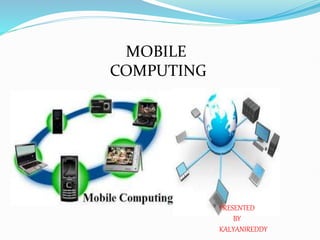
MOBILE
COMPUTING
PRESENTED
BY
KALYANIREDDY
OVERVIEW
 What is Mobile Computing?
 Why go mobile?
 Types of wireless devices
 Mobile objects
 Moving object databases (MOD)
 Applications of Mobile Computing
 Challenges
 Future of Mobile Computing
 Conclusion
WHAT IS MOBILE COMPUTING?
 Mobile Computing is a technology that allows
transmission of data,
voice and video via a
computer or any other
wireless enabled device
without having to be
connected to a fixed
physical link.
WHY GO MOBILE?
 Enable anywhere/anytime connectivity
 Bring computer communications to areas without pre-
existing infrastructure
 Enable mobility
 Enable new applications
 An exciting new research area
WIRELESS NETWORK
A wireless network is a computer network that uses
wireless data connections between network nodes.
 Wireless networking is a method by which
homes, telecommunications networks and business
installations avoid the costly process of introducing
cables into a building, or as a connection between
various equipment locations.
TYPES OF WIRELESS DEVICES
 Laptops
 Palmtops
 PDAs
 Cell phones
 Pagers
 Sensors
MOBILE OBJECTS
 Mobile objects, sometimes called mobile agents, are
bits of code that can move to another execution site
(presumably on a different machine) under their own
programmatic control, where they can then efficiently
interact with the local environment.
 Commercial instantiations of this technology include
Aglets from IBM, Concordia from Mitsubishi, and
Voyager from Object Space.
Moving Object Databases (MOD)
 Deals with Mobile Objects whose geometry, position
changes over time
 Traditional DBMS alone is incapable for this purpose
 MOD is built on top of existing DBMS to support a
critical set of capabilities.
COMPARISION
WIRED WIRELESS
 High bandwidth
 Low bandwidth variability
 Can listen on wire
 High power machines
 High resource machines
 Low delay
 Connected operation
 Low bandwidth
 High bandwidth variability
 Hidden terminal problem
 Low power machines
 Low resource machines
 High delay
 Disconnected operation
APPLICATIONS OF MOBILE
COMPUTING
 For Estate Agents
 In courts
 In companies
 Stock Information Collection/Control
 Credit Card Verification
 Taxi/Truck Dispatch
 Electronic Mail/Paging
Challenges
 Disconnection
 Low bandwidth
 High bandwidth variability
 Low power and resources
 Security risks
 Wide variety terminals and devices with different
capabilities
 Device attributes
 Fit more functionality into single, smaller device
ADVANTAGES
 Location Flexibility
Saves Time
Enhanced Productivity
Ease of Research
Entertainment
Streamlining of Business Processes
FUTURE OF MOBILE COMPUTING
 Use of Artificial Intelligence
 Integrated Circuitry -> Compact Size
 Increases in Computer Processor speeds
CONCLUSION
 Today's computing has rapidly grown from being confined
to a single location. With mobile computing, people can
work from the comfort of any location they wish to as long
as the connection and the security concerns are properly
factored. In the same light, the presence of high speed
connections has also promoted the use of mobile
computing.

Being an ever growing and emerging technology, mobile
computing will continue to be a core service in computing,
and Information and Communications Technology.
mobilecomputing2s-17080915542656 (2).pdf

mobilecomputing2s-17080915542656 (2).pdf

  • 1.
  • 2.
    OVERVIEW  What isMobile Computing?  Why go mobile?  Types of wireless devices  Mobile objects  Moving object databases (MOD)  Applications of Mobile Computing  Challenges  Future of Mobile Computing  Conclusion
  • 3.
    WHAT IS MOBILECOMPUTING?  Mobile Computing is a technology that allows transmission of data, voice and video via a computer or any other wireless enabled device without having to be connected to a fixed physical link.
  • 4.
    WHY GO MOBILE? Enable anywhere/anytime connectivity  Bring computer communications to areas without pre- existing infrastructure  Enable mobility  Enable new applications  An exciting new research area
  • 5.
    WIRELESS NETWORK A wirelessnetwork is a computer network that uses wireless data connections between network nodes.  Wireless networking is a method by which homes, telecommunications networks and business installations avoid the costly process of introducing cables into a building, or as a connection between various equipment locations.
  • 6.
    TYPES OF WIRELESSDEVICES  Laptops  Palmtops  PDAs  Cell phones  Pagers  Sensors
  • 7.
    MOBILE OBJECTS  Mobileobjects, sometimes called mobile agents, are bits of code that can move to another execution site (presumably on a different machine) under their own programmatic control, where they can then efficiently interact with the local environment.  Commercial instantiations of this technology include Aglets from IBM, Concordia from Mitsubishi, and Voyager from Object Space.
  • 8.
    Moving Object Databases(MOD)  Deals with Mobile Objects whose geometry, position changes over time  Traditional DBMS alone is incapable for this purpose  MOD is built on top of existing DBMS to support a critical set of capabilities.
  • 9.
    COMPARISION WIRED WIRELESS  Highbandwidth  Low bandwidth variability  Can listen on wire  High power machines  High resource machines  Low delay  Connected operation  Low bandwidth  High bandwidth variability  Hidden terminal problem  Low power machines  Low resource machines  High delay  Disconnected operation
  • 10.
    APPLICATIONS OF MOBILE COMPUTING For Estate Agents  In courts  In companies  Stock Information Collection/Control  Credit Card Verification  Taxi/Truck Dispatch  Electronic Mail/Paging
  • 11.
    Challenges  Disconnection  Lowbandwidth  High bandwidth variability  Low power and resources  Security risks  Wide variety terminals and devices with different capabilities  Device attributes  Fit more functionality into single, smaller device
  • 12.
    ADVANTAGES  Location Flexibility SavesTime Enhanced Productivity Ease of Research Entertainment Streamlining of Business Processes
  • 13.
    FUTURE OF MOBILECOMPUTING  Use of Artificial Intelligence  Integrated Circuitry -> Compact Size  Increases in Computer Processor speeds
  • 14.
    CONCLUSION  Today's computinghas rapidly grown from being confined to a single location. With mobile computing, people can work from the comfort of any location they wish to as long as the connection and the security concerns are properly factored. In the same light, the presence of high speed connections has also promoted the use of mobile computing.  Being an ever growing and emerging technology, mobile computing will continue to be a core service in computing, and Information and Communications Technology.