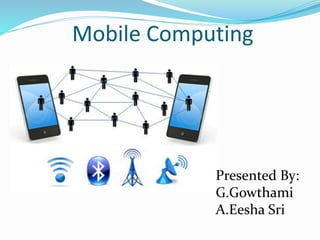
Mobile Computing
Presented By:
G.Gowthami
A.Eesha Sri
Contents
 What is mobile computing?
 Why go mobile?
 Principles
 Comparison to wired networks
 Wireless devices
 Applications of mobile computing
 Challenges
 Future of mobile computing
 Conclusion
What is Mobile Computing?
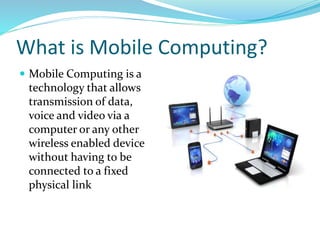
 Mobile Computing is a
technology that allows
transmission of data,
voice and video via a
computer or any other
wireless enabled device
without having to be
connected to a fixed
physical link
Why Go Mobile?
 Enable all time and
anywhere connectivity
 Bring computer
communications to areas
without pre-existing
infrastructure
 Enable mobility
 Enable new applications
 An exciting new research
area
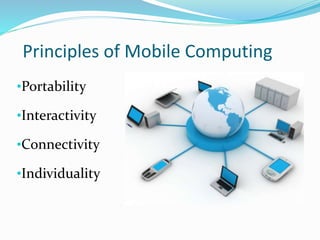
Principles of Mobile Computing
•Portability
•Interactivity
•Connectivity
•Individuality
Comparison to Wired Network
Wired Networks Mobile Networks
 high bandwidth
 low bandwidth variability
 can listen on wire
 high power machines
 high resource machines
 need physical
access(security)
 low delay
 connected operation
 low bandwidth
 high bandwidth variability
 hidden terminal problem
 low power machines
 low resource machines
 need proximity
 higher delay
 disconnected operation
Different Wireless Devices
Palmtop Laptops Cell phones
SensorsPagersPDAs
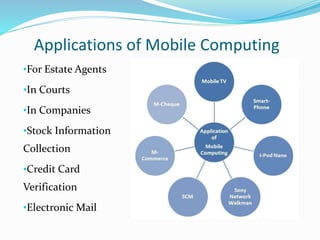
Applications of Mobile Computing
•For Estate Agents
•In Courts
•In Companies
•Stock Information
Collection
•Credit Card
Verification
•Electronic Mail
Challenges
 Disconnection
 Low bandwidth
 High bandwidth variability
 Low power and resources
 Security risks
 Wide variety terminals
 Devices with different
capabilities
 Device attributes
 Fit more functionality into
single, smaller device
Future of Mobile Computing
 Use of Artificial
Intelligence
 Compact Size
Integrated
Circuitry
 Increases in
Computer
Processor speeds
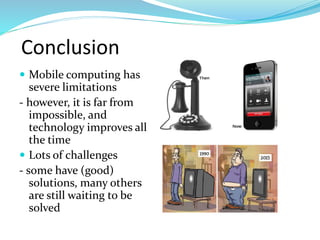
Conclusion
 Mobile computing has
severe limitations
- however, it is far from
impossible, and
technology improves all
the time
 Lots of challenges
- some have (good)
solutions, many others
are still waiting to be
solved
Any
Queries
Mobile computing

Mobile computing

  • 1.
  • 2.
    Contents  What ismobile computing?  Why go mobile?  Principles  Comparison to wired networks  Wireless devices  Applications of mobile computing  Challenges  Future of mobile computing  Conclusion
  • 3.
    What is MobileComputing?  Mobile Computing is a technology that allows transmission of data, voice and video via a computer or any other wireless enabled device without having to be connected to a fixed physical link
  • 4.
    Why Go Mobile? Enable all time and anywhere connectivity  Bring computer communications to areas without pre-existing infrastructure  Enable mobility  Enable new applications  An exciting new research area
  • 5.
    Principles of MobileComputing •Portability •Interactivity •Connectivity •Individuality
  • 6.
    Comparison to WiredNetwork Wired Networks Mobile Networks  high bandwidth  low bandwidth variability  can listen on wire  high power machines  high resource machines  need physical access(security)  low delay  connected operation  low bandwidth  high bandwidth variability  hidden terminal problem  low power machines  low resource machines  need proximity  higher delay  disconnected operation
  • 7.
    Different Wireless Devices PalmtopLaptops Cell phones SensorsPagersPDAs
  • 8.
    Applications of MobileComputing •For Estate Agents •In Courts •In Companies •Stock Information Collection •Credit Card Verification •Electronic Mail
  • 9.
    Challenges  Disconnection  Lowbandwidth  High bandwidth variability  Low power and resources  Security risks  Wide variety terminals  Devices with different capabilities  Device attributes  Fit more functionality into single, smaller device
  • 10.
    Future of MobileComputing  Use of Artificial Intelligence  Compact Size Integrated Circuitry  Increases in Computer Processor speeds
  • 11.
    Conclusion  Mobile computinghas severe limitations - however, it is far from impossible, and technology improves all the time  Lots of challenges - some have (good) solutions, many others are still waiting to be solved
  • 12.