Mobile Data Networks – today and tomorrow Jørgen Grinnes | Telenor Norway
Agenda  Timeline  6 Tomorrow’s network 5 Trends and challenges 4 Today’s network 3 2 1 Value proposition Mobile broadband growth
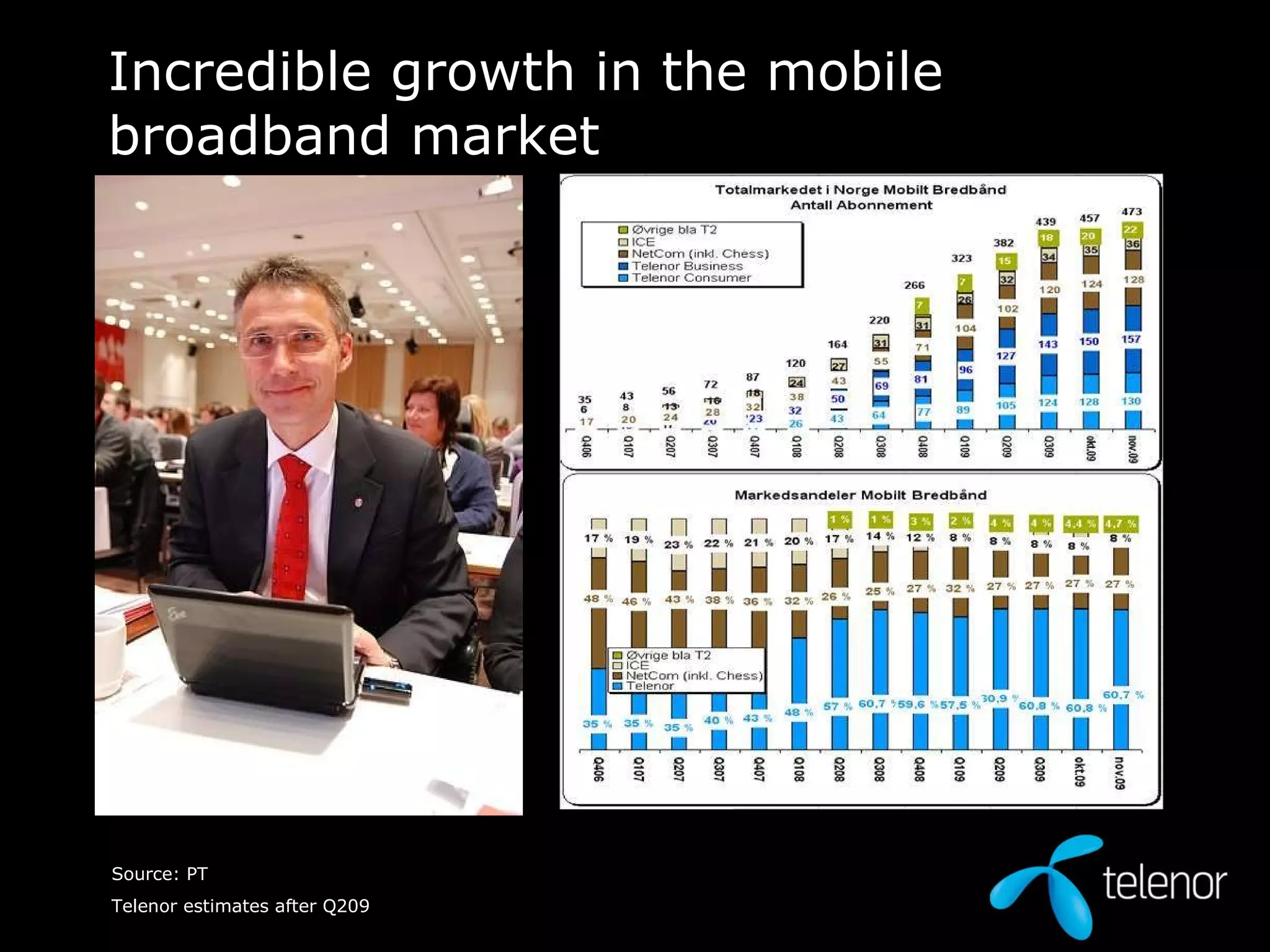
Incredible growth in the mobile broadband market Source: PT Telenor estimates after Q209
Mobile broadband: a great value prop Plug & play Works first time and every time  Easy Mobile internet throughout the country  Mobile broadband where people live and holiday  Anywhere Predictable prices for all segments  All you can eat – but with fair usage cap’ Affordable A broadband experiece 0,5 – 1,5 mbps  Broadband
Telenor offers nationwide internet coverage and broadband where people live and holiday  >23% Area >400 WiFi hot spots  >87% Households  Coverage
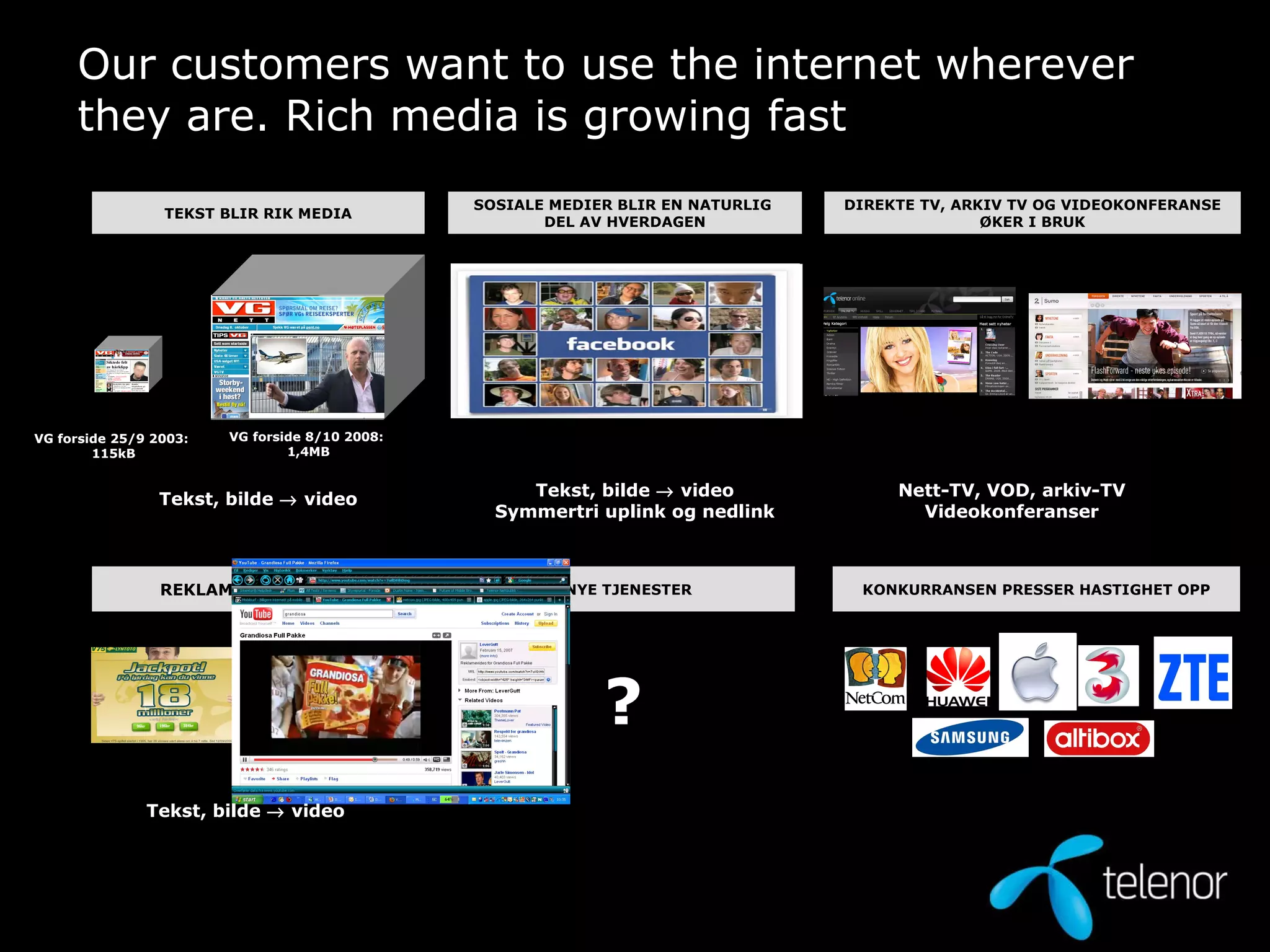
Our customers want to use the internet wherever they are. Rich media is growing fast  KONKURRANSEN PRESSER HASTIGHET OPP TEKST BLIR RIK MEDIA DIREKTE TV, ARKIV TV OG VIDEOKONFERANSE ØKER I BRUK REKLAME BLIR VIDEO NYE TJENESTER SOSIALE MEDIER BLIR EN NATURLIG  DEL AV HVERDAGEN VG forside 25/9 2003:  115kB VG forside 8/10 2008:  1,4MB Nett-TV, VOD, arkiv-TV Videokonferanser Tekst, bilde    video ? Tekst, bilde    video Symmertri uplink og nedlink Tekst, bilde    video
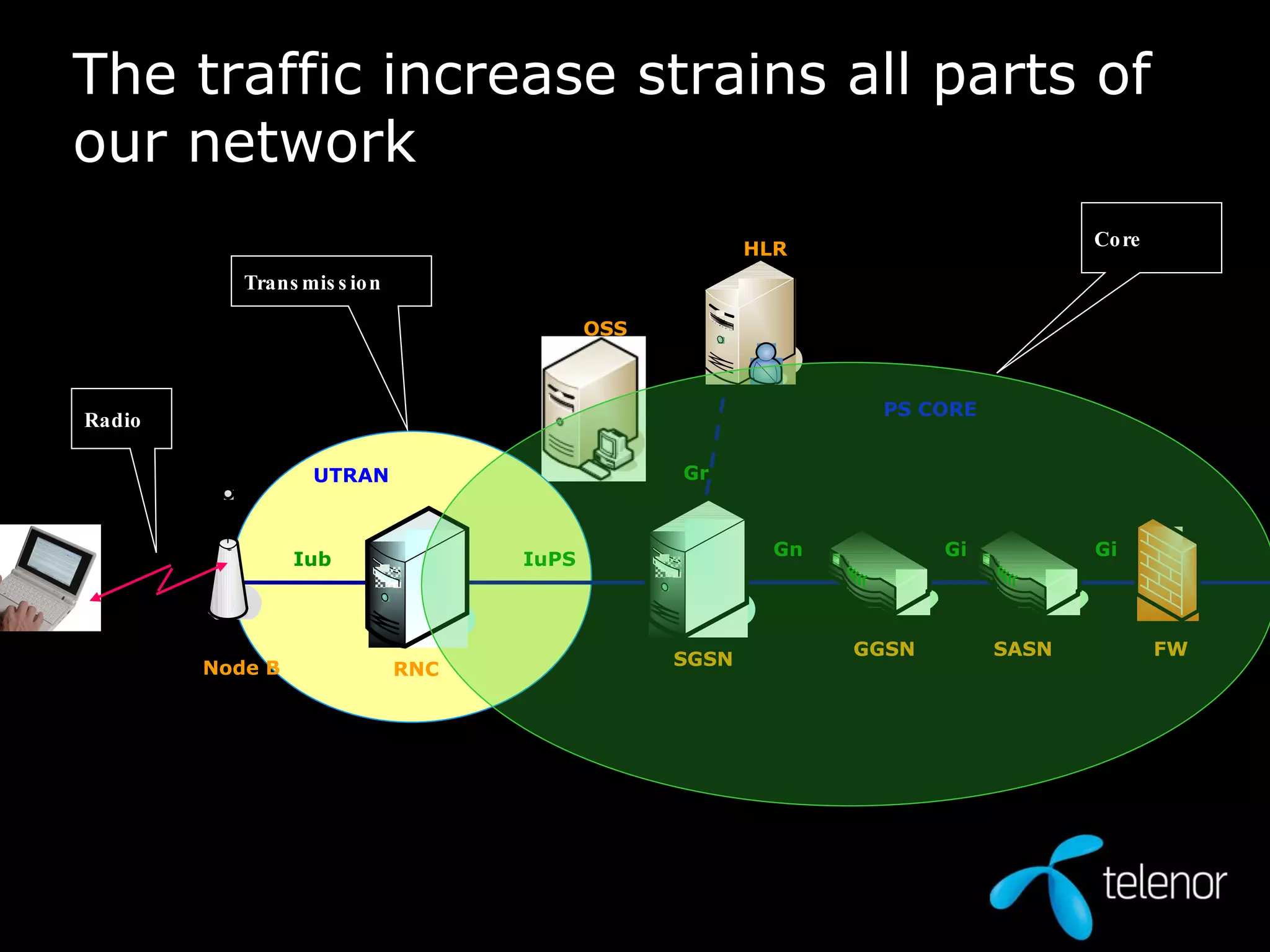
GGSN SGSN Gn IuPS Gi RNC Node B Iub HLR PS CORE UTRAN SASN FW Gi Gr Radio Core Transmission  OSS The traffic increase strains all parts of our network
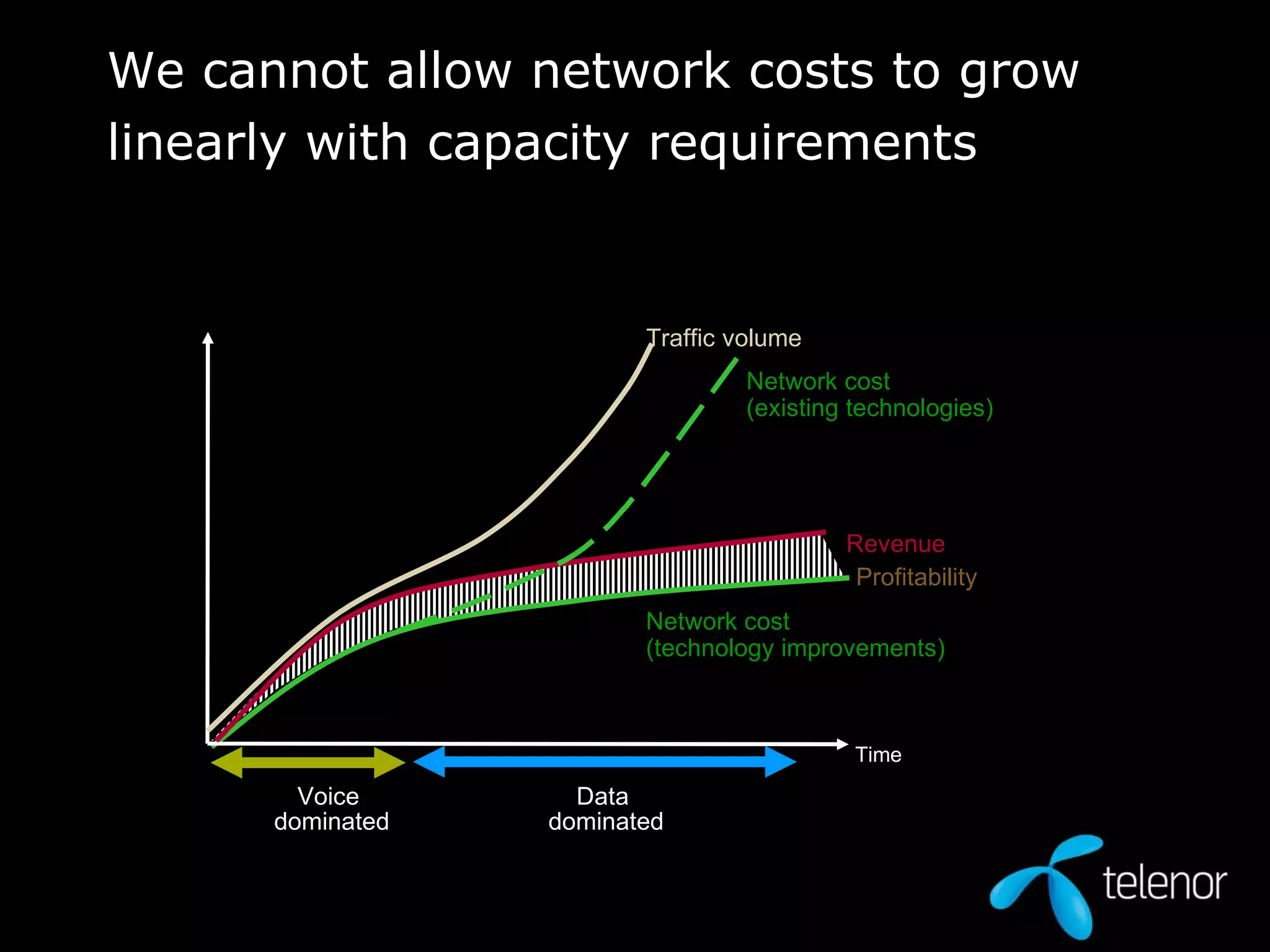
We cannot allow network costs to grow linearly with capacity requirements  Network cost  (technology improvements) Profitability  Voice  dominated Data  dominated Traffic volume Revenue  Time Network cost  (existing technologies)
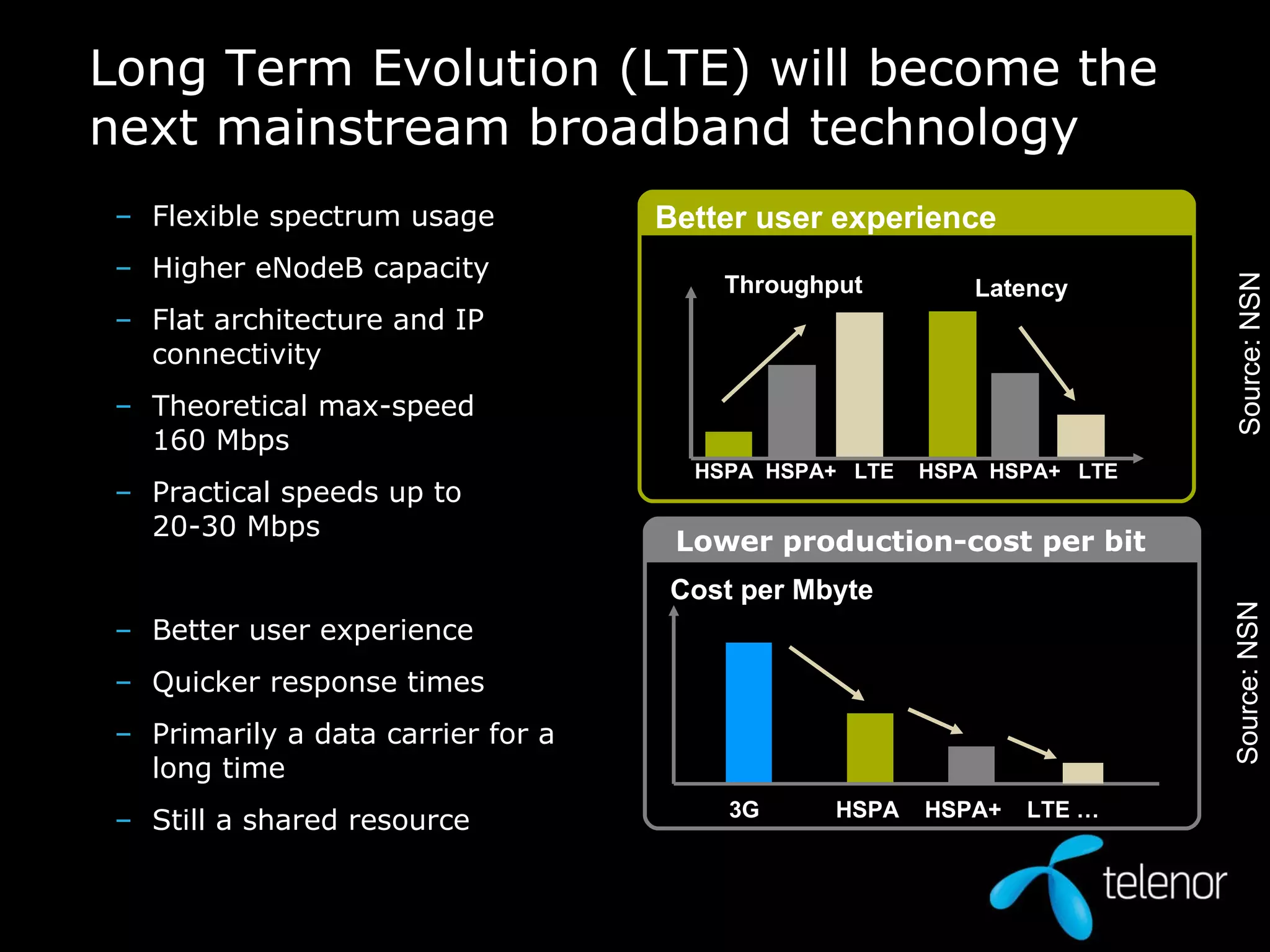
Flexible spectrum usage Higher eNodeB capacity Flat architecture and IP connectivity Theoretical max-speed  160 Mbps Practical speeds up to  20-30 Mbps  Better user experience Quicker response times Primarily a data carrier for a long time Still a shared resource Long Term Evolution (LTE) will become the next mainstream broadband technology Better user experience HSPA  HSPA+  LTE Throughput Latency HSPA  HSPA+  LTE 3G  HSPA  HSPA+  LTE … Cost per Mbyte Lower production-cost per bit Source: NSN Source: NSN
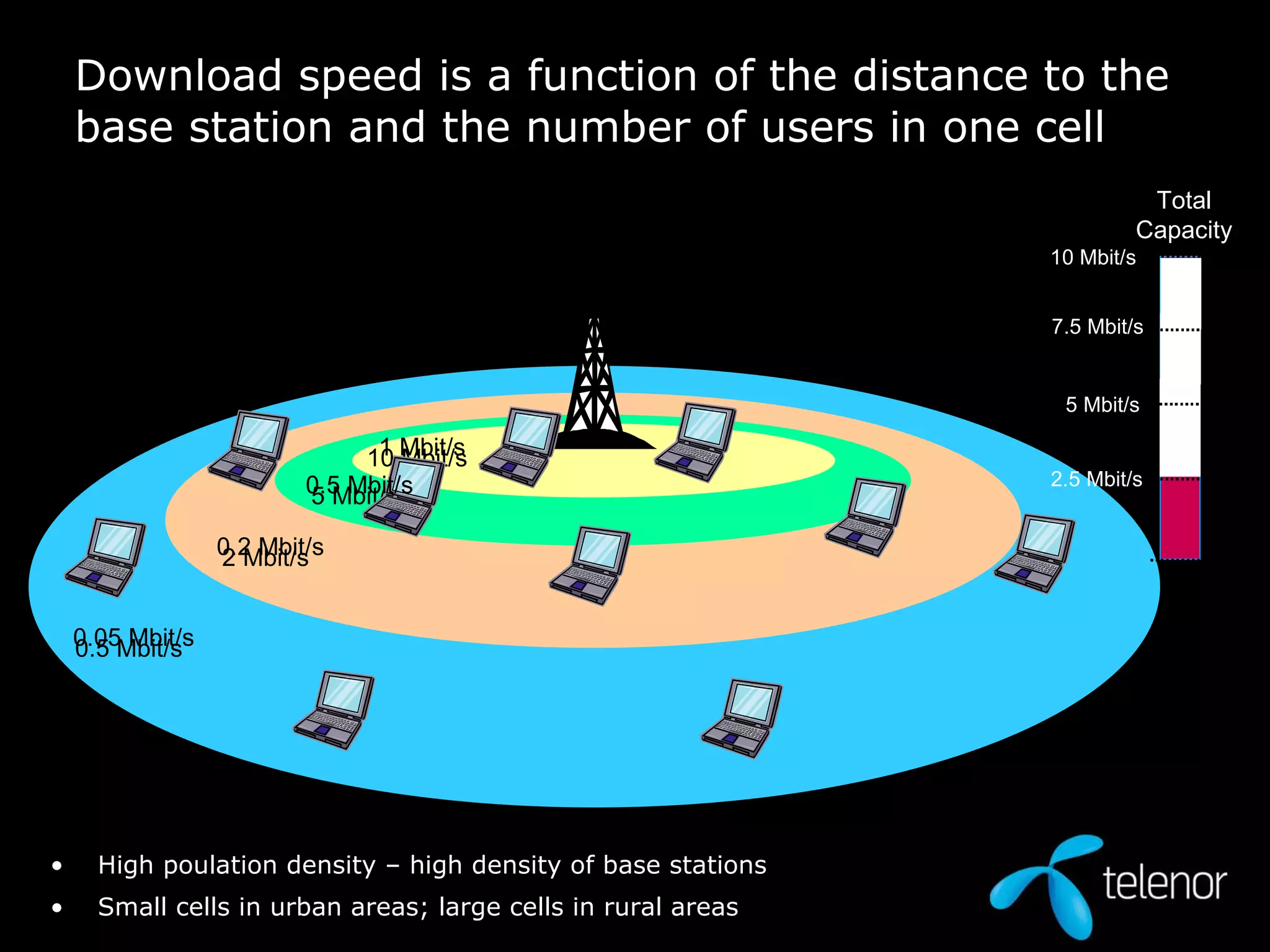
Download speed is a function of the distance to the base station and the number of users in one cell Total Capacity High poulation density – high density of base stations Small cells in urban areas; large cells in rural areas 10 Mbit/s 5 Mbit/s 2 Mbit/s 0.5 Mbit/s 10 Mbit/s 2.5 Mbit/s 5 Mbit/s 7.5 Mbit/s 1 Mbit/s 0.5 Mbit/s 0.2 Mbit/s 0.05 Mbit/s
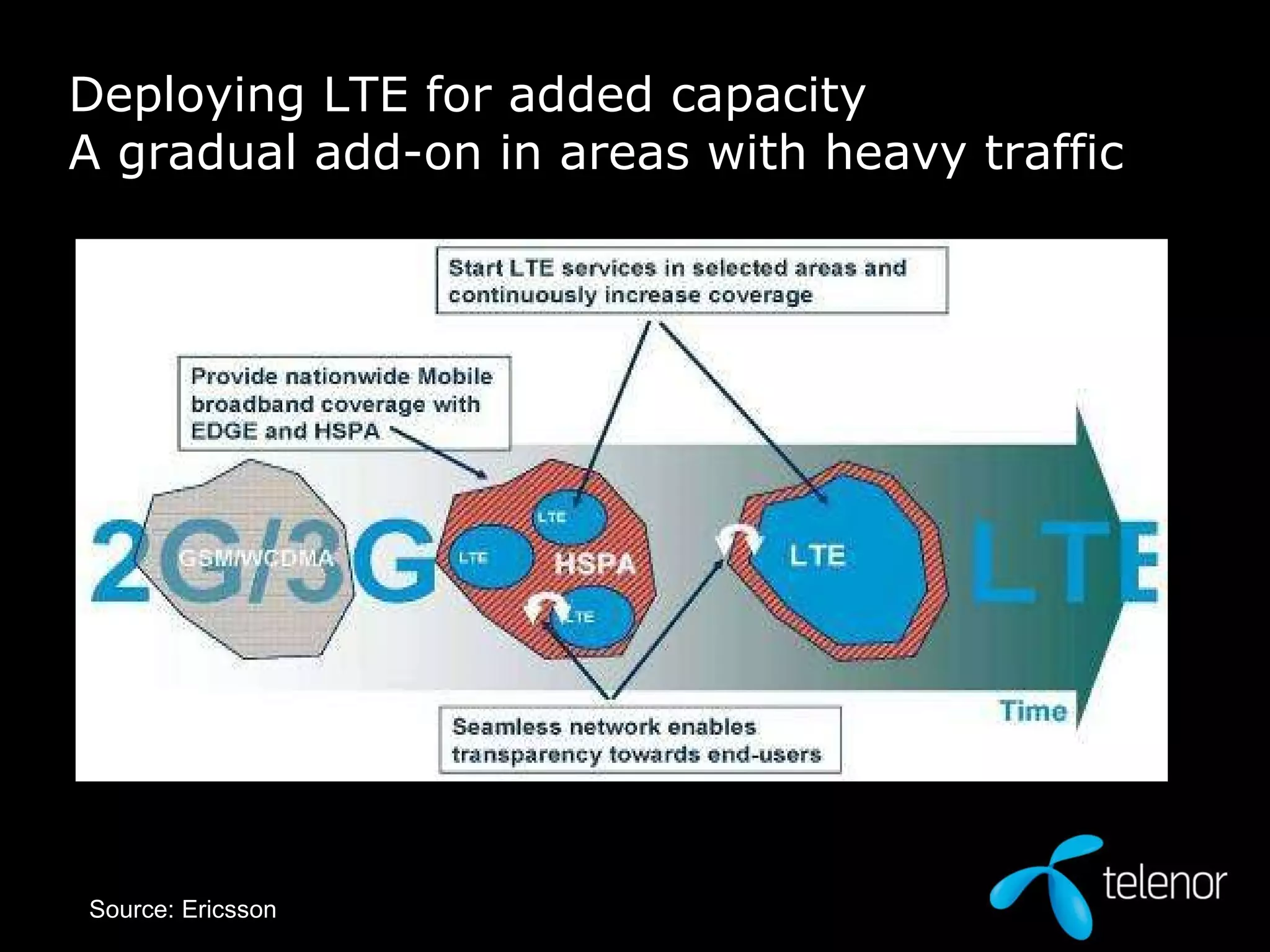
Deploying LTE for added capacity  A gradual add-on in areas with heavy traffic Source: Ericsson
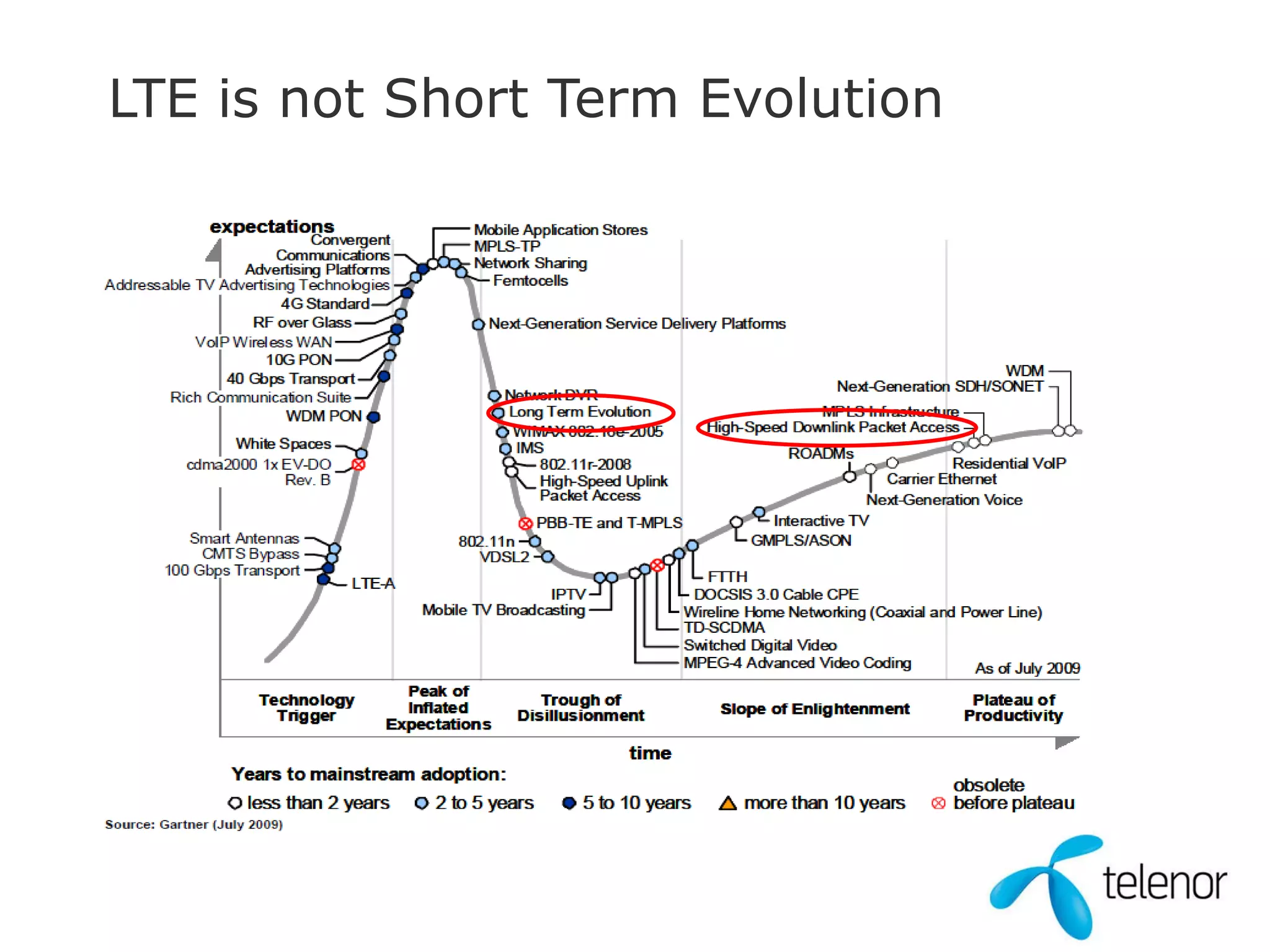
LTE is not Short Term Evolution
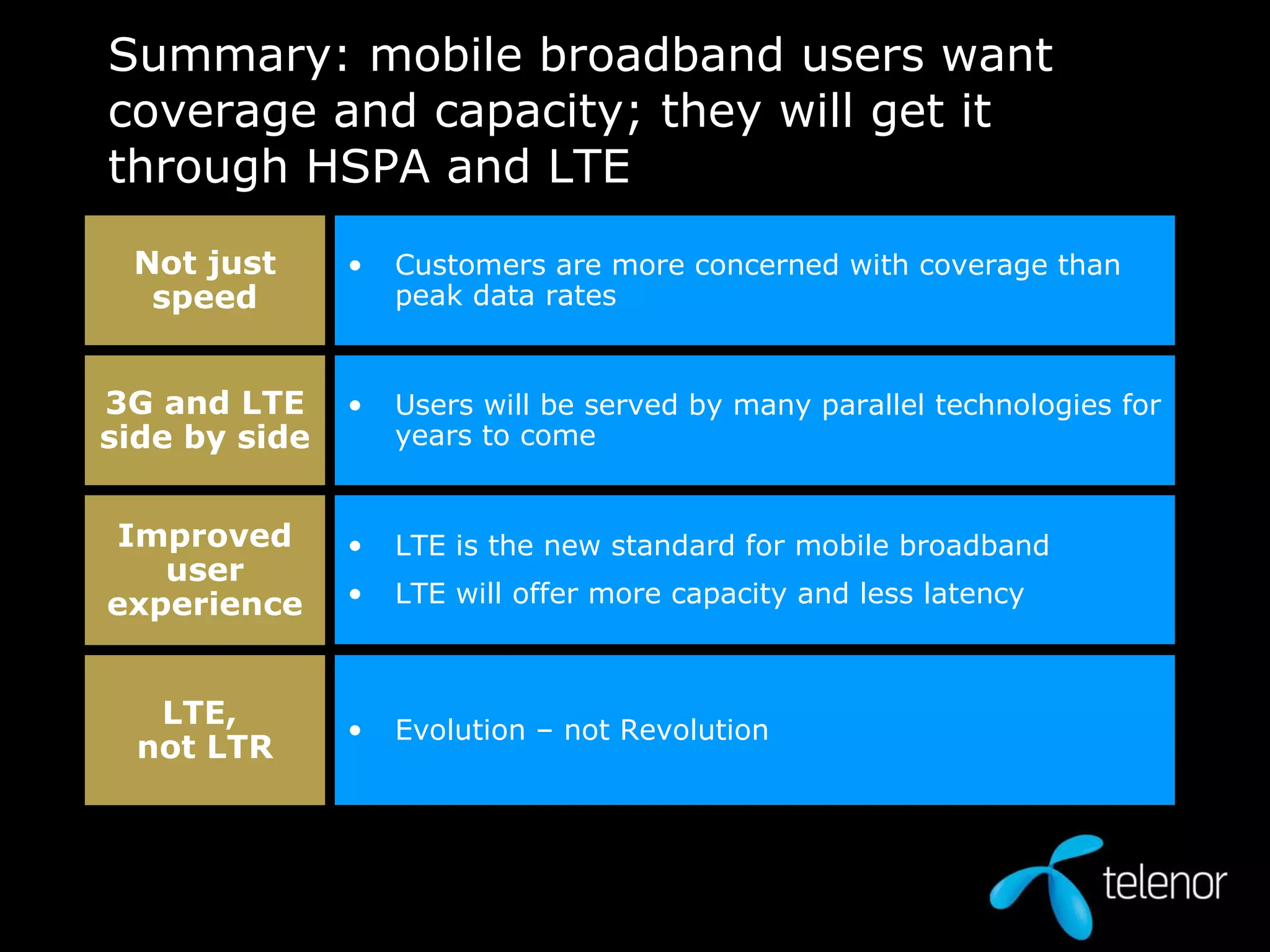
Summary: mobile broadband users want coverage and capacity; they will get it through HSPA and LTE  Customers are more concerned with coverage than peak data rates  Not just speed LTE is the new standard for mobile broadband LTE will offer more capacity and less latency  Improved user experience Evolution – not Revolution  LTE,  not LTR Users will be served by many parallel technologies for years to come  3G and LTE side by side

Mobile Networks Today And Tomorrow

  • 1.
    Mobile Data Networks– today and tomorrow Jørgen Grinnes | Telenor Norway
  • 2.
    Agenda Timeline 6 Tomorrow’s network 5 Trends and challenges 4 Today’s network 3 2 1 Value proposition Mobile broadband growth
  • 3.
    Incredible growth inthe mobile broadband market Source: PT Telenor estimates after Q209
  • 4.
    Mobile broadband: agreat value prop Plug & play Works first time and every time Easy Mobile internet throughout the country Mobile broadband where people live and holiday Anywhere Predictable prices for all segments All you can eat – but with fair usage cap’ Affordable A broadband experiece 0,5 – 1,5 mbps Broadband
  • 5.
    Telenor offers nationwideinternet coverage and broadband where people live and holiday >23% Area >400 WiFi hot spots >87% Households Coverage
  • 6.
    Our customers wantto use the internet wherever they are. Rich media is growing fast KONKURRANSEN PRESSER HASTIGHET OPP TEKST BLIR RIK MEDIA DIREKTE TV, ARKIV TV OG VIDEOKONFERANSE ØKER I BRUK REKLAME BLIR VIDEO NYE TJENESTER SOSIALE MEDIER BLIR EN NATURLIG DEL AV HVERDAGEN VG forside 25/9 2003: 115kB VG forside 8/10 2008: 1,4MB Nett-TV, VOD, arkiv-TV Videokonferanser Tekst, bilde  video ? Tekst, bilde  video Symmertri uplink og nedlink Tekst, bilde  video
  • 7.
    GGSN SGSN GnIuPS Gi RNC Node B Iub HLR PS CORE UTRAN SASN FW Gi Gr Radio Core Transmission OSS The traffic increase strains all parts of our network
  • 8.
    We cannot allownetwork costs to grow linearly with capacity requirements Network cost (technology improvements) Profitability Voice dominated Data dominated Traffic volume Revenue Time Network cost (existing technologies)
  • 9.
    Flexible spectrum usageHigher eNodeB capacity Flat architecture and IP connectivity Theoretical max-speed 160 Mbps Practical speeds up to 20-30 Mbps Better user experience Quicker response times Primarily a data carrier for a long time Still a shared resource Long Term Evolution (LTE) will become the next mainstream broadband technology Better user experience HSPA HSPA+ LTE Throughput Latency HSPA HSPA+ LTE 3G HSPA HSPA+ LTE … Cost per Mbyte Lower production-cost per bit Source: NSN Source: NSN
  • 10.
    Download speed isa function of the distance to the base station and the number of users in one cell Total Capacity High poulation density – high density of base stations Small cells in urban areas; large cells in rural areas 10 Mbit/s 5 Mbit/s 2 Mbit/s 0.5 Mbit/s 10 Mbit/s 2.5 Mbit/s 5 Mbit/s 7.5 Mbit/s 1 Mbit/s 0.5 Mbit/s 0.2 Mbit/s 0.05 Mbit/s
  • 11.
    Deploying LTE foradded capacity A gradual add-on in areas with heavy traffic Source: Ericsson
  • 12.
    LTE is notShort Term Evolution
  • 13.
    Summary: mobile broadbandusers want coverage and capacity; they will get it through HSPA and LTE Customers are more concerned with coverage than peak data rates Not just speed LTE is the new standard for mobile broadband LTE will offer more capacity and less latency Improved user experience Evolution – not Revolution LTE, not LTR Users will be served by many parallel technologies for years to come 3G and LTE side by side

Editor's Notes

  • #10 Higher eNode B capacity due to wider freq- blocks. HSPA Maks 10 MHz LTE: maks 20MHz