See inside for further details
Mobile Location-Based
Services
Mobile Location-Based Services is the seventh consecutive
report from Berg Insight analysing the latest developments on the
European and North American LBS markets.
This report in the LBS Research Series from Berg Insight provides
you with 160 pages of unique business intelligence including 5-year
industry forecasts and expert commentary on which to base your
business decisions.
This report will allow you to:
	 Profit from 30 new executive interviews with market leading
companies.
	 Learn about the LBS strategies of major telecom operators
in Europe and North America.
	 Identify key players on the European and North American
mobile LBS market.
	Understand the opportunities and challenges for
location-based advertising.
	 Benefit from valuable insights about the most successful
LBS propositions on the market.
	 Comprehend from valuable insights about the most
successful LBS propositions on the market.
	 Predict future business opportunities for mobile
industry players.
LBS Research Series
Berg Insight’s LBS Research Series
What are the real business opportunities for LBS on the global market? Berg
Insight’s LBS Research Series is a unique series of market reports published on
a quarterly basis. Each title offers detailed analysis of the most interesting LBS
topics such as handset-based satellite positioning technology, mobile personal
navigation services and location-enabled content services. Once per year we also
publish a summary of our research with detailed forecasts for the major regions.
www.berginsight.com
Order now!
Please visit our web site to order this
report and find more information about
our other titles at www.berginsight.com
This report answers the following questions:
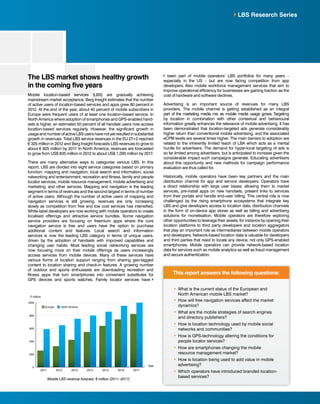
Mobile LBS revenue forecast, € million (2011–2017)
LBS Research Series
The LBS market shows healthy growth
in the coming five years
Mobile location-based services (LBS) are gradually achieving
mainstream market acceptance. Berg Insight estimates that the number
of active users of location-based services and apps grew 80 percent in
2012. At the end of the year, about 40 percent of mobile subscribers in
Europe were frequent users of at least one location-based service. In
North America where adoption of smartphones and GPS-enabled hand-
sets is higher, an estimated 50 percent of all handset users now access
location-based services regularly. However, the significant growth in
usageandnumberofactiveLBSusershavenotyetresultedinsubstantial
growth in revenues. Total LBS service revenues in the EU 27+2 reached
€ 325 million in 2012 and Berg Insight forecasts LBS revenues to grow to
about € 825 million by 2017. In North America, revenues are forecasted
to grow from US$ 835 million in 2012 to about US$ 1,295 million by 2017.
There are many alternative ways to categorise various LBS. In this
report, LBS are divided into eight service categories based on primary
function: mapping and navigation, local search and information, social
networking and entertainment, recreation and fitness, family and people
locator services, mobile resource management, mobile advertising and
marketing, and other services. Mapping and navigation is the leading
segment in terms of revenues and the second largest in terms of number
of active users. Although the number of active users of mapping and
navigation services is still growing, revenues are only increasing
slowly as competition from free and low cost services has intensified.
White-label developers are now working with mobile operators to create
localised offerings and attractive service bundles. Some navigation
service providers are focusing on freemium apps where the core
navigation service is free and users have the option to purchase
additional content and features. Local search and information
services is now the leading LBS category in terms of unique users,
driven by the adoption of handsets with improved capabilities and
changing user habits. Most leading social networking services are
now focusing more on their mobile offerings as users increasingly
access services from mobile devices. Many of these services have
various forms of location support ranging from sharing geo-tagged
content to location sharing and check-in features. A growing number
of outdoor and sports enthusiasts are downloading recreation and
fitness apps that turn smartphones into convenient substitutes for
GPS devices and sports watches. Family locator services have
been part of mobile operators’ LBS portfolios for many years –
especially in the US – but are now facing competition from app
developers. Also mobile workforce management services that aim to
improve operational efficiency for businesses are gaining traction as the
cost of hardware and software declines.
Advertising is an important source of revenues for many LBS
providers. The mobile channel is getting established as an integral
part of the marketing media mix as mobile media usage grows. Targeting
by location in combination with other contextual and behavioural
information greatly enhances the relevance of mobile advertising. It has
been demonstrated that location-targeted ads generate considerably
higher return than conventional mobile advertising, and the associated
eCPM levels are several times higher. The main barriers to adoption are
related to the inherently limited reach of LBA which acts as a mental
hurdle for advertisers. The demand for hyper-local targeting of ads is
so far limited among advertisers, but is anticipated to increase given the
considerable impact such campaigns generate. Educating advertisers
about this opportunity and new methods for campaign performance
evaluation are thus called for.
Historically, mobile operators have been key partners and the main
distribution channel for app and service developers. Operators have
a direct relationship with large user bases, allowing them to market
services, pre-install apps on new handsets, present links to services
from their portals and handle end-user billing. This central role is now
challenged by the rising smartphone ecosystems that integrate key
LBS and give developers access to location data, distribution channels
in the form of on-device app stores as well as billing and advertising
solutions for monetisation. Mobile operators are therefore exploring
other opportunities to leverage their assets, for instance by opening their
location platforms to third party developers and location aggregators
that play an important role as intermediaries between mobile operators
and developers. Network-based location data is valuable for developers
and third parties that need to locate any device, not only GPS-enabled
smartphones. Mobile operators can provide network-based location
data for services such as mobile analytics as well as fraud management
and secure authentication.
	 What is the current status of the European and
North American mobile LBS market?
	 How will free navigation services affect the market
dynamics?
	 What are the mobile strategies of search engines
and directory publishers?
	 How is location technology used by mobile social
networks and communities?
	 How is GPS-technology altering the conditions for
people locator services?
	 How are smartphones changing the mobile
resource management market?
	 How is location being used to add value in mobile
advertising?
	 Which operators have introduced branded location-
based services?
0
200
400
600
800
1000
2017201620152014201320122011
€ million
Year
Europe North America
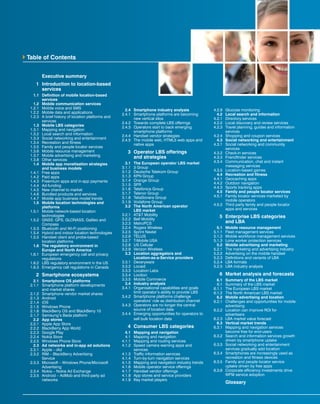
Executive summary
	 1	 Introduction to location-based 	
		services
	 1.1	 Definition of mobile location-based
services
	 1.2	 Mobile communication services
	 1.2.1	 Mobile voice and SMS
	 1.2.2	 Mobile data and applications
	 1.2.3	 A brief history of location platforms and
services
	 1.3	 Mobile LBS categories
	 1.3.1	 Mapping and navigation
	 1.3.2	 Local search and information
	 1.3.3	 Social networking and entertainment
	 1.3.4	 Recreation and fitness
	 1.3.5	 Family and people locator services
	 1.3.6	 Mobile resource management
	 1.3.7	 Mobile advertising and marketing
	 1.3.8	 Other services
	 1.4	 Mobile app monetisation strategies
and business models
	 1.4.1	 Free apps
	 1.4.2	 Paid apps
	 1.4.3	 Freemium apps and in-app payments
	 1.4.4	Ad-funding
	 1.4.5	 New channel to market
	 1.4.6	 Bundled products and services
	 1.4.7	 Mobile app business model trends
	 1.5	 Mobile location technologies and
platforms
	 1.5.1	 Mobile network-based location
technologies
	 1.5.2	 GNSS: GPS, GLONASS, Galileo and
Compass
	 1.5.3	 Bluetooth and Wi-Fi positioning
	 1.5.4	 Hybrid and indoor location technologies
	 1.5.5	 Handset client and probe-based
location platforms
	 1.6	 The regulatory environment in
Europe and North America
	 1.6.1	 European emergency call and privacy
regulations
	 1.6.2	 LBS regulatory environment in the US
	 1.6.3	 Emergency call regulations in Canada
	 2	 Smartphone ecosystems
	 2.1	 Smartphone OS platforms
	 2.1.1	 Smartphone platform developments
and market shares
	 2.1.2	 Smartphone vendor market shares
	 2.1.3	Android
	 2.1.4	iOS
	 2.1.5	 Windows Phone
	 2.1.6	 BlackBerry OS and BlackBerry 10
	 2.1.7	 Samsung’s Bada platform
	 2.2	 App stores
	 2.2.1	 Apple App Store
	 2.2.2	 BlackBerry App World
	 2.2.3	 Google Play
	 2.2.4	 Nokia Store
	 2.2.5	 Windows Phone Store
	 2.3	 Ad networks and in-app ad solutions
	 2.3.1	 Apple – iAd
	 2.3.2	 RIM – BlackBerry Advertising
Service	
	 2.3.3	 Microsoft – Windows Phone/Microsoft
Advertising
	 2.3.4	 Nokia – Nokia Ad Exchange
	 2.3.5	 Android – AdMob and third-party ad
networks
	 2.4	 Smartphone industry analysis
	 2.4.1	 Smartphone platforms are becoming
new vertical silos
	 2.4.2	 Towards complete LBS offerings
	 2.4.3	 Operators start to back emerging
smartphone platforms
	 2.4.4	 Handset vendor strategies
	 2.4.5	 The mobile web, HTML5 web apps and
native apps
	 3	 Operator LBS offerings
		 and strategies
	 3.1	 The European operator LBS market
	 3.1.1	 3 Group
	 3.1.2	 Deutsche Telekom Group
	 3.1.3	 KPN Group
	 3.1.4	 Orange Group
	 3.1.5	SFR
	 3.1.6	 Telefónica Group
	 3.1.7	 Telenor Group
	 3.1.8	 TeliaSonera Group
	 3.1.9	 Vodafone Group
	 3.2	 The North American operator
LBS market
	 3.2.1	 AT&T Mobility
	 3.2.2	 Bell Mobility
	 3.2.3	MetroPCS
	 3.2.4	 Rogers Wireless
	 3.2.5	 Sprint Nextel
	 3.2.6	TELUS
	 3.2.7	 T-Mobile USA
	 3.2.8	 US Cellular
	 3.2.9	 Verizon Wireless
	 3.3	 Location aggregators and
Location-as-a-Service providers
	 3.3.1	Deveryware
	 3.3.2	Locaid
	 3.3.3	 Location Labs
	 3.3.4	Lociloci
	 3.3.5	 Mobile Commerce
	 3.4	 Industry analysis
	 3.4.1	 Organisational capabilities and goals
limit operator’s ability to provide LBS
	 3.4.2	 Smartphone platforms challenge
operators’ role as distribution channel
	 3.4.3	 Operators are no longer the central
source of location data
	 3.4.4	 Emerging opportunities for operators to
sell bulk location data
	 4	 Consumer LBS categories
	 4.1	 Mapping and navigation
	 4.1	 Mapping and navigation
	 4.1.1	 Mapping and routing services
	 4.1.2	 Speed camera warning apps and
services
	 4.1.3	 Traffic information services
	 4.1.4	 Turn-by-turn navigation services
	 4.1.5	 Mapping and navigation industry trends
	 4.1.6	 Mobile operator service offerings
	 4.1.7	 Handset vendor offerings
	 4.1.8	 App stores and service providers
	 4.1.9	 Key market players
	 4.2.9	 Glucose monitoring
	 4.2	 Local search and information
	 4.2.1	 Directory services
	 4.2.2	 Local discovery and review services
	 4.2.3	 Travel planning, guides and information
services
	 4.2.4	 Shopping and coupon services
	 4.3	 Social networking and entertainment
	 4.3.1	 Social networking and community
services
	 4.3.2	 Check-in services
	 4.3.3	 Friendfinder services
	 4.3.4	 Communication, chat and instant
messaging services
	 4.3.5	 Location-based games
	 4.4	 Recreation and fitness
	 4.4.1	 Geocaching apps
	 4.4.2	 Outdoor navigation
	 4.4.3	 Sports tracking apps
	 4.5	 Family and people locator services
	 4.5.1	 Family locator services marketed by
mobile operators
	 4.5.2	 Third party family and people locator
apps and services
	 5	 Enterprise LBS categories
		 and LBA
	 5.1	 Mobile resource management
	 5.1.1	 Fleet management services
	 5.1.2	 Mobile workforce management services
	 5.1.3	 Lone worker protection services	
	 5.2	 Mobile advertising and marketing
	 5.2.1	 The marketing and advertising industry
	 5.2.2	 Advertising on the mobile handset
	 5.2.3	 Definitions and variants of LBA
	 5.2.4	 LBA formats
	 5.2.5	 LBA industry analysis
	 6	 Market analysis and forecasts
	 6.1	 Summary of the LBS market
	 6.1	 Summary of the LBS market
	 6.1.1	 The European LBS market
	 6.1.2	 The North American LBS market
	 6.2	 Mobile advertising and location
	 6.2.1	 Challenges and opportunities for mobile
advertising
	 6.2.2	 Location can improve ROI for
advertisers
	 6.2.3	 LBA market value forecast
	 6.3	 Vertical market trends
	 6.3.1	 Mapping and navigation services
become free for end-users
	 6.3.2	 Search and information services growth
driven by smartphone uptake
	 6.3.3	 Social networking and entertainment
services gradually add location
	 6.3.4	 Smartphones are increasingly used as
recreation and fitness devices
	 6.3.5	 Family and people locator service
uptake driven by free apps
	 6.3.6	 Corporate efficiency investments drive
WFM service adoption
		Glossary
Table of Contents
Address PostcodeCountry
Position CompanyFamily/Surname Forename
Telephone FAX Email
You can place your order in the following alternative ways:
1. Place your order online in our web shop at www.berginsight.com
2. Fax this order sheet to us at fax number: +46 31 711 30 96
3. Mail this order sheet to us at: Berg Insight AB, Viktoriagatan 3, 411 25 Gothenburg, Sweden
4. Email your order to: info@berginsight.com
5. Phone us at +46 31 711 30 91
Your PO number Your VAT/TVA/IVA/BTW/MWST number
VAT is chargeable on all orders from Sweden. Orders from all other countries in the European Union
must include the buyer’s VAT Registration number below in order to avoid the addition of VAT.
Reports will be dispatched once full
payment has been received. For any
enquiries regarding this, please contact
us. Payment may be made by credit
card, cheque made payable to Berg
Insight AB, Viktoriagatan 3, 411 25
Gothenburg, Sweden or by direct bank
transfer to Skandinaviska Enskilda
Banken, 106 40 Stockholm, Sweden.
Account Holder: Berg Insight AB
Account number: 5011 10 402 80
BIC/SWIFT: ESSESESS
IBAN: SE92 5000 0000 0501 1104 0280
Please charge my credit card
VISA Mastercard
Billing address
Postcode Country
Signature Date
We enclose our cheque payable to Berg Insight AB
Please invoice me
Card number
Cardholder’s name Signature
CV codeExpiry date (MM/YY)
/
Related productsWho should buy this report?
Berg Insight AB, Viktoriagatan 3, SE-411 25 Gothenburg, Sweden • Phone +46 31 711 30 91 • Fax +46 31 711 30 96 • www.berginsight.com • info@berginsight.com
©BergInsightAB-No.100
Order form — TO RECEIVE YOUR COPY OF MOBILE LOCATION-BASED SERVICES
Choose type of format
Paper copy.........................1500 EUR
PDF 1-5 user license..........2250 EUR
PDF corporate license........4500 EUR
Mobile Location-Based Services is the foremost source of
information about the European and North American mobile
LBS market. Whether you are a vendor, telecom operator,
investor, consultant or government agency, you will gain
valuable insights from our in-depth research.
	 People Monitoring and Safety Solutions
	 Location-Based Advertising and Marketing
	 The Global Wireless M2M Market
	 Mobile Navigation Services and Devices
LBS Research Series
About the Author
André Malm is a senior analyst with a Masters
degree from Chalmers University of Technology. He
joined Berg Insight in 2006 and his areas of expertise
include location-based services, personal navigation
services, handset technologies and wireless M2M
markets.
Berg Insight offers premier business intelligence
to the telecom industry. We produce concise reports
providing key facts and strategic insights about pivotal
developments in our focus areas. From time to time
we also perform custom research assignments. Our
vision is to be the most valuable source of intelligence
for our customers.

Mobile Location-Based Services

  • 1.
    See inside forfurther details Mobile Location-Based Services Mobile Location-Based Services is the seventh consecutive report from Berg Insight analysing the latest developments on the European and North American LBS markets. This report in the LBS Research Series from Berg Insight provides you with 160 pages of unique business intelligence including 5-year industry forecasts and expert commentary on which to base your business decisions. This report will allow you to: Profit from 30 new executive interviews with market leading companies. Learn about the LBS strategies of major telecom operators in Europe and North America. Identify key players on the European and North American mobile LBS market. Understand the opportunities and challenges for location-based advertising. Benefit from valuable insights about the most successful LBS propositions on the market. Comprehend from valuable insights about the most successful LBS propositions on the market. Predict future business opportunities for mobile industry players. LBS Research Series Berg Insight’s LBS Research Series What are the real business opportunities for LBS on the global market? Berg Insight’s LBS Research Series is a unique series of market reports published on a quarterly basis. Each title offers detailed analysis of the most interesting LBS topics such as handset-based satellite positioning technology, mobile personal navigation services and location-enabled content services. Once per year we also publish a summary of our research with detailed forecasts for the major regions. www.berginsight.com Order now! Please visit our web site to order this report and find more information about our other titles at www.berginsight.com
  • 2.
    This report answersthe following questions: Mobile LBS revenue forecast, € million (2011–2017) LBS Research Series The LBS market shows healthy growth in the coming five years Mobile location-based services (LBS) are gradually achieving mainstream market acceptance. Berg Insight estimates that the number of active users of location-based services and apps grew 80 percent in 2012. At the end of the year, about 40 percent of mobile subscribers in Europe were frequent users of at least one location-based service. In North America where adoption of smartphones and GPS-enabled hand- sets is higher, an estimated 50 percent of all handset users now access location-based services regularly. However, the significant growth in usageandnumberofactiveLBSusershavenotyetresultedinsubstantial growth in revenues. Total LBS service revenues in the EU 27+2 reached € 325 million in 2012 and Berg Insight forecasts LBS revenues to grow to about € 825 million by 2017. In North America, revenues are forecasted to grow from US$ 835 million in 2012 to about US$ 1,295 million by 2017. There are many alternative ways to categorise various LBS. In this report, LBS are divided into eight service categories based on primary function: mapping and navigation, local search and information, social networking and entertainment, recreation and fitness, family and people locator services, mobile resource management, mobile advertising and marketing, and other services. Mapping and navigation is the leading segment in terms of revenues and the second largest in terms of number of active users. Although the number of active users of mapping and navigation services is still growing, revenues are only increasing slowly as competition from free and low cost services has intensified. White-label developers are now working with mobile operators to create localised offerings and attractive service bundles. Some navigation service providers are focusing on freemium apps where the core navigation service is free and users have the option to purchase additional content and features. Local search and information services is now the leading LBS category in terms of unique users, driven by the adoption of handsets with improved capabilities and changing user habits. Most leading social networking services are now focusing more on their mobile offerings as users increasingly access services from mobile devices. Many of these services have various forms of location support ranging from sharing geo-tagged content to location sharing and check-in features. A growing number of outdoor and sports enthusiasts are downloading recreation and fitness apps that turn smartphones into convenient substitutes for GPS devices and sports watches. Family locator services have been part of mobile operators’ LBS portfolios for many years – especially in the US – but are now facing competition from app developers. Also mobile workforce management services that aim to improve operational efficiency for businesses are gaining traction as the cost of hardware and software declines. Advertising is an important source of revenues for many LBS providers. The mobile channel is getting established as an integral part of the marketing media mix as mobile media usage grows. Targeting by location in combination with other contextual and behavioural information greatly enhances the relevance of mobile advertising. It has been demonstrated that location-targeted ads generate considerably higher return than conventional mobile advertising, and the associated eCPM levels are several times higher. The main barriers to adoption are related to the inherently limited reach of LBA which acts as a mental hurdle for advertisers. The demand for hyper-local targeting of ads is so far limited among advertisers, but is anticipated to increase given the considerable impact such campaigns generate. Educating advertisers about this opportunity and new methods for campaign performance evaluation are thus called for. Historically, mobile operators have been key partners and the main distribution channel for app and service developers. Operators have a direct relationship with large user bases, allowing them to market services, pre-install apps on new handsets, present links to services from their portals and handle end-user billing. This central role is now challenged by the rising smartphone ecosystems that integrate key LBS and give developers access to location data, distribution channels in the form of on-device app stores as well as billing and advertising solutions for monetisation. Mobile operators are therefore exploring other opportunities to leverage their assets, for instance by opening their location platforms to third party developers and location aggregators that play an important role as intermediaries between mobile operators and developers. Network-based location data is valuable for developers and third parties that need to locate any device, not only GPS-enabled smartphones. Mobile operators can provide network-based location data for services such as mobile analytics as well as fraud management and secure authentication. What is the current status of the European and North American mobile LBS market? How will free navigation services affect the market dynamics? What are the mobile strategies of search engines and directory publishers? How is location technology used by mobile social networks and communities? How is GPS-technology altering the conditions for people locator services? How are smartphones changing the mobile resource management market? How is location being used to add value in mobile advertising? Which operators have introduced branded location- based services? 0 200 400 600 800 1000 2017201620152014201320122011 € million Year Europe North America
  • 3.
    Executive summary 1 Introduction to location-based services 1.1 Definition of mobile location-based services 1.2 Mobile communication services 1.2.1 Mobile voice and SMS 1.2.2 Mobile data and applications 1.2.3 A brief history of location platforms and services 1.3 Mobile LBS categories 1.3.1 Mapping and navigation 1.3.2 Local search and information 1.3.3 Social networking and entertainment 1.3.4 Recreation and fitness 1.3.5 Family and people locator services 1.3.6 Mobile resource management 1.3.7 Mobile advertising and marketing 1.3.8 Other services 1.4 Mobile app monetisation strategies and business models 1.4.1 Free apps 1.4.2 Paid apps 1.4.3 Freemium apps and in-app payments 1.4.4 Ad-funding 1.4.5 New channel to market 1.4.6 Bundled products and services 1.4.7 Mobile app business model trends 1.5 Mobile location technologies and platforms 1.5.1 Mobile network-based location technologies 1.5.2 GNSS: GPS, GLONASS, Galileo and Compass 1.5.3 Bluetooth and Wi-Fi positioning 1.5.4 Hybrid and indoor location technologies 1.5.5 Handset client and probe-based location platforms 1.6 The regulatory environment in Europe and North America 1.6.1 European emergency call and privacy regulations 1.6.2 LBS regulatory environment in the US 1.6.3 Emergency call regulations in Canada 2 Smartphone ecosystems 2.1 Smartphone OS platforms 2.1.1 Smartphone platform developments and market shares 2.1.2 Smartphone vendor market shares 2.1.3 Android 2.1.4 iOS 2.1.5 Windows Phone 2.1.6 BlackBerry OS and BlackBerry 10 2.1.7 Samsung’s Bada platform 2.2 App stores 2.2.1 Apple App Store 2.2.2 BlackBerry App World 2.2.3 Google Play 2.2.4 Nokia Store 2.2.5 Windows Phone Store 2.3 Ad networks and in-app ad solutions 2.3.1 Apple – iAd 2.3.2 RIM – BlackBerry Advertising Service 2.3.3 Microsoft – Windows Phone/Microsoft Advertising 2.3.4 Nokia – Nokia Ad Exchange 2.3.5 Android – AdMob and third-party ad networks 2.4 Smartphone industry analysis 2.4.1 Smartphone platforms are becoming new vertical silos 2.4.2 Towards complete LBS offerings 2.4.3 Operators start to back emerging smartphone platforms 2.4.4 Handset vendor strategies 2.4.5 The mobile web, HTML5 web apps and native apps 3 Operator LBS offerings and strategies 3.1 The European operator LBS market 3.1.1 3 Group 3.1.2 Deutsche Telekom Group 3.1.3 KPN Group 3.1.4 Orange Group 3.1.5 SFR 3.1.6 Telefónica Group 3.1.7 Telenor Group 3.1.8 TeliaSonera Group 3.1.9 Vodafone Group 3.2 The North American operator LBS market 3.2.1 AT&T Mobility 3.2.2 Bell Mobility 3.2.3 MetroPCS 3.2.4 Rogers Wireless 3.2.5 Sprint Nextel 3.2.6 TELUS 3.2.7 T-Mobile USA 3.2.8 US Cellular 3.2.9 Verizon Wireless 3.3 Location aggregators and Location-as-a-Service providers 3.3.1 Deveryware 3.3.2 Locaid 3.3.3 Location Labs 3.3.4 Lociloci 3.3.5 Mobile Commerce 3.4 Industry analysis 3.4.1 Organisational capabilities and goals limit operator’s ability to provide LBS 3.4.2 Smartphone platforms challenge operators’ role as distribution channel 3.4.3 Operators are no longer the central source of location data 3.4.4 Emerging opportunities for operators to sell bulk location data 4 Consumer LBS categories 4.1 Mapping and navigation 4.1 Mapping and navigation 4.1.1 Mapping and routing services 4.1.2 Speed camera warning apps and services 4.1.3 Traffic information services 4.1.4 Turn-by-turn navigation services 4.1.5 Mapping and navigation industry trends 4.1.6 Mobile operator service offerings 4.1.7 Handset vendor offerings 4.1.8 App stores and service providers 4.1.9 Key market players 4.2.9 Glucose monitoring 4.2 Local search and information 4.2.1 Directory services 4.2.2 Local discovery and review services 4.2.3 Travel planning, guides and information services 4.2.4 Shopping and coupon services 4.3 Social networking and entertainment 4.3.1 Social networking and community services 4.3.2 Check-in services 4.3.3 Friendfinder services 4.3.4 Communication, chat and instant messaging services 4.3.5 Location-based games 4.4 Recreation and fitness 4.4.1 Geocaching apps 4.4.2 Outdoor navigation 4.4.3 Sports tracking apps 4.5 Family and people locator services 4.5.1 Family locator services marketed by mobile operators 4.5.2 Third party family and people locator apps and services 5 Enterprise LBS categories and LBA 5.1 Mobile resource management 5.1.1 Fleet management services 5.1.2 Mobile workforce management services 5.1.3 Lone worker protection services 5.2 Mobile advertising and marketing 5.2.1 The marketing and advertising industry 5.2.2 Advertising on the mobile handset 5.2.3 Definitions and variants of LBA 5.2.4 LBA formats 5.2.5 LBA industry analysis 6 Market analysis and forecasts 6.1 Summary of the LBS market 6.1 Summary of the LBS market 6.1.1 The European LBS market 6.1.2 The North American LBS market 6.2 Mobile advertising and location 6.2.1 Challenges and opportunities for mobile advertising 6.2.2 Location can improve ROI for advertisers 6.2.3 LBA market value forecast 6.3 Vertical market trends 6.3.1 Mapping and navigation services become free for end-users 6.3.2 Search and information services growth driven by smartphone uptake 6.3.3 Social networking and entertainment services gradually add location 6.3.4 Smartphones are increasingly used as recreation and fitness devices 6.3.5 Family and people locator service uptake driven by free apps 6.3.6 Corporate efficiency investments drive WFM service adoption Glossary Table of Contents
  • 4.
    Address PostcodeCountry Position CompanyFamily/SurnameForename Telephone FAX Email You can place your order in the following alternative ways: 1. Place your order online in our web shop at www.berginsight.com 2. Fax this order sheet to us at fax number: +46 31 711 30 96 3. Mail this order sheet to us at: Berg Insight AB, Viktoriagatan 3, 411 25 Gothenburg, Sweden 4. Email your order to: info@berginsight.com 5. Phone us at +46 31 711 30 91 Your PO number Your VAT/TVA/IVA/BTW/MWST number VAT is chargeable on all orders from Sweden. Orders from all other countries in the European Union must include the buyer’s VAT Registration number below in order to avoid the addition of VAT. Reports will be dispatched once full payment has been received. For any enquiries regarding this, please contact us. Payment may be made by credit card, cheque made payable to Berg Insight AB, Viktoriagatan 3, 411 25 Gothenburg, Sweden or by direct bank transfer to Skandinaviska Enskilda Banken, 106 40 Stockholm, Sweden. Account Holder: Berg Insight AB Account number: 5011 10 402 80 BIC/SWIFT: ESSESESS IBAN: SE92 5000 0000 0501 1104 0280 Please charge my credit card VISA Mastercard Billing address Postcode Country Signature Date We enclose our cheque payable to Berg Insight AB Please invoice me Card number Cardholder’s name Signature CV codeExpiry date (MM/YY) / Related productsWho should buy this report? Berg Insight AB, Viktoriagatan 3, SE-411 25 Gothenburg, Sweden • Phone +46 31 711 30 91 • Fax +46 31 711 30 96 • www.berginsight.com • info@berginsight.com ©BergInsightAB-No.100 Order form — TO RECEIVE YOUR COPY OF MOBILE LOCATION-BASED SERVICES Choose type of format Paper copy.........................1500 EUR PDF 1-5 user license..........2250 EUR PDF corporate license........4500 EUR Mobile Location-Based Services is the foremost source of information about the European and North American mobile LBS market. Whether you are a vendor, telecom operator, investor, consultant or government agency, you will gain valuable insights from our in-depth research. People Monitoring and Safety Solutions Location-Based Advertising and Marketing The Global Wireless M2M Market Mobile Navigation Services and Devices LBS Research Series About the Author André Malm is a senior analyst with a Masters degree from Chalmers University of Technology. He joined Berg Insight in 2006 and his areas of expertise include location-based services, personal navigation services, handset technologies and wireless M2M markets. Berg Insight offers premier business intelligence to the telecom industry. We produce concise reports providing key facts and strategic insights about pivotal developments in our focus areas. From time to time we also perform custom research assignments. Our vision is to be the most valuable source of intelligence for our customers.