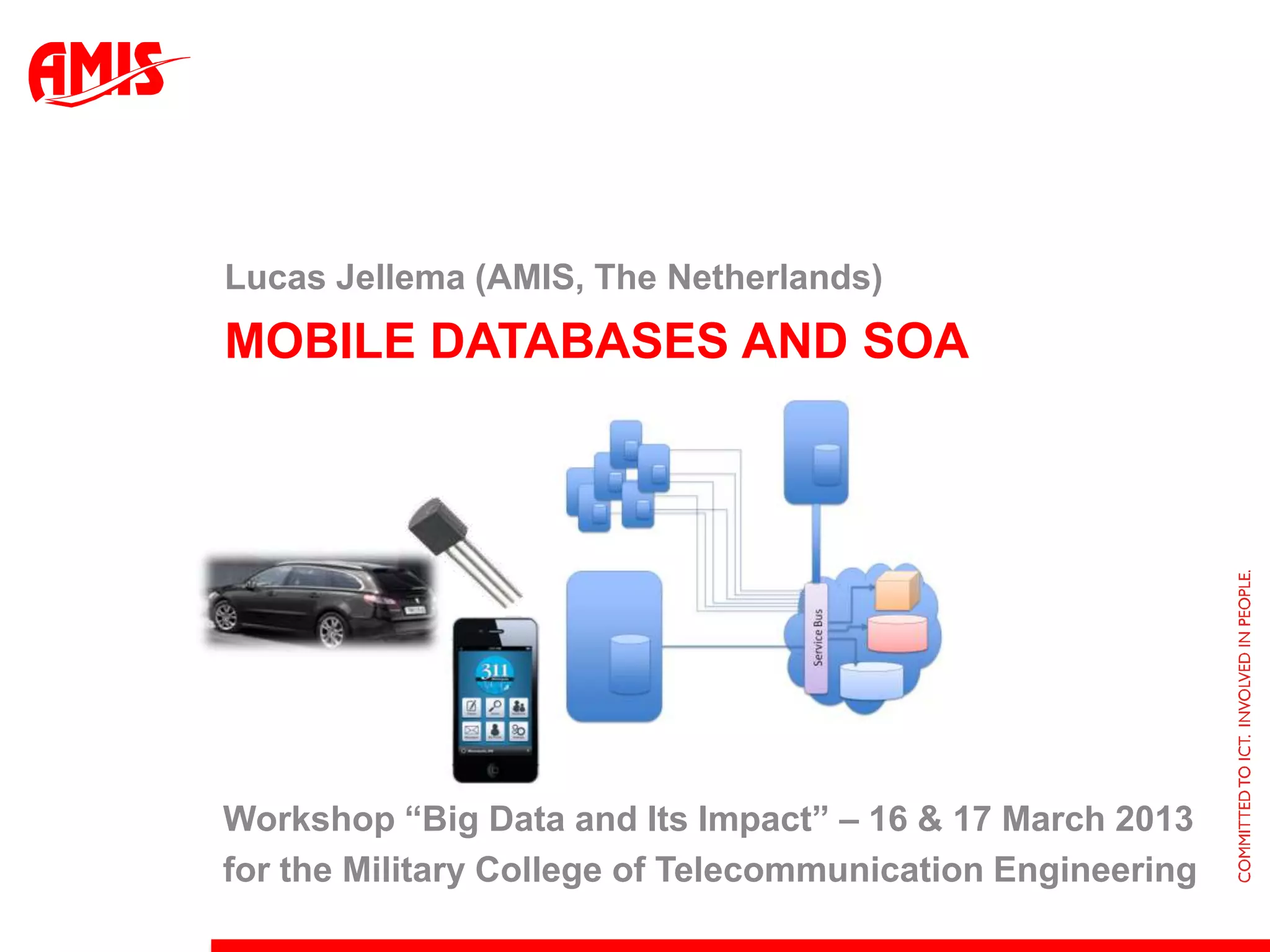
Lucas Jellema (AMIS, The Netherlands)
    MOBILE DATABASES AND SOA


    Workshop “Big Data and Its Impact” – 16 & 17 March 2013
    for the Military College of Telecommunication Engineering
1
THE PRESENTER:
    LUCAS JELLEMA
    • Lives in The Netherlands
      (close to Amsterdam)
    • 1994-2002 Oracle Consulting Global Center of
      Excellence for Internet Development
    • Joined AMIS in 2002 – now working as
      CTO, Consultant (Architect & Technical Lead) &
      Trainer
    • Oracle ACE (2005) & ACE Director (2006)
    • Author of „Oracle SOA Suite 11g Handbook‟
      (Oracle Press, 2010)
    • Presenter at Oracle OpenWorld, JavaOne, OTN
      Yathra & more User Group Conferences
    • Frequent blogger at http://technology.amis.nl
    • Active with SQL & PL/SQL, Java EE &
2     ADF, SOA, BPM & more Fusion Middleware
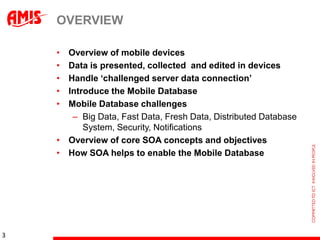
OVERVIEW

    • Overview of mobile devices
    • Data is presented, collected and edited in devices
    • Handle „challenged server data connection‟
    • Introduce the Mobile Database
    • Mobile Database challenges
       – Big Data, Fast Data, Fresh Data, Distributed Database
          System, Security, Notifications
    • Overview of core SOA concepts and objectives
    • How SOA helps to enable the Mobile Database


3
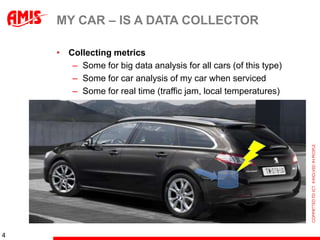
MY CAR – IS A DATA COLLECTOR

    • Collecting metrics
       – Some for big data analysis for all cars (of this type)
       – Some for car analysis of my car when serviced
       – Some for real time (traffic jam, local temperatures)


4
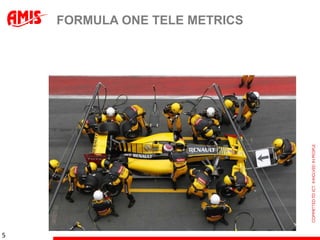
FORMULA ONE TELE METRICS


5
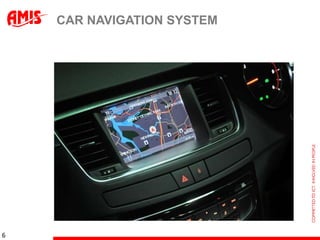
CAR NAVIGATION SYSTEM


6
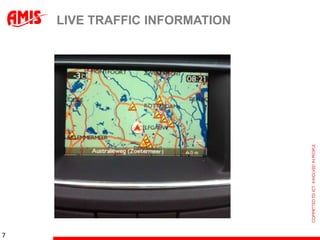
LIVE TRAFFIC INFORMATION


7
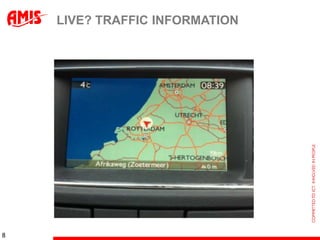
LIVE? TRAFFIC INFORMATION


8
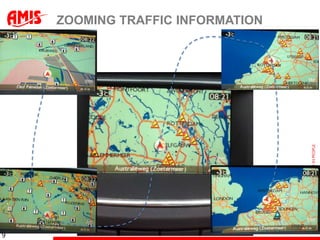
ZOOMING TRAFFIC INFORMATION


9
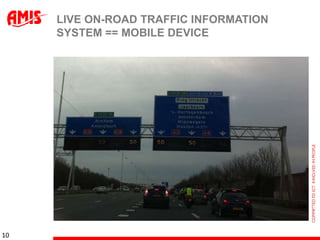
LIVE ON-ROAD TRAFFIC INFORMATION
     SYSTEM == MOBILE DEVICE


10
ON SITE CRASH INSPECTION


11
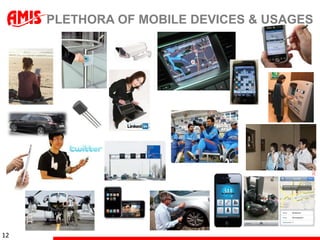
PLETHORA OF MOBILE DEVICES & USAGES


12
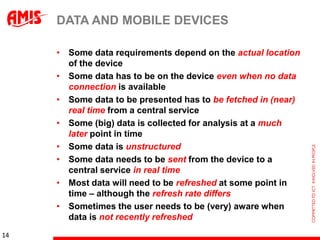
MOBILE AGENTS

                ATM

                         Security Badge Scanners
     Sensors
               Audio Guide
                                             Traffic Information
         Barcode Scanners &                   Satellites
          Handheld Devices
                                                            Cars
                                  Security Gates
                                                            Navigation Systems
                              Push Buttons
                                                      Cameras
                                Mobile Phones                        Microphones
                                                                     & Speakers
                                                      Tablets


           Report                Read                      Read &
                                 & Edit                    Refresh
                                                           (Alert)
13
DATA AND MOBILE DEVICES

     • Some data requirements depend on the actual location
       of the device
     • Some data has to be on the device even when no data
       connection is available
     • Some data to be presented has to be fetched in (near)
       real time from a central service
     • Some (big) data is collected for analysis at a much
       later point in time
     • Some data is unstructured
     • Some data needs to be sent from the device to a
       central service in real time
     • Most data will need to be refreshed at some point in
       time – although the refresh rate differs
     • Sometimes the user needs to be (very) aware when
       data is not recently refreshed
14
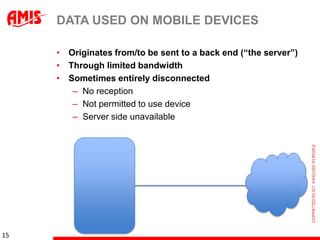
DATA USED ON MOBILE DEVICES

     • Originates from/to be sent to a back end (“the server”)
     • Through limited bandwidth
     • Sometimes entirely disconnected
        – No reception
        – Not permitted to use device
        – Server side unavailable


15
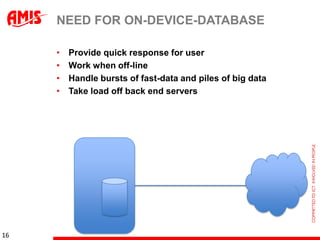
NEED FOR ON-DEVICE-DATABASE

     •   Provide quick response for user
     •   Work when off-line
     •   Handle bursts of fast-data and piles of big data
     •   Take load off back end servers


16
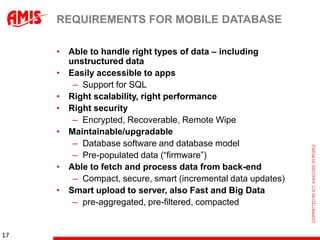
REQUIREMENTS FOR MOBILE DATABASE

     • Able to handle right types of data – including
       unstructured data
     • Easily accessible to apps
        – Support for SQL
     • Right scalability, right performance
     • Right security
        – Encrypted, Recoverable, Remote Wipe
     • Maintainable/upgradable
        – Database software and database model
        – Pre-populated data (“firmware”)
     • Able to fetch and process data from back-end
        – Compact, secure, smart (incremental data updates)
     • Smart upload to server, also Fast and Big Data
        – pre-aggregated, pre-filtered, compacted


17
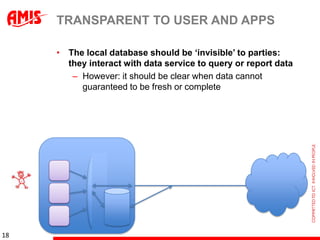
TRANSPARENT TO USER AND APPS

     • The local database should be „invisible‟ to parties:
       they interact with data service to query or report data
        – However: it should be clear when data cannot
          guaranteed to be fresh or complete


18
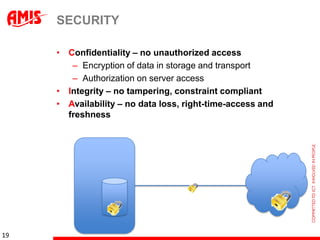
SECURITY

     • Confidentiality – no unauthorized access
        – Encryption of data in storage and transport
        – Authorization on server access
     • Integrity – no tampering, constraint compliant
     • Availability – no data loss, right-time-access and
       freshness


19
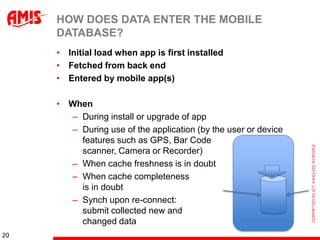
HOW DOES DATA ENTER THE MOBILE
     DATABASE?
     • Initial load when app is first installed
     • Fetched from back end
     • Entered by mobile app(s)

     • When
       – During install or upgrade of app
       – During use of the application (by the user or device
         features such as GPS, Bar Code
         scanner, Camera or Recorder)
       – When cache freshness is in doubt
       – When cache completeness
         is in doubt
       – Synch upon re-connect:
         submit collected new and
         changed data
20
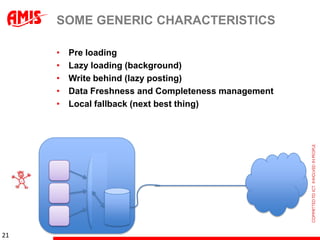
SOME GENERIC CHARACTERISTICS

     •   Pre loading
     •   Lazy loading (background)
     •   Write behind (lazy posting)
     •   Data Freshness and Completeness management
     •   Local fallback (next best thing)


21
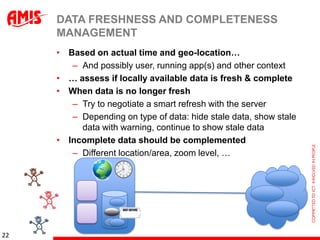
DATA FRESHNESS AND COMPLETENESS
     MANAGEMENT
     • Based on actual time and geo-location…
        – And possibly user, running app(s) and other context
     • … assess if locally available data is fresh & complete
     • When data is no longer fresh
        – Try to negotiate a smart refresh with the server
        – Depending on type of data: hide stale data, show stale
          data with warning, continue to show stale data
     • Incomplete data should be complemented
        – Different location/area, zoom level, …


22
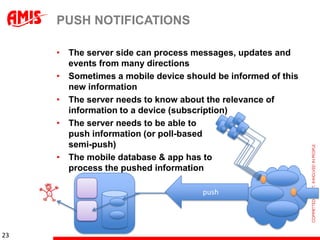
PUSH NOTIFICATIONS

     • The server side can process messages, updates and
       events from many directions
     • Sometimes a mobile device should be informed of this
       new information
     • The server needs to know about the relevance of
       information to a device (subscription)
     • The server needs to be able to
       push information (or poll-based
       semi-push)
     • The mobile database & app has to
       process the pushed information

                                     push


23
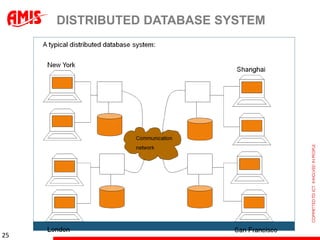
MOBILE DATABASE(S) & BACK END
     SYSTEMS IS A …


24
DISTRIBUTED DATABASE SYSTEM


25
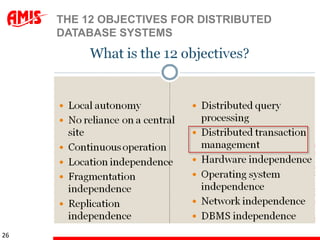
THE 12 OBJECTIVES FOR DISTRIBUTED
     DATABASE SYSTEMS


26
MOBILE DATABASES DO NOT SUPPORT
     DISTRIBUTED TRANSACTIONS
     • Server side updates happen independent from clients
        – Refresh of Mobile Database may take place at any
            point in the future
     • Data manipulation in Mobile Database is committed
       locally on the device
        – Upload to server happens later: „write (far) behind‟
     • This means that at some point after the transaction is
       complete, the transaction
       is „replicated‟ to other
       databases
     • During this replication,
       conflicts may occur


27
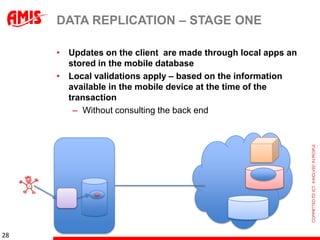
DATA REPLICATION – STAGE ONE

     • Updates on the client are made through local apps an
       stored in the mobile database
     • Local validations apply – based on the information
       available in the mobile device at the time of the
       transaction
        – Without consulting the back end


28
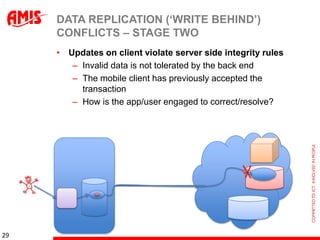
DATA REPLICATION („WRITE BEHIND‟)
     CONFLICTS – STAGE TWO
     • Updates on client violate server side integrity rules
        – Invalid data is not tolerated by the back end
        – The mobile client has previously accepted the
          transaction
        – How is the app/user engaged to correct/resolve?


29
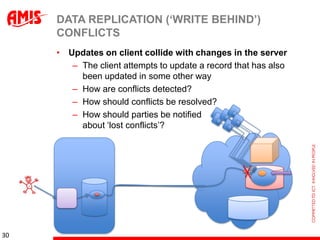
DATA REPLICATION („WRITE BEHIND‟)
     CONFLICTS
     • Updates on client collide with changes in the server
        – The client attempts to update a record that has also
          been updated in some other way
        – How are conflicts detected?
        – How should conflicts be resolved?
        – How should parties be notified
          about „lost conflicts‟?


30
SOA = BAD

31
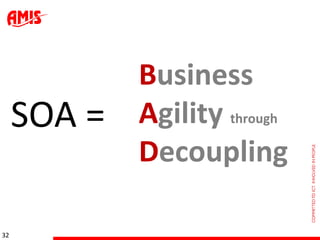
Business
     SOA =   Agility through
             Decoupling

32
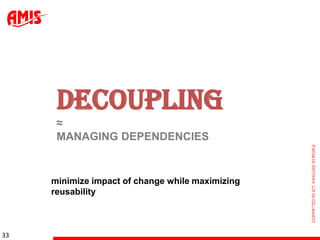
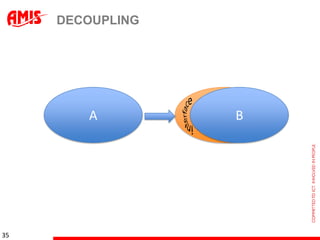
DECOUPLING
      ≈
      MANAGING DEPENDENCIES


     minimize impact of change while maximizing
     reusability


33
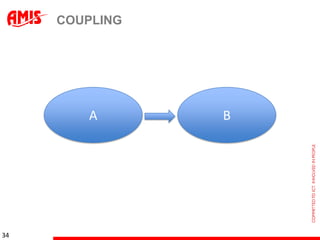
COUPLING


        A       B


34
DECOUPLING


        A         B B


35
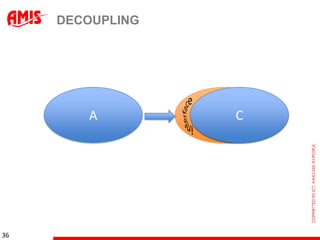
DECOUPLING


        A         B B
                    C


36
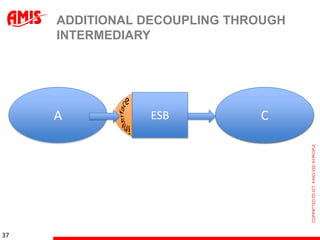
ADDITIONAL DECOUPLING THROUGH
     INTERMEDIARY


     A            B
                ESB           B
                              C


37
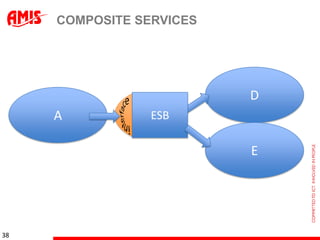
COMPOSITE SERVICES


                          D
     A             B
                 ESB

                          E


38
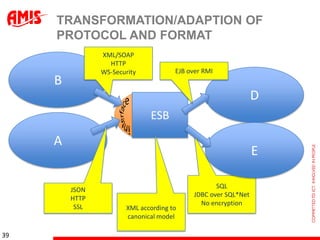
TRANSFORMATION/ADAPTION OF
     PROTOCOL AND FORMAT
                XML/SOAP
                  HTTP
                WS-Security           EJB over RMI
     B
                                                                D
                                B
                              ESB

     A
                                                                E

                                                   SQL
         JSON
                                            JDBC over SQL*Net
         HTTP
                                              No encryption
          SSL          XML according to
                       canonical model

39
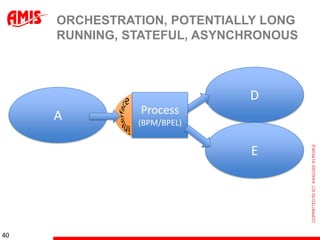
ORCHESTRATION, POTENTIALLY LONG
     RUNNING, STATEFUL, ASYNCHRONOUS


                             D
     A         Process
                  B
               (BPM/BPEL)


                             E


40
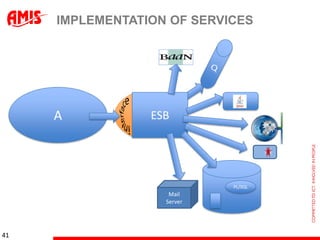
IMPLEMENTATION OF SERVICES


     A             B
                 ESB


                            PL/SQL
                    Mail
                   Server


41
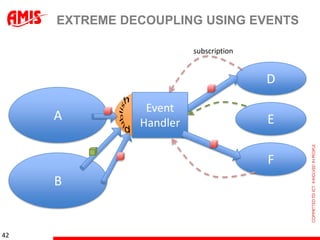
EXTREME DECOUPLING USING EVENTS

                         subscription


                                        D
                Event
     A            B
               Handler                  E

                                        F
     B


42
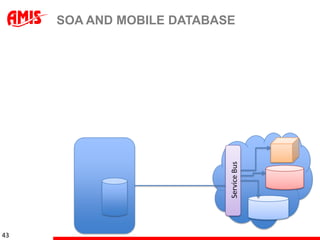
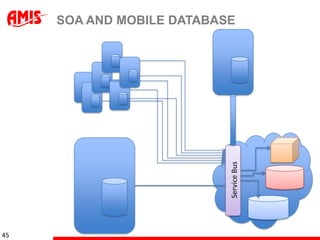
SOA AND MOBILE DATABASE


43                         Service Bus
SOA AND MOBILE DATABASE

     • Services that hide underlying complexity
        – Technology, formats, protocols, data structure of back
          end systems
     • Services that handle two-way data synchronization
        – Possibly conflicting changes on both ends
        – Violation of server side data constraints
        – Smart refresh of data on mobile device
     • ESB that supports subscriptions and push to send
       alerts/notifications/updates to mobile devices
     • ESB that exposes services in appropriate protocol and
       format (e.g. http/json)
     • ESB that handles
       security in transport
       and message contents

44
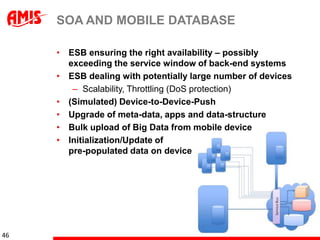
SOA AND MOBILE DATABASE


45                         Service Bus
SOA AND MOBILE DATABASE

     • ESB ensuring the right availability – possibly
       exceeding the service window of back-end systems
     • ESB dealing with potentially large number of devices
        – Scalability, Throttling (DoS protection)
     • (Simulated) Device-to-Device-Push
     • Upgrade of meta-data, apps and data-structure
     • Bulk upload of Big Data from mobile device
     • Initialization/Update of
       pre-populated data on device


46
SUMMARY

     • Mobile Database is a necessity to ensure apps can run
        – With acceptable performance
        – At all (in off-line situations)
     • Mobile Database is a local cache that contains a
       snapshot of the „back end data‟ at a certain timestamp
        – Cache is not complete and is not current
        – Cache contains data collected and edited on device
     • Mobile Database is part of distributed database system
        – Without real-time distributed transactions
        – Periodic synchronization between Mobile Database and
          Server is required (to really complete the transaction)
        – Data conflicts need to be resolved
     • SOA can help to hide complexity of back end and offer
       available services with fitting protocol and data format
        – Providing security, handling peak loads, supporting
          push, understanding delta-based updates, …
47
RESOURCES

     • Blog: technology.amis.nl
        – On Oracle, SQL, Java, SOA, BPM & more
     • Email: lucas.jellema@amis.nl

     •      : lucasjellema

     • Slideshare: www.slideshare.net/lucasjellema
     •          : www.amis.nl, info@amis.nl
                 +31 306016000
                 Edisonbaan 15, Nieuwegein
                 The Netherlands


48

Mobile Database and Service Oriented Architecture

  • 1.
    Lucas Jellema (AMIS,The Netherlands) MOBILE DATABASES AND SOA Workshop “Big Data and Its Impact” – 16 & 17 March 2013 for the Military College of Telecommunication Engineering 1
  • 2.
    THE PRESENTER: LUCAS JELLEMA • Lives in The Netherlands (close to Amsterdam) • 1994-2002 Oracle Consulting Global Center of Excellence for Internet Development • Joined AMIS in 2002 – now working as CTO, Consultant (Architect & Technical Lead) & Trainer • Oracle ACE (2005) & ACE Director (2006) • Author of „Oracle SOA Suite 11g Handbook‟ (Oracle Press, 2010) • Presenter at Oracle OpenWorld, JavaOne, OTN Yathra & more User Group Conferences • Frequent blogger at http://technology.amis.nl • Active with SQL & PL/SQL, Java EE & 2 ADF, SOA, BPM & more Fusion Middleware
  • 3.
    OVERVIEW • Overview of mobile devices • Data is presented, collected and edited in devices • Handle „challenged server data connection‟ • Introduce the Mobile Database • Mobile Database challenges – Big Data, Fast Data, Fresh Data, Distributed Database System, Security, Notifications • Overview of core SOA concepts and objectives • How SOA helps to enable the Mobile Database 3
  • 4.
    MY CAR –IS A DATA COLLECTOR • Collecting metrics – Some for big data analysis for all cars (of this type) – Some for car analysis of my car when serviced – Some for real time (traffic jam, local temperatures) 4
  • 5.
  • 6.
  • 7.
  • 8.
  • 9.
  • 10.
    LIVE ON-ROAD TRAFFICINFORMATION SYSTEM == MOBILE DEVICE 10
  • 11.
    ON SITE CRASHINSPECTION 11
  • 12.
    PLETHORA OF MOBILEDEVICES & USAGES 12
  • 13.
    MOBILE AGENTS ATM Security Badge Scanners Sensors Audio Guide Traffic Information Barcode Scanners & Satellites Handheld Devices Cars Security Gates Navigation Systems Push Buttons Cameras Mobile Phones Microphones & Speakers Tablets Report Read Read & & Edit Refresh (Alert) 13
  • 14.
    DATA AND MOBILEDEVICES • Some data requirements depend on the actual location of the device • Some data has to be on the device even when no data connection is available • Some data to be presented has to be fetched in (near) real time from a central service • Some (big) data is collected for analysis at a much later point in time • Some data is unstructured • Some data needs to be sent from the device to a central service in real time • Most data will need to be refreshed at some point in time – although the refresh rate differs • Sometimes the user needs to be (very) aware when data is not recently refreshed 14
  • 15.
    DATA USED ONMOBILE DEVICES • Originates from/to be sent to a back end (“the server”) • Through limited bandwidth • Sometimes entirely disconnected – No reception – Not permitted to use device – Server side unavailable 15
  • 16.
    NEED FOR ON-DEVICE-DATABASE • Provide quick response for user • Work when off-line • Handle bursts of fast-data and piles of big data • Take load off back end servers 16
  • 17.
    REQUIREMENTS FOR MOBILEDATABASE • Able to handle right types of data – including unstructured data • Easily accessible to apps – Support for SQL • Right scalability, right performance • Right security – Encrypted, Recoverable, Remote Wipe • Maintainable/upgradable – Database software and database model – Pre-populated data (“firmware”) • Able to fetch and process data from back-end – Compact, secure, smart (incremental data updates) • Smart upload to server, also Fast and Big Data – pre-aggregated, pre-filtered, compacted 17
  • 18.
    TRANSPARENT TO USERAND APPS • The local database should be „invisible‟ to parties: they interact with data service to query or report data – However: it should be clear when data cannot guaranteed to be fresh or complete 18
  • 19.
    SECURITY • Confidentiality – no unauthorized access – Encryption of data in storage and transport – Authorization on server access • Integrity – no tampering, constraint compliant • Availability – no data loss, right-time-access and freshness 19
  • 20.
    HOW DOES DATAENTER THE MOBILE DATABASE? • Initial load when app is first installed • Fetched from back end • Entered by mobile app(s) • When – During install or upgrade of app – During use of the application (by the user or device features such as GPS, Bar Code scanner, Camera or Recorder) – When cache freshness is in doubt – When cache completeness is in doubt – Synch upon re-connect: submit collected new and changed data 20
  • 21.
    SOME GENERIC CHARACTERISTICS • Pre loading • Lazy loading (background) • Write behind (lazy posting) • Data Freshness and Completeness management • Local fallback (next best thing) 21
  • 22.
    DATA FRESHNESS ANDCOMPLETENESS MANAGEMENT • Based on actual time and geo-location… – And possibly user, running app(s) and other context • … assess if locally available data is fresh & complete • When data is no longer fresh – Try to negotiate a smart refresh with the server – Depending on type of data: hide stale data, show stale data with warning, continue to show stale data • Incomplete data should be complemented – Different location/area, zoom level, … 22
  • 23.
    PUSH NOTIFICATIONS • The server side can process messages, updates and events from many directions • Sometimes a mobile device should be informed of this new information • The server needs to know about the relevance of information to a device (subscription) • The server needs to be able to push information (or poll-based semi-push) • The mobile database & app has to process the pushed information push 23
  • 24.
    MOBILE DATABASE(S) &BACK END SYSTEMS IS A … 24
  • 25.
  • 26.
    THE 12 OBJECTIVESFOR DISTRIBUTED DATABASE SYSTEMS 26
  • 27.
    MOBILE DATABASES DONOT SUPPORT DISTRIBUTED TRANSACTIONS • Server side updates happen independent from clients – Refresh of Mobile Database may take place at any point in the future • Data manipulation in Mobile Database is committed locally on the device – Upload to server happens later: „write (far) behind‟ • This means that at some point after the transaction is complete, the transaction is „replicated‟ to other databases • During this replication, conflicts may occur 27
  • 28.
    DATA REPLICATION –STAGE ONE • Updates on the client are made through local apps an stored in the mobile database • Local validations apply – based on the information available in the mobile device at the time of the transaction – Without consulting the back end 28
  • 29.
    DATA REPLICATION („WRITEBEHIND‟) CONFLICTS – STAGE TWO • Updates on client violate server side integrity rules – Invalid data is not tolerated by the back end – The mobile client has previously accepted the transaction – How is the app/user engaged to correct/resolve? 29
  • 30.
    DATA REPLICATION („WRITEBEHIND‟) CONFLICTS • Updates on client collide with changes in the server – The client attempts to update a record that has also been updated in some other way – How are conflicts detected? – How should conflicts be resolved? – How should parties be notified about „lost conflicts‟? 30
  • 31.
  • 32.
    Business SOA = Agility through Decoupling 32
  • 33.
    DECOUPLING ≈ MANAGING DEPENDENCIES minimize impact of change while maximizing reusability 33
  • 34.
    COUPLING A B 34
  • 35.
    DECOUPLING A B B 35
  • 36.
    DECOUPLING A B B C 36
  • 37.
    ADDITIONAL DECOUPLING THROUGH INTERMEDIARY A B ESB B C 37
  • 38.
    COMPOSITE SERVICES D A B ESB E 38
  • 39.
    TRANSFORMATION/ADAPTION OF PROTOCOL AND FORMAT XML/SOAP HTTP WS-Security EJB over RMI B D B ESB A E SQL JSON JDBC over SQL*Net HTTP No encryption SSL XML according to canonical model 39
  • 40.
    ORCHESTRATION, POTENTIALLY LONG RUNNING, STATEFUL, ASYNCHRONOUS D A Process B (BPM/BPEL) E 40
  • 41.
    IMPLEMENTATION OF SERVICES A B ESB PL/SQL Mail Server 41
  • 42.
    EXTREME DECOUPLING USINGEVENTS subscription D Event A B Handler E F B 42
  • 43.
    SOA AND MOBILEDATABASE 43 Service Bus
  • 44.
    SOA AND MOBILEDATABASE • Services that hide underlying complexity – Technology, formats, protocols, data structure of back end systems • Services that handle two-way data synchronization – Possibly conflicting changes on both ends – Violation of server side data constraints – Smart refresh of data on mobile device • ESB that supports subscriptions and push to send alerts/notifications/updates to mobile devices • ESB that exposes services in appropriate protocol and format (e.g. http/json) • ESB that handles security in transport and message contents 44
  • 45.
    SOA AND MOBILEDATABASE 45 Service Bus
  • 46.
    SOA AND MOBILEDATABASE • ESB ensuring the right availability – possibly exceeding the service window of back-end systems • ESB dealing with potentially large number of devices – Scalability, Throttling (DoS protection) • (Simulated) Device-to-Device-Push • Upgrade of meta-data, apps and data-structure • Bulk upload of Big Data from mobile device • Initialization/Update of pre-populated data on device 46
  • 47.
    SUMMARY • Mobile Database is a necessity to ensure apps can run – With acceptable performance – At all (in off-line situations) • Mobile Database is a local cache that contains a snapshot of the „back end data‟ at a certain timestamp – Cache is not complete and is not current – Cache contains data collected and edited on device • Mobile Database is part of distributed database system – Without real-time distributed transactions – Periodic synchronization between Mobile Database and Server is required (to really complete the transaction) – Data conflicts need to be resolved • SOA can help to hide complexity of back end and offer available services with fitting protocol and data format – Providing security, handling peak loads, supporting push, understanding delta-based updates, … 47
  • 48.
    RESOURCES • Blog: technology.amis.nl – On Oracle, SQL, Java, SOA, BPM & more • Email: lucas.jellema@amis.nl • : lucasjellema • Slideshare: www.slideshare.net/lucasjellema • : www.amis.nl, info@amis.nl +31 306016000 Edisonbaan 15, Nieuwegein The Netherlands 48

Editor's Notes

  • #2 Process
  • #7 Different zoom level, different informationMaps are updated once a year when my car is serviced
  • #8 Semi liveTransmitted along with radio signalUpdate with changing zoom levelImportant to know when information is not fresh
  • #9 No traffic jams indicated: are there none or is the connection unavailable?
  • #10 Semi liveTransmitted along with radio signalUpdate with changing zoom levelImportant to know when information is not fresh
  • #13 Types and usagesData collectionPhoto cameraSound recorderWork anytime anywhereeReaderNavigationInspection sheetTour guide3d overlayEmailChatAct on tasks in business process (approval, decision)