CONTENTS
• ABSTRACT
• INTRODUCTION
• CONCEPT OF CLOUD COMPUTING
• WHAT IS MOBILE CLOUD COMPUTING (MCC)
• ISSUES AND FUNCTIONALITIES
• SERVICES AND MODEL OF MCC
• THE RELEVANCE OF MCC TO LIBRARY SERVICES
• OPPORTUNITIES OF MOBILE CLOUD IN LIBRARIES
• BENEFITS OF MOBILE CLOUD IN LIBRARIES
• RISK AND CHALLENGES OF MOBILE CLOUD COMPUTING
• CONCLUSION
CLOUD COMPUTING
Common
Location-Independent
Online
Utility
Demand
 Common: implies multi-tenancy
 Utility: implies pay-for-use
 On Demand: implies infinite, immediate, invisible scalability
CLOUD COMPUTING
Cloud computing created as a symbol is an abstraction for
the complex infrastructure
Cloud computing assigns remote services with a user's
data, software and computation
allows users to use applications without installation on
their local machine
allows users to access much more efficient computing by
centralized storage, memory, and processing
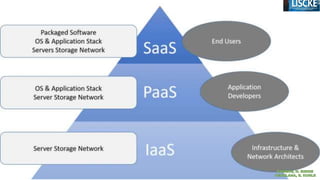
Cloud computing is categorized into IaaS, PaaS and SaaS
which also serves as layers of cloud computing system.
WHAT IS MOBILE CLOUD COMPUTING (MCC)
Mobile Cloud Computing (MCC) combines
mobile computing and cloud computing. It
refers to an infrastructure where data storage
and data processing can happen outside of the
mobile device
•Mobile devices becoming an essential part of human life
•Lack in Resources
•Mobile Challenges (battery Power and availability)
•Integration Device with cloud
•Provision of efficient and effective applications for devices
What Motivate MCC
Aepona (2010) described it as a new distributed
computing paradigm for mobile applications
whereby the storage and the data processing are
migrated from the smart mobile devices to
resources rich and powerful centralized
computing data centers in the computational
cloud.
The following authors defined MCC at different times as a combination of
cloud computing and mobile computing
Sanaei, Abolfazli, Gani, and Shiraz, (2012).
Hirsch and Ng (2011)
Dinh, Lee, Nivato
Wang (2011)
Christensen (2009)
Chun and Maniatis (2009) and Kovachev (2010) introduced different
approaches to mobile device to the cloud-based on resources available and
elasticity of an application on the device
Issues and Functionalities
Mobile cloud computing has the following characteristics:
Storage and sharing
Universal accessibility
Collaborative interactions
Learner-centered which add knowledge to interested and willing users.
Mobile cloud computing is cost-effective
Mobile Cloud computing also brings an array of new features
MCC is characterized by features such as platform, location, and device
independence, which make it easily adaptable for all sizes of businesses, in
particular small and mid-sized.
As asserted by Chang, Bacigalupo, Wills, and De Roure, (2010)
Services and Model of MCC
The main objectives of MCC
• Provide mobility so that users can access resources through wireless
technology from anywhere they are (Bheda and Lakhani, 2013).
• To deliver location-aware mobile service with mobility to users based
on scalable mobile cloud resources in networks, computers storages
and mobile devices.
• To deliver them with secure mobile cloud resources, service
applications and data using energy-efficient mobile cloud resources in a
pay-as-you-use model.
Similar to three service models of cloud computing
(SaaS, PaaS, IaaS), primary service models of MCC
are listed as follows:
•Mobile Network-as-a-Service (MNaaS)
•Mobile Cloud Infrastructure-as-a-Service (MIaaS)
•Mobile Data-as-a-Service (MDaaS)
•Mobile Platform-as-a-Service (MPaaS)
•Mobile Software-as-a-Service (MSaaS)
THE RELEVANCE OF MCC TO LIBRARY SERVICES
OPPORTUNITIES AND BENEFITS OF MOBILE CLOUD IN LIBRARIES
• MCC and CC allows libraries to put maximum contents in the cloud thus allows users to
access the contents easily on mobile devices.
• Physical books and other documents can be scanned into a searchable database and made
accessible to library users.
• Libraries with digital collections and electronic resources can move such contents to the
cloud and this gives users increased capacity and less need for updates and maintenance.
• MCC remains a better platform for libraries to be relevant in emerging technologies in
providing service to teaming young population of library users who prefer using or glued to
mobile devices.
• To overcome bottlenecks of server access restriction and complexity libraries MCC and
obtained high computing power, greater sharing of information resources and easy updates
of information and technologies to library services.
• MCC and Cloud computing allows libraries to move the processing
effort from the local devices to the data center facilities.
• MCC applications provide flexibility not only for organizations but
also for educational: universities, schools, institutions, and libraries.
• Services, applications and data are stored on multiple servers that
can be accessed through the Internet.
• MCC has many advantages such as expected performance, reduced
upfront investment, high availability, reduced launching time, infinite
scalability, tremendous fault tolerance capability, and accessibility,
enhanced collaboration, and mobility, allow users to use any device.
• MCC and Cloud computing can be utilized under circumstances
where the availability of resources is limited.
• MCC eliminates the impulsion of storage capacity of mobile devices.
• Gives room for mobile users to store large data improving the
accuracy and reliability of storing and retrieving data on the cloud.
• Help to reduce the running cost for compute-intensive applications.
• MCC also gives room for many services to be integrated easily to
meet the demand of the users.
• Offers unlimited access to cloud infrastructures, apps, stores, and
cloud-based applications.
• MCC allows users to access library services anywhere, anytime and
reduces IT infrastructure and ongoing IT costs thus saves time and
energy of the users.
• Users also have the opportunity to connect to other library users
throughout the world and share information.
• It reduces operational cost.
• MCC requires less time updating applications on the mobile devices
• MCC provides very high-level data protection especially for sensitive data that include user
information.
• Allow the library to recover data from the cloud by following a certain process in case of a
disaster
• MCC libraries will be able to provide new services to the users and develop strategies to
provide 24/7 services.
• MCC will also allow the library to advertise other programs
• MCC enables librarians and para-professional staff members to work more efficiently by
freeing them to a fixed terminals place.
• With MCC, library personnel can work from anywhere, even at home and give more
productive result.
• MCC gives room for staff collaboration .
• MCC improves the library personnel skills and broadens their scope of knowledge
Challenges
• Service from Network Provider/ Signal Disturbance:
• Loss of the battery and network:
• Low Bandwidth:
• Division of Application Services:
• Privacy and Security:
• Control of applications
• Enhancing the Efficiency of Data Access:
• Limitations of the hand-held devices:
• Problem of individualization of mobile devices:
• Quality of service:
BENEFITS
•It is cost effective for libraries and service
provider, libraries don’t need to constantly
maintain and upgrade hardware or software.
•Computing maintenance, storage, and updates
are completed on the cloud side, mobile devices
serve for display only.
Libraries can successfully use the followings
on MCC
•Open source software like KOHA, Dspace,
Green stone (Repository and Digitalization)
•Drupal (Content Management Software)
•OCLC Web scale
•Ex-Libris Cloud
•Duraspace’s DuraCloud
•Moodle for LMS
RECOMMEDATIONS
AND
CONCLUSION
REFERENCES
• AEPONA (2010) White Paper. Network as a service and mobile cloud computing. February 20
Available at: http://www.aepona.com/downloads/Aepona_White_Pap
er_NaaS_&_MCC_Feb_2010.pdf (Accessed 3rd August 2019)
• Bheda, H. A. and Lakhani, J. (2013). Application processing approach for smart mobile devices
in mobile cloud computing. An International Journal of Advanced Research in Computer
Science and Software Engineering. 3(8).
https://www.researchgate.net/publication/259865832_Application_Processing_Approach_for
_Smart_Mobile_Devices_in_Mobile_Cloud_Computing. (Accessed 3rd August 2019)
• Chang, R. S., Gruhn, J., Gao, V., George, R. and Tsai, W.T. (2013). Mobile cloud computing
research- issues, challenges, and needs. 7th IEEE International Symposium on Mobile Cloud
Computing and Services. https://eprints.bbk.ac.uk/7935/ (Accessed 3rd August 2019)
• Chang, V., Bacigalupo, D., Wills, G. and De Roure, D. (2010). A categorization of cloud
computing business models. In Proceedings of the 10th IEEE/ACM International Conference on
Cluster, Cloud and Grid Computing. Pp.509-512. IEEE Computer Society.
http://eprints.leedsbeckett.ac.uk/648/1/vchang_ccgrid_2010_poster.pdf (Accessed 3rd August
2019)

MOBILE CLOUD COMPUTING: ISSUE AND OPPORTUNITIES IN LIBRARIES

  • 2.
    CONTENTS • ABSTRACT • INTRODUCTION •CONCEPT OF CLOUD COMPUTING • WHAT IS MOBILE CLOUD COMPUTING (MCC) • ISSUES AND FUNCTIONALITIES • SERVICES AND MODEL OF MCC • THE RELEVANCE OF MCC TO LIBRARY SERVICES • OPPORTUNITIES OF MOBILE CLOUD IN LIBRARIES • BENEFITS OF MOBILE CLOUD IN LIBRARIES • RISK AND CHALLENGES OF MOBILE CLOUD COMPUTING • CONCLUSION
  • 3.
    CLOUD COMPUTING Common Location-Independent Online Utility Demand  Common:implies multi-tenancy  Utility: implies pay-for-use  On Demand: implies infinite, immediate, invisible scalability
  • 4.
    CLOUD COMPUTING Cloud computingcreated as a symbol is an abstraction for the complex infrastructure Cloud computing assigns remote services with a user's data, software and computation allows users to use applications without installation on their local machine allows users to access much more efficient computing by centralized storage, memory, and processing Cloud computing is categorized into IaaS, PaaS and SaaS which also serves as layers of cloud computing system.
  • 6.
    WHAT IS MOBILECLOUD COMPUTING (MCC) Mobile Cloud Computing (MCC) combines mobile computing and cloud computing. It refers to an infrastructure where data storage and data processing can happen outside of the mobile device
  • 7.
    •Mobile devices becomingan essential part of human life •Lack in Resources •Mobile Challenges (battery Power and availability) •Integration Device with cloud •Provision of efficient and effective applications for devices What Motivate MCC
  • 8.
    Aepona (2010) describedit as a new distributed computing paradigm for mobile applications whereby the storage and the data processing are migrated from the smart mobile devices to resources rich and powerful centralized computing data centers in the computational cloud.
  • 9.
    The following authorsdefined MCC at different times as a combination of cloud computing and mobile computing Sanaei, Abolfazli, Gani, and Shiraz, (2012). Hirsch and Ng (2011) Dinh, Lee, Nivato Wang (2011) Christensen (2009) Chun and Maniatis (2009) and Kovachev (2010) introduced different approaches to mobile device to the cloud-based on resources available and elasticity of an application on the device
  • 10.
    Issues and Functionalities Mobilecloud computing has the following characteristics: Storage and sharing Universal accessibility Collaborative interactions Learner-centered which add knowledge to interested and willing users. Mobile cloud computing is cost-effective Mobile Cloud computing also brings an array of new features MCC is characterized by features such as platform, location, and device independence, which make it easily adaptable for all sizes of businesses, in particular small and mid-sized. As asserted by Chang, Bacigalupo, Wills, and De Roure, (2010)
  • 11.
    Services and Modelof MCC The main objectives of MCC • Provide mobility so that users can access resources through wireless technology from anywhere they are (Bheda and Lakhani, 2013). • To deliver location-aware mobile service with mobility to users based on scalable mobile cloud resources in networks, computers storages and mobile devices. • To deliver them with secure mobile cloud resources, service applications and data using energy-efficient mobile cloud resources in a pay-as-you-use model.
  • 12.
    Similar to threeservice models of cloud computing (SaaS, PaaS, IaaS), primary service models of MCC are listed as follows: •Mobile Network-as-a-Service (MNaaS) •Mobile Cloud Infrastructure-as-a-Service (MIaaS) •Mobile Data-as-a-Service (MDaaS) •Mobile Platform-as-a-Service (MPaaS) •Mobile Software-as-a-Service (MSaaS)
  • 13.
    THE RELEVANCE OFMCC TO LIBRARY SERVICES OPPORTUNITIES AND BENEFITS OF MOBILE CLOUD IN LIBRARIES • MCC and CC allows libraries to put maximum contents in the cloud thus allows users to access the contents easily on mobile devices. • Physical books and other documents can be scanned into a searchable database and made accessible to library users. • Libraries with digital collections and electronic resources can move such contents to the cloud and this gives users increased capacity and less need for updates and maintenance. • MCC remains a better platform for libraries to be relevant in emerging technologies in providing service to teaming young population of library users who prefer using or glued to mobile devices. • To overcome bottlenecks of server access restriction and complexity libraries MCC and obtained high computing power, greater sharing of information resources and easy updates of information and technologies to library services.
  • 14.
    • MCC andCloud computing allows libraries to move the processing effort from the local devices to the data center facilities. • MCC applications provide flexibility not only for organizations but also for educational: universities, schools, institutions, and libraries. • Services, applications and data are stored on multiple servers that can be accessed through the Internet. • MCC has many advantages such as expected performance, reduced upfront investment, high availability, reduced launching time, infinite scalability, tremendous fault tolerance capability, and accessibility, enhanced collaboration, and mobility, allow users to use any device. • MCC and Cloud computing can be utilized under circumstances where the availability of resources is limited.
  • 15.
    • MCC eliminatesthe impulsion of storage capacity of mobile devices. • Gives room for mobile users to store large data improving the accuracy and reliability of storing and retrieving data on the cloud. • Help to reduce the running cost for compute-intensive applications. • MCC also gives room for many services to be integrated easily to meet the demand of the users. • Offers unlimited access to cloud infrastructures, apps, stores, and cloud-based applications. • MCC allows users to access library services anywhere, anytime and reduces IT infrastructure and ongoing IT costs thus saves time and energy of the users. • Users also have the opportunity to connect to other library users throughout the world and share information.
  • 16.
    • It reducesoperational cost. • MCC requires less time updating applications on the mobile devices • MCC provides very high-level data protection especially for sensitive data that include user information. • Allow the library to recover data from the cloud by following a certain process in case of a disaster • MCC libraries will be able to provide new services to the users and develop strategies to provide 24/7 services. • MCC will also allow the library to advertise other programs • MCC enables librarians and para-professional staff members to work more efficiently by freeing them to a fixed terminals place. • With MCC, library personnel can work from anywhere, even at home and give more productive result. • MCC gives room for staff collaboration . • MCC improves the library personnel skills and broadens their scope of knowledge
  • 17.
    Challenges • Service fromNetwork Provider/ Signal Disturbance: • Loss of the battery and network: • Low Bandwidth: • Division of Application Services: • Privacy and Security: • Control of applications • Enhancing the Efficiency of Data Access: • Limitations of the hand-held devices: • Problem of individualization of mobile devices: • Quality of service:
  • 18.
    BENEFITS •It is costeffective for libraries and service provider, libraries don’t need to constantly maintain and upgrade hardware or software. •Computing maintenance, storage, and updates are completed on the cloud side, mobile devices serve for display only.
  • 19.
    Libraries can successfullyuse the followings on MCC •Open source software like KOHA, Dspace, Green stone (Repository and Digitalization) •Drupal (Content Management Software) •OCLC Web scale •Ex-Libris Cloud •Duraspace’s DuraCloud •Moodle for LMS
  • 20.
  • 21.
    REFERENCES • AEPONA (2010)White Paper. Network as a service and mobile cloud computing. February 20 Available at: http://www.aepona.com/downloads/Aepona_White_Pap er_NaaS_&_MCC_Feb_2010.pdf (Accessed 3rd August 2019) • Bheda, H. A. and Lakhani, J. (2013). Application processing approach for smart mobile devices in mobile cloud computing. An International Journal of Advanced Research in Computer Science and Software Engineering. 3(8). https://www.researchgate.net/publication/259865832_Application_Processing_Approach_for _Smart_Mobile_Devices_in_Mobile_Cloud_Computing. (Accessed 3rd August 2019) • Chang, R. S., Gruhn, J., Gao, V., George, R. and Tsai, W.T. (2013). Mobile cloud computing research- issues, challenges, and needs. 7th IEEE International Symposium on Mobile Cloud Computing and Services. https://eprints.bbk.ac.uk/7935/ (Accessed 3rd August 2019) • Chang, V., Bacigalupo, D., Wills, G. and De Roure, D. (2010). A categorization of cloud computing business models. In Proceedings of the 10th IEEE/ACM International Conference on Cluster, Cloud and Grid Computing. Pp.509-512. IEEE Computer Society. http://eprints.leedsbeckett.ac.uk/648/1/vchang_ccgrid_2010_poster.pdf (Accessed 3rd August 2019)