MOBILE COMPUTING
Cellular System and Medium Access Control
by,
S.Subhalakshmi
M.Sc(Computer Science)
Nadar Saraswathi college of arts and science,Theni.
CONTENT:
Cellular System
Advantages
Disadvantages
Medium Access Control(MAC)
Motivation for a specialized MAC
Types of MAC
Cellular System:
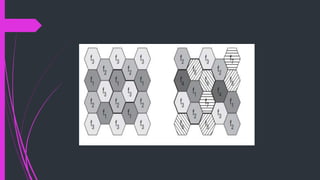
 Cellular systems for mobile communications implement SDM.
Each transmitter typically called a base station.
 Cell radii can vary from tens of meters in buildings, and
hundreds of meters in cities, up to tens of kilometers in the
countryside.
Advantages:
1. Higher Capacity:
 If one transmitter is far away from another, i.e., outside the
interference range, it can reuse the same frequencies.
 But frequencies are a scarce resource and, the number of
concurrent users per cell is very limited.
 Huge cells do not allow for more users. On the contrary, they
are limited to less possible users per km2.
2. Less Transmission Power:
 While power aspects are not a big problem for base stations,
they are indeed problematic for mobile stations.
 A receiver far away from a base station would need much more
transmit power than the current few Watts.
 But energy is a serious problem for mobile handheld devices.
3.Local Interference Only:
 Having long distances between sender and receiver results in
even more interference problems.
4.Robustness:
 Cellular systems are decentralized and so, more robust against
the failure of single components.
 If one antenna fails, this only influences communication within
a small area.
Disadvantages:
1.Infrastructure needed:
 Cellular systems need a complex infrastructure to connect all
base stations.
 This includes many antennas, switches for call forwarding,
location register to find a mobile station etc, which makes the
Whole system quite expensive.
2. Handover needed:
 The mobile station has to perform a handover when changing
from one cell to another.
 Depending on the cell size and the speed of movement, this
can happen quite often.
3.Frequency planning:
 To avoid interference between transmitters using the
same frequencies, frequencies have to be distributed carefully.
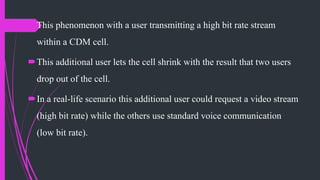
This phenomenon with a user transmitting a high bit rate stream
within a CDM cell.
This additional user lets the cell shrink with the result that two users
drop out of the cell.
In a real-life scenario this additional user could request a video stream
(high bit rate) while the others use standard voice communication
(low bit rate).
Medium Access Control (MAC):
 Medium access control comprises all mechanism that regulate
user access to medium using SDM,TDM,FDM or CDM.
 MAC is thus similar to traffic regulations in the highway
multiplexing.
 MAC belongs to Data link Layer(DLC).
Motivation for a specialized MAC:
 Carrier sense multiple access with collision
detection,(CSMA/CD) which works as follows.
 A sender senses the medium (a wire or coaxial cable) to
see if it is free.
 If the medium is busy, the sender waits until it is free.
 If the medium is free, the sender starts transmitting data and
continues to listen into the medium.
 If the sender detects a collision while sending, it stops at once
and sends a jamming signal.
Types of MAC:
There are two types of MAC. There are
1. Hidden and exposed terminals
2. Near and far terminals

Mobile computing

  • 1.
    MOBILE COMPUTING Cellular Systemand Medium Access Control by, S.Subhalakshmi M.Sc(Computer Science) Nadar Saraswathi college of arts and science,Theni.
  • 2.
    CONTENT: Cellular System Advantages Disadvantages Medium AccessControl(MAC) Motivation for a specialized MAC Types of MAC
  • 3.
    Cellular System:  Cellularsystems for mobile communications implement SDM. Each transmitter typically called a base station.  Cell radii can vary from tens of meters in buildings, and hundreds of meters in cities, up to tens of kilometers in the countryside.
  • 5.
    Advantages: 1. Higher Capacity: If one transmitter is far away from another, i.e., outside the interference range, it can reuse the same frequencies.  But frequencies are a scarce resource and, the number of concurrent users per cell is very limited.  Huge cells do not allow for more users. On the contrary, they are limited to less possible users per km2.
  • 6.
    2. Less TransmissionPower:  While power aspects are not a big problem for base stations, they are indeed problematic for mobile stations.  A receiver far away from a base station would need much more transmit power than the current few Watts.  But energy is a serious problem for mobile handheld devices.
  • 7.
    3.Local Interference Only: Having long distances between sender and receiver results in even more interference problems. 4.Robustness:  Cellular systems are decentralized and so, more robust against the failure of single components.  If one antenna fails, this only influences communication within a small area.
  • 8.
    Disadvantages: 1.Infrastructure needed:  Cellularsystems need a complex infrastructure to connect all base stations.  This includes many antennas, switches for call forwarding, location register to find a mobile station etc, which makes the Whole system quite expensive.
  • 9.
    2. Handover needed: The mobile station has to perform a handover when changing from one cell to another.  Depending on the cell size and the speed of movement, this can happen quite often. 3.Frequency planning:  To avoid interference between transmitters using the same frequencies, frequencies have to be distributed carefully.
  • 11.
    This phenomenon witha user transmitting a high bit rate stream within a CDM cell. This additional user lets the cell shrink with the result that two users drop out of the cell. In a real-life scenario this additional user could request a video stream (high bit rate) while the others use standard voice communication (low bit rate).
  • 12.
    Medium Access Control(MAC):  Medium access control comprises all mechanism that regulate user access to medium using SDM,TDM,FDM or CDM.  MAC is thus similar to traffic regulations in the highway multiplexing.  MAC belongs to Data link Layer(DLC).
  • 13.
    Motivation for aspecialized MAC:  Carrier sense multiple access with collision detection,(CSMA/CD) which works as follows.  A sender senses the medium (a wire or coaxial cable) to see if it is free.  If the medium is busy, the sender waits until it is free.
  • 14.
     If themedium is free, the sender starts transmitting data and continues to listen into the medium.  If the sender detects a collision while sending, it stops at once and sends a jamming signal. Types of MAC: There are two types of MAC. There are 1. Hidden and exposed terminals 2. Near and far terminals