MOBILE BANKING
ADOPTION
Imran Reza 16-071
Zakaria Hasan 17-006
Rafia Khan 20-036
Imtiaz Rashid Merit 553
Mobile Banking
◦ Mobile banking can be defined as the ability to
conduct bank transactions via a mobile device, or
more broadly to conduct financial transactions via a
mobile terminal (Drexelius & Herzig, 2001)
◦ Mobile banking is the performing of finance related
functions on a mobile device like a Smartphone or
tablet.
◦ Also known as m-banking/ MFS (Mobile Financial
Services)
◦ Mobile Financial Services (MFS) is an approach to
offering financial services that combines banking with
mobile wireless networks which enables users to
execute banking transactions
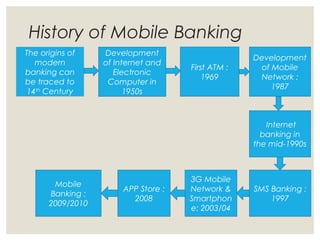
History of Mobile Banking
The origins of
modern
banking can
be traced to
14th
Century
Development
of Internet and
Electronic
Computer in
1950s
First ATM :
1969
Development
of Mobile
Network :
1987
Internet
banking in
the mid-1990s
SMS Banking :
1997
3G Mobile
Network &
Smartphon
e: 2003/04
APP Store :
2008
Mobile
Banking :
2009/2010
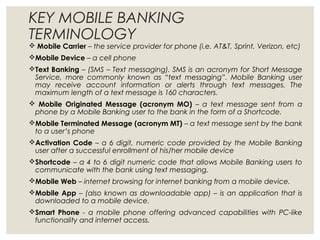
KEY MOBILE BANKING
TERMINOLOGY
 Mobile Carrier – the service provider for phone (i.e. AT&T, Sprint, Verizon, etc)
Mobile Device – a cell phone
Text Banking – (SMS – Text messaging). SMS is an acronym for Short Message
Service, more commonly known as “text messaging”. Mobile Banking user
may receive account information or alerts through text messages. The
maximum length of a text message is 160 characters.
 Mobile Originated Message (acronym MO) – a text message sent from a
phone by a Mobile Banking user to the bank in the form of a Shortcode.
Mobile Terminated Message (acronym MT) – a text message sent by the bank
to a user’s phone
Activation Code – a 6 digit, numeric code provided by the Mobile Banking
user after a successful enrollment of his/her mobile device
Shortcode – a 4 to 6 digit numeric code that allows Mobile Banking users to
communicate with the bank using text messaging.
Mobile Web – internet browsing for internet banking from a mobile device.
Mobile App – (also known as downloadable app) – is an application that is
downloaded to a mobile device.
Smart Phone - a mobile phone offering advanced capabilities with PC-like
functionality and internet access.
Agent- A person or organization authorized by a bank to carry out
financial transactions on behalf of the bank. Often these are small
shops whose proprietor can provide cash in and cash out services to a‐ ‐
bank’s clients.
ARPU(Average Revenue Per User) – standard comparable measure of
revenues for mobile network operators.
IVR (Interactive Voice Response) – refers to different ways users can use
a voice prompted menu driven service over the phone.
Prepaid Mobile instruments- Allow customers to add value and spend
this value at vendors, utilities and other merchants. But cash out is either‐
not permitted or highly restricted. Airtel Money in India and MobiCash in
Bangladesh are prepaid mobile instruments.
MNO(Mobile Network Operator) – Airtel, Banglalink, Citicell,
GrameenPhone, Robi, Teletalk.
USSD (Unstructured Supplementary Service Data) – a real time
communication channel between a mobile handset and the servers of
a mobile network operator. MFS providers typically require a
commercial agreement with a mobile network operator to gain access
to USSD, but this has the advantage of being accessible over any
handset.
UISC-(Union Information and Service Centers)– rural one stop services‐
outlets in Bangladesh run by local entrepreneurs offering internet based
information services. In some cases UISCs are being used as agents for
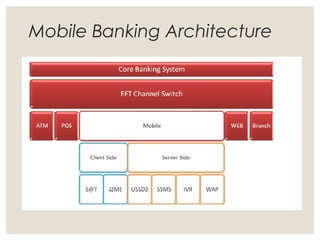
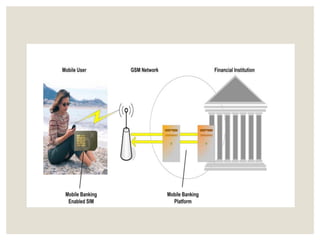
Mobile Banking Architecture
Types of Mobile Banking Service
 Banks classify these services based on how information flows
 A Pull transaction is one in which a mobile phone user actively
requests a service or information from the bank. For example,
inquiring about an account balance is a pull transaction. So is
transferring funds, paying a bill or requesting a transaction history.
Because banks must respond or take some action based on the
user request, pull transactions are considered two-way exchanges.
 A Push transaction, on the other hand, is one in which the bank
sends information based on a set of rules. A minimum balance
alert is a good example of a push transaction.
Mobile Banking Services
◦ Account information
◦ Transaction
◦ Investments
◦ Support
◦ Content services
Advantages of Mobile
Banking
 Benefits for Mobile Operators
- Operators can expand their services portfolio, promote their brands
and create strategic marketing differentiation - attracting new
customers
- Mobile Banking strengthens customer loyalty and reduces churn and
attrition rates.
- Mobile Banking increases operator revenue by boosting traffic
Benefits for Financial Institutions
- Mobile Banking allows financial institutions to enhance customer
satisfaction and retention by offering new, better services while
gaining a direct marketing channel for their products and services
- They attract new customers to the one on-one bank-customer
relationship
- By turning mobile phones into their bank’s ATMs, financial institutions
gain access to new markets, different from those traditionally served
by their physical branches.
- As access to mobile phones grows worldwide, so does the
opportunity to attract more customers and extend the reach of
financial services.
- Access to banking services at anytime and from anywhere also
generates revenue through higher service usage, and reduces
operating expenses because of fewer direct teller interactions, while
maintaining or improving the level of services.
- Financial institutions gain another important benefit by adding
Mobile Banking to their existing channels. They will be with their
customers at all times.
 Benefits for the End User
- Mobility
- More Secured than Manual Transactions
- Time Independent (24/7)
- Less Costly
- Convenient
- Speedy
 ONE OTHER IMPORTANT BENEFIT- ENCOURAGES GREEN AND
PAPERLESS BANKING
Disadvantages of Mobile
BankingMay prove costly for normal mobile holders
Restricted scope
Non-uniformity of services
One account managed through only one number
Threat of virus and spams
Higher costs of KYC (Know Your Customer)
Risk of Unofficial mobile application
Theft of mobile
Loss of Personal Banking Experience
Discomfort due to Small Screen
Not considered for bulky or large volume of transactions
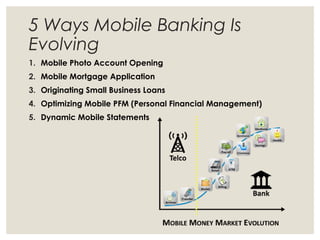
5 Ways Mobile Banking Is
Evolving
1. Mobile Photo Account Opening
2. Mobile Mortgage Application
3. Originating Small Business Loans
4. Optimizing Mobile PFM (Personal Financial Management)
5. Dynamic Mobile Statements
M-Banking in Bangladesh
◦ The new era of banking in Bangladesh 'Mobile Banking' was
inaugurated at 31st March 2011
◦ The central bank issued guidelines on “Mobile Financial
Services for Banks” in September 2011 clearly stating a
choice to make the market bank-led.
◦ Two early leaders of M-banking in Bangladesh are- bKash
(Brac Bank) & Duch Bangla Mobile
◦ Bangladesh Bank has fixed the transaction limit for the
account holders of mobile financial services at maximum Tk.
10,000 daily and a total of Tk. 25,000 on monthly
◦ Two major reasons behind m-Banking in Bangladesh are-
Addressing the Un-banked & Less Costly but easier
Transaction method
◦ Current Situation :
◦ Approved Mobile Financial Services (in broad categories) are listed
below
- Disbursement of inward foreign remittances.
- Cash in /out using mobile account through agents/Bank branches/
ATMs/Mobile Operator's outlets.
- Person to Business Payments e.g. a. utility bill payments, b. merchant‐
payments.
- Business to Person Payments e.g. salary disbursement, dividend and
refund warrant payments, vendor payments, etc.
- Government to Person Payments e.g. elderly allowances. Freedom‐
fighter allowances, subsidies, etc.
- Person to Government Payments e.g. tax, levy payments.
- Person to Person Payments (One registered mobile Account to another
registered mobile account).
- Other payments like microfinance, overdrawn facility, insurance
premium, DPS, etc.
Notable Benefits of m-Banking
in Bangladesh
◦ The practical and attractive features of mobile financial services
are a strong draw for individual customers.
◦ Relatively low costly and less time consuming
◦ Another key benefit to the individual is how MFS lets users spend less
of their time overcoming bureaucratic obstacles.
◦ Mobile banking reduces its customers’ reliance on cash, a feature
that brings increased convenience and savings potential into
Bangladeshis’ lives.
◦ Increased GDP- With mobile financial services adoption,
Bangladesh could see a GDP increase of US$6 billion, or 2 percent,
by 2020.
◦ New Job Creation
◦ Tax Revenue Growth
◦ Reducing Rural Poverty
◦ Health Care Improvements
◦ Managing Natural Disasters
Performing M-Banking in
Bangladesh◦ Bank Mobile Account Registration: Registration can be done in any
approved agent point. Bank system will give a IVR (Interactive Voice
Response) call or USSD prompt menu. Then the subscriber will give a
four number PIN code to the answer which will use for transaction.
◦ Documents for registration: Filled KYC Form (given by the approved
agent), Photos of the subscriber, National or any eligible ID card.
◦ Mobile Account Number: Your Mobile number will be the account
number where a Check digit will be included.
◦ Compatible Mobile set: Any type of mobile set can be used for the
service.
◦ Account opening: Only 10/- (ten taka) will be needed for the first
installment.
◦ Balance deposit and withdrawal: Money can be deposited in any
branch of the bank and approved agent. Then the system will send a
confirmation message and the agent will give a receipt. Withdrawing
can be done from approved agent bank ATM booth. In this process
you will receive a IVR call or USSD prompt menu where you will have
to give your PIN code. After successful transaction your will receive
money from the agent and receive a confirmation message from the
bank system.
Cash-in (Cash deposit)
◦ Customer hands over cash to
Agent
◦ Agent inflates the transaction,
from his/her mobile
◦ Agent gets prompt menu and
reply agent enters customer's
mobile account number
(including check digit) and
amount
◦ Agent enters his/her PIN
◦ System credits customer's
account for the same amount
◦ Agent issues a receipt to the
customer
◦ System sends a SMS to the
customer's mobile
Cash-out (Cash withdrawal)
◦ Customer asks the Agent or
withdrawal of an amount from
his or her mobile account
◦ Agent initiates the transaction
from his/her mobile
◦ Agent gets prompt menu and in
replay agent enters customer's
mobile account number
(including check digit) and
amount to withdraw
◦ System sends prompt menu to
the customer's mobile (or by IVR
Call "You are going o withdraw
Tk. XXXX from your mobile
account if you want to
continue, please enter your 4-
digit pin)
◦ Customer enters his/her PIN
◦ System debited customers
account and sends an SMS to
the customers mobile
◦ Agent hands over money to the
customer
Challenges of Mobile Banking in
Bangladesh
◦ Poor Banking and IT infrastructure
◦ Lack of proper strategic plan
◦ Lack of international standard communication channel.
◦ High cost of establishing technology driven banking system.
◦ Inadequate back and front office management.
◦ Lack of integrated plan among the banks, MNO and the Central
Bank authority.
◦ Inefficient clearing house facilities.
◦ Inappropriate software and less trust by the bank authorities on
local software.
◦ Legal barriers and inappropriate policy framework.
◦ Lack of suitable product structure of banks and MFIs
Mobile banking adoption

Mobile banking adoption

  • 1.
    MOBILE BANKING ADOPTION Imran Reza16-071 Zakaria Hasan 17-006 Rafia Khan 20-036 Imtiaz Rashid Merit 553
  • 2.
    Mobile Banking ◦ Mobilebanking can be defined as the ability to conduct bank transactions via a mobile device, or more broadly to conduct financial transactions via a mobile terminal (Drexelius & Herzig, 2001) ◦ Mobile banking is the performing of finance related functions on a mobile device like a Smartphone or tablet. ◦ Also known as m-banking/ MFS (Mobile Financial Services) ◦ Mobile Financial Services (MFS) is an approach to offering financial services that combines banking with mobile wireless networks which enables users to execute banking transactions
  • 3.
    History of MobileBanking The origins of modern banking can be traced to 14th Century Development of Internet and Electronic Computer in 1950s First ATM : 1969 Development of Mobile Network : 1987 Internet banking in the mid-1990s SMS Banking : 1997 3G Mobile Network & Smartphon e: 2003/04 APP Store : 2008 Mobile Banking : 2009/2010
  • 4.
    KEY MOBILE BANKING TERMINOLOGY Mobile Carrier – the service provider for phone (i.e. AT&T, Sprint, Verizon, etc) Mobile Device – a cell phone Text Banking – (SMS – Text messaging). SMS is an acronym for Short Message Service, more commonly known as “text messaging”. Mobile Banking user may receive account information or alerts through text messages. The maximum length of a text message is 160 characters.  Mobile Originated Message (acronym MO) – a text message sent from a phone by a Mobile Banking user to the bank in the form of a Shortcode. Mobile Terminated Message (acronym MT) – a text message sent by the bank to a user’s phone Activation Code – a 6 digit, numeric code provided by the Mobile Banking user after a successful enrollment of his/her mobile device Shortcode – a 4 to 6 digit numeric code that allows Mobile Banking users to communicate with the bank using text messaging. Mobile Web – internet browsing for internet banking from a mobile device. Mobile App – (also known as downloadable app) – is an application that is downloaded to a mobile device. Smart Phone - a mobile phone offering advanced capabilities with PC-like functionality and internet access.
  • 5.
    Agent- A personor organization authorized by a bank to carry out financial transactions on behalf of the bank. Often these are small shops whose proprietor can provide cash in and cash out services to a‐ ‐ bank’s clients. ARPU(Average Revenue Per User) – standard comparable measure of revenues for mobile network operators. IVR (Interactive Voice Response) – refers to different ways users can use a voice prompted menu driven service over the phone. Prepaid Mobile instruments- Allow customers to add value and spend this value at vendors, utilities and other merchants. But cash out is either‐ not permitted or highly restricted. Airtel Money in India and MobiCash in Bangladesh are prepaid mobile instruments. MNO(Mobile Network Operator) – Airtel, Banglalink, Citicell, GrameenPhone, Robi, Teletalk. USSD (Unstructured Supplementary Service Data) – a real time communication channel between a mobile handset and the servers of a mobile network operator. MFS providers typically require a commercial agreement with a mobile network operator to gain access to USSD, but this has the advantage of being accessible over any handset. UISC-(Union Information and Service Centers)– rural one stop services‐ outlets in Bangladesh run by local entrepreneurs offering internet based information services. In some cases UISCs are being used as agents for
  • 6.
  • 8.
    Types of MobileBanking Service
  • 9.
     Banks classifythese services based on how information flows  A Pull transaction is one in which a mobile phone user actively requests a service or information from the bank. For example, inquiring about an account balance is a pull transaction. So is transferring funds, paying a bill or requesting a transaction history. Because banks must respond or take some action based on the user request, pull transactions are considered two-way exchanges.  A Push transaction, on the other hand, is one in which the bank sends information based on a set of rules. A minimum balance alert is a good example of a push transaction.
  • 10.
    Mobile Banking Services ◦Account information ◦ Transaction ◦ Investments ◦ Support ◦ Content services
  • 11.
    Advantages of Mobile Banking Benefits for Mobile Operators - Operators can expand their services portfolio, promote their brands and create strategic marketing differentiation - attracting new customers - Mobile Banking strengthens customer loyalty and reduces churn and attrition rates. - Mobile Banking increases operator revenue by boosting traffic Benefits for Financial Institutions - Mobile Banking allows financial institutions to enhance customer satisfaction and retention by offering new, better services while gaining a direct marketing channel for their products and services - They attract new customers to the one on-one bank-customer relationship - By turning mobile phones into their bank’s ATMs, financial institutions gain access to new markets, different from those traditionally served by their physical branches.
  • 12.
    - As accessto mobile phones grows worldwide, so does the opportunity to attract more customers and extend the reach of financial services. - Access to banking services at anytime and from anywhere also generates revenue through higher service usage, and reduces operating expenses because of fewer direct teller interactions, while maintaining or improving the level of services. - Financial institutions gain another important benefit by adding Mobile Banking to their existing channels. They will be with their customers at all times.  Benefits for the End User - Mobility - More Secured than Manual Transactions - Time Independent (24/7) - Less Costly - Convenient - Speedy  ONE OTHER IMPORTANT BENEFIT- ENCOURAGES GREEN AND PAPERLESS BANKING
  • 13.
    Disadvantages of Mobile BankingMayprove costly for normal mobile holders Restricted scope Non-uniformity of services One account managed through only one number Threat of virus and spams Higher costs of KYC (Know Your Customer) Risk of Unofficial mobile application Theft of mobile Loss of Personal Banking Experience Discomfort due to Small Screen Not considered for bulky or large volume of transactions
  • 14.
    5 Ways MobileBanking Is Evolving 1. Mobile Photo Account Opening 2. Mobile Mortgage Application 3. Originating Small Business Loans 4. Optimizing Mobile PFM (Personal Financial Management) 5. Dynamic Mobile Statements
  • 15.
    M-Banking in Bangladesh ◦The new era of banking in Bangladesh 'Mobile Banking' was inaugurated at 31st March 2011 ◦ The central bank issued guidelines on “Mobile Financial Services for Banks” in September 2011 clearly stating a choice to make the market bank-led. ◦ Two early leaders of M-banking in Bangladesh are- bKash (Brac Bank) & Duch Bangla Mobile ◦ Bangladesh Bank has fixed the transaction limit for the account holders of mobile financial services at maximum Tk. 10,000 daily and a total of Tk. 25,000 on monthly ◦ Two major reasons behind m-Banking in Bangladesh are- Addressing the Un-banked & Less Costly but easier Transaction method
  • 16.
    ◦ Current Situation: ◦ Approved Mobile Financial Services (in broad categories) are listed below - Disbursement of inward foreign remittances. - Cash in /out using mobile account through agents/Bank branches/ ATMs/Mobile Operator's outlets. - Person to Business Payments e.g. a. utility bill payments, b. merchant‐ payments. - Business to Person Payments e.g. salary disbursement, dividend and refund warrant payments, vendor payments, etc. - Government to Person Payments e.g. elderly allowances. Freedom‐ fighter allowances, subsidies, etc. - Person to Government Payments e.g. tax, levy payments. - Person to Person Payments (One registered mobile Account to another registered mobile account). - Other payments like microfinance, overdrawn facility, insurance premium, DPS, etc.
  • 19.
    Notable Benefits ofm-Banking in Bangladesh ◦ The practical and attractive features of mobile financial services are a strong draw for individual customers. ◦ Relatively low costly and less time consuming ◦ Another key benefit to the individual is how MFS lets users spend less of their time overcoming bureaucratic obstacles. ◦ Mobile banking reduces its customers’ reliance on cash, a feature that brings increased convenience and savings potential into Bangladeshis’ lives. ◦ Increased GDP- With mobile financial services adoption, Bangladesh could see a GDP increase of US$6 billion, or 2 percent, by 2020. ◦ New Job Creation ◦ Tax Revenue Growth ◦ Reducing Rural Poverty ◦ Health Care Improvements ◦ Managing Natural Disasters
  • 20.
    Performing M-Banking in Bangladesh◦Bank Mobile Account Registration: Registration can be done in any approved agent point. Bank system will give a IVR (Interactive Voice Response) call or USSD prompt menu. Then the subscriber will give a four number PIN code to the answer which will use for transaction. ◦ Documents for registration: Filled KYC Form (given by the approved agent), Photos of the subscriber, National or any eligible ID card. ◦ Mobile Account Number: Your Mobile number will be the account number where a Check digit will be included. ◦ Compatible Mobile set: Any type of mobile set can be used for the service. ◦ Account opening: Only 10/- (ten taka) will be needed for the first installment. ◦ Balance deposit and withdrawal: Money can be deposited in any branch of the bank and approved agent. Then the system will send a confirmation message and the agent will give a receipt. Withdrawing can be done from approved agent bank ATM booth. In this process you will receive a IVR call or USSD prompt menu where you will have to give your PIN code. After successful transaction your will receive money from the agent and receive a confirmation message from the bank system.
  • 21.
    Cash-in (Cash deposit) ◦Customer hands over cash to Agent ◦ Agent inflates the transaction, from his/her mobile ◦ Agent gets prompt menu and reply agent enters customer's mobile account number (including check digit) and amount ◦ Agent enters his/her PIN ◦ System credits customer's account for the same amount ◦ Agent issues a receipt to the customer ◦ System sends a SMS to the customer's mobile Cash-out (Cash withdrawal) ◦ Customer asks the Agent or withdrawal of an amount from his or her mobile account ◦ Agent initiates the transaction from his/her mobile ◦ Agent gets prompt menu and in replay agent enters customer's mobile account number (including check digit) and amount to withdraw ◦ System sends prompt menu to the customer's mobile (or by IVR Call "You are going o withdraw Tk. XXXX from your mobile account if you want to continue, please enter your 4- digit pin) ◦ Customer enters his/her PIN ◦ System debited customers account and sends an SMS to the customers mobile ◦ Agent hands over money to the customer
  • 22.
    Challenges of MobileBanking in Bangladesh ◦ Poor Banking and IT infrastructure ◦ Lack of proper strategic plan ◦ Lack of international standard communication channel. ◦ High cost of establishing technology driven banking system. ◦ Inadequate back and front office management. ◦ Lack of integrated plan among the banks, MNO and the Central Bank authority. ◦ Inefficient clearing house facilities. ◦ Inappropriate software and less trust by the bank authorities on local software. ◦ Legal barriers and inappropriate policy framework. ◦ Lack of suitable product structure of banks and MFIs