Welcome
 To Our Presentation
1
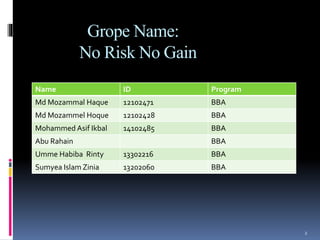
Grope Name:
No Risk No Gain
Name ID Program
Md Mozammal Haque 12102471 BBA
Md Mozammel Hoque 12102428 BBA
Mohammed Asif Ikbal 14102485 BBA
Abu Rahain BBA
Umme Habiba Rinty 13302216 BBA
Sumyea Islam Zinia 13202060 BBA
2
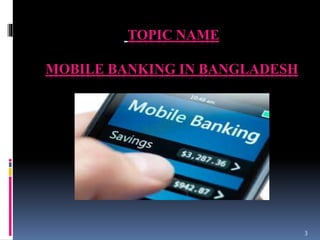
TOPIC NAME
MOBILE BANKING IN BANGLADESH
3
The aim of our presentation is to tell you the present
situation of mobile banking in Bangladesh
AIM
4
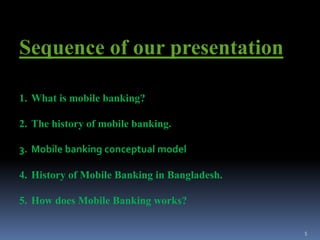
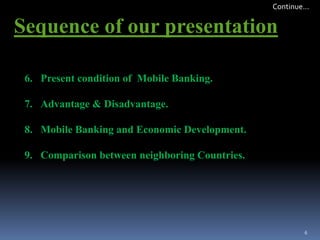
Sequence of our presentation
1. What is mobile banking?
2. The history of mobile banking.
3. Mobile banking conceptual model
4. History of Mobile Banking in Bangladesh.
5. How does Mobile Banking works?
5
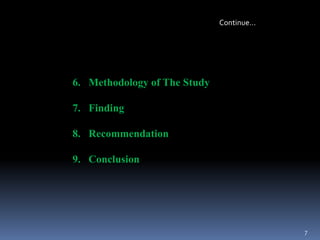
6. Present condition of Mobile Banking.
7. Advantage & Disadvantage.
8. Mobile Banking and Economic Development.
9. Comparison between neighboring Countries.
Sequence of our presentation
6
Continue…
6. Methodology of The Study
7. Finding
8. Recommendation
9. Conclusion
7
Continue…
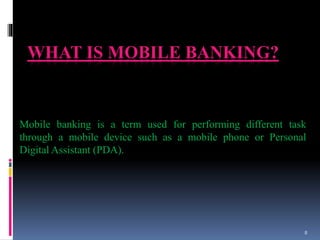
WHAT IS MOBILE BANKING?
Mobile banking is a term used for performing different task
through a mobile device such as a mobile phone or Personal
Digital Assistant (PDA).
8
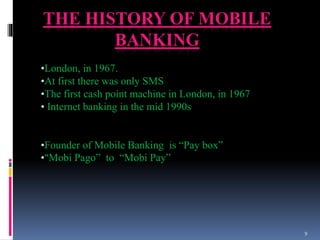
THE HISTORY OF MOBILE
BANKING
•London, in 1967.
•At first there was only SMS
•The first cash point machine in London, in 1967
• Internet banking in the mid 1990s
•Founder of Mobile Banking is “Pay box”
•“Mobi Pago” to “Mobi Pay”
9
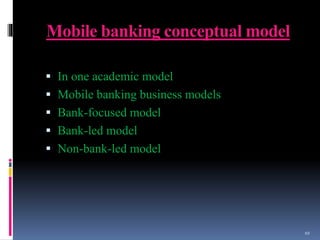
Mobile banking conceptual model
 In one academic model
 Mobile banking business models
 Bank-focused model
 Bank-led model
 Non-bank-led model
10
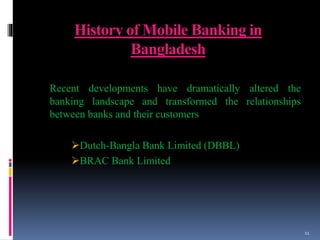
History of Mobile Banking in
Bangladesh
Recent developments have dramatically altered the
banking landscape and transformed the relationships
between banks and their customers
Dutch-Bangla Bank Limited (DBBL)
BRAC Bank Limited
11
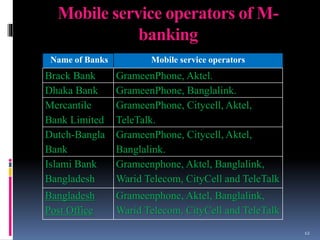
Mobile service operators of M-
banking
Name of Banks Mobile service operators
Brack Bank GrameenPhone, Aktel.
Dhaka Bank GrameenPhone, Banglalink.
Mercantile
Bank Limited
GrameenPhone, Citycell, Aktel,
TeleTalk.
Dutch-Bangla
Bank
GrameenPhone, Citycell, Aktel,
Banglalink.
Islami Bank
Bangladesh
Grameenphone, Aktel, Banglalink,
Warid Telecom, CityCell and TeleTalk
Bangladesh
Post Office
Grameenphone, Aktel, Banglalink,
Warid Telecom, CityCell and TeleTalk
12
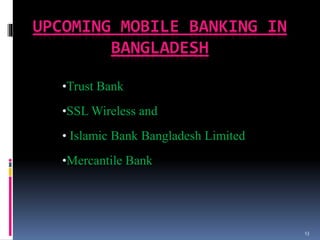
UPCOMING MOBILE BANKING IN
BANGLADESH
•Trust Bank
•SSL Wireless and
• Islamic Bank Bangladesh Limited
•Mercantile Bank
13
MOBILE BANKING SERVICES
1) Account Information:
2) Payment, Deposits, Withdrawals & Transfers:
3) Investments:
4) Support:
5) Content Services:
14
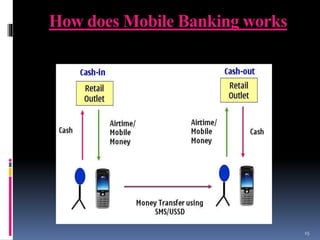
How does Mobile Banking works
15
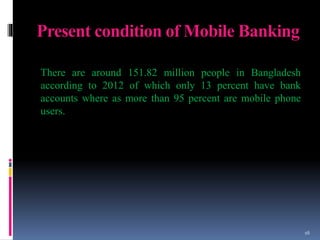
Present condition of Mobile Banking
There are around 151.82 million people in Bangladesh
according to 2012 of which only 13 percent have bank
accounts where as more than 95 percent are mobile phone
users.
16
17
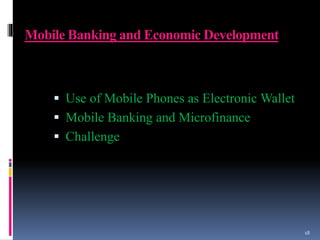
Mobile Banking and Economic Development
 Use of Mobile Phones as Electronic Wallet
 Mobile Banking and Microfinance
 Challenge
18
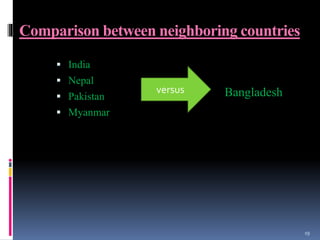
Comparison between neighboring countries
 India
 Nepal
 Pakistan
 Myanmar
Bangladeshversus
19
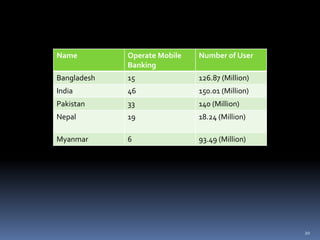
Name Operate Mobile
Banking
Number of User
Bangladesh 15 126.87 (Million)
India 46 150.01 (Million)
Pakistan 33 140 (Million)
Nepal 19 18.24 (Million)
Myanmar 6 93.49 (Million)
20
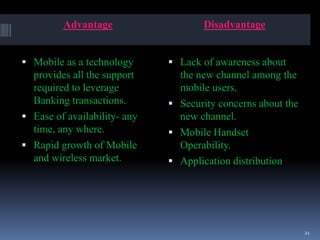
Advantage Disadvantage
 Mobile as a technology
provides all the support
required to leverage
Banking transactions.
 Ease of availability- any
time, any where.
 Rapid growth of Mobile
and wireless market.
 Lack of awareness about
the new channel among the
mobile users.
 Security concerns about the
new channel.
 Mobile Handset
Operability.
 Application distribution
21
Findings
 Most of the rural area people are the potential
customer of mobile banking.
 Mobile banking is not available on every device.
Some banks do not provide mobile banking at all.
 35% of m-banking customer are highly satisfied
with present m-banking service.
 Some village people do not trust mobile banking
as traditional banking system.
 Most people heard about it but not have a clear
idea
22
Recommendation
 Government must have to take adequate measures
to ensure the uninterrupted supply of raw
materials for M-Banking.
 To reduced M-Banking limitation all banks should
provide this opportunity.
 Government should easier the process to lunch
mobile banking service.
 User guide should be provided to all intended
customers.
 Banks should use all mobile service operators
available in Bangladesh.
 More services should be included in M- banking.
23
Methodology Of The Study
 All the data and information which is related to
my task was collected from secondary source.
 We used Microsoft Word and Microsoft
PowerPoint to prepare this presentation.
24
Conclusion
 More than three billion mobile phones are
currently in operation worldwide and fully 70%
of the total population of developing countries fall
within the coverage of existing cellular networks.
 As 99 percent of the people of Bangladesh are
under the mobile phone network, almost all will
have access to the formal financial channel.
 More than 7.5 crore people are using mobile
phones. If the banks can reach out to the un-
banked people, the dream of more people
having bank accounts can be fulfilled.
25
source
26
1. www.google.com
2. www.answer.com
3. www.bkash.com
4. www.dbbl.com.bd
5. The Daily star-Friday, July 22, 2011
6. http://www.thedailystar.net/newDesign/news-details.php?nid=195176
Dutch bangle bank ltd Mobile banking
7. http://www.dutchbanglabank.com/electronic_banking/mobile_bankin
g.html BRAC Bank mobile bank news.
8. Benamati, J. S., & Serva, M.A. (2007).Trust and distrust in online
banking:Their role in developing countries. InformationTechnology
for Development, 13(2), 161-175.
27
28

Mobile banking in bangladesh

  • 1.
    Welcome  To OurPresentation 1
  • 2.
    Grope Name: No RiskNo Gain Name ID Program Md Mozammal Haque 12102471 BBA Md Mozammel Hoque 12102428 BBA Mohammed Asif Ikbal 14102485 BBA Abu Rahain BBA Umme Habiba Rinty 13302216 BBA Sumyea Islam Zinia 13202060 BBA 2
  • 3.
  • 4.
    The aim ofour presentation is to tell you the present situation of mobile banking in Bangladesh AIM 4
  • 5.
    Sequence of ourpresentation 1. What is mobile banking? 2. The history of mobile banking. 3. Mobile banking conceptual model 4. History of Mobile Banking in Bangladesh. 5. How does Mobile Banking works? 5
  • 6.
    6. Present conditionof Mobile Banking. 7. Advantage & Disadvantage. 8. Mobile Banking and Economic Development. 9. Comparison between neighboring Countries. Sequence of our presentation 6 Continue…
  • 7.
    6. Methodology ofThe Study 7. Finding 8. Recommendation 9. Conclusion 7 Continue…
  • 8.
    WHAT IS MOBILEBANKING? Mobile banking is a term used for performing different task through a mobile device such as a mobile phone or Personal Digital Assistant (PDA). 8
  • 9.
    THE HISTORY OFMOBILE BANKING •London, in 1967. •At first there was only SMS •The first cash point machine in London, in 1967 • Internet banking in the mid 1990s •Founder of Mobile Banking is “Pay box” •“Mobi Pago” to “Mobi Pay” 9
  • 10.
    Mobile banking conceptualmodel  In one academic model  Mobile banking business models  Bank-focused model  Bank-led model  Non-bank-led model 10
  • 11.
    History of MobileBanking in Bangladesh Recent developments have dramatically altered the banking landscape and transformed the relationships between banks and their customers Dutch-Bangla Bank Limited (DBBL) BRAC Bank Limited 11
  • 12.
    Mobile service operatorsof M- banking Name of Banks Mobile service operators Brack Bank GrameenPhone, Aktel. Dhaka Bank GrameenPhone, Banglalink. Mercantile Bank Limited GrameenPhone, Citycell, Aktel, TeleTalk. Dutch-Bangla Bank GrameenPhone, Citycell, Aktel, Banglalink. Islami Bank Bangladesh Grameenphone, Aktel, Banglalink, Warid Telecom, CityCell and TeleTalk Bangladesh Post Office Grameenphone, Aktel, Banglalink, Warid Telecom, CityCell and TeleTalk 12
  • 13.
    UPCOMING MOBILE BANKINGIN BANGLADESH •Trust Bank •SSL Wireless and • Islamic Bank Bangladesh Limited •Mercantile Bank 13
  • 14.
    MOBILE BANKING SERVICES 1)Account Information: 2) Payment, Deposits, Withdrawals & Transfers: 3) Investments: 4) Support: 5) Content Services: 14
  • 15.
    How does MobileBanking works 15
  • 16.
    Present condition ofMobile Banking There are around 151.82 million people in Bangladesh according to 2012 of which only 13 percent have bank accounts where as more than 95 percent are mobile phone users. 16
  • 17.
  • 18.
    Mobile Banking andEconomic Development  Use of Mobile Phones as Electronic Wallet  Mobile Banking and Microfinance  Challenge 18
  • 19.
    Comparison between neighboringcountries  India  Nepal  Pakistan  Myanmar Bangladeshversus 19
  • 20.
    Name Operate Mobile Banking Numberof User Bangladesh 15 126.87 (Million) India 46 150.01 (Million) Pakistan 33 140 (Million) Nepal 19 18.24 (Million) Myanmar 6 93.49 (Million) 20
  • 21.
    Advantage Disadvantage  Mobileas a technology provides all the support required to leverage Banking transactions.  Ease of availability- any time, any where.  Rapid growth of Mobile and wireless market.  Lack of awareness about the new channel among the mobile users.  Security concerns about the new channel.  Mobile Handset Operability.  Application distribution 21
  • 22.
    Findings  Most ofthe rural area people are the potential customer of mobile banking.  Mobile banking is not available on every device. Some banks do not provide mobile banking at all.  35% of m-banking customer are highly satisfied with present m-banking service.  Some village people do not trust mobile banking as traditional banking system.  Most people heard about it but not have a clear idea 22
  • 23.
    Recommendation  Government musthave to take adequate measures to ensure the uninterrupted supply of raw materials for M-Banking.  To reduced M-Banking limitation all banks should provide this opportunity.  Government should easier the process to lunch mobile banking service.  User guide should be provided to all intended customers.  Banks should use all mobile service operators available in Bangladesh.  More services should be included in M- banking. 23
  • 24.
    Methodology Of TheStudy  All the data and information which is related to my task was collected from secondary source.  We used Microsoft Word and Microsoft PowerPoint to prepare this presentation. 24
  • 25.
    Conclusion  More thanthree billion mobile phones are currently in operation worldwide and fully 70% of the total population of developing countries fall within the coverage of existing cellular networks.  As 99 percent of the people of Bangladesh are under the mobile phone network, almost all will have access to the formal financial channel.  More than 7.5 crore people are using mobile phones. If the banks can reach out to the un- banked people, the dream of more people having bank accounts can be fulfilled. 25
  • 26.
    source 26 1. www.google.com 2. www.answer.com 3.www.bkash.com 4. www.dbbl.com.bd 5. The Daily star-Friday, July 22, 2011 6. http://www.thedailystar.net/newDesign/news-details.php?nid=195176 Dutch bangle bank ltd Mobile banking 7. http://www.dutchbanglabank.com/electronic_banking/mobile_bankin g.html BRAC Bank mobile bank news. 8. Benamati, J. S., & Serva, M.A. (2007).Trust and distrust in online banking:Their role in developing countries. InformationTechnology for Development, 13(2), 161-175.
  • 27.
  • 28.