mobile banking
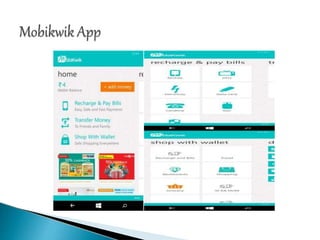
Mobile banking (also known as M-Banking, SMS Banking) is a term
used for performing balance checks, account transactions, payments,
credit applications and other banking transactions through a mobile
device such as a mobile phone or Personal DigitalAssistant (PDA).
Current Mobile BankingApplications:
◦ SMS Banking
◦ W
AP Banking
◦ STK (Sim Toolkit) Banking
 Online services started in New York in 1981 when four of the
city’s major banks (Citibank, Chase Manhattan, Chemical and
Manufacturers Hanover) offered home banking services using
the videotex system.
 May 1995: Wells Fargo – the first bank in the world offer
customer access to their accounts over the internet.
 The earliest mobile banking services were offered over SMS.
 With the introduction of the 1st primitive smart phones with WAP
support enabling the use of the mobile web in 1999, the first
European banks started to offer mobile banking.
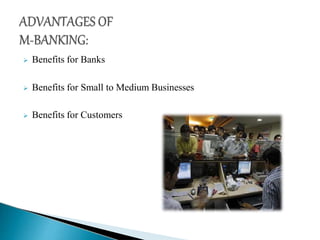
 Benefits for Banks
 Benefits for Small to Medium Businesses
 Benefits for Customers
 Large customer coverage
 Reducing the costs of operations
 Promoting their services and products internationally
 Increasing the customer satisfaction and providing a personalized
relationship with customers
 To run its operations more
effectively
 Lower cost than traditional
financial management
mechanisms
 Convenience
 Cost
 Speed
 Competitiveness
 Communication
 Environmental
 Others (offering one-stop-shop
solutions)
 Security
 Fraudulent Bank websites
 Ignorance
 Illiteracy
 Poor and/or lack of technological infrastructure and reliable
power supply
 Preference to paper money, as opposed to “virtual” cash in
transactions
Reserve Bank of India had set up the Mobile Payments Forum Of
India (MPFI), a ‘Working Group on Mobile Banking’ to examine different
aspects of Mobile Banking (M-banking). The Group had focused on three
major areas of M-banking, i.e.,
 Technology and security issues,
 Business issues and
 Regulatory and supervisory issues.
⦁ State Bank of India
⦁ Union Bank of India
⦁ PNB
⦁ ICICI
FreedoM, SMS Banking,
SMS Banking, UMobile
SMS Banking ,App based
iMobile, SMS Banking, M-PESA,
mRupee
SMS Banking,App Based
Phone Banking, Internet Banking on
Mobile, SMS banking.
⦁ HDFC
⦁ AXIS Bank
In this busy world computer and mobiles are playing
vital role. Every good thing has some bad corners.
Likewise Electronic and Mobile banking also have many
benefits and some drawbacks. It’s all based on the user.
If we use electronic and mobile banking properly then it
is very useful for the people. It is helpful to improve the
economy of the country.
h1SMEN7LeodZS7SN108.pptx

h1SMEN7LeodZS7SN108.pptx

  • 1.
  • 2.
    Mobile banking (alsoknown as M-Banking, SMS Banking) is a term used for performing balance checks, account transactions, payments, credit applications and other banking transactions through a mobile device such as a mobile phone or Personal DigitalAssistant (PDA). Current Mobile BankingApplications: ◦ SMS Banking ◦ W AP Banking ◦ STK (Sim Toolkit) Banking
  • 3.
     Online servicesstarted in New York in 1981 when four of the city’s major banks (Citibank, Chase Manhattan, Chemical and Manufacturers Hanover) offered home banking services using the videotex system.  May 1995: Wells Fargo – the first bank in the world offer customer access to their accounts over the internet.  The earliest mobile banking services were offered over SMS.  With the introduction of the 1st primitive smart phones with WAP support enabling the use of the mobile web in 1999, the first European banks started to offer mobile banking.
  • 4.
     Benefits forBanks  Benefits for Small to Medium Businesses  Benefits for Customers
  • 5.
     Large customercoverage  Reducing the costs of operations  Promoting their services and products internationally  Increasing the customer satisfaction and providing a personalized relationship with customers
  • 6.
     To runits operations more effectively  Lower cost than traditional financial management mechanisms
  • 7.
     Convenience  Cost Speed  Competitiveness  Communication  Environmental  Others (offering one-stop-shop solutions)
  • 8.
     Security  FraudulentBank websites  Ignorance  Illiteracy  Poor and/or lack of technological infrastructure and reliable power supply  Preference to paper money, as opposed to “virtual” cash in transactions
  • 9.
    Reserve Bank ofIndia had set up the Mobile Payments Forum Of India (MPFI), a ‘Working Group on Mobile Banking’ to examine different aspects of Mobile Banking (M-banking). The Group had focused on three major areas of M-banking, i.e.,  Technology and security issues,  Business issues and  Regulatory and supervisory issues.
  • 10.
    ⦁ State Bankof India ⦁ Union Bank of India ⦁ PNB ⦁ ICICI FreedoM, SMS Banking, SMS Banking, UMobile SMS Banking ,App based iMobile, SMS Banking, M-PESA, mRupee SMS Banking,App Based Phone Banking, Internet Banking on Mobile, SMS banking. ⦁ HDFC ⦁ AXIS Bank
  • 13.
    In this busyworld computer and mobiles are playing vital role. Every good thing has some bad corners. Likewise Electronic and Mobile banking also have many benefits and some drawbacks. It’s all based on the user. If we use electronic and mobile banking properly then it is very useful for the people. It is helpful to improve the economy of the country.