MOBILE APPLICATION
DEVELOPMENT
LECTURE – 4b
By: AbuBakar Ubaid
LAYOUTS
By: AbuBakar Ubaid
LINEARLAYOUT
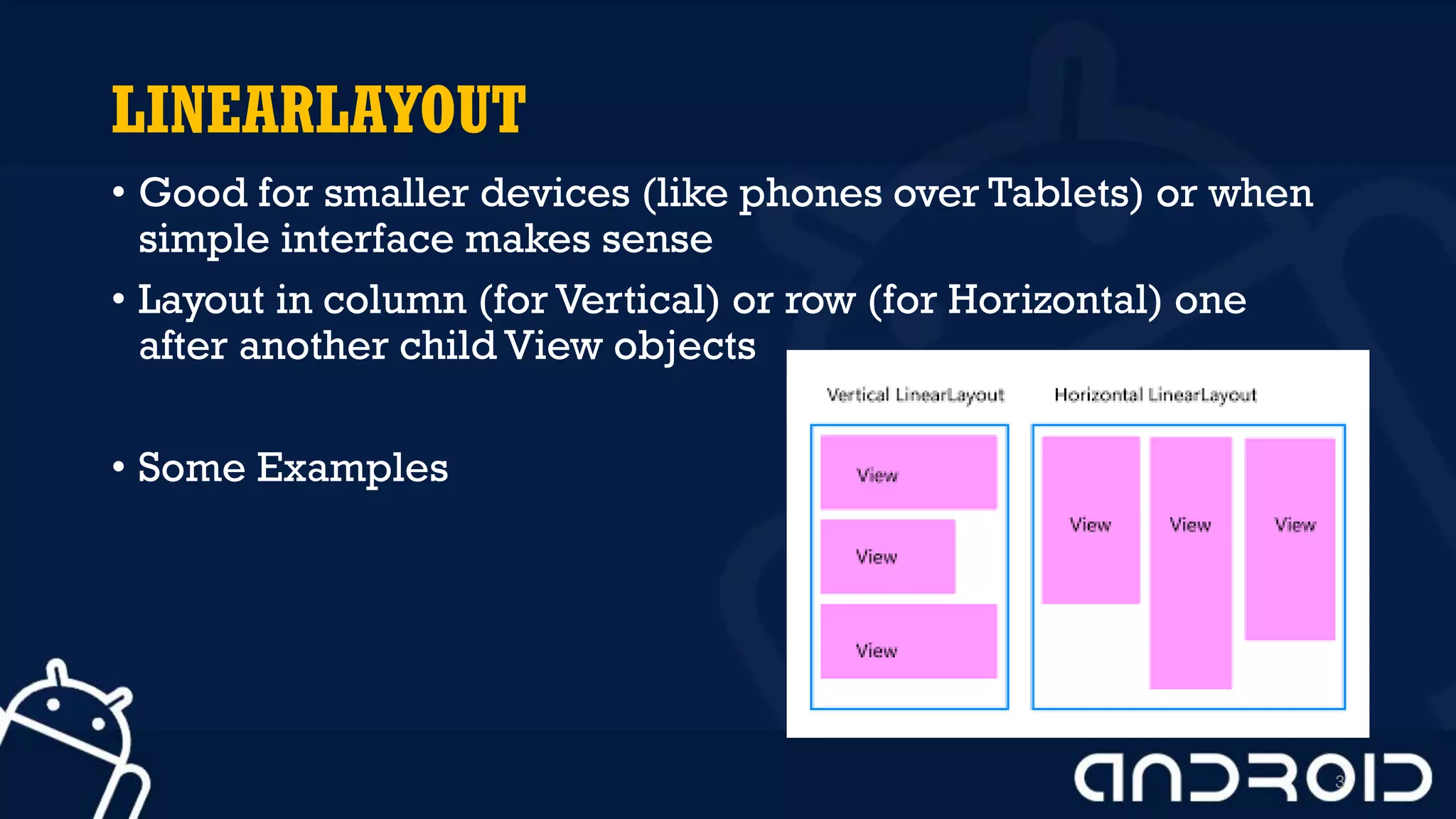
• Good for smaller devices (like phones over Tablets) or when
simple interface makes sense
• Layout in column (for Vertical) or row (for Horizontal) one
after another child View objects
• Some Examples
3
LINEARLAYOUT
Good:
• Simple
• Know exactly how it will look on every device
Bad:
• Well for many interfaces too simple….
BUT  see next slide
• BUT, REMEMBER you can have a ViewGroup (another Layout) inside
as a member of the LinearLayout to make a more COMPLEX interface
• ALSO can make more coplex
4
LinearLayout Very SIMPLE Example
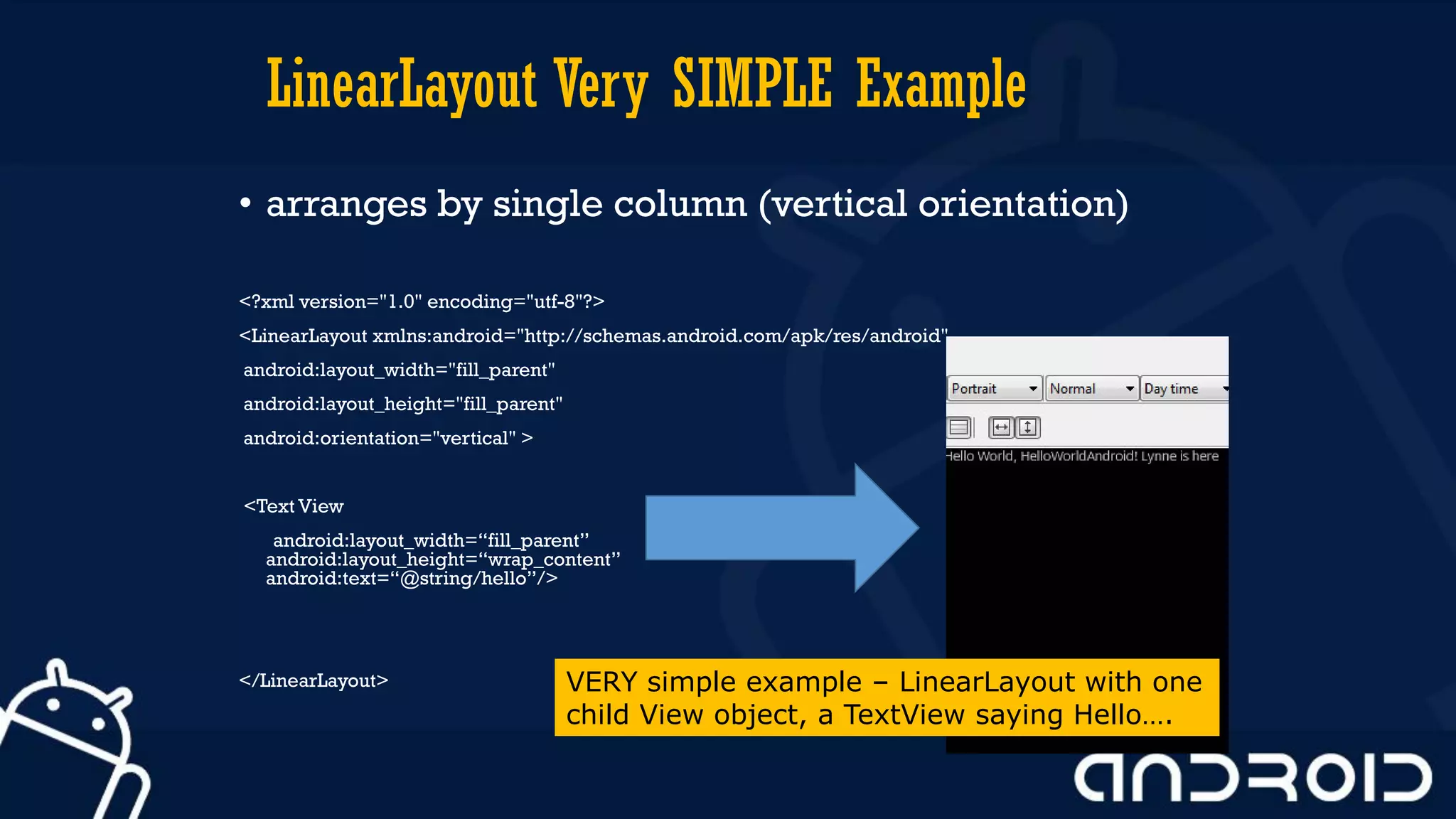
• arranges by single column (vertical orientation)
<?xml version="1.0" encoding="utf-8"?>
<LinearLayout xmlns:android="http://schemas.android.com/apk/res/android"
android:layout_width="fill_parent"
android:layout_height="fill_parent"
android:orientation="vertical" >
<Text View
android:layout_width=“fill_parent”
android:layout_height=“wrap_content”
android:text=“@string/hello”/>
</LinearLayout> VERY simple example – LinearLayout with one
child View object, a TextView saying Hello….
LinearLayout Example 2
<?xml version="1.0" encoding="utf-8"?>
<LinearLayout
xmlns:android="http://schemas.android.com/apk/res/android"
android:layout_width="fill_parent"
android:layout_height="fill_parent“
android:orientation="vertical" >
<Button android:id="@+id/btn_webbrowser"
android:layout_width="fill_parent"
android:layout_height="wrap_content"
android:text="Web Browser“
android:onClick="onClickWebBrowser" />
<Button android:id="@+id/btn_makecalls"
android:layout_width="fill_parent"
android:layout_height="wrap_content“
android:text="Make Calls"
android:onClick="onClickMakeCalls" />
<Button android:id="@+id/btn_showMap"
android:layout_width="fill_parent"
android:layout_height="wrap_content“
android:text="Show Map"
android:onClick="onClickShowMap" />
<Button android:id="@+id/btn_launchMyBrowser"
android:layout_width="fill_parent"
android:layout_height="wrap_content"
android:text="Launch My Browser"
android:onClick="onClickLaunchMyBrowser" />
</LinearLayout>
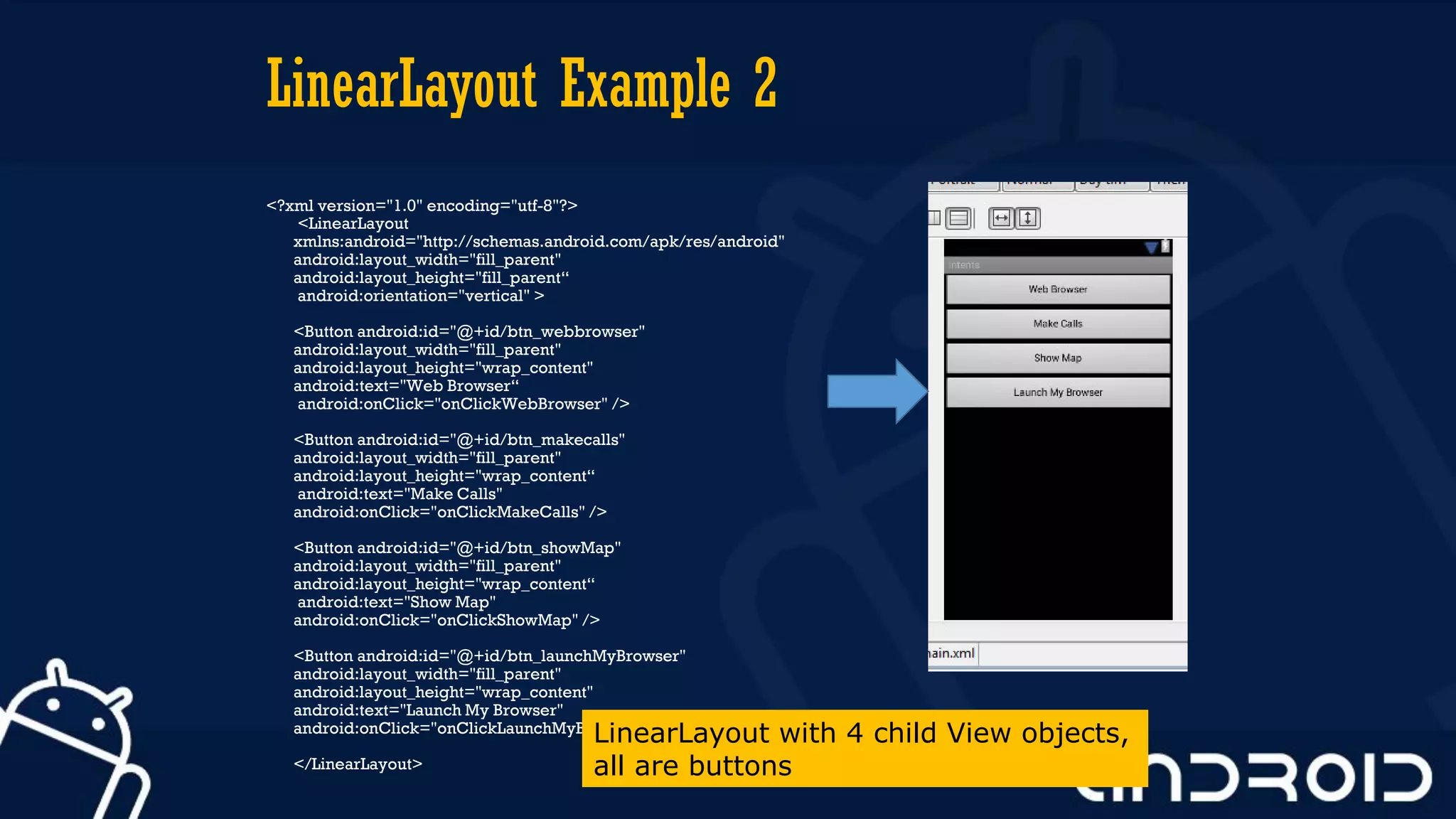
LinearLayout with 4 child View objects,
all are buttons
LinearLayout attributes
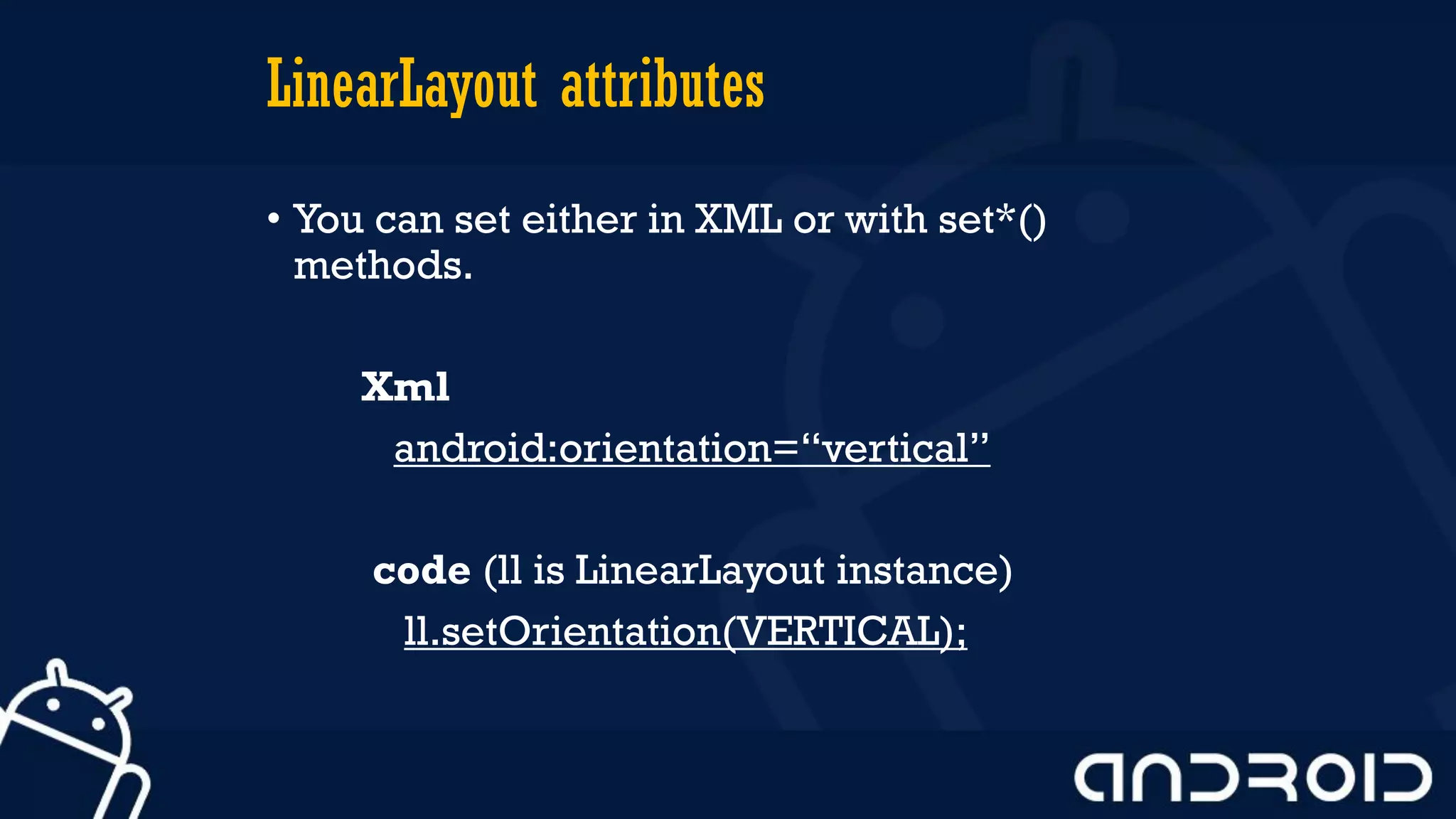
• You can set either in XML or with set*()
methods.
Xml
android:orientation=“vertical”
code (ll is LinearLayout instance)
ll.setOrientation(VERTICAL);
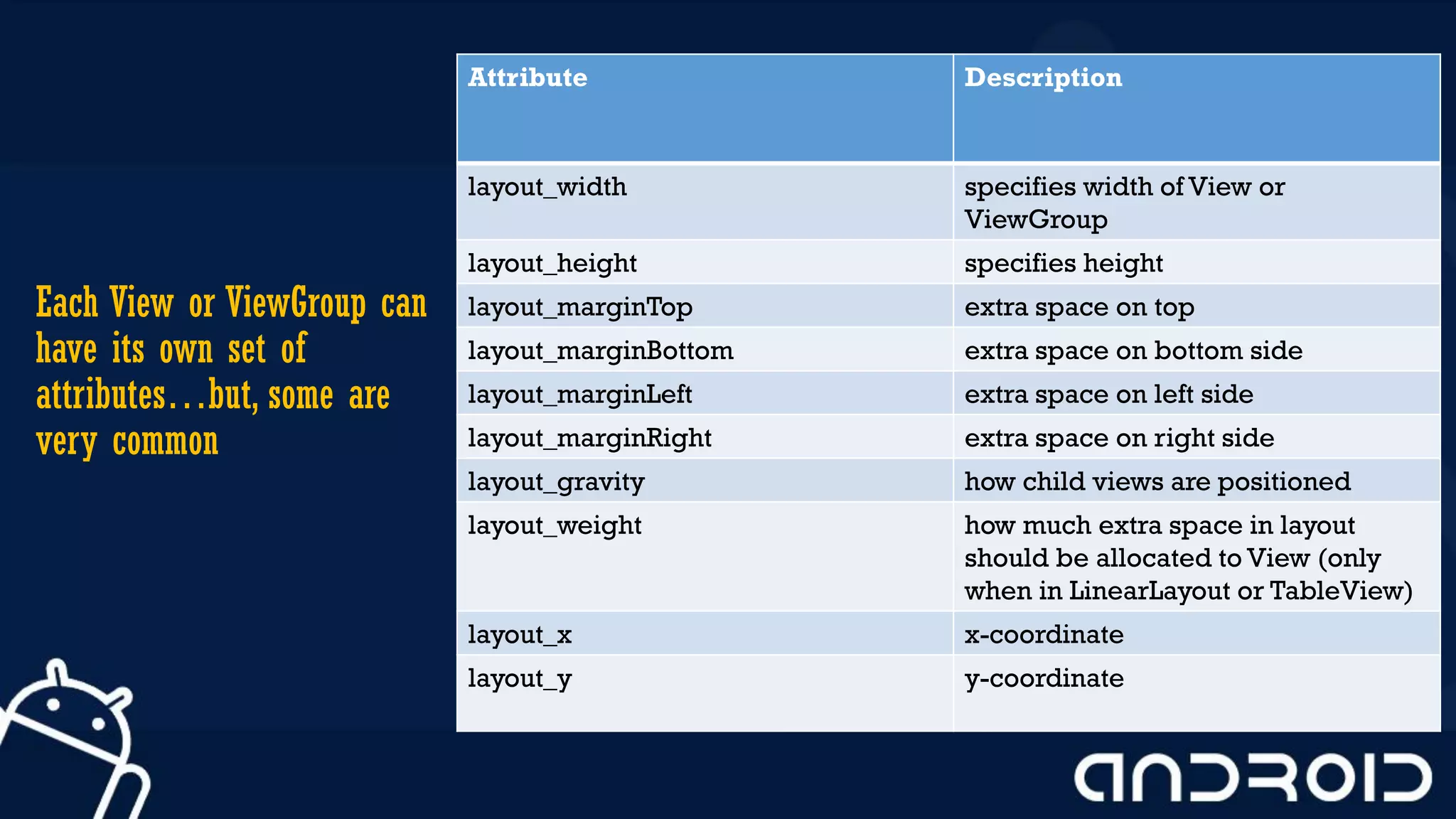
Each View or ViewGroup can
have its own set of
attributes…but, some are
very common
Attribute Description
layout_width specifies width of View or
ViewGroup
layout_height specifies height
layout_marginTop extra space on top
layout_marginBottom extra space on bottom side
layout_marginLeft extra space on left side
layout_marginRight extra space on right side
layout_gravity how child views are positioned
layout_weight how much extra space in layout
should be allocated to View (only
when in LinearLayout or TableView)
layout_x x-coordinate
layout_y y-coordinate
Another Option to get Complexity What
about Other Layouts
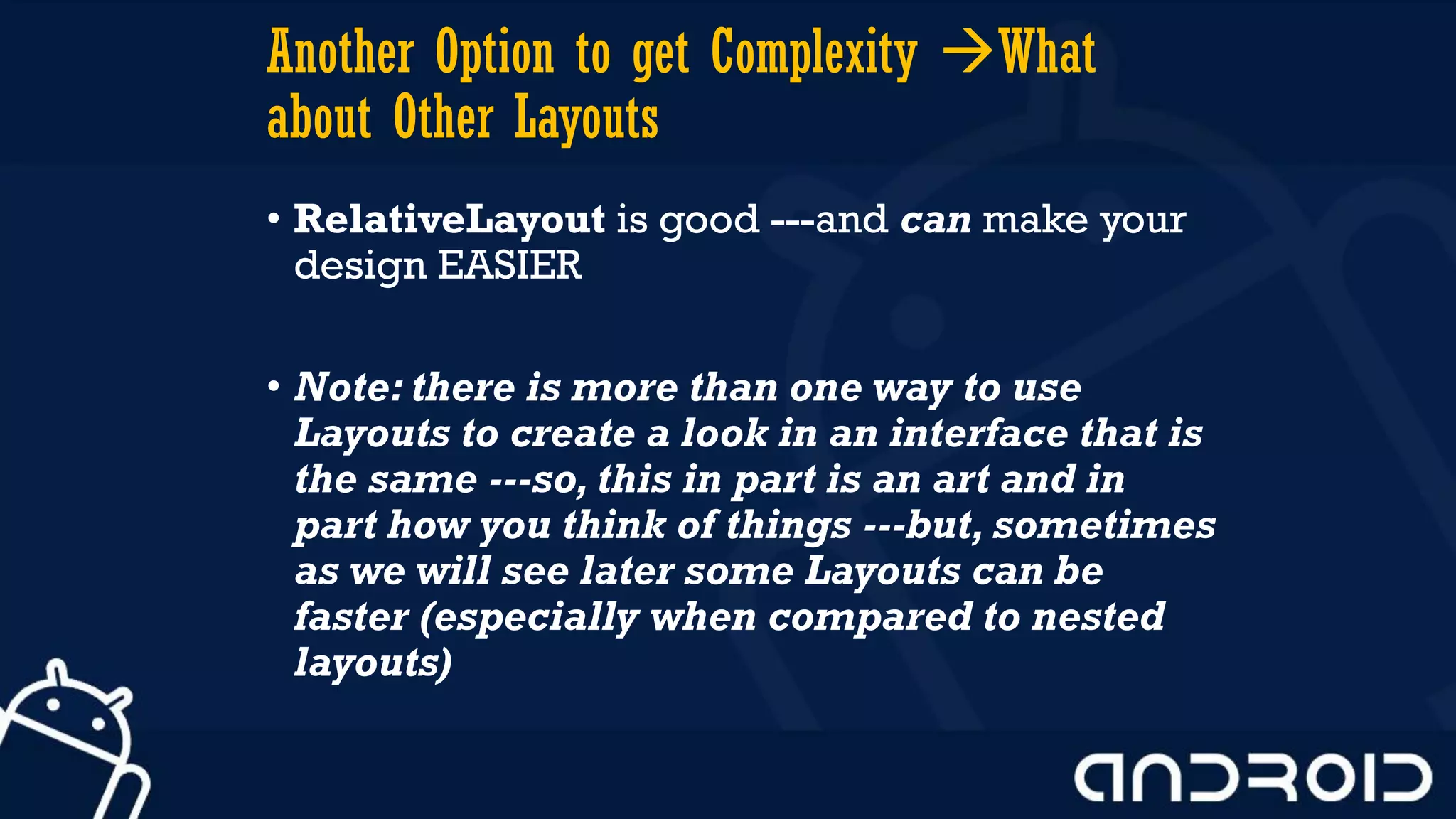
• RelativeLayout is good ---and can make your
design EASIER
• Note: there is more than one way to use
Layouts to create a look in an interface that is
the same ---so, this in part is an art and in
part how you think of things ---but, sometimes
as we will see later some Layouts can be
faster (especially when compared to nested
layouts)
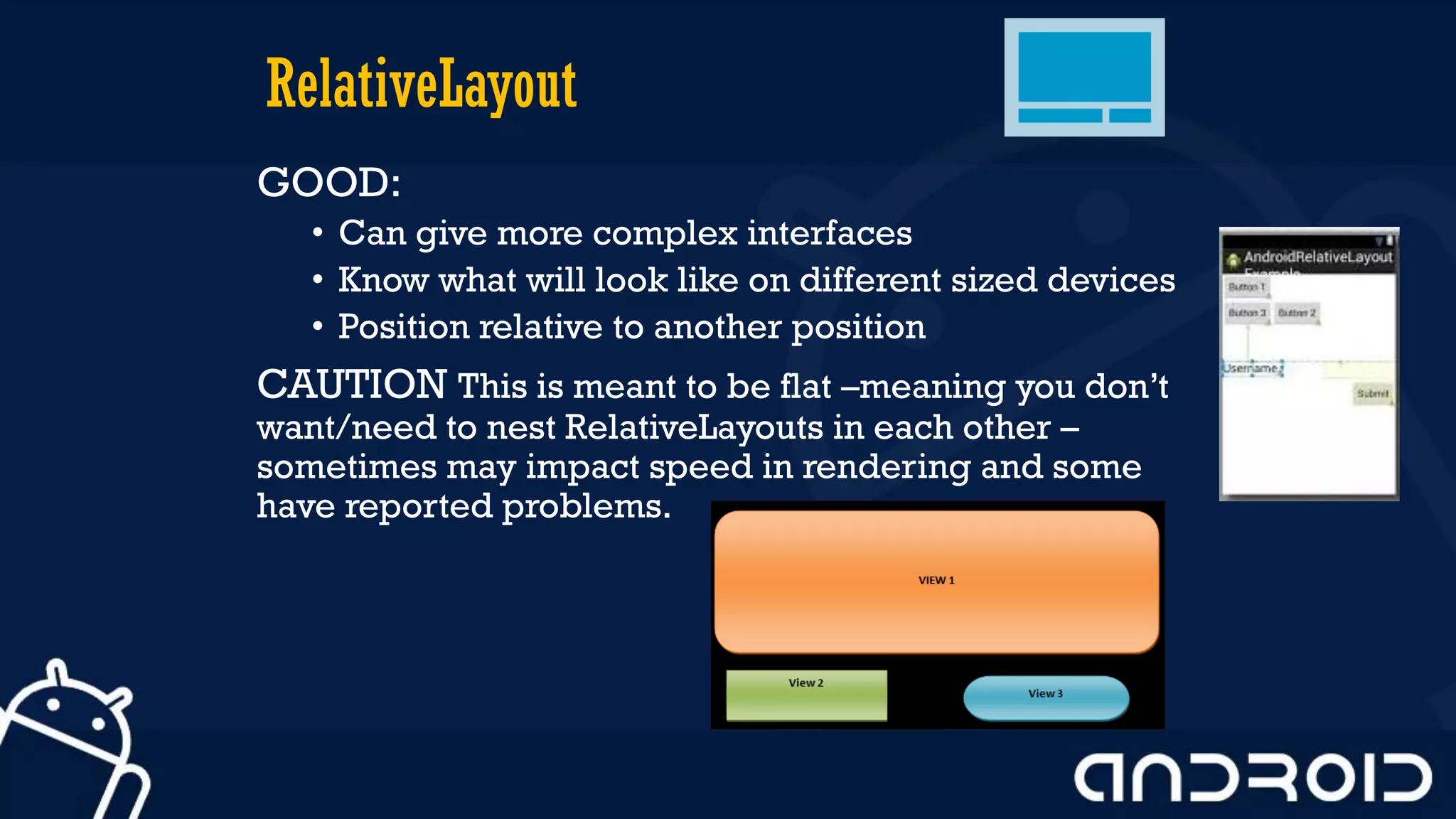
RelativeLayout
GOOD:
• Can give more complex interfaces
• Know what will look like on different sized devices
• Position relative to another position
CAUTION This is meant to be flat –meaning you don’t
want/need to nest RelativeLayouts in each other –
sometimes may impact speed in rendering and some
have reported problems.
RelativeLayout – how it works
Parameters in XML (or can map to method calls in Java
RelativeLayout class)
• Position relative to Parent
android:layout_alignParentTop,
android:layout_alignParentBottom,
android:layout_alignParentLeft, android:layout_alignParentRight
VALUE = ‘true’ ---If "true", moves to that edge of Parent
android:layout_centerVertical
VALUE= “true” -- If "true", centers this child vertically within its
parent.
• Position relative to another widget
android:layout_below, android:layout_above,
android:layout_toLeftOf, android:layout_toRightOf
VALUE=“resource ID of other widget” -- Positions the top edge
of this view below/aboveof the view specified with a resource ID.
OR Positions the left edge of this view to the left/right of the
view specified with a resource ID.
RelativeLayout – how it works
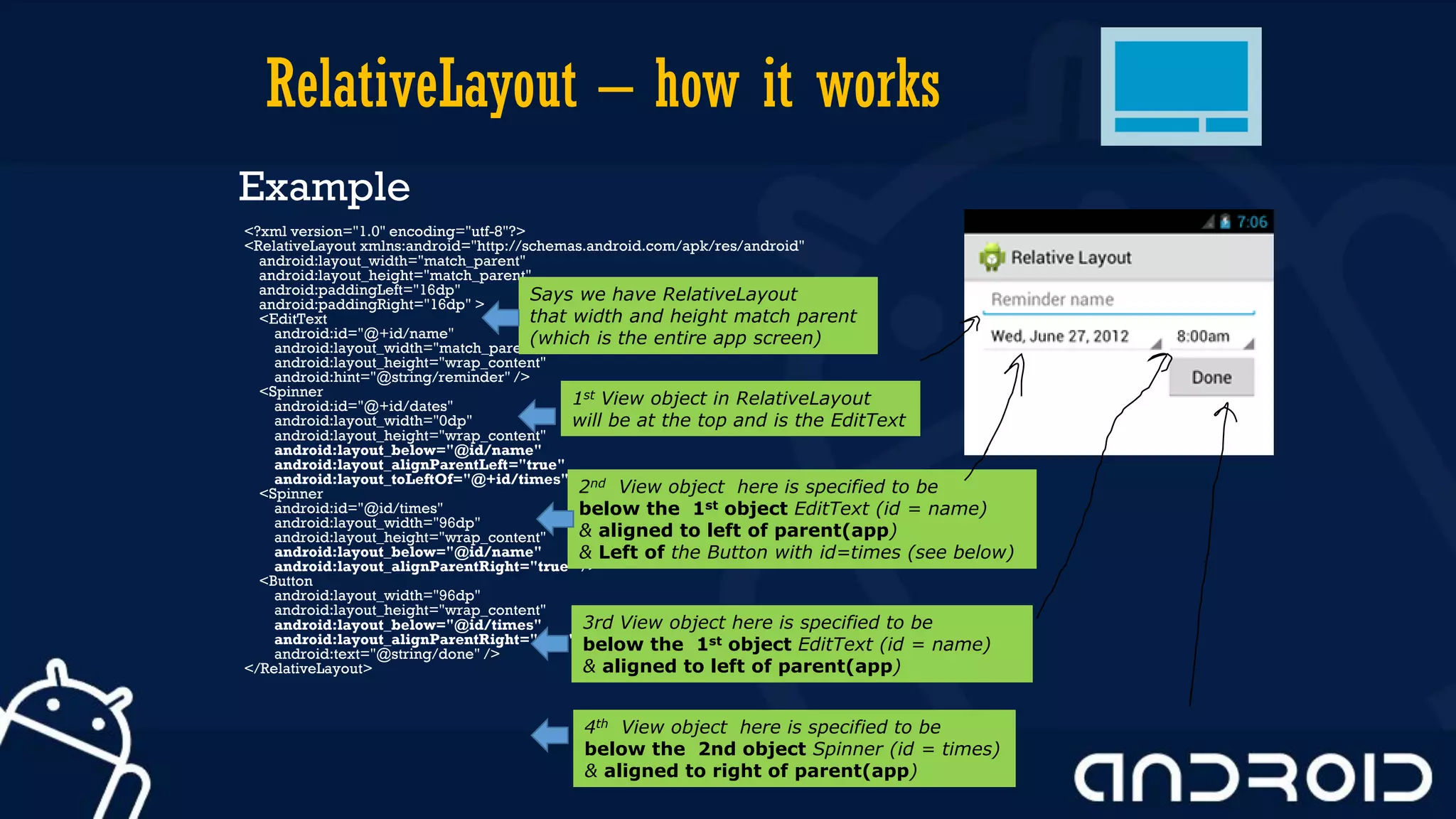
Example
<?xml version="1.0" encoding="utf-8"?>
<RelativeLayout xmlns:android="http://schemas.android.com/apk/res/android"
android:layout_width="match_parent"
android:layout_height="match_parent"
android:paddingLeft="16dp"
android:paddingRight="16dp" >
<EditText
android:id="@+id/name"
android:layout_width="match_parent"
android:layout_height="wrap_content"
android:hint="@string/reminder" />
<Spinner
android:id="@+id/dates"
android:layout_width="0dp"
android:layout_height="wrap_content"
android:layout_below="@id/name"
android:layout_alignParentLeft="true"
android:layout_toLeftOf="@+id/times" />
<Spinner
android:id="@id/times"
android:layout_width="96dp"
android:layout_height="wrap_content"
android:layout_below="@id/name"
android:layout_alignParentRight="true" />
<Button
android:layout_width="96dp"
android:layout_height="wrap_content"
android:layout_below="@id/times"
android:layout_alignParentRight="true"
android:text="@string/done" />
</RelativeLayout>
Says we have RelativeLayout
that width and height match parent
(which is the entire app screen)
1st View object in RelativeLayout
will be at the top and is the EditText
2nd View object here is specified to be
below the 1st object EditText (id = name)
& aligned to left of parent(app)
& Left of the Button with id=times (see below)
3rd View object here is specified to be
below the 1st object EditText (id = name)
& aligned to left of parent(app)
4th View object here is specified to be
below the 2nd object Spinner (id = times)
& aligned to right of parent(app)
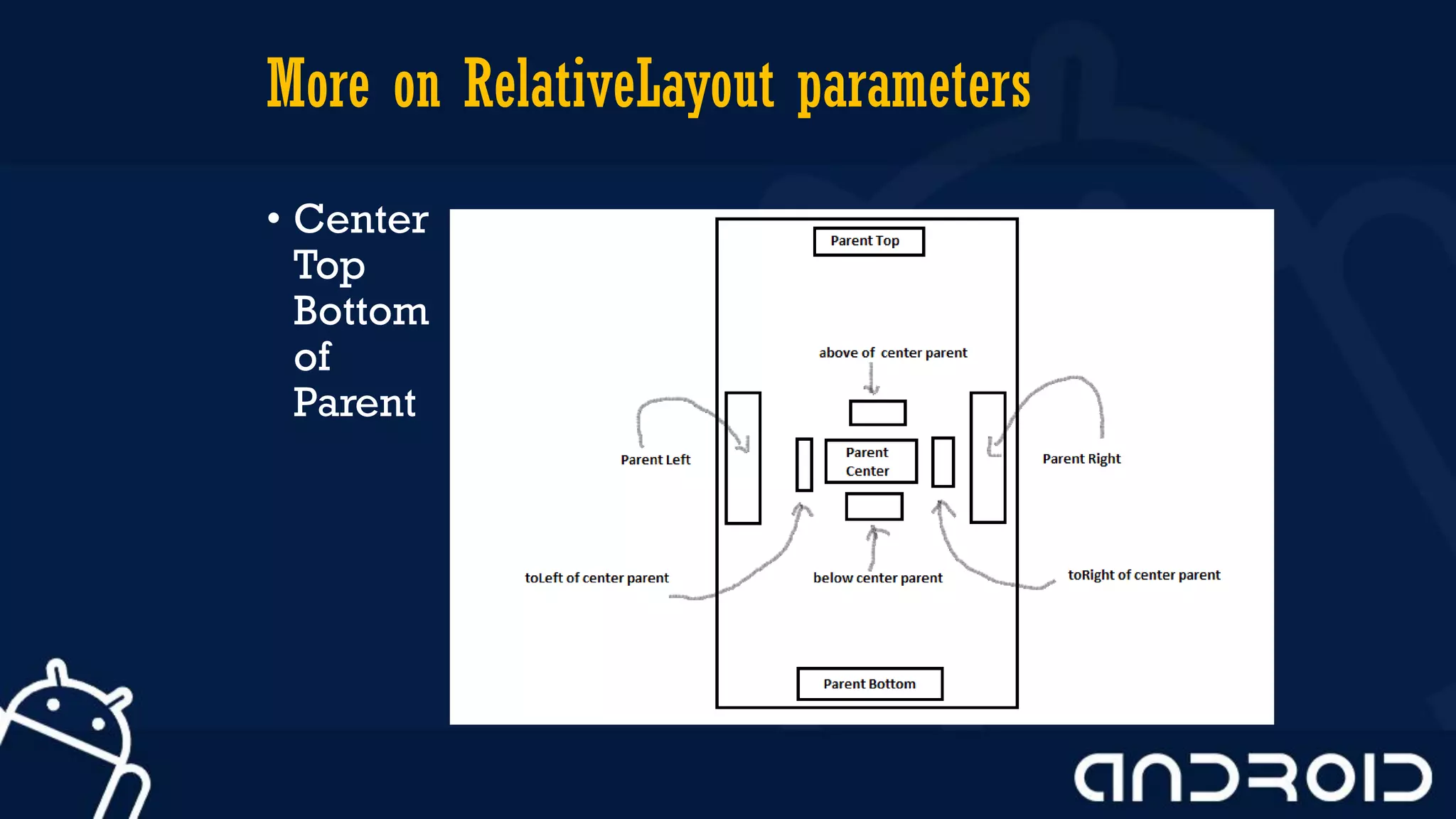
More on RelativeLayout parameters
• Center
Top
Bottom
of
Parent
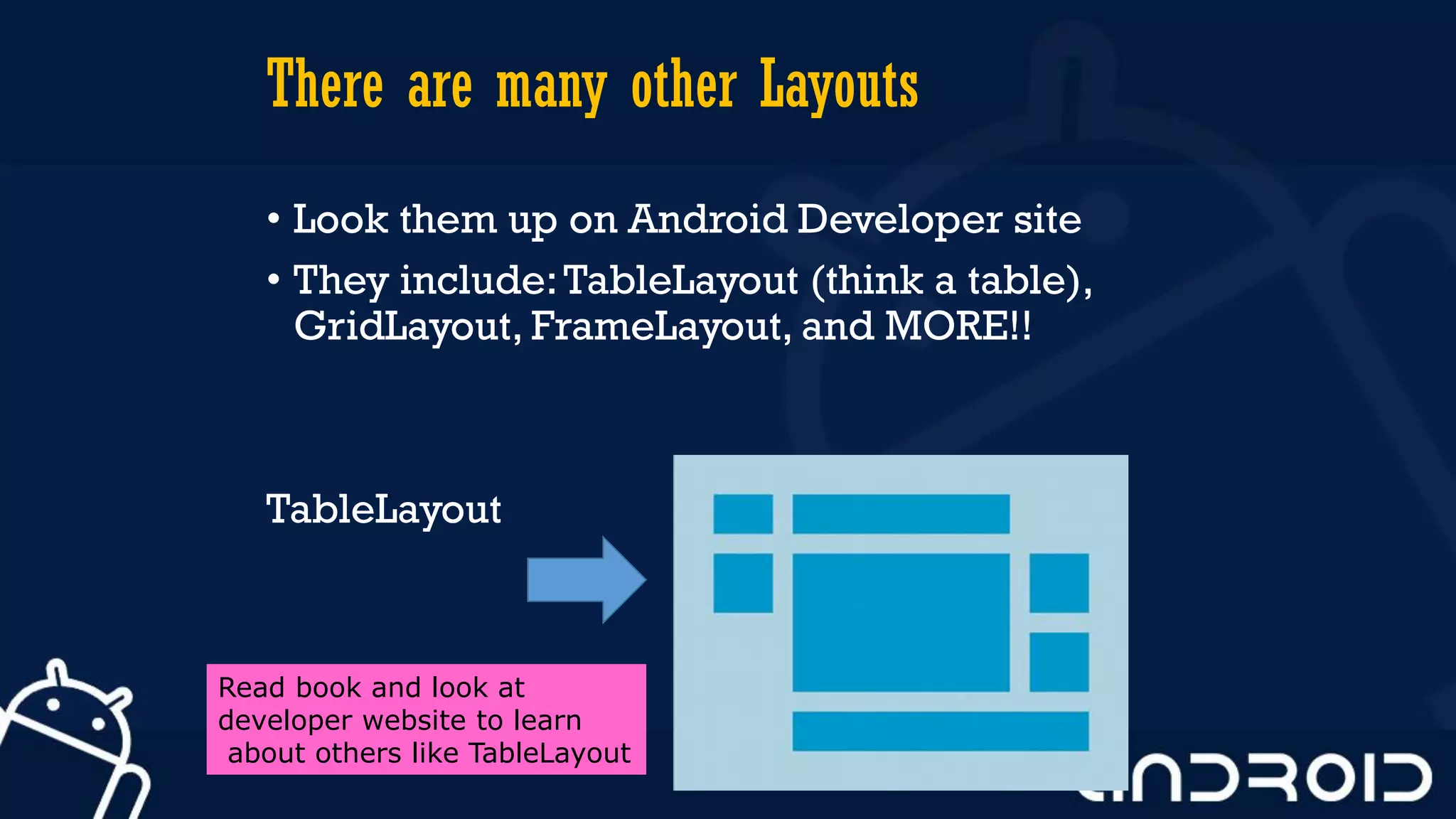
There are many other Layouts
• Look them up on Android Developer site
• They include:TableLayout (think a table),
GridLayout, FrameLayout, and MORE!!
TableLayout
Read book and look at
developer website to learn
about others like TableLayout
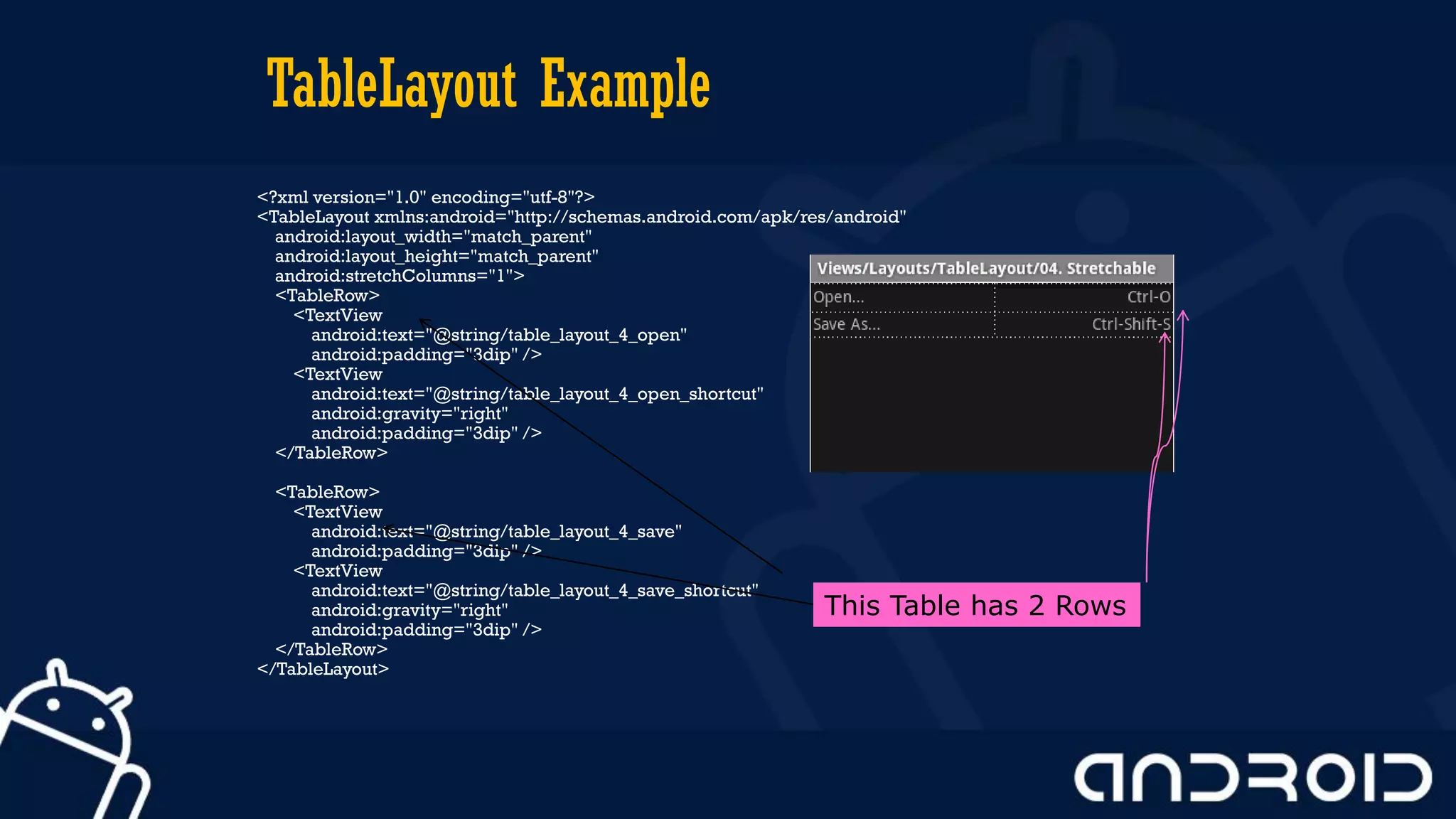
TableLayout Example
<?xml version="1.0" encoding="utf-8"?>
<TableLayout xmlns:android="http://schemas.android.com/apk/res/android"
android:layout_width="match_parent"
android:layout_height="match_parent"
android:stretchColumns="1">
<TableRow>
<TextView
android:text="@string/table_layout_4_open"
android:padding="3dip" />
<TextView
android:text="@string/table_layout_4_open_shortcut"
android:gravity="right"
android:padding="3dip" />
</TableRow>
<TableRow>
<TextView
android:text="@string/table_layout_4_save"
android:padding="3dip" />
<TextView
android:text="@string/table_layout_4_save_shortcut"
android:gravity="right"
android:padding="3dip" />
</TableRow>
</TableLayout>
This Table has 2 Rows
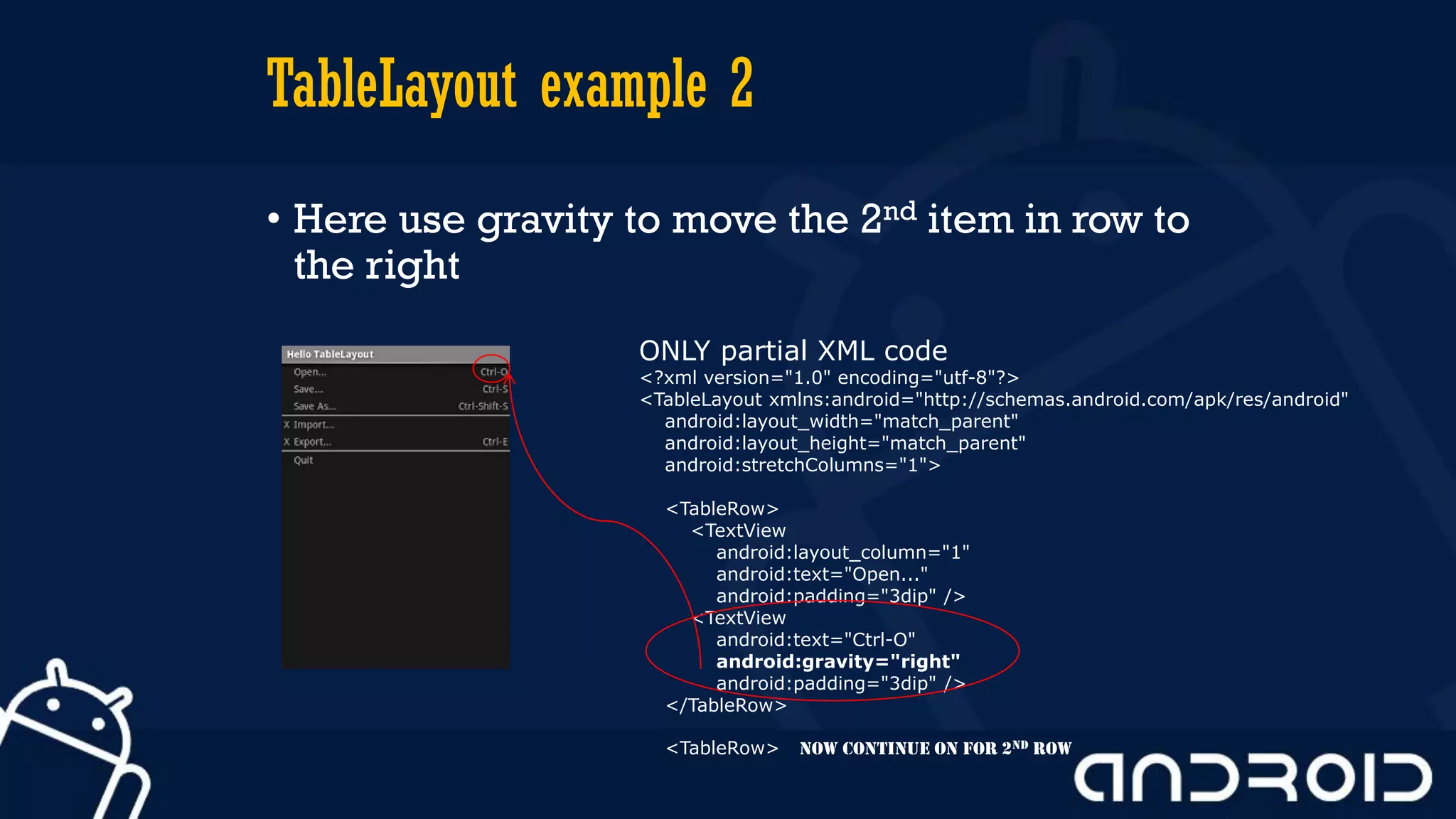
TableLayout example 2
• Here use gravity to move the 2nd item in row to
the right
ONLY partial XML code
<?xml version="1.0" encoding="utf-8"?>
<TableLayout xmlns:android="http://schemas.android.com/apk/res/android"
android:layout_width="match_parent"
android:layout_height="match_parent"
android:stretchColumns="1">
<TableRow>
<TextView
android:layout_column="1"
android:text="Open..."
android:padding="3dip" />
<TextView
android:text="Ctrl-O"
android:gravity="right"
android:padding="3dip" />
</TableRow>
<TableRow> NOW CONTINUE ON FOR 2nd row
THANK YOU 
LECTURE – 4b “Layouts”
By: AbuBakar Ubaid

MOBILE APPLICATION DEVELOPMENT

  • 1.
  • 2.
  • 3.
    LINEARLAYOUT • Good forsmaller devices (like phones over Tablets) or when simple interface makes sense • Layout in column (for Vertical) or row (for Horizontal) one after another child View objects • Some Examples 3
  • 4.
    LINEARLAYOUT Good: • Simple • Knowexactly how it will look on every device Bad: • Well for many interfaces too simple…. BUT  see next slide • BUT, REMEMBER you can have a ViewGroup (another Layout) inside as a member of the LinearLayout to make a more COMPLEX interface • ALSO can make more coplex 4
  • 5.
    LinearLayout Very SIMPLEExample • arranges by single column (vertical orientation) <?xml version="1.0" encoding="utf-8"?> <LinearLayout xmlns:android="http://schemas.android.com/apk/res/android" android:layout_width="fill_parent" android:layout_height="fill_parent" android:orientation="vertical" > <Text View android:layout_width=“fill_parent” android:layout_height=“wrap_content” android:text=“@string/hello”/> </LinearLayout> VERY simple example – LinearLayout with one child View object, a TextView saying Hello….
  • 6.
    LinearLayout Example 2 <?xmlversion="1.0" encoding="utf-8"?> <LinearLayout xmlns:android="http://schemas.android.com/apk/res/android" android:layout_width="fill_parent" android:layout_height="fill_parent“ android:orientation="vertical" > <Button android:id="@+id/btn_webbrowser" android:layout_width="fill_parent" android:layout_height="wrap_content" android:text="Web Browser“ android:onClick="onClickWebBrowser" /> <Button android:id="@+id/btn_makecalls" android:layout_width="fill_parent" android:layout_height="wrap_content“ android:text="Make Calls" android:onClick="onClickMakeCalls" /> <Button android:id="@+id/btn_showMap" android:layout_width="fill_parent" android:layout_height="wrap_content“ android:text="Show Map" android:onClick="onClickShowMap" /> <Button android:id="@+id/btn_launchMyBrowser" android:layout_width="fill_parent" android:layout_height="wrap_content" android:text="Launch My Browser" android:onClick="onClickLaunchMyBrowser" /> </LinearLayout> LinearLayout with 4 child View objects, all are buttons
  • 7.
    LinearLayout attributes • Youcan set either in XML or with set*() methods. Xml android:orientation=“vertical” code (ll is LinearLayout instance) ll.setOrientation(VERTICAL);
  • 8.
    Each View orViewGroup can have its own set of attributes…but, some are very common Attribute Description layout_width specifies width of View or ViewGroup layout_height specifies height layout_marginTop extra space on top layout_marginBottom extra space on bottom side layout_marginLeft extra space on left side layout_marginRight extra space on right side layout_gravity how child views are positioned layout_weight how much extra space in layout should be allocated to View (only when in LinearLayout or TableView) layout_x x-coordinate layout_y y-coordinate
  • 9.
    Another Option toget Complexity What about Other Layouts • RelativeLayout is good ---and can make your design EASIER • Note: there is more than one way to use Layouts to create a look in an interface that is the same ---so, this in part is an art and in part how you think of things ---but, sometimes as we will see later some Layouts can be faster (especially when compared to nested layouts)
  • 10.
    RelativeLayout GOOD: • Can givemore complex interfaces • Know what will look like on different sized devices • Position relative to another position CAUTION This is meant to be flat –meaning you don’t want/need to nest RelativeLayouts in each other – sometimes may impact speed in rendering and some have reported problems.
  • 11.
    RelativeLayout – howit works Parameters in XML (or can map to method calls in Java RelativeLayout class) • Position relative to Parent android:layout_alignParentTop, android:layout_alignParentBottom, android:layout_alignParentLeft, android:layout_alignParentRight VALUE = ‘true’ ---If "true", moves to that edge of Parent android:layout_centerVertical VALUE= “true” -- If "true", centers this child vertically within its parent. • Position relative to another widget android:layout_below, android:layout_above, android:layout_toLeftOf, android:layout_toRightOf VALUE=“resource ID of other widget” -- Positions the top edge of this view below/aboveof the view specified with a resource ID. OR Positions the left edge of this view to the left/right of the view specified with a resource ID.
  • 12.
    RelativeLayout – howit works Example <?xml version="1.0" encoding="utf-8"?> <RelativeLayout xmlns:android="http://schemas.android.com/apk/res/android" android:layout_width="match_parent" android:layout_height="match_parent" android:paddingLeft="16dp" android:paddingRight="16dp" > <EditText android:id="@+id/name" android:layout_width="match_parent" android:layout_height="wrap_content" android:hint="@string/reminder" /> <Spinner android:id="@+id/dates" android:layout_width="0dp" android:layout_height="wrap_content" android:layout_below="@id/name" android:layout_alignParentLeft="true" android:layout_toLeftOf="@+id/times" /> <Spinner android:id="@id/times" android:layout_width="96dp" android:layout_height="wrap_content" android:layout_below="@id/name" android:layout_alignParentRight="true" /> <Button android:layout_width="96dp" android:layout_height="wrap_content" android:layout_below="@id/times" android:layout_alignParentRight="true" android:text="@string/done" /> </RelativeLayout> Says we have RelativeLayout that width and height match parent (which is the entire app screen) 1st View object in RelativeLayout will be at the top and is the EditText 2nd View object here is specified to be below the 1st object EditText (id = name) & aligned to left of parent(app) & Left of the Button with id=times (see below) 3rd View object here is specified to be below the 1st object EditText (id = name) & aligned to left of parent(app) 4th View object here is specified to be below the 2nd object Spinner (id = times) & aligned to right of parent(app)
  • 13.
    More on RelativeLayoutparameters • Center Top Bottom of Parent
  • 14.
    There are manyother Layouts • Look them up on Android Developer site • They include:TableLayout (think a table), GridLayout, FrameLayout, and MORE!! TableLayout Read book and look at developer website to learn about others like TableLayout
  • 15.
    TableLayout Example <?xml version="1.0"encoding="utf-8"?> <TableLayout xmlns:android="http://schemas.android.com/apk/res/android" android:layout_width="match_parent" android:layout_height="match_parent" android:stretchColumns="1"> <TableRow> <TextView android:text="@string/table_layout_4_open" android:padding="3dip" /> <TextView android:text="@string/table_layout_4_open_shortcut" android:gravity="right" android:padding="3dip" /> </TableRow> <TableRow> <TextView android:text="@string/table_layout_4_save" android:padding="3dip" /> <TextView android:text="@string/table_layout_4_save_shortcut" android:gravity="right" android:padding="3dip" /> </TableRow> </TableLayout> This Table has 2 Rows
  • 16.
    TableLayout example 2 •Here use gravity to move the 2nd item in row to the right ONLY partial XML code <?xml version="1.0" encoding="utf-8"?> <TableLayout xmlns:android="http://schemas.android.com/apk/res/android" android:layout_width="match_parent" android:layout_height="match_parent" android:stretchColumns="1"> <TableRow> <TextView android:layout_column="1" android:text="Open..." android:padding="3dip" /> <TextView android:text="Ctrl-O" android:gravity="right" android:padding="3dip" /> </TableRow> <TableRow> NOW CONTINUE ON FOR 2nd row
  • 17.
    THANK YOU  LECTURE– 4b “Layouts” By: AbuBakar Ubaid