IMPLEMENTING DHCP Chapter 1
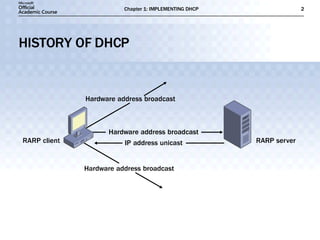
HISTORY OF DHCP
THE ROLE OF DHCP Dynamically assigns TCP/IP addresses Dynamically assigns TCP/IP configuration information Simplifies network administration
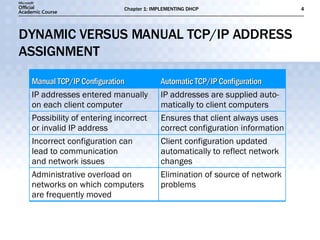
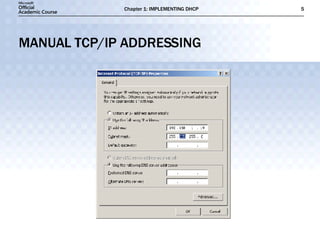
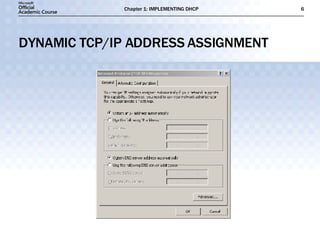
DYNAMIC VERSUS MANUAL TCP/IP ADDRESS ASSIGNMENT M M a a n n u u a a l l T T C C P P / / I I P P C C o o n n f f i i g g u u r r a a t t i i o o n n A A u u t t o o m m a a t t i i c c T T C C P P / / I I P P C C o o n n f f i i g g u u r r a a t t i i o o n n IP addresses entered manually on each client computer IP addresses are supplied auto- matically to client computers Possibility of entering incorrect or invalid IP address Ensures that client always uses correct configuration information Incorrect configuration can lead to communication and network issues Client configuration updated automatically to reflect network changes Administrative overload on networks on which computers are frequently moved Elimination of source of network problems
MANUAL TCP/IP ADDRESSING
DYNAMIC TCP/IP ADDRESS ASSIGNMENT
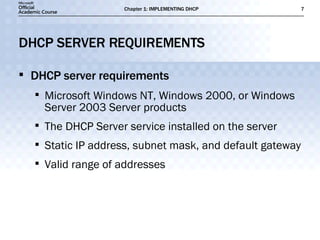
DHCP SERVER REQUIREMENTS DHCP server requirements Microsoft Windows NT, Windows 2000, or Windows Server 2003 Server products The DHCP Server service installed on the server Static IP address, subnet mask, and default gateway Valid range of addresses
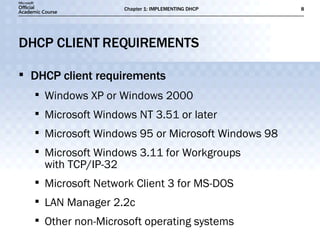
DHCP CLIENT REQUIREMENTS DHCP client requirements Windows XP or Windows 2000 Microsoft Windows NT 3.51 or later Microsoft Windows 95 or Microsoft Windows 98 Microsoft Windows 3.11 for Workgroups  with TCP/IP-32 Microsoft Network Client 3 for MS-DOS LAN Manager 2.2c Other non-Microsoft operating systems
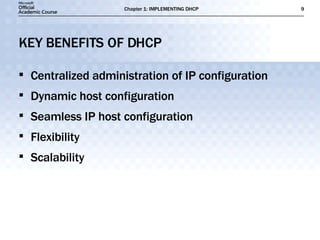
KEY BENEFITS OF DHCP Centralized administration of IP configuration Dynamic host configuration Seamless IP host configuration Flexibility Scalability
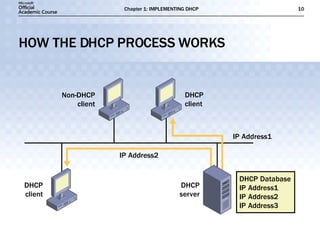
HOW THE DHCP PROCESS WORKS
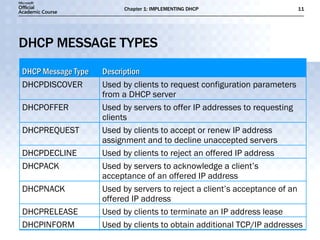
DHCP MESSAGE TYPES Used by clients to obtain additional TCP/IP addresses D D H H C C P P M M e e s s s s a a g g e e T T y y p p e e D D e e s s c c r r i i p p t t i i o o n n DHCPDISCOVER Used by clients to request configuration parameters from a DHCP server DHCPOFFER Used by servers to offer IP addresses to requesting clients DHCPREQUEST Used by clients to accept or renew IP address assignment and to decline unaccepted servers DHCPDECLINE Used by clients to reject an offered IP address DHCPACK Used by servers to acknowledge a client’s acceptance of an offered IP address DHCPNACK Used by servers to reject a client’s acceptance of an offered IP address DHCPRELEASE Used by clients to terminate an IP address lease DHCPINFORM
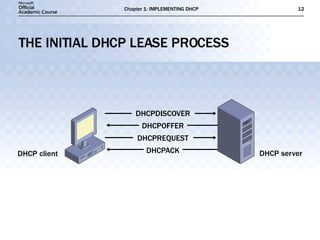
THE INITIAL DHCP LEASE PROCESS
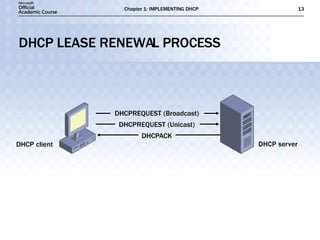
DHCP LEASE RENEWAL PROCESS
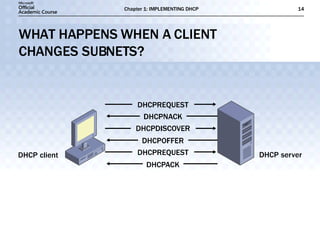
WHAT HAPPENS WHEN A CLIENT  CHANGES SUBNETS?
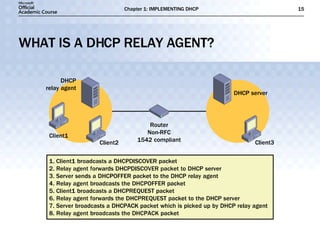
WHAT IS A DHCP RELAY AGENT?
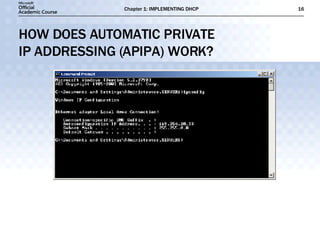
HOW DOES AUTOMATIC PRIVATE  IP ADDRESSING (APIPA) WORK?
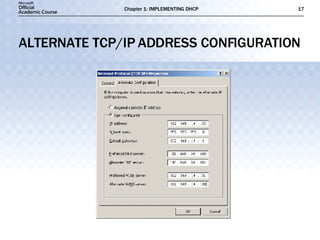
ALTERNATE TCP/IP ADDRESS CONFIGURATION
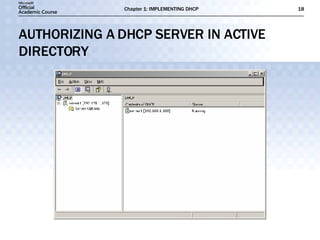
AUTHORIZING A DHCP SERVER IN ACTIVE DIRECTORY
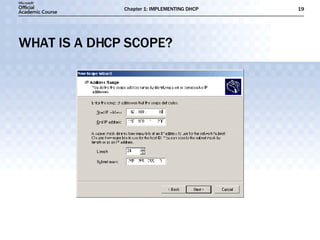
WHAT IS A DHCP SCOPE?
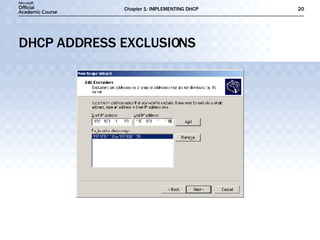
DHCP ADDRESS EXCLUSIONS
MULTICAST ADDRESS CONFIGURATION  USING DHCP The multicast address range is 224.0.0.0 through 239.255.255.255.
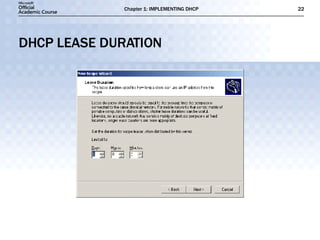
DHCP LEASE DURATION
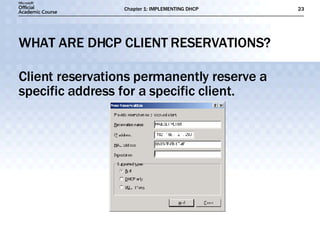
WHAT ARE DHCP CLIENT RESERVATIONS? Client reservations permanently reserve a specific address for a specific client.
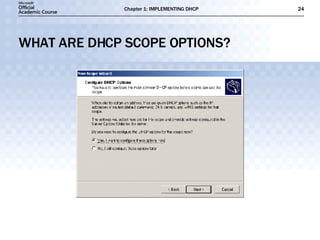
WHAT ARE DHCP SCOPE OPTIONS?
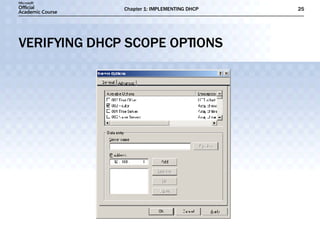
VERIFYING DHCP SCOPE OPTIONS
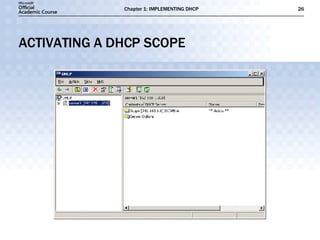
ACTIVATING A DHCP SCOPE
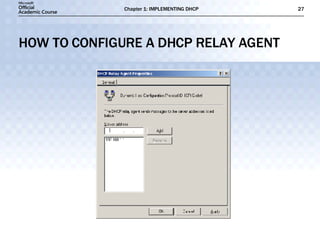
HOW TO CONFIGURE A DHCP RELAY AGENT
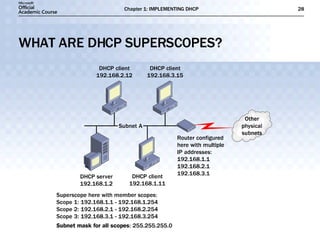
WHAT ARE DHCP SUPERSCOPES?
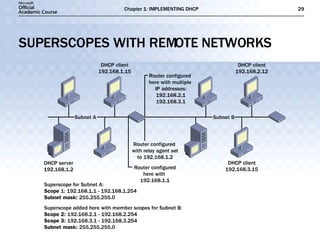
SUPERSCOPES WITH REMOTE NETWORKS
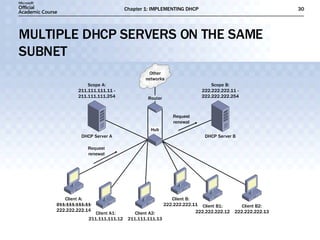
MULTIPLE DHCP SERVERS ON THE SAME SUBNET
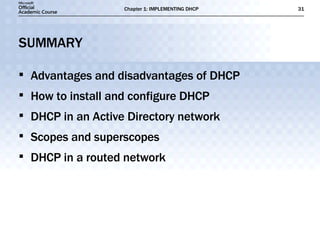
SUMMARY Advantages and disadvantages of DHCP How to install and configure DHCP DHCP in an Active Directory network Scopes and superscopes DHCP in a routed network

Moac291 Week02

  • 1.
  • 2.
  • 3.
    THE ROLE OFDHCP Dynamically assigns TCP/IP addresses Dynamically assigns TCP/IP configuration information Simplifies network administration
  • 4.
    DYNAMIC VERSUS MANUALTCP/IP ADDRESS ASSIGNMENT M M a a n n u u a a l l T T C C P P / / I I P P C C o o n n f f i i g g u u r r a a t t i i o o n n A A u u t t o o m m a a t t i i c c T T C C P P / / I I P P C C o o n n f f i i g g u u r r a a t t i i o o n n IP addresses entered manually on each client computer IP addresses are supplied auto- matically to client computers Possibility of entering incorrect or invalid IP address Ensures that client always uses correct configuration information Incorrect configuration can lead to communication and network issues Client configuration updated automatically to reflect network changes Administrative overload on networks on which computers are frequently moved Elimination of source of network problems
  • 5.
  • 6.
  • 7.
    DHCP SERVER REQUIREMENTSDHCP server requirements Microsoft Windows NT, Windows 2000, or Windows Server 2003 Server products The DHCP Server service installed on the server Static IP address, subnet mask, and default gateway Valid range of addresses
  • 8.
    DHCP CLIENT REQUIREMENTSDHCP client requirements Windows XP or Windows 2000 Microsoft Windows NT 3.51 or later Microsoft Windows 95 or Microsoft Windows 98 Microsoft Windows 3.11 for Workgroups with TCP/IP-32 Microsoft Network Client 3 for MS-DOS LAN Manager 2.2c Other non-Microsoft operating systems
  • 9.
    KEY BENEFITS OFDHCP Centralized administration of IP configuration Dynamic host configuration Seamless IP host configuration Flexibility Scalability
  • 10.
    HOW THE DHCPPROCESS WORKS
  • 11.
    DHCP MESSAGE TYPESUsed by clients to obtain additional TCP/IP addresses D D H H C C P P M M e e s s s s a a g g e e T T y y p p e e D D e e s s c c r r i i p p t t i i o o n n DHCPDISCOVER Used by clients to request configuration parameters from a DHCP server DHCPOFFER Used by servers to offer IP addresses to requesting clients DHCPREQUEST Used by clients to accept or renew IP address assignment and to decline unaccepted servers DHCPDECLINE Used by clients to reject an offered IP address DHCPACK Used by servers to acknowledge a client’s acceptance of an offered IP address DHCPNACK Used by servers to reject a client’s acceptance of an offered IP address DHCPRELEASE Used by clients to terminate an IP address lease DHCPINFORM
  • 12.
    THE INITIAL DHCPLEASE PROCESS
  • 13.
  • 14.
    WHAT HAPPENS WHENA CLIENT CHANGES SUBNETS?
  • 15.
    WHAT IS ADHCP RELAY AGENT?
  • 16.
    HOW DOES AUTOMATICPRIVATE IP ADDRESSING (APIPA) WORK?
  • 17.
  • 18.
    AUTHORIZING A DHCPSERVER IN ACTIVE DIRECTORY
  • 19.
    WHAT IS ADHCP SCOPE?
  • 20.
  • 21.
    MULTICAST ADDRESS CONFIGURATION USING DHCP The multicast address range is 224.0.0.0 through 239.255.255.255.
  • 22.
  • 23.
    WHAT ARE DHCPCLIENT RESERVATIONS? Client reservations permanently reserve a specific address for a specific client.
  • 24.
    WHAT ARE DHCPSCOPE OPTIONS?
  • 25.
  • 26.
  • 27.
    HOW TO CONFIGUREA DHCP RELAY AGENT
  • 28.
    WHAT ARE DHCPSUPERSCOPES?
  • 29.
  • 30.
    MULTIPLE DHCP SERVERSON THE SAME SUBNET
  • 31.
    SUMMARY Advantages anddisadvantages of DHCP How to install and configure DHCP DHCP in an Active Directory network Scopes and superscopes DHCP in a routed network

Editor's Notes

  • #2 Briefly discuss the topics covered in the chapter. Refer to the objectives list at the beginning of the chapter.