Microsoft®
Official Course
Module 6
Implementing Dynamic Host
Configuration Protocol
Module Overview
• Installing a DHCP Server Role
• Configuring DHCP Scopes
• Managing a DHCP Database
• Securing and Monitoring DHCP
Lesson 1: Installing a DHCP Server Role
• Benefits of Using DHCP
• How DHCP Allocates IP Addresses
• How DHCP Lease Generation Works
• How DHCP Lease Renewal Works
• How DHCP Interacts with DNS
• What Is a DHCP Relay Agent?
• DHCP Server Authorization
• Demonstration: Adding the DHCP Server Role
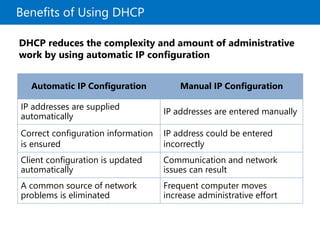
Benefits of Using DHCP
DHCP reduces the complexity and amount of administrative
work by using automatic IP configuration
Automatic IP Configuration Manual IP Configuration
IP addresses are supplied
automatically
IP addresses are entered manually
Correct configuration information
is ensured
IP address could be entered
incorrectly
Client configuration is updated
automatically
Communication and network
issues can result
A common source of network
problems is eliminated
Frequent computer moves
increase administrative effort
How DHCP Allocates IP Addresses
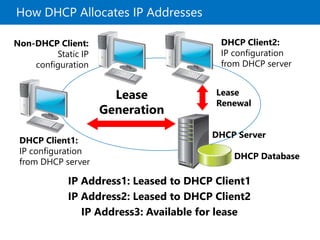
IP Address1: Leased to DHCP Client1
IP Address2: Leased to DHCP Client2
IP Address3: Available for lease
DHCP Server
DHCP Client2:
IP configuration
from DHCP server
Non-DHCP Client:
Static IP
configuration
DHCP Client1:
IP configuration
from DHCP server
Lease
Generation
Lease
Renewal
DHCP Database
How DHCP Lease Generation Works
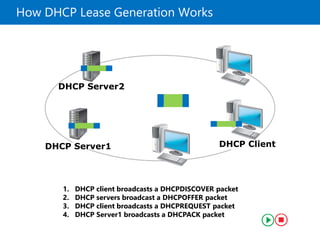
DHCP Server2
DHCP Server1 DHCP Client
1. DHCP client broadcasts a DHCPDISCOVER packet
2. DHCP servers broadcast a DHCPOFFER packet
3. DHCP client broadcasts a DHCPREQUEST packet
4. DHCP Server1 broadcasts a DHCPACK packet
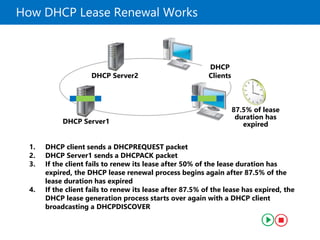
87.5% of lease
duration has
expired
1. DHCP client sends a DHCPREQUEST packet
2. DHCP Server1 sends a DHCPACK packet
3. If the client fails to renew its lease after 50% of the lease duration has
expired, the DHCP lease renewal process begins again after 87.5% of the
lease duration has expired
4. If the client fails to renew its lease after 87.5% of the lease has expired, the
DHCP lease generation process starts over again with a DHCP client
broadcasting a DHCPDISCOVER
DHCP Server2
DHCP
Clients
DHCP Server1
How DHCP Lease Renewal Works
How DHCP Interacts with DNS
• DHCP can:
• Register client records into DNS zones
• Use DNS dynamic update protocol
• To use secure DNS dynamic updates, add DHCP
servers to the AD DS DnsUpdateProxy global
group
• DHCP policies:
• Automatically assign settings based on FQDN
• Register workgroup computers with guest DNS suffix
• Disable PTR registrations without disabling host record
registration
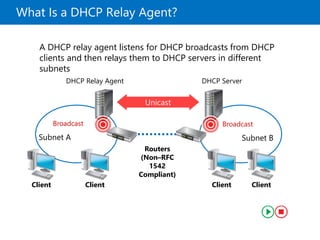
What Is a DHCP Relay Agent?
A DHCP relay agent listens for DHCP broadcasts from DHCP
clients and then relays them to DHCP servers in different
subnets
DHCP ServerDHCP Relay Agent
Routers
(Non–RFC
1542
Compliant)
Unicast
Broadcast
Subnet A Subnet B
Broadcast
Client Client Client Client
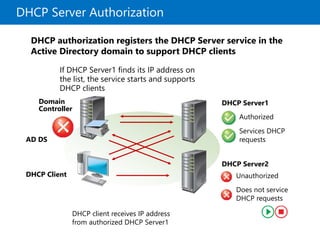
DHCP Server Authorization
DHCP Server2 checks with the domain
controller to obtain a list of authorized DHCP
servers
If DHCP Server2 does not find its IP address
on the list, the service does not start and
support DHCP clients
DHCP client receives IP address
from authorized DHCP Server1
DHCP Server1 checks with the domain
controller to obtain a list of authorized
DHCP servers
If DHCP Server1 finds its IP address on
the list, the service starts and supports
DHCP clients
Domain
Controller
AD DS
DHCP Client Unauthorized
Does not service
DHCP requests
Authorized
Services DHCP
requests
DHCP Server1
DHCP Server2
DHCP authorization registers the DHCP Server service in the
Active Directory domain to support DHCP clients
Demonstration: Adding the DHCP Server Role
In this demonstration, you will see how to
install and authorize the DHCP server role.
Lesson 2: Configuring DHCP Scopes
• What Are DHCP Scopes?
• What Is a DHCP Reservation?
• What Are DHCP Options?
• How Are DHCP Options Applied?
• Demonstration: Creating and Configuring a DHCP
Scope
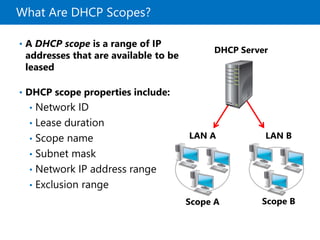
What Are DHCP Scopes?
• A DHCP scope is a range of IP
addresses that are available to be
leased
• DHCP scope properties include:
• Network ID
• Lease duration
• Scope name
• Subnet mask
• Network IP address range
• Exclusion range
LAN B
Scope B
LAN A
Scope A
DHCP Server
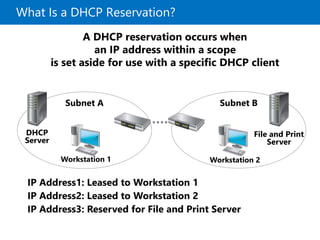
What Is a DHCP Reservation?
A DHCP reservation occurs when
an IP address within a scope
is set aside for use with a specific DHCP client
IP Address1: Leased to Workstation 1
IP Address2: Leased to Workstation 2
IP Address3: Reserved for File and Print Server
File and Print
Server
Workstation 2
DHCP
Server
Subnet A
Workstation 1
Subnet B
What Are DHCP Options?
DHCP options:
• Are values for common configuration data
• Apply to the server, scopes, reservations, and class
options
Common scope options are:
• Router (Default Gateway)
• DNS Name
• DNS Servers
• WINS Servers
How Are DHCP Options Applied?
You can apply DHCP options at various levels:
• Server
• Scope
• Class
• Reserved client
Typically, you do not apply the class or reserved
client options
Demonstration: Creating and Configuring a
DHCP Scope
In this demonstration, you will see how to
configure scope and scope options in DHCP
Lesson 3: Managing a DHCP Database
• What Is a DHCP Database?
• Backing Up and Restoring a DHCP Database
• Reconciling a DHCP Database
• Moving a DHCP Database
What Is a DHCP Database?
Windows Server 2012 stores the DHCP database in
the %Systemroot%System32Dhcp folder
The DHCP database files include:
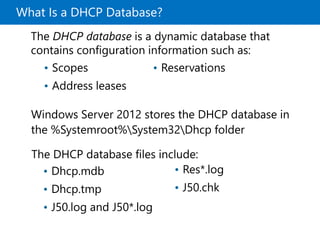
The DHCP database is a dynamic database that
contains configuration information such as:
• Scopes
• Address leases
• Reservations
• Dhcp.mdb
• Dhcp.tmp
• J50.log and J50*.log
• Res*.log
• J50.chk
Backing Up and Restoring a DHCP Database
DHCP
Server
DHCP
Offline
Storage
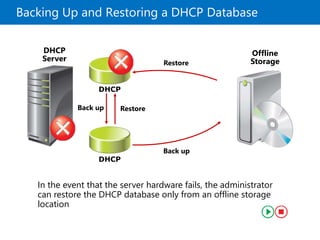
The DHCP service automatically backs up the DHCP
database to the backup directory on the local drive
If the original database is unable to load, the DHCP service
automatically restores from the backup directory on the
local drive
The administrator moves a copy of the backed up
DHCP database to an offline storage location
In the event that the server hardware fails, the administrator
can restore the DHCP database only from an offline storage
location
Back up Restore
Back up
Restore
DHCP
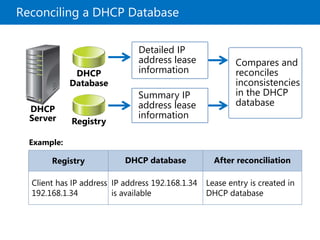
Reconciling a DHCP Database
Registry DHCP database After reconciliation
Client has IP address
192.168.1.34
IP address 192.168.1.34
is available
Lease entry is created in
DHCP database
Summary IP
address lease
information
Detailed IP
address lease
information
Compares and
reconciles
inconsistencies
in the DHCP
database
DHCP
Server
DHCP
Database
Registry
Example:
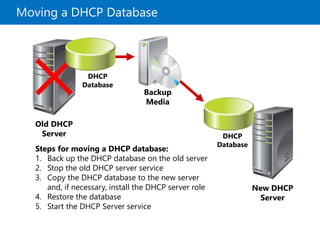
Moving a DHCP Database
Backup
Media
Old DHCP
Server
New DHCP
Server
DHCP
Database
DHCP
Database
Steps for moving a DHCP database:
1. Back up the DHCP database on the old server
2. Stop the old DHCP server service
3. Copy the DHCP database to the new server
and, if necessary, install the DHCP server role
4. Restore the database
5. Start the DHCP Server service
Lesson 4: Securing and Monitoring DHCP
• Preventing an Unauthorized Computer from
Obtaining a Lease
• Restricting Unauthorized, NonMicrosoft DHCP
Servers from Leasing IP Addresses
• Delegating DHCP Administration
• What Are DHCP Statistics?
• What Is DHCP Audit Logging?
• Discussion: Common DHCP Issues
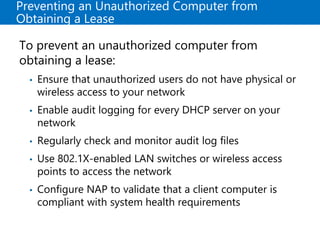
Preventing an Unauthorized Computer from
Obtaining a Lease
To prevent an unauthorized computer from
obtaining a lease:
• Ensure that unauthorized users do not have physical or
wireless access to your network
• Enable audit logging for every DHCP server on your
network
• Regularly check and monitor audit log files
• Use 802.1X-enabled LAN switches or wireless access
points to access the network
• Configure NAP to validate that a client computer is
compliant with system health requirements
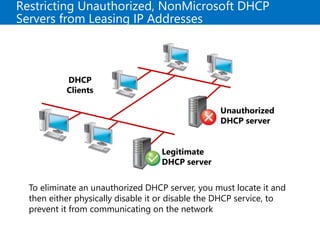
Restricting Unauthorized, NonMicrosoft DHCP
Servers from Leasing IP Addresses
DHCP
Clients
Unauthorized
DHCP server
Legitimate
DHCP server
To eliminate an unauthorized DHCP server, you must locate it and
then either physically disable it or disable the DHCP service, to
prevent it from communicating on the network
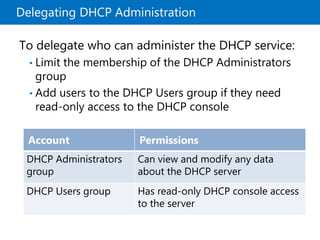
Delegating DHCP Administration
To delegate who can administer the DHCP service:
• Limit the membership of the DHCP Administrators
group
• Add users to the DHCP Users group if they need
read-only access to the DHCP console
Account Permissions
DHCP Administrators
group
Can view and modify any data
about the DHCP server
DHCP Users group Has read-only DHCP console access
to the server
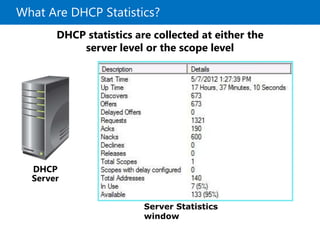
What Are DHCP Statistics?
DHCP statistics are collected at either the
server level or the scope level
DHCP
Server
Server Statistics
window
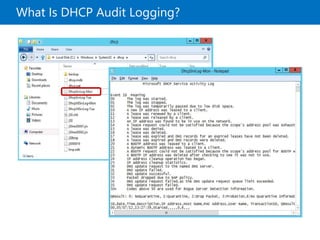
What Is DHCP Audit Logging?
Discussion: Common DHCP Issues
10 minutes
Common issues that can occur when you do not
configure DHCP properly:
• Address conflicts
• Failure to obtain a DHCP address
• Address obtained from an incorrect scope
• DHCP database suffered data corruption or loss
• DHCP server has exhausted its IP address pool
Lab: Implementing DHCP
• Exercise 1: Implementing DHCP
• Exercise 2: Implementing a DHCP Relay Agent
(Optional Exercise)
Logon Information
Virtual machines 20410C-LON-DC1
20410C-LON-SVR1
20410C-LON-RTR
20410C-LON-CL1
20410C-LON-CL2
User name AdatumAdministrator
Password Pa$$w0rd
Estimated Time: 45 minutes
Lab Scenario
A. Datum Corporation has an IT office and data
center in London, which supports the London location
and other locations as well. A. Datum has recently
deployed a Windows 2012 Server infrastructure with
Windows 8 clients.
You have recently accepted a promotion to the
server support team. One of your first assignments
is to configure the infrastructure service for a new
branch office. As part of this assignment, you need to
configure a DHCP server that will provide IP addresses
and configuration to client computers. Servers are
configured with static IP addresses and do not use
DHCP.
Lab Review
• For what is the DHCP scope used?
• How should you configure a computer to receive
an IP address from the DHCP server?
• Why do you need MAC address for a DHCP server
reservation?
• What information do you need to configure on a
DHCP relay agent?
Module Review and Takeaways
• Review Questions
• Best Practices
• Tools

Microsoft Offical Course 20410C_06

  • 1.
    Microsoft® Official Course Module 6 ImplementingDynamic Host Configuration Protocol
  • 2.
    Module Overview • Installinga DHCP Server Role • Configuring DHCP Scopes • Managing a DHCP Database • Securing and Monitoring DHCP
  • 3.
    Lesson 1: Installinga DHCP Server Role • Benefits of Using DHCP • How DHCP Allocates IP Addresses • How DHCP Lease Generation Works • How DHCP Lease Renewal Works • How DHCP Interacts with DNS • What Is a DHCP Relay Agent? • DHCP Server Authorization • Demonstration: Adding the DHCP Server Role
  • 4.
    Benefits of UsingDHCP DHCP reduces the complexity and amount of administrative work by using automatic IP configuration Automatic IP Configuration Manual IP Configuration IP addresses are supplied automatically IP addresses are entered manually Correct configuration information is ensured IP address could be entered incorrectly Client configuration is updated automatically Communication and network issues can result A common source of network problems is eliminated Frequent computer moves increase administrative effort
  • 5.
    How DHCP AllocatesIP Addresses IP Address1: Leased to DHCP Client1 IP Address2: Leased to DHCP Client2 IP Address3: Available for lease DHCP Server DHCP Client2: IP configuration from DHCP server Non-DHCP Client: Static IP configuration DHCP Client1: IP configuration from DHCP server Lease Generation Lease Renewal DHCP Database
  • 6.
    How DHCP LeaseGeneration Works DHCP Server2 DHCP Server1 DHCP Client 1. DHCP client broadcasts a DHCPDISCOVER packet 2. DHCP servers broadcast a DHCPOFFER packet 3. DHCP client broadcasts a DHCPREQUEST packet 4. DHCP Server1 broadcasts a DHCPACK packet
  • 7.
    87.5% of lease durationhas expired 1. DHCP client sends a DHCPREQUEST packet 2. DHCP Server1 sends a DHCPACK packet 3. If the client fails to renew its lease after 50% of the lease duration has expired, the DHCP lease renewal process begins again after 87.5% of the lease duration has expired 4. If the client fails to renew its lease after 87.5% of the lease has expired, the DHCP lease generation process starts over again with a DHCP client broadcasting a DHCPDISCOVER DHCP Server2 DHCP Clients DHCP Server1 How DHCP Lease Renewal Works
  • 8.
    How DHCP Interactswith DNS • DHCP can: • Register client records into DNS zones • Use DNS dynamic update protocol • To use secure DNS dynamic updates, add DHCP servers to the AD DS DnsUpdateProxy global group • DHCP policies: • Automatically assign settings based on FQDN • Register workgroup computers with guest DNS suffix • Disable PTR registrations without disabling host record registration
  • 9.
    What Is aDHCP Relay Agent? A DHCP relay agent listens for DHCP broadcasts from DHCP clients and then relays them to DHCP servers in different subnets DHCP ServerDHCP Relay Agent Routers (Non–RFC 1542 Compliant) Unicast Broadcast Subnet A Subnet B Broadcast Client Client Client Client
  • 10.
    DHCP Server Authorization DHCPServer2 checks with the domain controller to obtain a list of authorized DHCP servers If DHCP Server2 does not find its IP address on the list, the service does not start and support DHCP clients DHCP client receives IP address from authorized DHCP Server1 DHCP Server1 checks with the domain controller to obtain a list of authorized DHCP servers If DHCP Server1 finds its IP address on the list, the service starts and supports DHCP clients Domain Controller AD DS DHCP Client Unauthorized Does not service DHCP requests Authorized Services DHCP requests DHCP Server1 DHCP Server2 DHCP authorization registers the DHCP Server service in the Active Directory domain to support DHCP clients
  • 11.
    Demonstration: Adding theDHCP Server Role In this demonstration, you will see how to install and authorize the DHCP server role.
  • 12.
    Lesson 2: ConfiguringDHCP Scopes • What Are DHCP Scopes? • What Is a DHCP Reservation? • What Are DHCP Options? • How Are DHCP Options Applied? • Demonstration: Creating and Configuring a DHCP Scope
  • 13.
    What Are DHCPScopes? • A DHCP scope is a range of IP addresses that are available to be leased • DHCP scope properties include: • Network ID • Lease duration • Scope name • Subnet mask • Network IP address range • Exclusion range LAN B Scope B LAN A Scope A DHCP Server
  • 14.
    What Is aDHCP Reservation? A DHCP reservation occurs when an IP address within a scope is set aside for use with a specific DHCP client IP Address1: Leased to Workstation 1 IP Address2: Leased to Workstation 2 IP Address3: Reserved for File and Print Server File and Print Server Workstation 2 DHCP Server Subnet A Workstation 1 Subnet B
  • 15.
    What Are DHCPOptions? DHCP options: • Are values for common configuration data • Apply to the server, scopes, reservations, and class options Common scope options are: • Router (Default Gateway) • DNS Name • DNS Servers • WINS Servers
  • 16.
    How Are DHCPOptions Applied? You can apply DHCP options at various levels: • Server • Scope • Class • Reserved client Typically, you do not apply the class or reserved client options
  • 17.
    Demonstration: Creating andConfiguring a DHCP Scope In this demonstration, you will see how to configure scope and scope options in DHCP
  • 18.
    Lesson 3: Managinga DHCP Database • What Is a DHCP Database? • Backing Up and Restoring a DHCP Database • Reconciling a DHCP Database • Moving a DHCP Database
  • 19.
    What Is aDHCP Database? Windows Server 2012 stores the DHCP database in the %Systemroot%System32Dhcp folder The DHCP database files include: The DHCP database is a dynamic database that contains configuration information such as: • Scopes • Address leases • Reservations • Dhcp.mdb • Dhcp.tmp • J50.log and J50*.log • Res*.log • J50.chk
  • 20.
    Backing Up andRestoring a DHCP Database DHCP Server DHCP Offline Storage The DHCP service automatically backs up the DHCP database to the backup directory on the local drive If the original database is unable to load, the DHCP service automatically restores from the backup directory on the local drive The administrator moves a copy of the backed up DHCP database to an offline storage location In the event that the server hardware fails, the administrator can restore the DHCP database only from an offline storage location Back up Restore Back up Restore DHCP
  • 21.
    Reconciling a DHCPDatabase Registry DHCP database After reconciliation Client has IP address 192.168.1.34 IP address 192.168.1.34 is available Lease entry is created in DHCP database Summary IP address lease information Detailed IP address lease information Compares and reconciles inconsistencies in the DHCP database DHCP Server DHCP Database Registry Example:
  • 22.
    Moving a DHCPDatabase Backup Media Old DHCP Server New DHCP Server DHCP Database DHCP Database Steps for moving a DHCP database: 1. Back up the DHCP database on the old server 2. Stop the old DHCP server service 3. Copy the DHCP database to the new server and, if necessary, install the DHCP server role 4. Restore the database 5. Start the DHCP Server service
  • 23.
    Lesson 4: Securingand Monitoring DHCP • Preventing an Unauthorized Computer from Obtaining a Lease • Restricting Unauthorized, NonMicrosoft DHCP Servers from Leasing IP Addresses • Delegating DHCP Administration • What Are DHCP Statistics? • What Is DHCP Audit Logging? • Discussion: Common DHCP Issues
  • 24.
    Preventing an UnauthorizedComputer from Obtaining a Lease To prevent an unauthorized computer from obtaining a lease: • Ensure that unauthorized users do not have physical or wireless access to your network • Enable audit logging for every DHCP server on your network • Regularly check and monitor audit log files • Use 802.1X-enabled LAN switches or wireless access points to access the network • Configure NAP to validate that a client computer is compliant with system health requirements
  • 25.
    Restricting Unauthorized, NonMicrosoftDHCP Servers from Leasing IP Addresses DHCP Clients Unauthorized DHCP server Legitimate DHCP server To eliminate an unauthorized DHCP server, you must locate it and then either physically disable it or disable the DHCP service, to prevent it from communicating on the network
  • 26.
    Delegating DHCP Administration Todelegate who can administer the DHCP service: • Limit the membership of the DHCP Administrators group • Add users to the DHCP Users group if they need read-only access to the DHCP console Account Permissions DHCP Administrators group Can view and modify any data about the DHCP server DHCP Users group Has read-only DHCP console access to the server
  • 27.
    What Are DHCPStatistics? DHCP statistics are collected at either the server level or the scope level DHCP Server Server Statistics window
  • 28.
    What Is DHCPAudit Logging?
  • 29.
    Discussion: Common DHCPIssues 10 minutes Common issues that can occur when you do not configure DHCP properly: • Address conflicts • Failure to obtain a DHCP address • Address obtained from an incorrect scope • DHCP database suffered data corruption or loss • DHCP server has exhausted its IP address pool
  • 30.
    Lab: Implementing DHCP •Exercise 1: Implementing DHCP • Exercise 2: Implementing a DHCP Relay Agent (Optional Exercise) Logon Information Virtual machines 20410C-LON-DC1 20410C-LON-SVR1 20410C-LON-RTR 20410C-LON-CL1 20410C-LON-CL2 User name AdatumAdministrator Password Pa$$w0rd Estimated Time: 45 minutes
  • 31.
    Lab Scenario A. DatumCorporation has an IT office and data center in London, which supports the London location and other locations as well. A. Datum has recently deployed a Windows 2012 Server infrastructure with Windows 8 clients. You have recently accepted a promotion to the server support team. One of your first assignments is to configure the infrastructure service for a new branch office. As part of this assignment, you need to configure a DHCP server that will provide IP addresses and configuration to client computers. Servers are configured with static IP addresses and do not use DHCP.
  • 32.
    Lab Review • Forwhat is the DHCP scope used? • How should you configure a computer to receive an IP address from the DHCP server? • Why do you need MAC address for a DHCP server reservation? • What information do you need to configure on a DHCP relay agent?
  • 33.
    Module Review andTakeaways • Review Questions • Best Practices • Tools