Chapter 3. RESEARCH METHODOLOGY
Research Design
Research Locale
Respondents of the Study
Data Gathering Instrument
Data Gathering Procedure
Statistical Tool
Chapter 3
Methods
(Method of Research, Methodology, Methods of Research and Procedures)
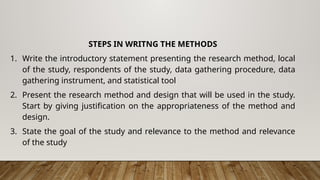
STEPS IN WRITNG THE METHODS
1. Write the introductory statement presenting the research method, local
of the study, respondents of the study, data gathering procedure, data
gathering instrument, and statistical tool
2. Present the research method and design that will be used in the study.
Start by giving justification on the appropriateness of the method and
design.
3. State the goal of the study and relevance to the method and relevance
of the study
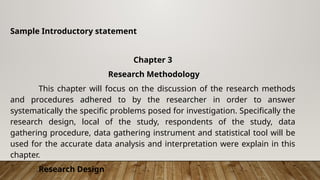
Sample Introductory statement
Chapter 3
Research Methodology
This chapter will focus on the discussion of the research methods
and procedures adhered to by the researcher in order to answer
systematically the specific problems posed for investigation. Specifically the
research design, local of the study, respondents of the study, data
gathering procedure, data gathering instrument and statistical tool will be
used for the accurate data analysis and interpretation were explain in this
chapter.
Research Design
How to Write the
Research Design
What is a Research Design
It is the overall plan, structure or strategy that guides a research project
from its preparation to final analysis of data. For quantitative research design
it is either descriptive, correlation, experimental and quasi-experimental
Steps in Writing a Research Design (It may written in only 3 short
paragraphs)
1. State the design use in the study (descriptive, correlation, etc.)
2. Define and discuss the research design that you are using.
3. Give the justification why you have chosen the identified research design.
Sample Research Design
Research Design
The study will use the quantitative method of research where the researcher
adopted the descriptive research design.
Descriptive research that will be used in the investigation as basis of gathering, analyzing,
classifying and tabulating data about prevailing conditions , practices, belief, processes, trends and
cause and effect relationship and then making and accurate and adequate interpretation about such
data with the aid of statistical methods. It involves some type of comparison and attempts to discover
existing relationship, manipulative variables so that the relationship of research problem can test the
study (Hubbard, 2018)
Descriptive study is considered appropriate for the study because the said research design
is really suitable in this study for a reason that this research would like to collect data to analyze and
asess the level of familiarity of online teaching among criminology instructors in Metro Manila
College.
How to Write the
Local of the Study
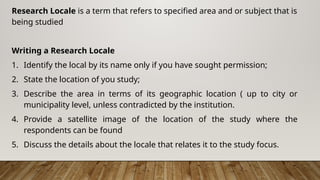
Research Locale is a term that refers to specified area and or subject that is
being studied
Writing a Research Locale
1. Identify the local by its name only if you have sought permission;
2. State the location of you study;
3. Describe the area in terms of its geographic location ( up to city or
municipality level, unless contradicted by the institution.
4. Provide a satellite image of the location of the study where the
respondents can be found
5. Discuss the details about the locale that relates it to the study focus.
Sample
Research Locale
The study will be conducted in Metro Manila College. It is a private
institution of hiher learning offering basic education courses and college
dgree courses like Bachelor of Science in Criminology
MMC is also authorized to offer post graduate education courses
like MA in EDucation, MS in Crimiology and Ph D in Developmental
Education.
During this time of Pandemic face to face classes is not suitable due
to the danger of mass transmition of COVID 19 as a deadly disease. Level
of Familiarity in the use of Online teaching to BS CRiminology Students is
timely research investigation in order to come up with an effective
classroom instructions.
How to Write the
Respondents of the
Study
Respondents of the Study is the Population and Samples of the study
Population - refers to the entire group that you will be used to draw conclusion of the study while
sample is the specific group the researcher will use in collecting the research data.
Sampling Method – is the technique used to select the individual members of a specific group.
Basis in Choosing a Sampling Method
1. Appropriateness of the technique to the study being conducted ( if the study requires interviewing
costumers then the appropriate sampling method should be Convenience Sampling)
2. The available respondents ( If there are very few respondents, the researcher should use
Purposive Sampling. If there is a large number of respondents, the researcher should use Simple
Random Sampling)
3. After identifying the needed population sampling follow the steps in writing the Respondents of the
Study;
a. Write the brief background of the respondents;
b. Total number of the respondents;
c. How were the sample chosen; and
c. Reason why the researcher chosen the respondents.
Sample of Respondents of the Study
Respondents of the Study
The researcher will utilize instructors in the College of Criminology to assess the Level of
Familiarity in the use of On line Teaching among Instructors in the College of Criminology.
A total of sixty eight (68) teachers as the main respondents of the study were selected using
the simple random sampling. They are described in terms of sex, age, position, title, length of service,
and highest educational attainment.
These sixty eight (68) teachers that will be used as a respondents of the study were chosen
from the Instructords of MMC College.
Table 1
How to Write the
Data Gathering Instrument
Steps in Writing the Data Gathering Instrument
1. Write the Introductory Statement;
2. Discuss how the instrument was formulated and organized;
3. Relate what comprises the content of the data gathering instrument;
4. State how the instrument was validated and how many validated the
instrument.
Sample
Data Gathering Instrument
The study will use a research-made questionnaire as a data gathering instrument in
gathering the needed data.
The First part consist of questions regarding the profile of the respondents in terms of
Age, Sex, Length of service, Educational Attainment and Position Held. A checklist was used to
indicate the respondent’s responses.
The second comprises of questions regarding the Professional Development Program
of Teachers with respect to Continuing Education, Research and Skills-Based Training. The
following arbitrary scale values were used.
Score Verbal Interpretation
Description
5 VGE
Very Great Extent
4 GT
Great Extent
3 ME
Moderate Extent
2 LE
Low Extent
1 VLE
Very Low Extent
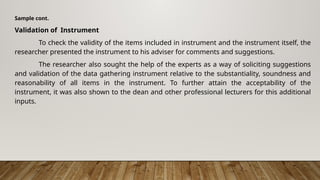
Sample cont.
Validation of Instrument
To check the validity of the items included in instrument and the instrument itself, the
researcher presented the instrument to his adviser for comments and suggestions.
The researcher also sought the help of the experts as a way of soliciting suggestions
and validation of the data gathering instrument relative to the substantiality, soundness and
reasonability of all items in the instrument. To further attain the acceptability of the
instrument, it was also shown to the dean and other professional lecturers for this additional
inputs.
How to Write the
Data Gathering Procedure
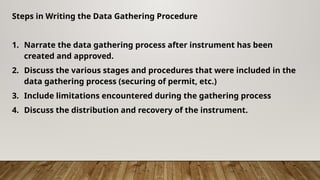
Steps in Writing the Data Gathering Procedure
1. Narrate the data gathering process after instrument has been
created and approved.
2. Discuss the various stages and procedures that were included in the
data gathering process (securing of permit, etc.)
3. Include limitations encountered during the gathering process
4. Discuss the distribution and recovery of the instrument.
Sample Data Gathering Procedure
Data Gathering Procedure
To facilitate the systematic collection of data, the researcher followed the standard
operating procedure usually followed in conducting the investigation. After Constructing the
Instrument, the questionnaire checklist was validated by some teachers who were not
included in the respondents of the study. The researcher sought the permission from the
schools division superintendent, principal of the school were the study was conducted and
distributed the questionnaire. After securing the a, the questionnaire were administered to
the teacher-respondents
Upon retrieval of the questionnaire, the data will be tallied, computed, and analyzed by
the statistician and interpreted by the researcher posed in the statement of the problem.
Based on the results, the conclusion will be drawn and recommendations will be
formulated. The finding of the study will serve as the output to the existing teacher training
program.
How to Write the
Statistical Tool
( Statistical Treatment of Data or Data Processing and Statistical Treatment)
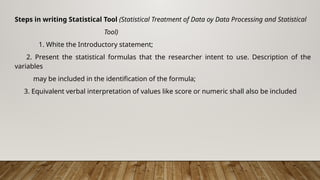
Steps in writing Statistical Tool (Statistical Treatment of Data oy Data Processing and Statistical
Tool)
1. White the Introductory statement;
2. Present the statistical formulas that the researcher intent to use. Description of the
variables
may be included in the identification of the formula;
3. Equivalent verbal interpretation of values like score or numeric shall also be included
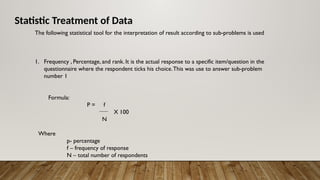
Statistic Treatment of Data
The following statistical tool for the interpretation of result according to sub-problems is used
1. Frequency , Percentage, and rank. It is the actual response to a specific item/question in the
questionnaire where the respondent ticks his choice.This was use to answer sub-problem
number 1
Formula:
P = f
X 100
N
Where
p- percentage
f – frequency of response
N – total number of respondents
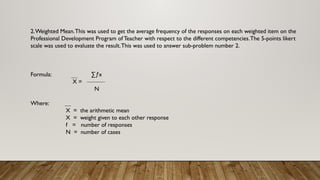
2.Weighted Mean.This was used to get the average frequency of the responses on each weighted item on the
Professional Development Program of Teacher with respect to the different competencies.The 5-points likert
scale was used to evaluate the result.This was used to answer sub-problem number 2.
Formula: ∑ƒx
X =
N
Where:
X = the arithmetic mean
X = weight given to each other response
f = number of responses
N = number of cases
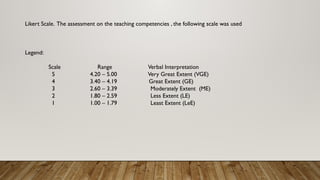
Likert Scale. The assessment on the teaching competencies , the following scale was used
Legend:
Scale Range Verbal Interpretation
5 4.20 – 5.00 Very Great Extent (VGE)
4 3.40 – 4.19 Great Extent (GE)
3 2.60 – 3.39 Moderately Extent (ME)
2 1.80 – 2.59 Less Extent (LE)
1 1.00 – 1.79 Least Extent (LeE)
References
Use the 7th
Edition of APA for your Citation
Sample Citation using APA 7th
Edition
References
Almieda, Adelaida B., Gaerlean Amelita A., Manly, Norita E. (2016), Research
Fundamentals, Adrian Publishing Co. Inc. Cubao Quezon City, Philippines ,
Cole K & Tomporowski, P.D. (2018) Effect of Acute Exercises on Execute Processing, Short
Term and Long Term Memory, Journal of Sport Science, V 26, p 333-344
Center for Disease Control (2019) E-cigarette ads and youth, https://w.w.w.
apa.org/pubs/info/reports/advertising children.
Thank You

MMC-Chapter-2-METHODS-OF-RESEARCH101.pptx

  • 1.
    Chapter 3. RESEARCHMETHODOLOGY Research Design Research Locale Respondents of the Study Data Gathering Instrument Data Gathering Procedure Statistical Tool
  • 2.
    Chapter 3 Methods (Method ofResearch, Methodology, Methods of Research and Procedures)
  • 3.
    STEPS IN WRITNGTHE METHODS 1. Write the introductory statement presenting the research method, local of the study, respondents of the study, data gathering procedure, data gathering instrument, and statistical tool 2. Present the research method and design that will be used in the study. Start by giving justification on the appropriateness of the method and design. 3. State the goal of the study and relevance to the method and relevance of the study
  • 4.
    Sample Introductory statement Chapter3 Research Methodology This chapter will focus on the discussion of the research methods and procedures adhered to by the researcher in order to answer systematically the specific problems posed for investigation. Specifically the research design, local of the study, respondents of the study, data gathering procedure, data gathering instrument and statistical tool will be used for the accurate data analysis and interpretation were explain in this chapter. Research Design
  • 5.
    How to Writethe Research Design
  • 6.
    What is aResearch Design It is the overall plan, structure or strategy that guides a research project from its preparation to final analysis of data. For quantitative research design it is either descriptive, correlation, experimental and quasi-experimental Steps in Writing a Research Design (It may written in only 3 short paragraphs) 1. State the design use in the study (descriptive, correlation, etc.) 2. Define and discuss the research design that you are using. 3. Give the justification why you have chosen the identified research design.
  • 7.
    Sample Research Design ResearchDesign The study will use the quantitative method of research where the researcher adopted the descriptive research design. Descriptive research that will be used in the investigation as basis of gathering, analyzing, classifying and tabulating data about prevailing conditions , practices, belief, processes, trends and cause and effect relationship and then making and accurate and adequate interpretation about such data with the aid of statistical methods. It involves some type of comparison and attempts to discover existing relationship, manipulative variables so that the relationship of research problem can test the study (Hubbard, 2018) Descriptive study is considered appropriate for the study because the said research design is really suitable in this study for a reason that this research would like to collect data to analyze and asess the level of familiarity of online teaching among criminology instructors in Metro Manila College.
  • 8.
    How to Writethe Local of the Study
  • 9.
    Research Locale isa term that refers to specified area and or subject that is being studied Writing a Research Locale 1. Identify the local by its name only if you have sought permission; 2. State the location of you study; 3. Describe the area in terms of its geographic location ( up to city or municipality level, unless contradicted by the institution. 4. Provide a satellite image of the location of the study where the respondents can be found 5. Discuss the details about the locale that relates it to the study focus.
  • 10.
    Sample Research Locale The studywill be conducted in Metro Manila College. It is a private institution of hiher learning offering basic education courses and college dgree courses like Bachelor of Science in Criminology MMC is also authorized to offer post graduate education courses like MA in EDucation, MS in Crimiology and Ph D in Developmental Education. During this time of Pandemic face to face classes is not suitable due to the danger of mass transmition of COVID 19 as a deadly disease. Level of Familiarity in the use of Online teaching to BS CRiminology Students is timely research investigation in order to come up with an effective classroom instructions.
  • 11.
    How to Writethe Respondents of the Study
  • 12.
    Respondents of theStudy is the Population and Samples of the study Population - refers to the entire group that you will be used to draw conclusion of the study while sample is the specific group the researcher will use in collecting the research data. Sampling Method – is the technique used to select the individual members of a specific group. Basis in Choosing a Sampling Method 1. Appropriateness of the technique to the study being conducted ( if the study requires interviewing costumers then the appropriate sampling method should be Convenience Sampling) 2. The available respondents ( If there are very few respondents, the researcher should use Purposive Sampling. If there is a large number of respondents, the researcher should use Simple Random Sampling)
  • 13.
    3. After identifyingthe needed population sampling follow the steps in writing the Respondents of the Study; a. Write the brief background of the respondents; b. Total number of the respondents; c. How were the sample chosen; and c. Reason why the researcher chosen the respondents.
  • 14.
    Sample of Respondentsof the Study Respondents of the Study The researcher will utilize instructors in the College of Criminology to assess the Level of Familiarity in the use of On line Teaching among Instructors in the College of Criminology. A total of sixty eight (68) teachers as the main respondents of the study were selected using the simple random sampling. They are described in terms of sex, age, position, title, length of service, and highest educational attainment. These sixty eight (68) teachers that will be used as a respondents of the study were chosen from the Instructords of MMC College. Table 1
  • 15.
    How to Writethe Data Gathering Instrument
  • 16.
    Steps in Writingthe Data Gathering Instrument 1. Write the Introductory Statement; 2. Discuss how the instrument was formulated and organized; 3. Relate what comprises the content of the data gathering instrument; 4. State how the instrument was validated and how many validated the instrument.
  • 17.
    Sample Data Gathering Instrument Thestudy will use a research-made questionnaire as a data gathering instrument in gathering the needed data. The First part consist of questions regarding the profile of the respondents in terms of Age, Sex, Length of service, Educational Attainment and Position Held. A checklist was used to indicate the respondent’s responses.
  • 18.
    The second comprisesof questions regarding the Professional Development Program of Teachers with respect to Continuing Education, Research and Skills-Based Training. The following arbitrary scale values were used. Score Verbal Interpretation Description 5 VGE Very Great Extent 4 GT Great Extent 3 ME Moderate Extent 2 LE Low Extent 1 VLE Very Low Extent
  • 19.
    Sample cont. Validation ofInstrument To check the validity of the items included in instrument and the instrument itself, the researcher presented the instrument to his adviser for comments and suggestions. The researcher also sought the help of the experts as a way of soliciting suggestions and validation of the data gathering instrument relative to the substantiality, soundness and reasonability of all items in the instrument. To further attain the acceptability of the instrument, it was also shown to the dean and other professional lecturers for this additional inputs.
  • 20.
    How to Writethe Data Gathering Procedure
  • 21.
    Steps in Writingthe Data Gathering Procedure 1. Narrate the data gathering process after instrument has been created and approved. 2. Discuss the various stages and procedures that were included in the data gathering process (securing of permit, etc.) 3. Include limitations encountered during the gathering process 4. Discuss the distribution and recovery of the instrument.
  • 22.
    Sample Data GatheringProcedure Data Gathering Procedure To facilitate the systematic collection of data, the researcher followed the standard operating procedure usually followed in conducting the investigation. After Constructing the Instrument, the questionnaire checklist was validated by some teachers who were not included in the respondents of the study. The researcher sought the permission from the schools division superintendent, principal of the school were the study was conducted and distributed the questionnaire. After securing the a, the questionnaire were administered to the teacher-respondents Upon retrieval of the questionnaire, the data will be tallied, computed, and analyzed by the statistician and interpreted by the researcher posed in the statement of the problem. Based on the results, the conclusion will be drawn and recommendations will be formulated. The finding of the study will serve as the output to the existing teacher training program.
  • 23.
    How to Writethe Statistical Tool ( Statistical Treatment of Data or Data Processing and Statistical Treatment)
  • 24.
    Steps in writingStatistical Tool (Statistical Treatment of Data oy Data Processing and Statistical Tool) 1. White the Introductory statement; 2. Present the statistical formulas that the researcher intent to use. Description of the variables may be included in the identification of the formula; 3. Equivalent verbal interpretation of values like score or numeric shall also be included
  • 25.
    Statistic Treatment ofData The following statistical tool for the interpretation of result according to sub-problems is used 1. Frequency , Percentage, and rank. It is the actual response to a specific item/question in the questionnaire where the respondent ticks his choice.This was use to answer sub-problem number 1 Formula: P = f X 100 N Where p- percentage f – frequency of response N – total number of respondents
  • 26.
    2.Weighted Mean.This wasused to get the average frequency of the responses on each weighted item on the Professional Development Program of Teacher with respect to the different competencies.The 5-points likert scale was used to evaluate the result.This was used to answer sub-problem number 2. Formula: ∑ƒx X = N Where: X = the arithmetic mean X = weight given to each other response f = number of responses N = number of cases
  • 27.
    Likert Scale. Theassessment on the teaching competencies , the following scale was used Legend: Scale Range Verbal Interpretation 5 4.20 – 5.00 Very Great Extent (VGE) 4 3.40 – 4.19 Great Extent (GE) 3 2.60 – 3.39 Moderately Extent (ME) 2 1.80 – 2.59 Less Extent (LE) 1 1.00 – 1.79 Least Extent (LeE)
  • 28.
    References Use the 7th Editionof APA for your Citation
  • 29.
    Sample Citation usingAPA 7th Edition References Almieda, Adelaida B., Gaerlean Amelita A., Manly, Norita E. (2016), Research Fundamentals, Adrian Publishing Co. Inc. Cubao Quezon City, Philippines , Cole K & Tomporowski, P.D. (2018) Effect of Acute Exercises on Execute Processing, Short Term and Long Term Memory, Journal of Sport Science, V 26, p 333-344 Center for Disease Control (2019) E-cigarette ads and youth, https://w.w.w. apa.org/pubs/info/reports/advertising children.
  • 30.