PRACTICAL RESEARCH 2
HUMSS STRAND
LESSON 10:
Research Methodology
RESEARCHDESIGN
is defined as the logical and coherent
overall strategy that the researcher uses
to integrate all the components of the
research study (Barrot, 2017).
RESEARCHDESIGN
According to Fraenkel and Wallen (2007), the
research designs in quantitative research are mostly
pre-established. Hence having an appropriate
research design in quantitative research, the
researcher will have a clearer comprehension of what
he is trying to analyze and interpret.
RESEARCHDESIGN
A.Non-Experimental
Survey
Descriptive
Correlational
Ex Post Facto
RESEARCHDESIGN
B. Experimental
Pre-Experimental
Quasi-Experimental
True Experimental
HOW TO WRITE?
Introduce the type of research design
to be used
Provide a definition or description of
the selected design
Explain why you will use that design
RESEARCH ENVIRONMENT
refers to the place where
you will conduct your
research study
HOW TO WRITE?
 Introduce place of study
 Give a short background or description
of the place
RESEARCH RESPONDENTS
refers to the objects, elements,
persons, or characteristics involved
in the study as the subject
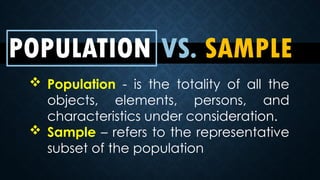
POPULATION VS. SAMPLE
 Population - is the totality of all the
objects, elements, persons, and
characteristics under consideration.
 Sample – refers to the representative
subset of the population
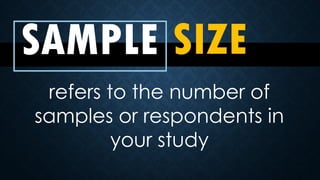
SAMPLE SIZE
refers to the number of
samples or respondents in
your study
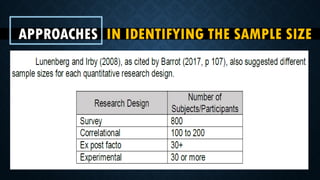
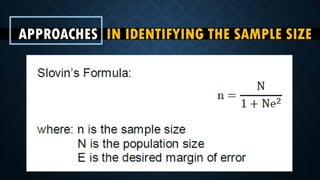
APPROACHES IN IDENTIFYING THE SAMPLE SIZE
HOW TO WRITE?
 Introduce your respondents
 Describe them as to their characteristics
including the sample size
 Explain why you choose them as your
respondents
 You can use table for the distribution oif your
respondents
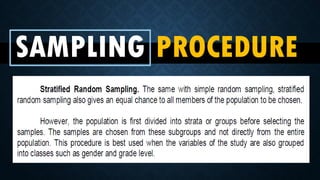
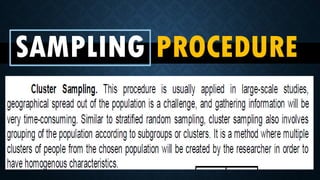
SAMPLING PROCEDURE
 Sampling – pertains to the systematic
process of selecting the group to be
analyzed in the research study.
SAMPLING PROCEDURE
SAMPLING PROCEDURE
SAMPLING PROCEDURE
SAMPLING PROCEDURE
SAMPLING PROCEDURE
HOW TO WRITE?
 Introduce the sampling procedure to be
used
 Define or describe the selected procedure
 Explain the actual process of applying that
procedure in obtaining your sample size
RESEARCH INSTRUMENTS
are basic tools researchers
used to gather data for
specific research problems
RESEARCH INSTRUMENTS
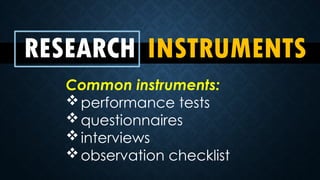
Common instruments:
performance tests
questionnaires
interviews
observation checklist
RESEARCH INSTRUMENTS
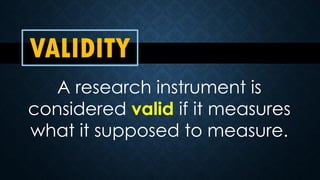
VALIDITY
A research instrument is
considered valid if it measures
what it supposed to measure.
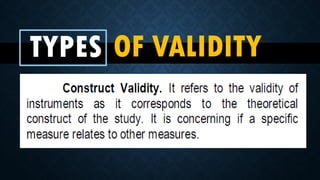
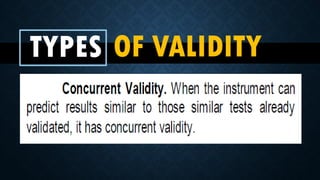
TYPES OF VALIDITY
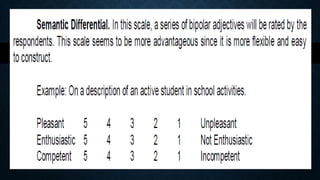
TYPES OF VALIDITY
TYPES OF VALIDITY
TYPES OF VALIDITY
TYPES OF VALIDITY
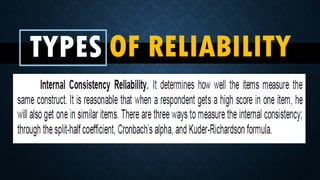
RELIABILITY
refers to the consistency of the
measures or results of the
instrument
TYPES OF RELIABILITY
HOW TO WRITE?
 Introduce the type of instrument to be used
 Give a short definition and description
 Explain the each part of your instrument
(include the source if adopted or modified
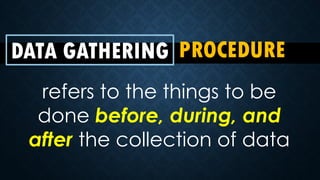
DATA GATHERING PROCEDURE
refers to the things to be
done before, during, and
after the collection of data
DATA GATHERING PROCEDURE
HOW TO WRITE?
In paragraph form, explain the
things to be done before, during,
and after the conduct of your
research study.
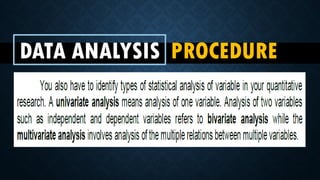
DATA ANALYSIS PROCEDURE
Data analysis in research is a process
in which gathered information are
summarized in such a manner that it
will yield answers to the research
questions.
DATA ANALYSIS PROCEDURE
HOW TO WRITE?
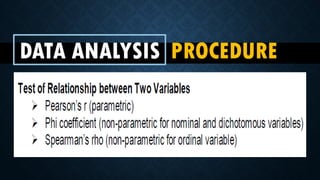
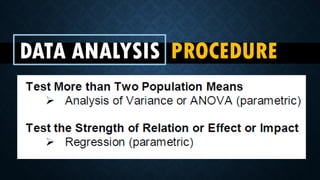
 Enumerate all the possible statistical
tools to be used
 Give a short description in each
statistical tool
 Explain where to use each statistical
tool in your study

PR2-1.pptx practically research that is about researching