 Selecting the pricing objective
 The company has to decide where to
position its market offering
 Then it need to pursue its objective through
pricing:
1. Survival
2. Maximum current profit
3. Maximum Market Share
4. Maximum Market Skimming
5. Product – Quality Leadership
1. Survival
 Plagued with overcapacity, intense
competition or changing consumer
wants-short run.
 Profit is secondary, to cover some
fixed costs and variable costs
2. Choose the maximum current prices,
sacrificing long run performance, ,
ignoring competitors reaction, and
legal restraint on price. This strategy
assumes that the firm has knowledge
of its demand and cost functions.
3. Maximise market share. Higher sales
volume lower unit costs and higher long-run
profit.
 The market is highly price sensitive and low
price stimulates market growth
 Production and distribution costs fall
 A low price discourages potential
competition.
4. Price skimming: Setting high prices to skim
the market
 A number of buyers have high current
demand
 The unit cost of producing a small volume
are not high
 The high initial price does not attract more
competitors
 The high price communicates the image of
a superior product.
5. A company may aim to be product-
quality leader in the market.
 Other Pricing objectives are
Partial cost recovery, full cost recovery,
social price etc.
Determining Demand
 Each pricing will lead to a different kind of
demand.
 The relation between alternative prices
and the demand can be plotted into a
demand curve.
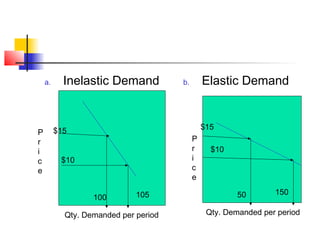
a. Inelastic Demand: Inversely proportional
b. In case of luxury or prestigious goods
slope will be upwards. If too high high the
level will fall.
a. Inelastic Demand b. Elastic Demand
P
r
i
c
e
Qty. Demanded per period
P
r
i
c
e
Qty. Demanded per period
$15
$10
100 105 50 150
$10
$15
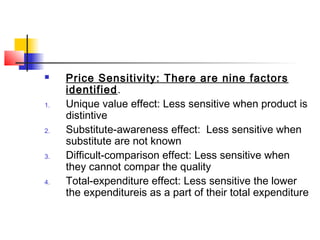
 Price Sensitivity: There are nine factors
identified.
1. Unique value effect: Less sensitive when product is
distintive
2. Substitute-awareness effect: Less sensitive when
substitute are not known
3. Difficult-comparison effect: Less sensitive when
they cannot compar the quality
4. Total-expenditure effect: Less sensitive the lower
the expenditureis as a part of their total expenditure
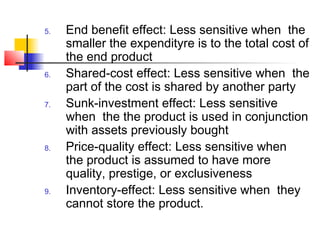
5. End benefit effect: Less sensitive when the
smaller the expendityre is to the total cost of
the end product
6. Shared-cost effect: Less sensitive when the
part of the cost is shared by another party
7. Sunk-investment effect: Less sensitive
when the the product is used in conjunction
with assets previously bought
8. Price-quality effect: Less sensitive when
the product is assumed to have more
quality, prestige, or exclusiveness
9. Inventory-effect: Less sensitive when they
cannot store the product.
Marketing channels
 Most marketers do not sell their goods
directly to the cutomers
 They have intermediaries constituting a
Marketing channel or a trade channel
 Forward flow
 Backward flow
 Three types of intermediaries:
1. Merchants: Wholesalers or Retailers- buy,
take title to and resell
2. Agents: brokers, manufacturers
representatives, sales agents-search for
customers and and negotiate on the
producers behalf but do not take title of the
goods
3. Facilitators: - Assist in distribution –
transportation, banks, warehouse,
advertising agencies, etc
 Marketing channels are sets of interdependent
organisations involved in the process of makng a
product or service available for use or consumption
 Why is Marketing channel needed ?
1. Financial resources
2. Not feasible
3. ROI can be more in their main business
 Intermediaries normally achieve superior
efficiency in making goods widely available
and accessible to target markets.
 Channel functions and flows:
 Moving goods from producers to
consumers – key functions
i. Gather information
ii. Develop and disseminate persuasive
communications
iii. Agreement on price to transfer
ownership
iv. Place orders with manufacturers
v. Fund for inventories
vi. Cover risk on channel work
vii. Storage and movement
viii. Payment of bills
ix. Oversee actual transfer of ownership
 Channel levels- Upto six levels :
1. Zero – level – direct level
2. One level – Retailer
3. Two level – Wholesaler and Retailer
4. Three level
 Service sector channels:
 Hospitals and schools
 Customers desired service output
levels:
1. Lot size
2. Waiting time
3. Spatial convenience
4. Product Variety
5. Service backup
 Identifying major channel alternatives:
1. Types of intermediaries : The firm
need to identify the types of
intermediaries avilable to carry on its
channel work
2. Number of intermediaries: Exclusive
distribution
i. Exclusive
ii. Selective
iii. Intensive
 Terms and responsibility of channel
partners:
 Each channel member must be
treated respectfully and given
opportunities to be profitable.
 Trade-relation mix:
1. Price policy
2. Conditions of sale
3. Territorial rights
4. Mutual services and responsibilities
 Evaluating channel members:
1. Economic
2. Control
3. Adaptive
 Channel management decisions:
1. Selecting channel members:
2. Training channel members
3. Motivating channel members: Channel
offering, Channel building programs
 Eliciting power to mange:
1. Coercive power
2. Reward power
3. Legitimate power
4. Expert power
5. Referent power

Mm18

  • 1.
     Selecting thepricing objective  The company has to decide where to position its market offering  Then it need to pursue its objective through pricing: 1. Survival 2. Maximum current profit 3. Maximum Market Share 4. Maximum Market Skimming 5. Product – Quality Leadership
  • 2.
    1. Survival  Plaguedwith overcapacity, intense competition or changing consumer wants-short run.  Profit is secondary, to cover some fixed costs and variable costs
  • 3.
    2. Choose themaximum current prices, sacrificing long run performance, , ignoring competitors reaction, and legal restraint on price. This strategy assumes that the firm has knowledge of its demand and cost functions.
  • 4.
    3. Maximise marketshare. Higher sales volume lower unit costs and higher long-run profit.  The market is highly price sensitive and low price stimulates market growth  Production and distribution costs fall  A low price discourages potential competition.
  • 5.
    4. Price skimming:Setting high prices to skim the market  A number of buyers have high current demand  The unit cost of producing a small volume are not high  The high initial price does not attract more competitors  The high price communicates the image of a superior product.
  • 6.
    5. A companymay aim to be product- quality leader in the market.  Other Pricing objectives are Partial cost recovery, full cost recovery, social price etc.
  • 7.
    Determining Demand  Eachpricing will lead to a different kind of demand.  The relation between alternative prices and the demand can be plotted into a demand curve. a. Inelastic Demand: Inversely proportional b. In case of luxury or prestigious goods slope will be upwards. If too high high the level will fall.
  • 8.
    a. Inelastic Demandb. Elastic Demand P r i c e Qty. Demanded per period P r i c e Qty. Demanded per period $15 $10 100 105 50 150 $10 $15
  • 9.
     Price Sensitivity:There are nine factors identified. 1. Unique value effect: Less sensitive when product is distintive 2. Substitute-awareness effect: Less sensitive when substitute are not known 3. Difficult-comparison effect: Less sensitive when they cannot compar the quality 4. Total-expenditure effect: Less sensitive the lower the expenditureis as a part of their total expenditure
  • 10.
    5. End benefiteffect: Less sensitive when the smaller the expendityre is to the total cost of the end product 6. Shared-cost effect: Less sensitive when the part of the cost is shared by another party 7. Sunk-investment effect: Less sensitive when the the product is used in conjunction with assets previously bought 8. Price-quality effect: Less sensitive when the product is assumed to have more quality, prestige, or exclusiveness 9. Inventory-effect: Less sensitive when they cannot store the product.
  • 11.
    Marketing channels  Mostmarketers do not sell their goods directly to the cutomers  They have intermediaries constituting a Marketing channel or a trade channel  Forward flow  Backward flow
  • 12.
     Three typesof intermediaries: 1. Merchants: Wholesalers or Retailers- buy, take title to and resell 2. Agents: brokers, manufacturers representatives, sales agents-search for customers and and negotiate on the producers behalf but do not take title of the goods 3. Facilitators: - Assist in distribution – transportation, banks, warehouse, advertising agencies, etc
  • 13.
     Marketing channelsare sets of interdependent organisations involved in the process of makng a product or service available for use or consumption
  • 14.
     Why isMarketing channel needed ? 1. Financial resources 2. Not feasible 3. ROI can be more in their main business  Intermediaries normally achieve superior efficiency in making goods widely available and accessible to target markets.
  • 15.
     Channel functionsand flows:  Moving goods from producers to consumers – key functions i. Gather information ii. Develop and disseminate persuasive communications iii. Agreement on price to transfer ownership
  • 16.
    iv. Place orderswith manufacturers v. Fund for inventories vi. Cover risk on channel work vii. Storage and movement viii. Payment of bills ix. Oversee actual transfer of ownership
  • 17.
     Channel levels-Upto six levels : 1. Zero – level – direct level 2. One level – Retailer 3. Two level – Wholesaler and Retailer 4. Three level
  • 18.
     Service sectorchannels:  Hospitals and schools
  • 19.
     Customers desiredservice output levels: 1. Lot size 2. Waiting time 3. Spatial convenience 4. Product Variety 5. Service backup
  • 20.
     Identifying majorchannel alternatives: 1. Types of intermediaries : The firm need to identify the types of intermediaries avilable to carry on its channel work
  • 21.
    2. Number ofintermediaries: Exclusive distribution i. Exclusive ii. Selective iii. Intensive
  • 22.
     Terms andresponsibility of channel partners:  Each channel member must be treated respectfully and given opportunities to be profitable.
  • 23.
     Trade-relation mix: 1.Price policy 2. Conditions of sale 3. Territorial rights 4. Mutual services and responsibilities
  • 24.
     Evaluating channelmembers: 1. Economic 2. Control 3. Adaptive
  • 25.
     Channel managementdecisions: 1. Selecting channel members: 2. Training channel members 3. Motivating channel members: Channel offering, Channel building programs
  • 26.
     Eliciting powerto mange: 1. Coercive power 2. Reward power 3. Legitimate power 4. Expert power 5. Referent power