ADVANCED
ADVERTISING
Marketing
What exactly is “Marketing”?
Marketing

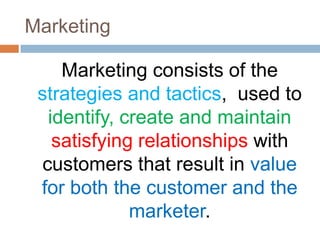
     Marketing consists of the
 strategies and tactics, used to
   identify, create and maintain
    satisfying relationships with
  customers that result in value
 for both the customer and the
              marketer.
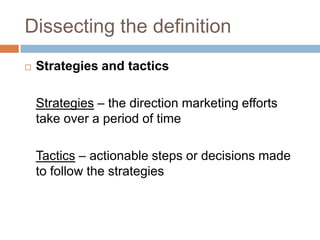
Dissecting the definition
   Strategies and tactics

    Strategies – the direction marketing efforts
    take over a period of time

    Tactics – actionable steps or decisions made
    to follow the strategies
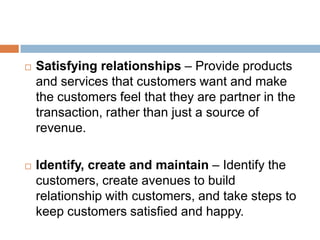
   Satisfying relationships – Provide products
    and services that customers want and make
    the customers feel that they are partner in the
    transaction, rather than just a source of
    revenue.

   Identify, create and maintain – Identify the
    customers, create avenues to build
    relationship with customers, and take steps to
    keep customers satisfied and happy.
   Value for both customer and marketer –
    both the customer and marketer gain benefit,
    not necessarily monetary.
Role of Marketing
   Developing products that satisfy needs and enhance
    society‟s quality of life.

   Creating a competitive environment that helps lower
    product prices.
   Developing product distribution system to provide
    product to a large number of customers and many
    geographic locations

   Building demand for products that require
    organizations to expand labor force
Marketing Mix

   A planned mix of the controllable elements of
    the product‟s marketing plan.

   They are adjusted until the right combination
    of the elements is found to serve the needs of
    the consumer and generating income for the
    organization
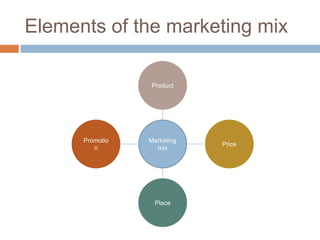
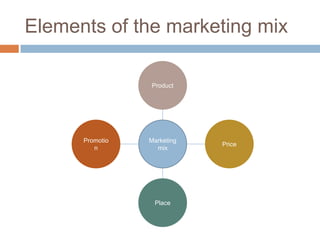
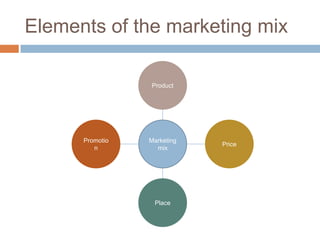
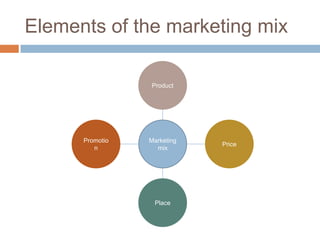
Elements of the marketing mix

                 Product


      Promotio   Marketing
                             Price
         n         mix


                  Place
Product
   The actual goods or services made for
    consumers according to their needs and
    requirements.

   Supporting elements like warranties and
    guarantees are also included in Product.

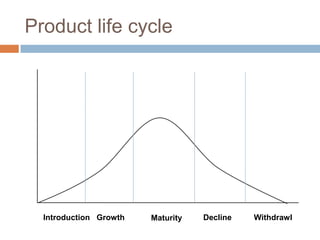
   Every product goes through a cycle called
    product life cycle. At each stage different
    strategies are used.
Product life cycle


  Introduction Growth   Maturity   Decline   Withdrawl
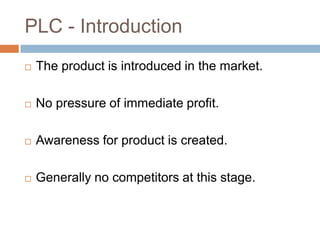
PLC - Introduction
   The product is introduced in the market.

   No pressure of immediate profit.

   Awareness for product is created.

   Generally no competitors at this stage.
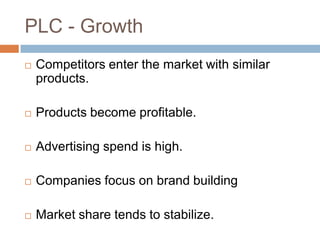
PLC - Growth
   Competitors enter the market with similar
    products.

   Products become profitable.

   Advertising spend is high.

   Companies focus on brand building

   Market share tends to stabilize.
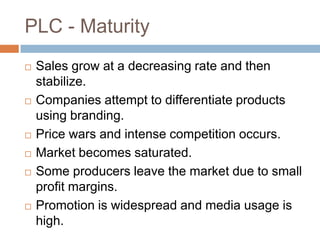
PLC - Maturity
   Sales grow at a decreasing rate and then
    stabilize.
   Companies attempt to differentiate products
    using branding.
   Price wars and intense competition occurs.
   Market becomes saturated.
   Some producers leave the market due to small
    profit margins.
   Promotion is widespread and media usage is
    high.
PLC - Decline
   More innovative products have entered the
    market.

   Consumers tastes have changed.

   Intense price –cutting

   Marketing spend is decreased.
PLC - Withdrawl


   Products are finally removed from the market,
    producers move on to other businesses.
Elements of the marketing mix

                 Product


      Promotio   Marketing
                             Price
         n         mix


                  Place
Price


  The process of setting a price
 for a product, including all kinds
       of incurred costs like
  production cost, manufacturing
 cost, storage cost, discounts to
           be offered etc.
Pricing strategies
   Four basic strategies

     Premium    pricing

     Penetration   Pricing

     Economy    Pricing

     Price   Skimming
Premium pricing
   Use a higher price where there is a
    uniqueness about the product or service.

   Used when a substantial competitive
    advantage exists.
   Such prices are charged for luxuries.
Penetration Pricing
   The price charged for products and services is
    set artificially low in order to gain market
    share.

   Once it is achieved , the price is increased.

   E.g. Habeeb masala used low introductory
    prices .
Economy pricing
   A no frills low price.


   The cost of manufacturing and marketing are
    kept at a minimum.
Price skimming
   Charge a high price because you have a
    substantial competitive advantage.

   This high price tends to attract new competitors
    into the market.

   As a result price of the product falls due to
    increased prices

   E.g telecom services
Other pricing strategies
   Psychological pricing
   Product line pricing
   Optional product pricing
   Captive product pricing
   Product bundle pricing
   Promotional pricing
   Geographical pricing
   Value pricing
   Psychological pricing
     Used  when marketer wants the consumer to
      respond on an emotional basis rather than a
      rational basis.
     E.g. 99 rupees only as compared to Rs.100

     Rs. 399 instead of Rs.400


   Product line pricing
     When   there is a range of services the pricing
      reflects the benefits of parts of the range.
     E.g hair cut – Rs. 300, protein treatment – Rs.
      400, whole package – Rs. 700
   Optional product pricing
     Companies will start to increase the amount the
      customer spends once they start to buy, by offering
      them the optional but tempting “extras”.
     E.g extra cheese for Rs.50 on a Rs.1100 pizza


   Captive product pricing
     The basic product is charged low. The
      accessories/refills/re usable parts are priced using
      premium pricing strategy
     E.g. a different charger for Samsung cellphones.


   Product bundle pricing
     Sellers combine several products in the same
      package.
     Usually used to move old stock.
   Promotional pricing
     Price used to promote a product.
     E.g. buy one get free


   Geographical Pricing
     Price varies in different geographical regions
     E.g. fast food items


   Value pricing
     When external factors like recession or increased
      competition force companies to provide „value‟
      products and services to retain sales.
     e.g. value meals at McDonalds
Elements of the marketing mix

                 Product


      Promotio   Marketing
                             Price
         n         mix


                  Place
Place

   Also called channel, distribution or
    intermediary.

   The mechanism through which goods or
    services are moved from the manufacturer/
    service provider to the user or consumer.
6 basic channel decisions
   1. Do we use direct or indirect channels?
    (direct to consumerr or indirect through a
    wholesaler)
   Single or multiple channels
   Cumulative length of the multiple channels
   Types of intermediary
   No of intermediary at each level
   Which companies as intermediaries to avoid
    „intrachannel‟ conflicts (e.g. fighting between
    local distributors)
Selection consideration
How to select a distributor:
 Market Segment

     Distributor
               must be familiar with your target
      consumer and segment


   Changes at different PLC stages
     In introductory phase, product may be available at
      specific locations. In maturity, at many generic
      locations.
Channel intermediaries
   Wholesalers
     Purchase    bulk, break down into packages, resell
      to retailers and have storage facilities
     Reduce producer to consumer contact, take some
      of marketing responsibilities.


   Agents
     Secure orders for producer and take commission,
     do not purchase product. Usually used in
     international markets.
Channel intermediaries
   Retailers
     Have a stronger personal relationship with the
      consumer.
     Holds several brands and products, hence consumer
      is exposed to several products.
     Are a strong brand themselves , e.g. Makro, Metro,
      Imtiaz…
   Internet
     Geographically dispersed market.
     Product reaches a wide audience

     Set up costs are low.

     Use e-commerce for payment.
Elements of the marketing mix

                 Product


      Promotio   Marketing
                             Price
         n         mix


                  Place
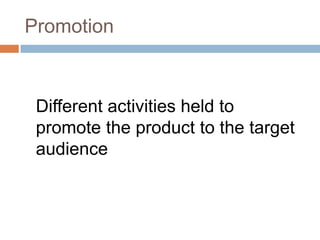
Promotion


 Different activities held to
 promote the product to the target
 audience
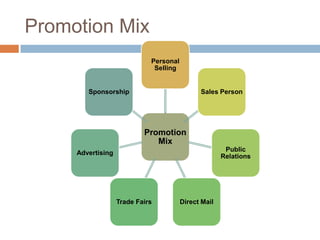
Promotion Mix
                             Personal
                              Selling


        Sponsorship                           Sales Person


                           Promotion
                              Mix
                                                       Public
     Advertising
                                                      Relations


                   Trade Fairs          Direct Mail
Personal Selling
   Effective way to manage personal customer
    relationships.

   The sales person acts on the behalf of the
    organization

   They contact consumers personally and
    motivate them to buy a product.
Sales Promotion
   All kinds of promotions except advertising,
    personal selling and public relations.
   E.g
     buy  one get one free
     Coupons
     Money off promotions
     Introductory offers
     Free accessories

   Should be carefully costed and compared with
    the next best alternative
Public Relations

   Deliberate, planned, sustained effort to
    establish and maintain mutually beneficial
    relationship between an organization and it‟s
    publics.

   Cheaper than other promotional elements.
Direct Mail
   Customers are targeted based upon a
    database.

   An email or snail mail is sent directly to
    customers in the specific target market, with
    the expectation that some of them will place an
    order.

   E.g. Medical students can be sent a mail
    regarding medical textbooks.
Trade Fairs and Exhibitions
   Used to meet companies to meet with both the
    trade and the consumer

   Intention is to create an impression rather than
    sell the product.

   Exhibitions are good for making new contacts
    and renewing old ones.
Advertising
   „Paid for‟ communication

   Used to develop attitudes, create awareness,
    and transmit information in order to gain
    response from the target market.

   Advertising media such as newspapers,
    magazines and journals, televsion, etc.
Sponsorship
   When an organization pays to be associated
    with a particular event, cause or image.

   Companies sponsor sports events like
    Olympics or Formula One, or TV shows etc.
    e.g Olper‟s associated with morning shows,
    Kisan pak raha hay kia etc.

   The attributes of the event are then associated
    with the sponsoring organization.

Advanced advertising marketing

  • 1.
  • 2.
    What exactly is“Marketing”?
  • 4.
    Marketing Marketing consists of the strategies and tactics, used to identify, create and maintain satisfying relationships with customers that result in value for both the customer and the marketer.
  • 5.
    Dissecting the definition  Strategies and tactics Strategies – the direction marketing efforts take over a period of time Tactics – actionable steps or decisions made to follow the strategies
  • 6.
    Satisfying relationships – Provide products and services that customers want and make the customers feel that they are partner in the transaction, rather than just a source of revenue.  Identify, create and maintain – Identify the customers, create avenues to build relationship with customers, and take steps to keep customers satisfied and happy.
  • 7.
    Value for both customer and marketer – both the customer and marketer gain benefit, not necessarily monetary.
  • 8.
    Role of Marketing  Developing products that satisfy needs and enhance society‟s quality of life.  Creating a competitive environment that helps lower product prices.  Developing product distribution system to provide product to a large number of customers and many geographic locations  Building demand for products that require organizations to expand labor force
  • 9.
    Marketing Mix  A planned mix of the controllable elements of the product‟s marketing plan.  They are adjusted until the right combination of the elements is found to serve the needs of the consumer and generating income for the organization
  • 10.
    Elements of themarketing mix Product Promotio Marketing Price n mix Place
  • 11.
    Product  The actual goods or services made for consumers according to their needs and requirements.  Supporting elements like warranties and guarantees are also included in Product.  Every product goes through a cycle called product life cycle. At each stage different strategies are used.
  • 12.
    Product life cycle Introduction Growth Maturity Decline Withdrawl
  • 13.
    PLC - Introduction  The product is introduced in the market.  No pressure of immediate profit.  Awareness for product is created.  Generally no competitors at this stage.
  • 14.
    PLC - Growth  Competitors enter the market with similar products.  Products become profitable.  Advertising spend is high.  Companies focus on brand building  Market share tends to stabilize.
  • 15.
    PLC - Maturity  Sales grow at a decreasing rate and then stabilize.  Companies attempt to differentiate products using branding.  Price wars and intense competition occurs.  Market becomes saturated.  Some producers leave the market due to small profit margins.  Promotion is widespread and media usage is high.
  • 16.
    PLC - Decline  More innovative products have entered the market.  Consumers tastes have changed.  Intense price –cutting  Marketing spend is decreased.
  • 17.
    PLC - Withdrawl  Products are finally removed from the market, producers move on to other businesses.
  • 18.
    Elements of themarketing mix Product Promotio Marketing Price n mix Place
  • 19.
    Price Theprocess of setting a price for a product, including all kinds of incurred costs like production cost, manufacturing cost, storage cost, discounts to be offered etc.
  • 20.
    Pricing strategies  Four basic strategies  Premium pricing  Penetration Pricing  Economy Pricing  Price Skimming
  • 21.
    Premium pricing  Use a higher price where there is a uniqueness about the product or service.  Used when a substantial competitive advantage exists.  Such prices are charged for luxuries.
  • 22.
    Penetration Pricing  The price charged for products and services is set artificially low in order to gain market share.  Once it is achieved , the price is increased.  E.g. Habeeb masala used low introductory prices .
  • 23.
    Economy pricing  A no frills low price.  The cost of manufacturing and marketing are kept at a minimum.
  • 24.
    Price skimming  Charge a high price because you have a substantial competitive advantage.  This high price tends to attract new competitors into the market.  As a result price of the product falls due to increased prices  E.g telecom services
  • 25.
    Other pricing strategies  Psychological pricing  Product line pricing  Optional product pricing  Captive product pricing  Product bundle pricing  Promotional pricing  Geographical pricing  Value pricing
  • 26.
    Psychological pricing  Used when marketer wants the consumer to respond on an emotional basis rather than a rational basis.  E.g. 99 rupees only as compared to Rs.100  Rs. 399 instead of Rs.400  Product line pricing  When there is a range of services the pricing reflects the benefits of parts of the range.  E.g hair cut – Rs. 300, protein treatment – Rs. 400, whole package – Rs. 700
  • 27.
    Optional product pricing  Companies will start to increase the amount the customer spends once they start to buy, by offering them the optional but tempting “extras”.  E.g extra cheese for Rs.50 on a Rs.1100 pizza  Captive product pricing  The basic product is charged low. The accessories/refills/re usable parts are priced using premium pricing strategy  E.g. a different charger for Samsung cellphones.  Product bundle pricing  Sellers combine several products in the same package.  Usually used to move old stock.
  • 28.
    Promotional pricing  Price used to promote a product.  E.g. buy one get free  Geographical Pricing  Price varies in different geographical regions  E.g. fast food items  Value pricing  When external factors like recession or increased competition force companies to provide „value‟ products and services to retain sales.  e.g. value meals at McDonalds
  • 29.
    Elements of themarketing mix Product Promotio Marketing Price n mix Place
  • 30.
    Place  Also called channel, distribution or intermediary.  The mechanism through which goods or services are moved from the manufacturer/ service provider to the user or consumer.
  • 31.
    6 basic channeldecisions  1. Do we use direct or indirect channels? (direct to consumerr or indirect through a wholesaler)  Single or multiple channels  Cumulative length of the multiple channels  Types of intermediary  No of intermediary at each level  Which companies as intermediaries to avoid „intrachannel‟ conflicts (e.g. fighting between local distributors)
  • 32.
    Selection consideration How toselect a distributor:  Market Segment  Distributor must be familiar with your target consumer and segment  Changes at different PLC stages  In introductory phase, product may be available at specific locations. In maturity, at many generic locations.
  • 33.
    Channel intermediaries  Wholesalers  Purchase bulk, break down into packages, resell to retailers and have storage facilities  Reduce producer to consumer contact, take some of marketing responsibilities.  Agents  Secure orders for producer and take commission, do not purchase product. Usually used in international markets.
  • 34.
    Channel intermediaries  Retailers  Have a stronger personal relationship with the consumer.  Holds several brands and products, hence consumer is exposed to several products.  Are a strong brand themselves , e.g. Makro, Metro, Imtiaz…  Internet  Geographically dispersed market.  Product reaches a wide audience  Set up costs are low.  Use e-commerce for payment.
  • 35.
    Elements of themarketing mix Product Promotio Marketing Price n mix Place
  • 36.
    Promotion Different activitiesheld to promote the product to the target audience
  • 37.
    Promotion Mix Personal Selling Sponsorship Sales Person Promotion Mix Public Advertising Relations Trade Fairs Direct Mail
  • 38.
    Personal Selling  Effective way to manage personal customer relationships.  The sales person acts on the behalf of the organization  They contact consumers personally and motivate them to buy a product.
  • 39.
    Sales Promotion  All kinds of promotions except advertising, personal selling and public relations.  E.g  buy one get one free  Coupons  Money off promotions  Introductory offers  Free accessories  Should be carefully costed and compared with the next best alternative
  • 40.
    Public Relations  Deliberate, planned, sustained effort to establish and maintain mutually beneficial relationship between an organization and it‟s publics.  Cheaper than other promotional elements.
  • 41.
    Direct Mail  Customers are targeted based upon a database.  An email or snail mail is sent directly to customers in the specific target market, with the expectation that some of them will place an order.  E.g. Medical students can be sent a mail regarding medical textbooks.
  • 42.
    Trade Fairs andExhibitions  Used to meet companies to meet with both the trade and the consumer  Intention is to create an impression rather than sell the product.  Exhibitions are good for making new contacts and renewing old ones.
  • 43.
    Advertising  „Paid for‟ communication  Used to develop attitudes, create awareness, and transmit information in order to gain response from the target market.  Advertising media such as newspapers, magazines and journals, televsion, etc.
  • 44.
    Sponsorship  When an organization pays to be associated with a particular event, cause or image.  Companies sponsor sports events like Olympics or Formula One, or TV shows etc. e.g Olper‟s associated with morning shows, Kisan pak raha hay kia etc.  The attributes of the event are then associated with the sponsoring organization.