Topics to becovered
1.Usage Patterns
2.Managed AI Services
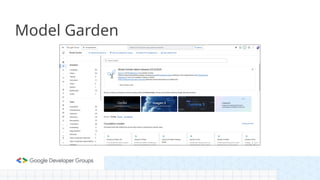
3.Model Garden
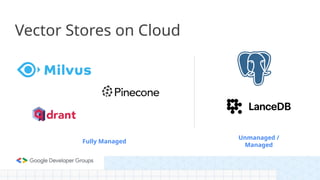
4.Vector Stores on Cloud
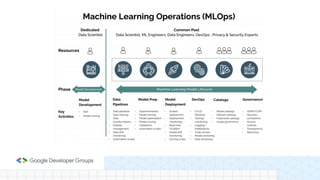
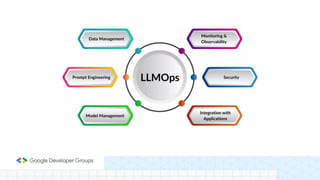
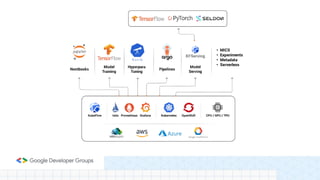
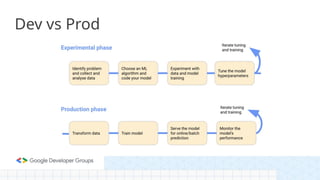
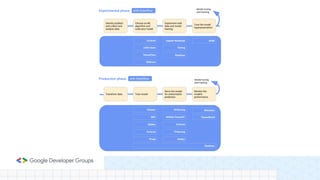
5.MLOps/ LLMOps
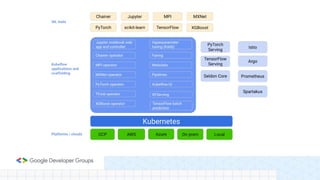
6.AI Meets Kubernetes
7.Kube Flow Architecture
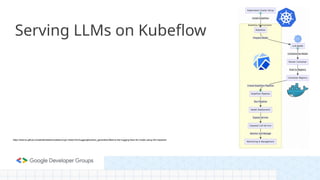
8.Serving LLMs on Kube Flow
9.AI Agents [additional]
10.Q & A
3.
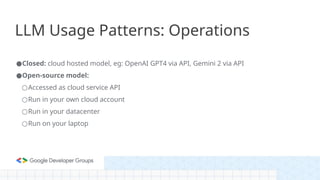
●Closed: cloud hostedmodel, eg: OpenAI GPT4 via API, Gemini 2 via API
●Open-source model:
○Accessed as cloud service API
○Run in your own cloud account
○Run in your datacenter
○Run on your laptop
LLM Usage Patterns: Operations
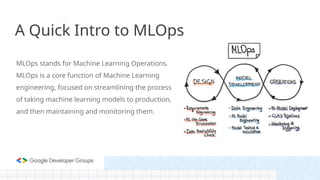
MLOps stands forMachine Learning Operations.
MLOps is a core function of Machine Learning
engineering, focused on streamlining the process
of taking machine learning models to production,
and then maintaining and monitoring them.
A Quick Intro to MLOps
12.
●Kubernetes is aContainer Orchestration platform.
●Specialized ML platform that is built for Kubernetes
●Collection of Pods and provides container images to
run ML workloads in Kubernetes Pods
Kubeflow and Kubernetes
13.
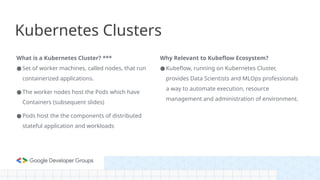
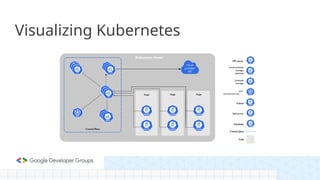
What is aKubernetes Cluster? ***
● Set of worker machines, called nodes, that run
containerized applications.
● The worker nodes host the Pods which have
Containers (subsequent slides)
● Pods host the the components of distributed
stateful application and workloads
Kubernetes Clusters
Why Relevant to Kubeflow Ecosystem?
● Kubeflow, running on Kubernetes Cluster,
provides Data Scientists and MLOps professionals
a way to automate execution, resource
management and administration of environment.
14.
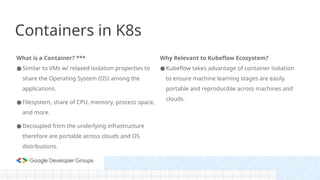
What is aContainer? ***
● Similar to VMs w/ relaxed isolation properties to
share the Operating System (OS) among the
applications.
● Filesystem, share of CPU, memory, process space,
and more.
● Decoupled from the underlying infrastructure
therefore are portable across clouds and OS
distributions.
Containers in K8s
Why Relevant to Kubeflow Ecosystem?
● Kubeflow takes advantage of container isolation
to ensure machine learning stages are easily
portable and reproducible across machines and
clouds.
15.
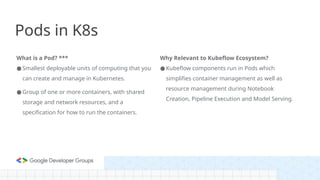
What is aPod? ***
● Smallest deployable units of computing that you
can create and manage in Kubernetes.
● Group of one or more containers, with shared
storage and network resources, and a
specification for how to run the containers.
Pods in K8s
Why Relevant to Kubeflow Ecosystem?
● Kubeflow components run in Pods which
simplifies container management as well as
resource management during Notebook
Creation, Pipeline Execution and Model Serving.
16.
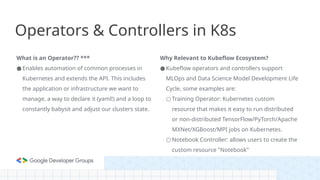
What is anOperator?? ***
● Enables automation of common processes in
Kubernetes and extends the API. This includes
the application or infrastructure we want to
manage, a way to declare it (yaml!) and a loop to
constantly babysit and adjust our clusters state.
Operators & Controllers in K8s
Why Relevant to Kubeflow Ecosystem?
● Kubeflow operators and controllers support
MLOps and Data Science Model Development Life
Cycle, some examples are:
○ Training Operator: Kubernetes custom
resource that makes it easy to run distributed
or non-distributed TensorFlow/PyTorch/Apache
MXNet/XGBoost/MPI jobs on Kubernetes.
○ Notebook Controller: allows users to create the
custom resource "Notebook"
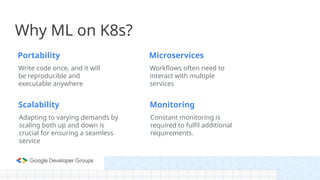
Portability
Write code once,and it will
be reproducible and
executable anywhere
Why ML on K8s?
Microservices
Workflows often need to
interact with multiple
services
Scalability
Adapting to varying demands by
scaling both up and down is
crucial for ensuring a seamless
service
Monitoring
Constant monitoring is
required to fulfil additional
requirements.
20.
Kubeflow, introduced byGoogle, is an open-source platform for
machine learning and MLOps on Kubernetes.
It is a complete toolkit for an ML workflow including data, training,
tuning, serving, monitoring and automated ML.
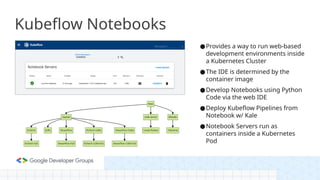
Kubeflow Notebooks
●Provides away to run web-based
development environments inside
a Kubernetes Cluster
●The IDE is determined by the
container image
●Develop Notebooks using Python
Code via the web IDE
●Deploy Kubeflow Pipelines from
Notebook w/ Kale
●Notebook Servers run as
containers inside a Kubernetes
Pod
28.
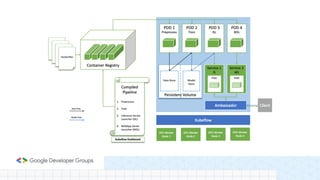
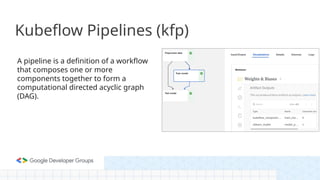
Kubeflow Pipelines (kfp)
Apipeline is a definition of a workflow
that composes one or more
components together to form a
computational directed acyclic graph
(DAG).
29.
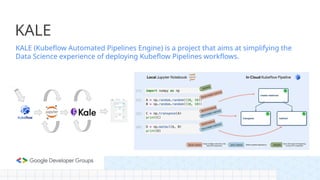
KALE
KALE (Kubeflow AutomatedPipelines Engine) is a project that aims at simplifying the
Data Science experience of deploying Kubeflow Pipelines workflows.
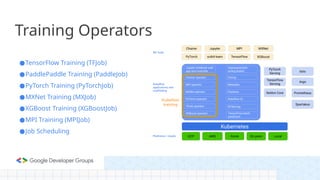
●TensorFlow Training (TFJob)
●PaddlePaddleTraining (PaddleJob)
●PyTorch Training (PyTorchJob)
●MXNet Training (MXJob)
●XGBoost Training (XGBoostJob)
●MPI Training (MPIJob)
●Job Scheduling
Training Operators
32.
KServe
● is aModel Inference Platform that runs on Kubernetes, built for highly scalable use cases
● provides a performant, standardized inference protocol across ML frameworks
● supports serverless inference workload with Autoscaling, including Scale to Zero on GP
● provides high scalability, density packing, intelligent routing using ModelMesh
● provides simple and pluggable production serving including prediction, pre/post processing, monitoring
and explainability
● advanced deployments with canary rollout, experiments, ensembles and transformers
Contact me on:
•Linkedin:
https://www.linkedin.com/in/sureshmichael
/
• Twitter:
https://twitter.com/TSMPeiris
• Email:
suresh@inforwaves.com
Questions and
Answers
Editor's Notes
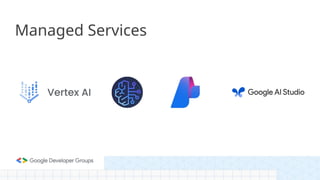
#3 In brief VertexAI is Google’s all in one managed AI platform, earlier it was mainly called AI platform, now everything is fully integrated into one place
Vertex AI is a unified AI platform that brings together all of Google's machine learning services under one roof. You can easily build machine learning models, deploy them, and scale them with Vertex AI's pre-trained and custom tooling. You can use AutoML and other advanced ML components to greatly improve productivity and scalability when developing ML solutions on Vertex AI. Vertex AI was also designed to be a user-friendly platform for beginners as well as a time-saving solution for experts, according to Google. That's why it's simple to train models and uses 80 percent fewer lines of code.
Vertex AI provides unified definitions/implementations of four concepts:
A dataset can be structured or unstructured. It has managed metadata including annotations, and can be stored anywhere on GCP. Realize that this is the vision — at present only Cloud Storage and BigQuery are supported. Not Bigtable or Pub/Sub (yet).
A training pipeline is a series of containerized steps that can be used to train an ML model using a dataset. The containerization helps with generalization, reproducibility, and auditability.
A model is an ML model with metadata that was built with a Training Pipeline or directly loaded (as long as it is in a compatible format).
An endpoint can be invoked by users for online predictions and explanations. It can have one or more models, and one or more versions of those models, with disambiguation carried out based on the request.
#4 In brief VertexAI is Google’s all in one managed AI platform, earlier it was mainly called AI platform, now everything is fully integrated into one place
Vertex AI is a unified AI platform that brings together all of Google's machine learning services under one roof. You can easily build machine learning models, deploy them, and scale them with Vertex AI's pre-trained and custom tooling. You can use AutoML and other advanced ML components to greatly improve productivity and scalability when developing ML solutions on Vertex AI. Vertex AI was also designed to be a user-friendly platform for beginners as well as a time-saving solution for experts, according to Google. That's why it's simple to train models and uses 80 percent fewer lines of code.
Vertex AI provides unified definitions/implementations of four concepts:
A dataset can be structured or unstructured. It has managed metadata including annotations, and can be stored anywhere on GCP. Realize that this is the vision — at present only Cloud Storage and BigQuery are supported. Not Bigtable or Pub/Sub (yet).
A training pipeline is a series of containerized steps that can be used to train an ML model using a dataset. The containerization helps with generalization, reproducibility, and auditability.
A model is an ML model with metadata that was built with a Training Pipeline or directly loaded (as long as it is in a compatible format).
An endpoint can be invoked by users for online predictions and explanations. It can have one or more models, and one or more versions of those models, with disambiguation carried out based on the request.
#6 In brief VertexAI is Google’s all in one managed AI platform, earlier it was mainly called AI platform, now everything is fully integrated into one place
Vertex AI is a unified AI platform that brings together all of Google's machine learning services under one roof. You can easily build machine learning models, deploy them, and scale them with Vertex AI's pre-trained and custom tooling. You can use AutoML and other advanced ML components to greatly improve productivity and scalability when developing ML solutions on Vertex AI. Vertex AI was also designed to be a user-friendly platform for beginners as well as a time-saving solution for experts, according to Google. That's why it's simple to train models and uses 80 percent fewer lines of code.
Vertex AI provides unified definitions/implementations of four concepts:
A dataset can be structured or unstructured. It has managed metadata including annotations, and can be stored anywhere on GCP. Realize that this is the vision — at present only Cloud Storage and BigQuery are supported. Not Bigtable or Pub/Sub (yet).
A training pipeline is a series of containerized steps that can be used to train an ML model using a dataset. The containerization helps with generalization, reproducibility, and auditability.
A model is an ML model with metadata that was built with a Training Pipeline or directly loaded (as long as it is in a compatible format).
An endpoint can be invoked by users for online predictions and explanations. It can have one or more models, and one or more versions of those models, with disambiguation carried out based on the request.
#11 In brief VertexAI is Google’s all in one managed AI platform, earlier it was mainly called AI platform, now everything is fully integrated into one place
Vertex AI is a unified AI platform that brings together all of Google's machine learning services under one roof. You can easily build machine learning models, deploy them, and scale them with Vertex AI's pre-trained and custom tooling. You can use AutoML and other advanced ML components to greatly improve productivity and scalability when developing ML solutions on Vertex AI. Vertex AI was also designed to be a user-friendly platform for beginners as well as a time-saving solution for experts, according to Google. That's why it's simple to train models and uses 80 percent fewer lines of code.
Vertex AI provides unified definitions/implementations of four concepts:
A dataset can be structured or unstructured. It has managed metadata including annotations, and can be stored anywhere on GCP. Realize that this is the vision — at present only Cloud Storage and BigQuery are supported. Not Bigtable or Pub/Sub (yet).
A training pipeline is a series of containerized steps that can be used to train an ML model using a dataset. The containerization helps with generalization, reproducibility, and auditability.
A model is an ML model with metadata that was built with a Training Pipeline or directly loaded (as long as it is in a compatible format).
An endpoint can be invoked by users for online predictions and explanations. It can have one or more models, and one or more versions of those models, with disambiguation carried out based on the request.
#12 In brief VertexAI is Google’s all in one managed AI platform, earlier it was mainly called AI platform, now everything is fully integrated into one place
Vertex AI is a unified AI platform that brings together all of Google's machine learning services under one roof. You can easily build machine learning models, deploy them, and scale them with Vertex AI's pre-trained and custom tooling. You can use AutoML and other advanced ML components to greatly improve productivity and scalability when developing ML solutions on Vertex AI. Vertex AI was also designed to be a user-friendly platform for beginners as well as a time-saving solution for experts, according to Google. That's why it's simple to train models and uses 80 percent fewer lines of code.
Vertex AI provides unified definitions/implementations of four concepts:
A dataset can be structured or unstructured. It has managed metadata including annotations, and can be stored anywhere on GCP. Realize that this is the vision — at present only Cloud Storage and BigQuery are supported. Not Bigtable or Pub/Sub (yet).
A training pipeline is a series of containerized steps that can be used to train an ML model using a dataset. The containerization helps with generalization, reproducibility, and auditability.
A model is an ML model with metadata that was built with a Training Pipeline or directly loaded (as long as it is in a compatible format).
An endpoint can be invoked by users for online predictions and explanations. It can have one or more models, and one or more versions of those models, with disambiguation carried out based on the request.
#13 In brief VertexAI is Google’s all in one managed AI platform, earlier it was mainly called AI platform, now everything is fully integrated into one place
Vertex AI is a unified AI platform that brings together all of Google's machine learning services under one roof. You can easily build machine learning models, deploy them, and scale them with Vertex AI's pre-trained and custom tooling. You can use AutoML and other advanced ML components to greatly improve productivity and scalability when developing ML solutions on Vertex AI. Vertex AI was also designed to be a user-friendly platform for beginners as well as a time-saving solution for experts, according to Google. That's why it's simple to train models and uses 80 percent fewer lines of code.
Vertex AI provides unified definitions/implementations of four concepts:
A dataset can be structured or unstructured. It has managed metadata including annotations, and can be stored anywhere on GCP. Realize that this is the vision — at present only Cloud Storage and BigQuery are supported. Not Bigtable or Pub/Sub (yet).
A training pipeline is a series of containerized steps that can be used to train an ML model using a dataset. The containerization helps with generalization, reproducibility, and auditability.
A model is an ML model with metadata that was built with a Training Pipeline or directly loaded (as long as it is in a compatible format).
An endpoint can be invoked by users for online predictions and explanations. It can have one or more models, and one or more versions of those models, with disambiguation carried out based on the request.
#14 In brief VertexAI is Google’s all in one managed AI platform, earlier it was mainly called AI platform, now everything is fully integrated into one place
Vertex AI is a unified AI platform that brings together all of Google's machine learning services under one roof. You can easily build machine learning models, deploy them, and scale them with Vertex AI's pre-trained and custom tooling. You can use AutoML and other advanced ML components to greatly improve productivity and scalability when developing ML solutions on Vertex AI. Vertex AI was also designed to be a user-friendly platform for beginners as well as a time-saving solution for experts, according to Google. That's why it's simple to train models and uses 80 percent fewer lines of code.
Vertex AI provides unified definitions/implementations of four concepts:
A dataset can be structured or unstructured. It has managed metadata including annotations, and can be stored anywhere on GCP. Realize that this is the vision — at present only Cloud Storage and BigQuery are supported. Not Bigtable or Pub/Sub (yet).
A training pipeline is a series of containerized steps that can be used to train an ML model using a dataset. The containerization helps with generalization, reproducibility, and auditability.
A model is an ML model with metadata that was built with a Training Pipeline or directly loaded (as long as it is in a compatible format).
An endpoint can be invoked by users for online predictions and explanations. It can have one or more models, and one or more versions of those models, with disambiguation carried out based on the request.
#15 In brief VertexAI is Google’s all in one managed AI platform, earlier it was mainly called AI platform, now everything is fully integrated into one place
Vertex AI is a unified AI platform that brings together all of Google's machine learning services under one roof. You can easily build machine learning models, deploy them, and scale them with Vertex AI's pre-trained and custom tooling. You can use AutoML and other advanced ML components to greatly improve productivity and scalability when developing ML solutions on Vertex AI. Vertex AI was also designed to be a user-friendly platform for beginners as well as a time-saving solution for experts, according to Google. That's why it's simple to train models and uses 80 percent fewer lines of code.
Vertex AI provides unified definitions/implementations of four concepts:
A dataset can be structured or unstructured. It has managed metadata including annotations, and can be stored anywhere on GCP. Realize that this is the vision — at present only Cloud Storage and BigQuery are supported. Not Bigtable or Pub/Sub (yet).
A training pipeline is a series of containerized steps that can be used to train an ML model using a dataset. The containerization helps with generalization, reproducibility, and auditability.
A model is an ML model with metadata that was built with a Training Pipeline or directly loaded (as long as it is in a compatible format).
An endpoint can be invoked by users for online predictions and explanations. It can have one or more models, and one or more versions of those models, with disambiguation carried out based on the request.
#16 In brief VertexAI is Google’s all in one managed AI platform, earlier it was mainly called AI platform, now everything is fully integrated into one place
Vertex AI is a unified AI platform that brings together all of Google's machine learning services under one roof. You can easily build machine learning models, deploy them, and scale them with Vertex AI's pre-trained and custom tooling. You can use AutoML and other advanced ML components to greatly improve productivity and scalability when developing ML solutions on Vertex AI. Vertex AI was also designed to be a user-friendly platform for beginners as well as a time-saving solution for experts, according to Google. That's why it's simple to train models and uses 80 percent fewer lines of code.
Vertex AI provides unified definitions/implementations of four concepts:
A dataset can be structured or unstructured. It has managed metadata including annotations, and can be stored anywhere on GCP. Realize that this is the vision — at present only Cloud Storage and BigQuery are supported. Not Bigtable or Pub/Sub (yet).
A training pipeline is a series of containerized steps that can be used to train an ML model using a dataset. The containerization helps with generalization, reproducibility, and auditability.
A model is an ML model with metadata that was built with a Training Pipeline or directly loaded (as long as it is in a compatible format).
An endpoint can be invoked by users for online predictions and explanations. It can have one or more models, and one or more versions of those models, with disambiguation carried out based on the request.
#18 In brief VertexAI is Google’s all in one managed AI platform, earlier it was mainly called AI platform, now everything is fully integrated into one place
Vertex AI is a unified AI platform that brings together all of Google's machine learning services under one roof. You can easily build machine learning models, deploy them, and scale them with Vertex AI's pre-trained and custom tooling. You can use AutoML and other advanced ML components to greatly improve productivity and scalability when developing ML solutions on Vertex AI. Vertex AI was also designed to be a user-friendly platform for beginners as well as a time-saving solution for experts, according to Google. That's why it's simple to train models and uses 80 percent fewer lines of code.
Vertex AI provides unified definitions/implementations of four concepts:
A dataset can be structured or unstructured. It has managed metadata including annotations, and can be stored anywhere on GCP. Realize that this is the vision — at present only Cloud Storage and BigQuery are supported. Not Bigtable or Pub/Sub (yet).
A training pipeline is a series of containerized steps that can be used to train an ML model using a dataset. The containerization helps with generalization, reproducibility, and auditability.
A model is an ML model with metadata that was built with a Training Pipeline or directly loaded (as long as it is in a compatible format).
An endpoint can be invoked by users for online predictions and explanations. It can have one or more models, and one or more versions of those models, with disambiguation carried out based on the request.