MLN Community of Practice: Progress so far
S. Mugo, S. Kibet, F. Mwatuni, B. Wawa, and BM Prasanna
Presentation at the USAID-funded MLN Diagnostics and Management Project -
Annual Review and Planning Meeting (Nov 18-19, 2016)
A Community of Practice (CoP) is: “A group of
people who share a concern or a passion for
something they do and learn how to do it better as
they interact regularly.” (Etienne Wenger)
The purpose of this MLN Phytosanitary CoP is to
create and ensure a structure that allows the
stakeholders to promote the best practices in
controlling the spread and impact of MLN in SSA,
and to build common capability in MLN-related
phytosanitary procedures and practices across the
organisations.
Why have a MLN Phytosanitary CoP?
1. To identify, gather, and seek agreement on the
phytosanitary community requirements, especially for
effective control of MLN in SSA.
2. To provide a forum/platform for the cooperation of activities
where the MLN Phytosanitary CoP adds value to the
existing initiatives.
3. To share learning across borders on key aspects, such as
standardized MLN diagnostics procedure(s), providing
training on MLN diagnostics, expediting adoption of
appropriate phytosanitary and diagnostic procedures,
identifying/validating and deploying novel and low-cost
MLN diagnostic protocols, etc.
MLN Phytosanitary CoP: Objectives
4. To identify linkages and opportunities for collaborative
strategic and technical projects related to MLN
phytosanitation and diagnostics in SSA.
5. To report on progress and provide updates of the projects
and programmes that have phytosanitary and diagnostics
components related to MLN.
6. To review maize seed certification and import/export
procedures in relation to MLN, and formulate appropriate
SOPs.
MLN Phytosanitary CoP: Objectives
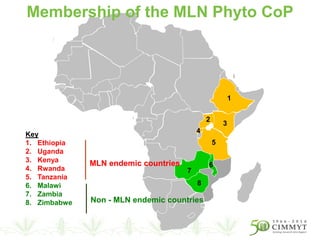
1
3
2
4
5
6
7
8
Key
1. Ethiopia
2. Uganda
3. Kenya
4. Rwanda
5. Tanzania
6. Malawi
7. Zambia
8. Zimbabwe
MLN endemic countries
Non - MLN endemic countries
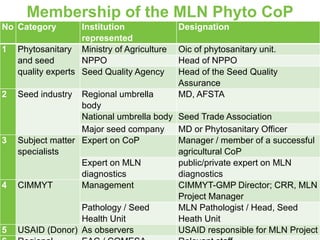
Membership of the MLN Phyto CoP
6
No Category Institution
represented
Designation
1 Phytosanitary
and seed
quality experts
Ministry of Agriculture Oic of phytosanitary unit.
NPPO Head of NPPO
Seed Quality Agency Head of the Seed Quality
Assurance
2 Seed industry Regional umbrella
body
MD, AFSTA
National umbrella body Seed Trade Association
Major seed company MD or Phytosanitary Officer
3 Subject matter
specialists
Expert on CoP Manager / member of a successful
agricultural CoP
Expert on MLN
diagnostics
public/private expert on MLN
diagnostics
4 CIMMYT Management CIMMYT-GMP Director; CRR, MLN
Project Manager
Pathology / Seed
Health Unit
MLN Pathologist / Head, Seed
Heath Unit
5 USAID (Donor) As observers USAID responsible for MLN Project
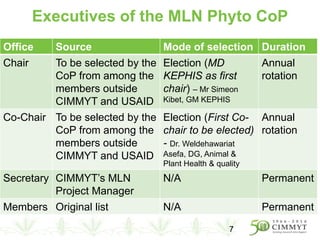
Executives of the MLN Phyto CoP
7
Office Source Mode of selection Duration
Chair To be selected by the
CoP from among the
members outside
CIMMYT and USAID
Election (MD
KEPHIS as first
chair) – Mr Simeon
Kibet, GM KEPHIS
Annual
rotation
Co-Chair To be selected by the
CoP from among the
members outside
CIMMYT and USAID
Election (First Co-
chair to be elected)
- Dr. Weldehawariat
Asefa, DG, Animal &
Plant Health & quality
Annual
rotation
Secretary CIMMYT’s MLN
Project Manager
N/A Permanent
Members Original list N/A Permanent
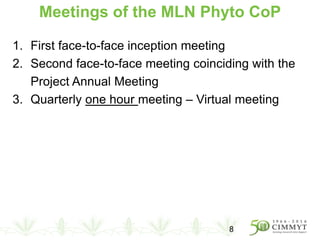
Meetings of the MLN Phyto CoP
1. First face-to-face inception meeting
2. Second face-to-face meeting coinciding with the
Project Annual Meeting
3. Quarterly one hour meeting – Virtual meeting
8
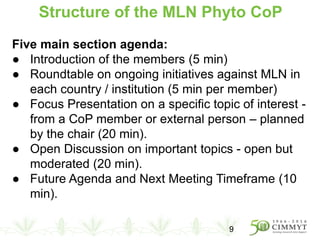
Structure of the MLN Phyto CoP
Five main section agenda:
● Introduction of the members (5 min)
● Roundtable on ongoing initiatives against MLN in
each country / institution (5 min per member)
● Focus Presentation on a specific topic of interest -
from a CoP member or external person – planned
by the chair (20 min).
● Open Discussion on important topics - open but
moderated (20 min).
● Future Agenda and Next Meeting Timeframe (10
min).
9
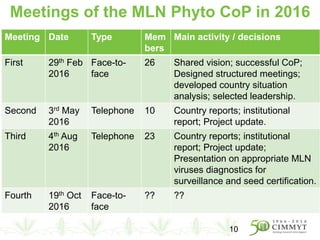
Meetings of the MLN Phyto CoP in 2016
10
Meeting Date Type Mem
bers
Main activity / decisions
First 29th Feb
2016
Face-to-
face
26 Shared vision; successful CoP;
Designed structured meetings;
developed country situation
analysis; selected leadership.
Second 3rd May
2016
Telephone 10 Country reports; institutional
report; Project update.
Third 4th Aug
2016
Telephone 23 Country reports; institutional
report; Project update;
Presentation on appropriate MLN
viruses diagnostics for
surveillance and seed certification.
Fourth 19th Oct
2016
Face-to-
face
?? ??
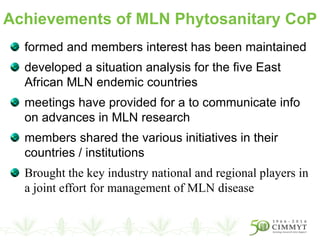
formed and members interest has been maintained
developed a situation analysis for the five East
African MLN endemic countries
meetings have provided for a to communicate info
on advances in MLN research
members shared the various initiatives in their
countries / institutions
Brought the key industry national and regional players in
a joint effort for management of MLN disease
Achievements of MLN Phytosanitary CoP
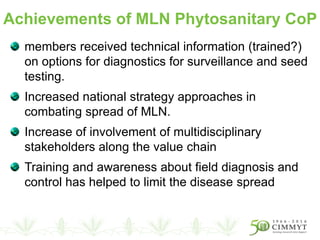
members received technical information (trained?)
on options for diagnostics for surveillance and seed
testing.
Increased national strategy approaches in
combating spread of MLN.
Increase of involvement of multidisciplinary
stakeholders along the value chain
Training and awareness about field diagnosis and
control has helped to limit the disease spread
Achievements of MLN Phytosanitary CoP
1. To identify, gather, and seek agreement on the
phytosanitary community requirements, especially for
effective control of MLN in SSA.
2. To provide a forum/platform for the cooperation of
activities where the MLN Phytosanitary CoP adds value
to the existing initiatives.
3. To share learning across borders on key aspects, such as
standardized MLN diagnostics procedure(s), providing
training on MLN diagnostics, expediting adoption of
appropriate phytosanitary and diagnostic procedures,
identifying / validating and deploying novel and low-cost
MLN diagnostic protocols, etc.
MLN Phytosanitary CoP: Objectives
4. To identify linkages and opportunities for collaborative
strategic and technical projects related to MLN
phytosanitation and diagnostics in SSA.
5. To report on progress and provide updates of the
projects and programmes that have phytosanitary and
diagnostics components related to MLN.
6. To review maize seed certification and import/export
procedures in relation to MLN, and formulate appropriate
SOPs.
MLN Phytosanitary CoP: Objectives
Mode for Virtual meetings:
● Webex / Skype / dial-in telephone limited by access to
internet services
● Telephone connectivity
● Telephone / skype / webex / dial-in / teleconferencing
services
● Shortage of time (1 hr for country reports, MLN project
update & technical brief)
Minimal debate outside the bi-monthly call
Low participation social media forum discussion
Inadequate resources for 1) effective and routine
surveillance and monitoring, 2) sensitizing farmers in proper
management of the MLN, training seed company
technicians and contract farmers (seed out-growers) on
sampling and testing for MLN.
Challenges
Regional approach ensured that countries strived to
achieve set goals
There is need to inform and interest high level agricultural
administrators in the MLN project countries
MLN phytosanitary CoP has been received as an
important aspect of combating MLN
MLN phytosanitary CoP has potential to be used for other
R4D projects
Lessons
Are the four meeting in a year adequate?
2016 = 2 face-to face and 2 virtual
2017 onward = 1 face to face and 3 virtual
Are we ready to include members from non
MLN-endemic countries?
Can CoP members adopt clear NPPO practices
for seed testing for MLND and threshold levels
for contaminated seed?
How can CoP help in ensuring affordable
diagnostic and testing kits.
Issues for discussion
Thank you
for your
interest!

MLN community of practice

  • 1.
    MLN Community ofPractice: Progress so far S. Mugo, S. Kibet, F. Mwatuni, B. Wawa, and BM Prasanna Presentation at the USAID-funded MLN Diagnostics and Management Project - Annual Review and Planning Meeting (Nov 18-19, 2016)
  • 2.
    A Community ofPractice (CoP) is: “A group of people who share a concern or a passion for something they do and learn how to do it better as they interact regularly.” (Etienne Wenger) The purpose of this MLN Phytosanitary CoP is to create and ensure a structure that allows the stakeholders to promote the best practices in controlling the spread and impact of MLN in SSA, and to build common capability in MLN-related phytosanitary procedures and practices across the organisations. Why have a MLN Phytosanitary CoP?
  • 3.
    1. To identify,gather, and seek agreement on the phytosanitary community requirements, especially for effective control of MLN in SSA. 2. To provide a forum/platform for the cooperation of activities where the MLN Phytosanitary CoP adds value to the existing initiatives. 3. To share learning across borders on key aspects, such as standardized MLN diagnostics procedure(s), providing training on MLN diagnostics, expediting adoption of appropriate phytosanitary and diagnostic procedures, identifying/validating and deploying novel and low-cost MLN diagnostic protocols, etc. MLN Phytosanitary CoP: Objectives
  • 4.
    4. To identifylinkages and opportunities for collaborative strategic and technical projects related to MLN phytosanitation and diagnostics in SSA. 5. To report on progress and provide updates of the projects and programmes that have phytosanitary and diagnostics components related to MLN. 6. To review maize seed certification and import/export procedures in relation to MLN, and formulate appropriate SOPs. MLN Phytosanitary CoP: Objectives
  • 5.
    1 3 2 4 5 6 7 8 Key 1. Ethiopia 2. Uganda 3.Kenya 4. Rwanda 5. Tanzania 6. Malawi 7. Zambia 8. Zimbabwe MLN endemic countries Non - MLN endemic countries Membership of the MLN Phyto CoP
  • 6.
    Membership of theMLN Phyto CoP 6 No Category Institution represented Designation 1 Phytosanitary and seed quality experts Ministry of Agriculture Oic of phytosanitary unit. NPPO Head of NPPO Seed Quality Agency Head of the Seed Quality Assurance 2 Seed industry Regional umbrella body MD, AFSTA National umbrella body Seed Trade Association Major seed company MD or Phytosanitary Officer 3 Subject matter specialists Expert on CoP Manager / member of a successful agricultural CoP Expert on MLN diagnostics public/private expert on MLN diagnostics 4 CIMMYT Management CIMMYT-GMP Director; CRR, MLN Project Manager Pathology / Seed Health Unit MLN Pathologist / Head, Seed Heath Unit 5 USAID (Donor) As observers USAID responsible for MLN Project
  • 7.
    Executives of theMLN Phyto CoP 7 Office Source Mode of selection Duration Chair To be selected by the CoP from among the members outside CIMMYT and USAID Election (MD KEPHIS as first chair) – Mr Simeon Kibet, GM KEPHIS Annual rotation Co-Chair To be selected by the CoP from among the members outside CIMMYT and USAID Election (First Co- chair to be elected) - Dr. Weldehawariat Asefa, DG, Animal & Plant Health & quality Annual rotation Secretary CIMMYT’s MLN Project Manager N/A Permanent Members Original list N/A Permanent
  • 8.
    Meetings of theMLN Phyto CoP 1. First face-to-face inception meeting 2. Second face-to-face meeting coinciding with the Project Annual Meeting 3. Quarterly one hour meeting – Virtual meeting 8
  • 9.
    Structure of theMLN Phyto CoP Five main section agenda: ● Introduction of the members (5 min) ● Roundtable on ongoing initiatives against MLN in each country / institution (5 min per member) ● Focus Presentation on a specific topic of interest - from a CoP member or external person – planned by the chair (20 min). ● Open Discussion on important topics - open but moderated (20 min). ● Future Agenda and Next Meeting Timeframe (10 min). 9
  • 10.
    Meetings of theMLN Phyto CoP in 2016 10 Meeting Date Type Mem bers Main activity / decisions First 29th Feb 2016 Face-to- face 26 Shared vision; successful CoP; Designed structured meetings; developed country situation analysis; selected leadership. Second 3rd May 2016 Telephone 10 Country reports; institutional report; Project update. Third 4th Aug 2016 Telephone 23 Country reports; institutional report; Project update; Presentation on appropriate MLN viruses diagnostics for surveillance and seed certification. Fourth 19th Oct 2016 Face-to- face ?? ??
  • 11.
    formed and membersinterest has been maintained developed a situation analysis for the five East African MLN endemic countries meetings have provided for a to communicate info on advances in MLN research members shared the various initiatives in their countries / institutions Brought the key industry national and regional players in a joint effort for management of MLN disease Achievements of MLN Phytosanitary CoP
  • 12.
    members received technicalinformation (trained?) on options for diagnostics for surveillance and seed testing. Increased national strategy approaches in combating spread of MLN. Increase of involvement of multidisciplinary stakeholders along the value chain Training and awareness about field diagnosis and control has helped to limit the disease spread Achievements of MLN Phytosanitary CoP
  • 13.
    1. To identify,gather, and seek agreement on the phytosanitary community requirements, especially for effective control of MLN in SSA. 2. To provide a forum/platform for the cooperation of activities where the MLN Phytosanitary CoP adds value to the existing initiatives. 3. To share learning across borders on key aspects, such as standardized MLN diagnostics procedure(s), providing training on MLN diagnostics, expediting adoption of appropriate phytosanitary and diagnostic procedures, identifying / validating and deploying novel and low-cost MLN diagnostic protocols, etc. MLN Phytosanitary CoP: Objectives
  • 14.
    4. To identifylinkages and opportunities for collaborative strategic and technical projects related to MLN phytosanitation and diagnostics in SSA. 5. To report on progress and provide updates of the projects and programmes that have phytosanitary and diagnostics components related to MLN. 6. To review maize seed certification and import/export procedures in relation to MLN, and formulate appropriate SOPs. MLN Phytosanitary CoP: Objectives
  • 15.
    Mode for Virtualmeetings: ● Webex / Skype / dial-in telephone limited by access to internet services ● Telephone connectivity ● Telephone / skype / webex / dial-in / teleconferencing services ● Shortage of time (1 hr for country reports, MLN project update & technical brief) Minimal debate outside the bi-monthly call Low participation social media forum discussion Inadequate resources for 1) effective and routine surveillance and monitoring, 2) sensitizing farmers in proper management of the MLN, training seed company technicians and contract farmers (seed out-growers) on sampling and testing for MLN. Challenges
  • 16.
    Regional approach ensuredthat countries strived to achieve set goals There is need to inform and interest high level agricultural administrators in the MLN project countries MLN phytosanitary CoP has been received as an important aspect of combating MLN MLN phytosanitary CoP has potential to be used for other R4D projects Lessons
  • 17.
    Are the fourmeeting in a year adequate? 2016 = 2 face-to face and 2 virtual 2017 onward = 1 face to face and 3 virtual Are we ready to include members from non MLN-endemic countries? Can CoP members adopt clear NPPO practices for seed testing for MLND and threshold levels for contaminated seed? How can CoP help in ensuring affordable diagnostic and testing kits. Issues for discussion
  • 18.