



HR and Communications:
Essential Business Catalysts
Maria Lazarimou
CEO Advocate/Burson-Marsteller
GPMA HR Forum 2014
Athens, April 24
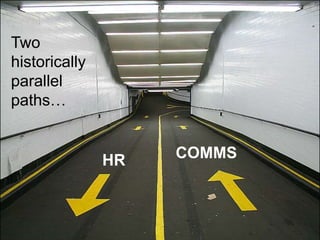
Two Historically Parallel paths
2
HR COMMS
Two
historically
parallel
paths…
…now converging
3
In today’s reputation driven
economy those functions have
no other choice but to
converge
They both need to serve
a common goal of
creating corporate value
4
To do this they both need to build a
bridge to the business strategy
5
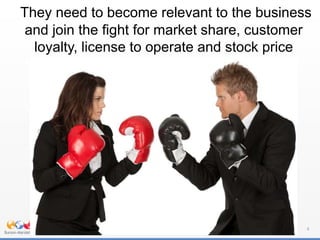
They need to become relevant to the business
and join the fight for market share, customer
loyalty, license to operate and stock price
A reputation Economy
6
“80 percent of reputation leaders across 300+ global
companies agree that we compete in a reputation economy
in which people buy products, take jobs, and make
investments based primarily on their trust, admiration and
appreciation for the companies and institutions that stand
behind them.
Only 20 percent feel they are ready to deliver on these
expectations and even take advantage of them.”
- 2013 Forbes Reputation Leaders study
7
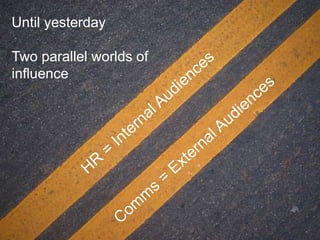
Until yesterday
Two parallel worlds of
influence
8
Today
Increasingly important HR Challenges
+
HR from the outside
9
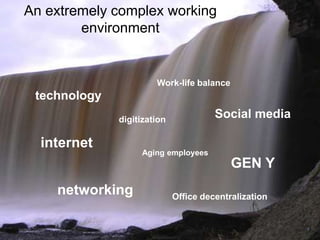
An extremely complex working
environment
technology
internet
Social media
GEN Y
networking
Work-life balance
Aging employees
digitization
Office decentralization
10
A new reality
Evolving challenges for HR
• Managing Talent
• Managing Demographics
• Becoming a learning
organization
• Managing work-life
balance
• Managing change and
cultural transformation
This is when HR & Coms started dating!
11
Both consumers and employees
seek companies with a vision
and a clear sense of purpose
12
The internal and external
view of a company becomes
unified.
13
HR and communications
have to work hand in
hand, developing and
nurturing the company’s
reputation.
14
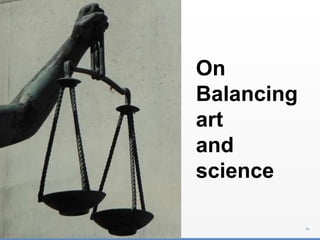
On
Balancing
art
and
science
15
Companies with high effectiveness
in change management &
communication are 3.5 times more
likely to significantly outperform
their industry peers than firms that
are not effective in these areas.
2013-2014 Change and
Communication ROI Study
16
“The project made us realize
that there are three outcomes
for most communication: to
inform, to instruct and to
inspire.”
[This] caused us to think differently about
outcomes. Why settle for informing
employees if there is a chance of
increasing their overall engagement with
the firm through more effective
communications?
Internal Communication as a business driver
17
HR & Communications
A Common Architecture
Burson-Marsteller has been tracking emerging organizational
performance trends and practices since 1997
18
• Scanning latest organizational performance- and organizational
communications-focused publications, studies and news coverage
• Conducting in-depth interviews with organizational performance counselors and
practitioners to understand the practices of public and private sector
organizations across most industries
• Leveraging Burson-Marsteller’s latest research on overall communications
trends, analyzing the implications for workplace communications
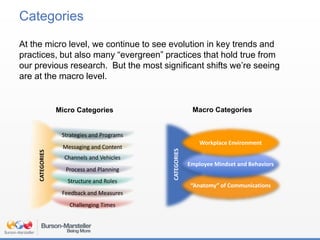
Categories
At the micro level, we continue to see evolution in key trends and
practices, but also many “evergreen” practices that hold true from
our previous research. But the most significant shifts we’re seeing
are at the macro level.
Micro Categories Macro Categories
CATEGORIES
Strategies and Programs
Messaging and Content
Channels and Vehicles
Process and Planning
Structure and Roles
Feedback and Measures
Challenging Times
CATEGORIES
Workplace Environment
Employee Mindset and Behaviors
“Anatomy” of Communications
Macro Trends: Workplace Environment
• From dissemination to conversation
• Digitization significantly affecting
expectations
• Workplace decentralization affecting
expectations as well
2,000+
European
communications
professionals
rated “coping
with the digital
evolution and
the social web”
as the most
important
strategic issue
for the next 3
years, ahead of
“linking business
strategy and
communication”
(54.9% vs. 44%)
European
Communication
Monitor, 2011
Macro Trends: Employee Mindset and Behaviors
• Individual-centric focus and experiences
• Increasing culture of co-ownership
• From empowerment to entitlement
• Increasing interest in organization’s health
Macro Trends: "Anatomy" of Communications
• Less is more
• Story sharing as well as storytelling
• The power of visuals
• Anywhere, any device
• Digital communities rule
• Relevance has become the baseline
NASA used a visual
storytelling technique
to explain the
complexity of the
Higgs boson
Newcomers Mobli
and SwitchCam are
taking visual story
sharing a step
further than “basic”
story sharing—
enabling the
crowdsourcing of
user-generated
videos and imagery
on common topics or
events to provide a
360o view from
around the world
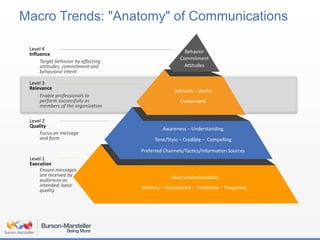
Macro Trends: "Anatomy" of Communications
Target behavior by affecting
attitudes, commitment and
behavioral intent
Enable professionals to
perform successfully as
members of the organization
Focus on message
and form
Ensure messages
are received by
audiences as
intended; basic
quality
Level 1
Execution
Level 2
Quality
Level 3
Relevance
Level 4
Influence Behavior
Commitment
Attitudes
Relevant – Useful
Customized
Tone/Style – Credible – Compelling
Awareness – Understanding
Preferred Channels/Tactics/Information Sources
Clear/Understandable
Delivery – Accessibility – Timeliness – Frequency
24
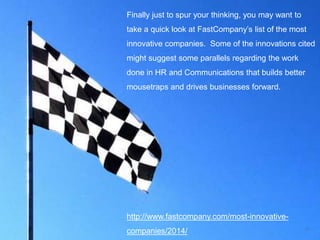
Finally just to spur your thinking, you may want to
take a quick look at FastCompany’s list of the most
innovative companies. Some of the innovations cited
might suggest some parallels regarding the work
done in HR and Communications that builds better
mousetraps and drives businesses forward.
http://www.fastcompany.com/most-innovative-
companies/2014/
25
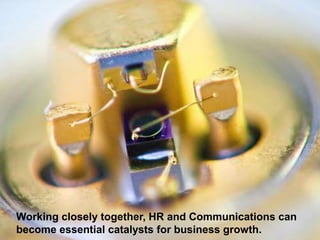
Working closely together, HR and Communications can
become essential catalysts for business growth.
26
Maria Lazarimou
Advocate/Burson-Marsteller
www.advocate-bm.gr
mlazarimou@advocate-bm.gr
Facebook – LinkedIn- Twitter:@marialaz

HR and Communications: Essential Business Catalysts

  • 1.
    HR and Communications: EssentialBusiness Catalysts Maria Lazarimou CEO Advocate/Burson-Marsteller GPMA HR Forum 2014 Athens, April 24
  • 2.
    Two Historically Parallelpaths 2 HR COMMS Two historically parallel paths…
  • 3.
    …now converging 3 In today’sreputation driven economy those functions have no other choice but to converge They both need to serve a common goal of creating corporate value
  • 4.
    4 To do thisthey both need to build a bridge to the business strategy
  • 5.
    5 They need tobecome relevant to the business and join the fight for market share, customer loyalty, license to operate and stock price
  • 6.
    A reputation Economy 6 “80percent of reputation leaders across 300+ global companies agree that we compete in a reputation economy in which people buy products, take jobs, and make investments based primarily on their trust, admiration and appreciation for the companies and institutions that stand behind them. Only 20 percent feel they are ready to deliver on these expectations and even take advantage of them.” - 2013 Forbes Reputation Leaders study
  • 7.
    7 Until yesterday Two parallelworlds of influence
  • 8.
    8 Today Increasingly important HRChallenges + HR from the outside
  • 9.
    9 An extremely complexworking environment technology internet Social media GEN Y networking Work-life balance Aging employees digitization Office decentralization
  • 10.
    10 A new reality Evolvingchallenges for HR • Managing Talent • Managing Demographics • Becoming a learning organization • Managing work-life balance • Managing change and cultural transformation This is when HR & Coms started dating!
  • 11.
    11 Both consumers andemployees seek companies with a vision and a clear sense of purpose
  • 12.
    12 The internal andexternal view of a company becomes unified.
  • 13.
    13 HR and communications haveto work hand in hand, developing and nurturing the company’s reputation.
  • 14.
  • 15.
    15 Companies with higheffectiveness in change management & communication are 3.5 times more likely to significantly outperform their industry peers than firms that are not effective in these areas. 2013-2014 Change and Communication ROI Study
  • 16.
    16 “The project madeus realize that there are three outcomes for most communication: to inform, to instruct and to inspire.” [This] caused us to think differently about outcomes. Why settle for informing employees if there is a chance of increasing their overall engagement with the firm through more effective communications? Internal Communication as a business driver
  • 17.
    17 HR & Communications ACommon Architecture
  • 18.
    Burson-Marsteller has beentracking emerging organizational performance trends and practices since 1997 18 • Scanning latest organizational performance- and organizational communications-focused publications, studies and news coverage • Conducting in-depth interviews with organizational performance counselors and practitioners to understand the practices of public and private sector organizations across most industries • Leveraging Burson-Marsteller’s latest research on overall communications trends, analyzing the implications for workplace communications
  • 19.
    Categories At the microlevel, we continue to see evolution in key trends and practices, but also many “evergreen” practices that hold true from our previous research. But the most significant shifts we’re seeing are at the macro level. Micro Categories Macro Categories CATEGORIES Strategies and Programs Messaging and Content Channels and Vehicles Process and Planning Structure and Roles Feedback and Measures Challenging Times CATEGORIES Workplace Environment Employee Mindset and Behaviors “Anatomy” of Communications
  • 20.
    Macro Trends: WorkplaceEnvironment • From dissemination to conversation • Digitization significantly affecting expectations • Workplace decentralization affecting expectations as well 2,000+ European communications professionals rated “coping with the digital evolution and the social web” as the most important strategic issue for the next 3 years, ahead of “linking business strategy and communication” (54.9% vs. 44%) European Communication Monitor, 2011
  • 21.
    Macro Trends: EmployeeMindset and Behaviors • Individual-centric focus and experiences • Increasing culture of co-ownership • From empowerment to entitlement • Increasing interest in organization’s health
  • 22.
    Macro Trends: "Anatomy"of Communications • Less is more • Story sharing as well as storytelling • The power of visuals • Anywhere, any device • Digital communities rule • Relevance has become the baseline NASA used a visual storytelling technique to explain the complexity of the Higgs boson Newcomers Mobli and SwitchCam are taking visual story sharing a step further than “basic” story sharing— enabling the crowdsourcing of user-generated videos and imagery on common topics or events to provide a 360o view from around the world
  • 23.
    Macro Trends: "Anatomy"of Communications Target behavior by affecting attitudes, commitment and behavioral intent Enable professionals to perform successfully as members of the organization Focus on message and form Ensure messages are received by audiences as intended; basic quality Level 1 Execution Level 2 Quality Level 3 Relevance Level 4 Influence Behavior Commitment Attitudes Relevant – Useful Customized Tone/Style – Credible – Compelling Awareness – Understanding Preferred Channels/Tactics/Information Sources Clear/Understandable Delivery – Accessibility – Timeliness – Frequency
  • 24.
    24 Finally just tospur your thinking, you may want to take a quick look at FastCompany’s list of the most innovative companies. Some of the innovations cited might suggest some parallels regarding the work done in HR and Communications that builds better mousetraps and drives businesses forward. http://www.fastcompany.com/most-innovative- companies/2014/
  • 25.
    25 Working closely together,HR and Communications can become essential catalysts for business growth.
  • 26.