


Corporate
Communication
Internal Strategy
Your internal brand
Too many companies focus on their customers at the expense of their
other major stakeholders: their employees. Companies spend so much
time and money trying to educate consumers about their brand that they
often forget to do the same with their own workforce. Having employees
who are ill-informed about what’s going on internally presents a
considerable danger; after all, if they don’t know what an organization’s
strategy is for the future or the goals it wishes to achieve, then how can
they possibly contribute to the best of their abilities? All companies, no
matter how big or small, should be coming up with ways to facilitate and
encourage communication between employees -- not just from the top
down, but also between peers.
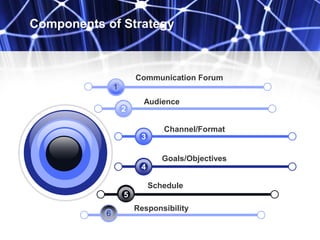
Audience
Channel/Format
Goals/Objectives
Schedule
5
4
3
2
Components of Strategy
1
6
Communication Forum
Responsibility
Communication Forum
• What type of communication are you advocating? This
could be a one-on-one meeting between a supervisor
and a subordinate or it could be a meeting with the
CEO that the whole company attends. Defining the
size and scope of your meeting will help to define the
other components.
Exceptional Customer Service
• Define your audience at the outset. Will this be the
whole company, one department, a committee or a
smaller group? Not all forms of communication work in
all settings and the size of the group you are
communicating to will help to define the number of
communication touchpoints you need.
Channel/Format
• Depending on the size of your group and the
complexity of the message, you may need multiple
touchpoints using different channels. For a widely
dispersed group, you may start with a video message,
then hold in person meetings and finally reinforce the
message in a one-on-one (O3). Many ties, having a
prepared FAQ sheet will help immeasurably to ensure
that the answers are consistent across the
organization.
Exceptional Customer Service
• There are six primary objectives that deserve focus
when thinking about communication. They are:
– Decision Making
– Information Sharing
– Status Update
– Innovation
– Team Building
– Problem Solving
• Decide in advance which one(s) you are trying to
achieve as that will drive the communication.
Schedule
• Although schedule seems like a simple component,
with the busy lives and travel plans everyone has these
days, it can be a complex undertaking to find a
day/time that works for everyone. For messages that
impact the whole organization or a substantial portion,
it is best to provide a link where employees who
missed the original message can access it.
Responsibility
• Nothing is worse than going to all the trouble of
defining an exceptional communication strategy only
for it to fall flat because everyone thought someone
else owned it. When speaking about responsibility, t is
not only who will deliver he message, but who will craft
the message and who will set up the way in which the
message will be delivered. Video, e-mail distribution
lists, a space for employees to gather.
Internal Communication Strategy

Internal Communication Strategy

  • 1.
  • 2.
    Your internal brand Toomany companies focus on their customers at the expense of their other major stakeholders: their employees. Companies spend so much time and money trying to educate consumers about their brand that they often forget to do the same with their own workforce. Having employees who are ill-informed about what’s going on internally presents a considerable danger; after all, if they don’t know what an organization’s strategy is for the future or the goals it wishes to achieve, then how can they possibly contribute to the best of their abilities? All companies, no matter how big or small, should be coming up with ways to facilitate and encourage communication between employees -- not just from the top down, but also between peers.
  • 3.
  • 4.
    Communication Forum • Whattype of communication are you advocating? This could be a one-on-one meeting between a supervisor and a subordinate or it could be a meeting with the CEO that the whole company attends. Defining the size and scope of your meeting will help to define the other components.
  • 5.
    Exceptional Customer Service •Define your audience at the outset. Will this be the whole company, one department, a committee or a smaller group? Not all forms of communication work in all settings and the size of the group you are communicating to will help to define the number of communication touchpoints you need.
  • 6.
    Channel/Format • Depending onthe size of your group and the complexity of the message, you may need multiple touchpoints using different channels. For a widely dispersed group, you may start with a video message, then hold in person meetings and finally reinforce the message in a one-on-one (O3). Many ties, having a prepared FAQ sheet will help immeasurably to ensure that the answers are consistent across the organization.
  • 7.
    Exceptional Customer Service •There are six primary objectives that deserve focus when thinking about communication. They are: – Decision Making – Information Sharing – Status Update – Innovation – Team Building – Problem Solving • Decide in advance which one(s) you are trying to achieve as that will drive the communication.
  • 8.
    Schedule • Although scheduleseems like a simple component, with the busy lives and travel plans everyone has these days, it can be a complex undertaking to find a day/time that works for everyone. For messages that impact the whole organization or a substantial portion, it is best to provide a link where employees who missed the original message can access it.
  • 9.
    Responsibility • Nothing isworse than going to all the trouble of defining an exceptional communication strategy only for it to fall flat because everyone thought someone else owned it. When speaking about responsibility, t is not only who will deliver he message, but who will craft the message and who will set up the way in which the message will be delivered. Video, e-mail distribution lists, a space for employees to gather.