Tracking Money
Flows
2.03
All About the Cash Flow
Cash Flow- movement of money in and out of the business’ cash accounts.
The cash flow statement monitors how the business uses cash throughout
a specific accounting period.
Adequate vs. Inadequate Cash?
Every business has a goal to maintain
adequate cash flow. It means that the
business is generating enough cash to
cover operating costs.
Inadequate cash flow can cause the
business to take risky loans, declare
bankruptcy, and ultimately close.
Cash Inflows vs. Outflows
Cash Inflows:
Operating Activities
Investing Activities
Financing Activities
Cash Outflows:
Salaries
Rent
Insurance
Loan repayments
Utilities
Capital expenditures
Taxes/Dividends
Why use a Cash Flow Statement?
Frankly, it’d be silly not do.
Businesses need to know what
cash is available for
inflow/outflow activities. A cash
flow statements provides the
structure for managers to make
sound decisions.
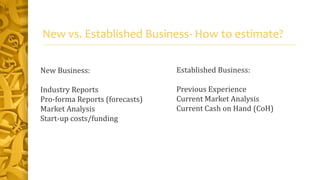
New vs. Established Business- How to estimate?
New Business:
Industry Reports
Pro-forma Reports (forecasts)
Market Analysis
Start-up costs/funding
Established Business:
Previous Experience
Current Market Analysis
Current Cash on Hand (CoH)
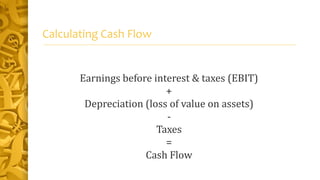
Calculating Cash Flow
Earnings before interest & taxes (EBIT)
+
Depreciation (loss of value on assets)
-
Taxes
=
Cash Flow
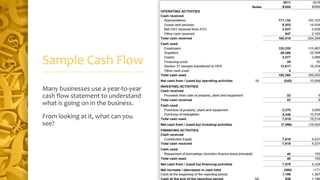
Sample Cash Flow
Many businesses use a year-to-year
cash flow statement to understand
what is going on in the business.
From looking at it, what can you
see?
Understanding the balance
sheet
2.03pt 2
What’s a Balance Sheet?
A snapshot of the financial position of a company’s assets,
liability and equity at a point in time.
Assets- products and property a company owns, cash and
items that can be quickly converted into cash
Liabilities- financial obligations the company has
Net Worth- the difference between assets and liabilities
Equity- money or property used to keep the company in a
balanced state
Other Terms to Know
Accounts Receivable: Money/Resources owed the business (revenues,
cash, interest, etc.)
Accounts Payable: Money/resources the business owes
Shareholder Equity: Total Assets- Total Liabilities
Retained Earnings: Money used to reinvest in the business
Extras-
Par Value: face value of an investment bond
Capital surplus: additional equity that’s not considered RE or stock
Treasury Stock: stock the business keeps
Reserves: Cash held on-hand or at a bank
Current Assets
Assets that can be changed into cash under a year:
Cash & Cash Equivalents
Accounts Receivable
Inventory
Also can be defined as the amount used to cover
debts and liabilities without selling fixed assets.
Fixed Assets
Fixed Assets are not easily turned into cash. In most cases, businesses
are examined by how much fixed assets it has. More fixed assets, the
more successful they are perceived to be.
Includes:
Land
Facilities
Large Equipment
Lenders use these items to decide whether to lend to a business.
Therefore, fixed assets are very important to traditional businesses.
Current Liabilities
Current Liabilities are debts or obligations a company owns that
typically need to be repaid within a year; usually paid with current
assets.
Included:
Short-term loans
Costs of Goods Sold (CoGS)
Finance Equations
Current Ratio- shows how well-positioned a company is to quickly
pay bills, a.k.a. solvency. A ratio over 1 is ideal.
The equation: Current Assets/Current Liabilities
Balance Sheet Equation- Used to check the balance sheet
numbers
Assets- Liabilities= Equity
Example Balance
Sheet
Income Statement
Also referred to as:
Profit & Loss Statement
Statement of Income & Expenses
Statement of Financial Performance
Earnings Statement
The goal? To summarize the profit-generating activities that occurred
over a particular period of time
Elements of the P&L Statement
Total Revenue: Total amount of sales and cash a business receives
Cost of Goods Sold: direct costs associated with the goods/services sold by company
Operating Expenses: costs associated with being in business
Depreciation: Wear and tear of equipment and resources
Amortization: paying off debts on an installment basis
Goodwill: account used to show money given to community, non-profits, and other
causes
Gross Profit: Money left over after CoGs
Net Income/Profit: Money left over after expenses
Example Income
Statement
Putting it All Together
Financial Data: Used to give managers, shareholders and investors an idea
of how well the business or department is performing.
Types of Financial Reports:
Statement of Cash Flows- How well does the business use cash in its
operations?
Balance Sheet- How solvent the business is; does it own more than it owes?
Profit and Loss Statement- How is the business generating revenue?
Goal: Display financial information in a way where managers can make
sound business decisions.

Mkting Mgmt 2.03

  • 1.
  • 2.
    All About theCash Flow Cash Flow- movement of money in and out of the business’ cash accounts. The cash flow statement monitors how the business uses cash throughout a specific accounting period.
  • 3.
    Adequate vs. InadequateCash? Every business has a goal to maintain adequate cash flow. It means that the business is generating enough cash to cover operating costs. Inadequate cash flow can cause the business to take risky loans, declare bankruptcy, and ultimately close.
  • 4.
    Cash Inflows vs.Outflows Cash Inflows: Operating Activities Investing Activities Financing Activities Cash Outflows: Salaries Rent Insurance Loan repayments Utilities Capital expenditures Taxes/Dividends
  • 5.
    Why use aCash Flow Statement? Frankly, it’d be silly not do. Businesses need to know what cash is available for inflow/outflow activities. A cash flow statements provides the structure for managers to make sound decisions.
  • 6.
    New vs. EstablishedBusiness- How to estimate? New Business: Industry Reports Pro-forma Reports (forecasts) Market Analysis Start-up costs/funding Established Business: Previous Experience Current Market Analysis Current Cash on Hand (CoH)
  • 7.
    Calculating Cash Flow Earningsbefore interest & taxes (EBIT) + Depreciation (loss of value on assets) - Taxes = Cash Flow
  • 8.
    Sample Cash Flow Manybusinesses use a year-to-year cash flow statement to understand what is going on in the business. From looking at it, what can you see?
  • 9.
  • 10.
    What’s a BalanceSheet? A snapshot of the financial position of a company’s assets, liability and equity at a point in time. Assets- products and property a company owns, cash and items that can be quickly converted into cash Liabilities- financial obligations the company has Net Worth- the difference between assets and liabilities Equity- money or property used to keep the company in a balanced state
  • 11.
    Other Terms toKnow Accounts Receivable: Money/Resources owed the business (revenues, cash, interest, etc.) Accounts Payable: Money/resources the business owes Shareholder Equity: Total Assets- Total Liabilities Retained Earnings: Money used to reinvest in the business Extras- Par Value: face value of an investment bond Capital surplus: additional equity that’s not considered RE or stock Treasury Stock: stock the business keeps Reserves: Cash held on-hand or at a bank
  • 12.
    Current Assets Assets thatcan be changed into cash under a year: Cash & Cash Equivalents Accounts Receivable Inventory Also can be defined as the amount used to cover debts and liabilities without selling fixed assets.
  • 13.
    Fixed Assets Fixed Assetsare not easily turned into cash. In most cases, businesses are examined by how much fixed assets it has. More fixed assets, the more successful they are perceived to be. Includes: Land Facilities Large Equipment Lenders use these items to decide whether to lend to a business. Therefore, fixed assets are very important to traditional businesses.
  • 14.
    Current Liabilities Current Liabilitiesare debts or obligations a company owns that typically need to be repaid within a year; usually paid with current assets. Included: Short-term loans Costs of Goods Sold (CoGS)
  • 15.
    Finance Equations Current Ratio-shows how well-positioned a company is to quickly pay bills, a.k.a. solvency. A ratio over 1 is ideal. The equation: Current Assets/Current Liabilities Balance Sheet Equation- Used to check the balance sheet numbers Assets- Liabilities= Equity
  • 16.
  • 17.
    Income Statement Also referredto as: Profit & Loss Statement Statement of Income & Expenses Statement of Financial Performance Earnings Statement The goal? To summarize the profit-generating activities that occurred over a particular period of time
  • 18.
    Elements of theP&L Statement Total Revenue: Total amount of sales and cash a business receives Cost of Goods Sold: direct costs associated with the goods/services sold by company Operating Expenses: costs associated with being in business Depreciation: Wear and tear of equipment and resources Amortization: paying off debts on an installment basis Goodwill: account used to show money given to community, non-profits, and other causes Gross Profit: Money left over after CoGs Net Income/Profit: Money left over after expenses
  • 19.
  • 20.
    Putting it AllTogether Financial Data: Used to give managers, shareholders and investors an idea of how well the business or department is performing. Types of Financial Reports: Statement of Cash Flows- How well does the business use cash in its operations? Balance Sheet- How solvent the business is; does it own more than it owes? Profit and Loss Statement- How is the business generating revenue? Goal: Display financial information in a way where managers can make sound business decisions.