Introduction to FinancialStatements
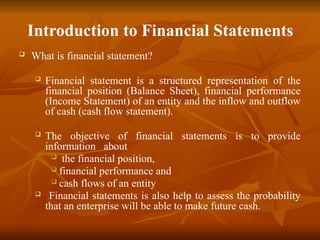
What is financial statement?
Financial statement is a structured representation of the
financial position (Balance Sheet), financial performance
(Income Statement) of an entity and the inflow and outflow
of cash (cash flow statement).
The objective of financial statements is to provide
information about
the financial position,
financial performance and
cash flows of an entity
Financial statements is also help to assess the probability
that an enterprise will be able to make future cash.
3.
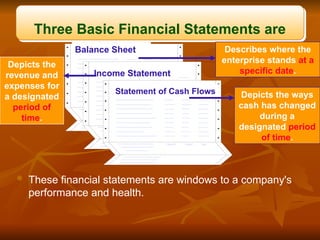
Three Basic FinancialStatements are
These financial statements are windows to a company's
performance and health.
Income Statement
Balance Sheet
Statement of Cash Flows
Describes where the
enterprise stands at a
specific date.
Depicts the
revenue and
expenses for
a designated
period of
time.
Depicts the ways
cash has changed
during a
designated period
of time.
4.
THE BALANCE SHEET
Whatis Balance sheet?
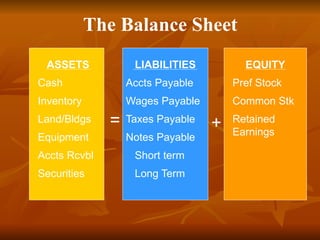
The balance sheet represents a record of a company's assets,
liabilities and equity at a particular point in time. Balance
sheet is named by the fact that a business’s financial structure
balances in the following manner:
Assets = Liabilities + Shareholders' Equity
Assets represent the resources that the business owns or
controls at a given point in time. This includes items such as
cash, inventory, machinery, buildings etc.
The other side of the equation represents the total value of the
financing the company has used to acquire those assets.
Liabilities represent debt, while equity represents the total
value of money that the owners have contributed to the
business – including retained earnings, which is the profit
made in previous years.
Why do weneed Balance sheet?
Because
Balance sheet provides investors with a snapshot of a company's
health as of the date provided on the financial statement.
If a company assets are large relative to liabilities, it's in
good shape. Conversely, if a company with a large amount of
liabilities relative to assets has risk to creditors.
The higher the debt ratio, the greater risk will be associated
with the firm's operation. In addition, high debt to assets ratio
may indicate low borrowing capacity of a firm, which in turn
will lower the firm's financial flexibility.
7.
THE INCOME STATEMENT
Whatis Income Statement?
The income statement shows an information about the
revenues, expenses and profit that was generated as a result
of the business' operations for that period and it measures a
company's performance over a specific time frame.
The components of income Statement are:
Revenue (how much the company earned)
Expenses (how much the company has spent)
Net Income before and after Tax (the profits of the
company)
8.
Because
Incomestatement answers the question, "How well
is the company's business?
“Does it performing well?
Basically, the question is "Is it making money?"
Firms with low expenses and high profits relative
to revenues are typically more desirable for
investment because it brings more money directly
to a shareholder.
Why do we need an Income Statement ?
9.
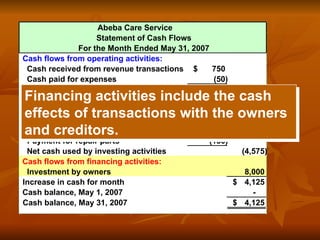
The statementof cash flows represents a record of a
business' cash inflows and outflows over a period of time.
It is the most sensitive statement and it focuses on the
following cash-related activities:
Operating Cash Flow: Cash generated from day-to-day
business operations.
Cash from Investing: Cash used for investing in assets,
as well as the proceeds from the sale of other
businesses, equipment or long-term assets
Cash from financing: Cash paid or received from the
issuing and borrowing of funds
THE STATEMENT OF CASH FLOWS
What is statement of cash flow?
10.
Statement ofcash flows is very important to investors, because
It shows how much actual cash a company has generated.
It shows the ability of firms to generate cash. Many
companies have shown “profits” on the income statement
but struggled later because of insufficient cash flows.
Because, the income statement includes non-cash revenues
or expenses, which the statement of cash flows excludes.
It shows correct figures of firms, because cash flow
statement is very difficult for a business to manipulate its
cash situation. Earnings can be manipulated, but it's tough to
“fake” cash in the bank. For this reason some investors use
the cash flow statement as a more conservative measure of
a company's performance.
Why do we need Statement of Cash Flows ?
11.
The threefinancial statements (Balance sheet, Income
statement and cash flow statement) are all related.
The changes of assets and liabilities that is indicated on
the balance sheet are also reflected in the revenues and
expenses which are stated on the income statement,
which shows the company’s gains or losses.
Cash flows provide more information about cash assets
listed on a balance sheet and are related, but not
equivalent, to net income shown on the income
statement.
Therefore, no one financial statement tells the
complete story of firms.
Bringing the financial statements All Together
12.
ACCOUNTING PRINCIPLES
Certain accountingprinciples that are
important for an understanding of
financial statements and how professional
judgment by accountants may affect the
application of those principles are shown in
the next slides
13.
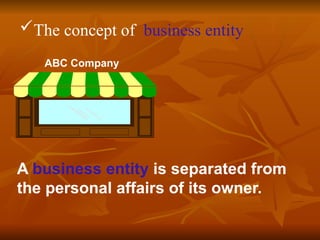
The concept ofbusiness entity
ABC Company
A business entity is separated from
the personal affairs of its owner.
14.
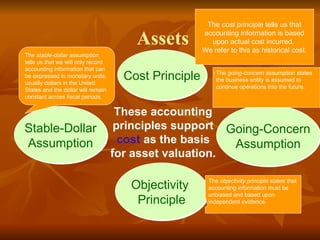
Assets
Cost Principle
Going-Concern
Assumption
Objectivity
Principle
Stable-Dollar
Assumption
These accounting
principlessupport
cost as the basis
for asset valuation.
The cost principle tells us that
accounting information is based
upon actual cost incurred.
We refer to this as historical cost.
The objectivity principle states that
accounting information must be
unbiased and based upon
independent evidence.
The stable-dollar assumption
tells us that we will only record
accounting information that can
be expressed in monetary units,
usually dollars in the United
States and the dollar will remain
constant across fiscal periods.
The going-concern assumption states
the business entity is assumed to
continue operations into the future.
15.
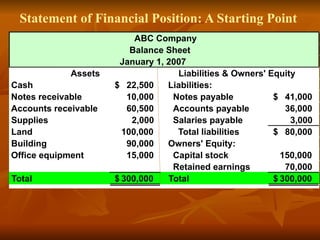
Statement of FinancialPosition: A Starting Point
ABC Company
Balance Sheet
January 1, 2007
Assets Liabilities & Owners' Equity
Cash 22,500
$ Liabilities:
Notes receivable 10,000 Notes payable 41,000
$
Accounts receivable 60,500 Accounts payable 36,000
Supplies 2,000 Salaries payable 3,000
Land 100,000 Total liabilities 80,000
$
Building 90,000 Owners' Equity:
Office equipment 15,000 Capital stock 150,000
Retained earnings 70,000
Total 300,000
$ Total 300,000
$
16.
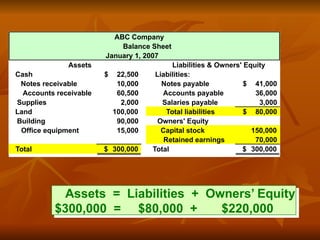
Assets = Liabilities+ Owners’ Equity
$300,000 = $80,000 + $220,000
ABC Company
Balance Sheet
January 1, 2007
Assets Liabilities & Owners' Equity
Cash 22,500
$ Liabilities:
Notes receivable 10,000 Notes payable 41,000
$
Accounts receivable 60,500 Accounts payable 36,000
Supplies 2,000 Salaries payable 3,000
Land 100,000 Total liabilities 80,000
$
Building 90,000 Owners' Equity
Office equipment 15,000 Capital stock 150,000
Retained earnings 70,000
Total 300,000
$ Total 300,000
$
17.
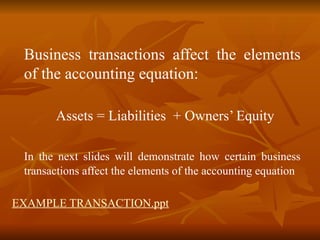
Business transactions affectthe elements
of the accounting equation:
Assets = Liabilities + Owners’ Equity
In the next slides will demonstrate how certain business
transactions affect the elements of the accounting equation
EXAMPLE TRANSACTION.ppt
18.
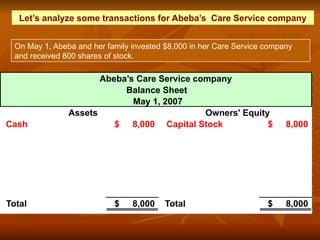
Let’s analyze sometransactions for Abeba’s Care Service company
On May 1, Abeba and her family invested $8,000 in her Care Service company
and received 800 shares of stock.
Abeba’s Care Service company
Balance Sheet
May 1, 2007
Assets
Cash 8,000
$ Capital Stock 8,000
$
Total 8,000
$ Total 8,000
$
Owners' Equity
19.
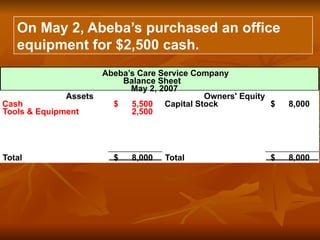
On May 2,Abeba’s purchased an office
equipment for $2,500 cash.
Abeba’s Care Service Company
Balance Sheet
May 2, 2007
Assets
Cash 5,500
$ Capital Stock 8,000
$
Tools & Equipment 2,500
Total 8,000
$ Total 8,000
$
Owners' Equity
20.
Assets = Liabilities+
Cash +
Accts.
Rec. +
Tools &
Equip. + Truck =
Notes
Payable +
Accts.
Pay. +
Capital
Stock +
Retained
Earnings
May 1 8,000
$ 8,000
$
Balances 8,000
$ 8,000
$
May 2 (2,500) 2,500
$
Balances 5,500
$ 2,500
$ 8,000
$
May 8 (2,000) 15,000
$ 13,000
$
Balances 3,500
$ 2,500
$ 15,000
$ 13,000
$ 8,000
$
May 11 300 300
$
Balances 3,500
$ 2,800
$ 15,000
$ 13,000
$ 300
$ 8,000
$
May 18 150
$ (150)
Balances 3,500
$ 150
$ 2,650
$ 15,000
$ 13,000
$ 300
$ 8,000
$
May 25 75 (75)
Balances 3,575
$ 75
$ 2,650
$ 15,000
$ 13,000
$ 300
$ 8,000
$
May 28 (150) (150)
Balances 3,425
$ 75
$ 2,650
$ 15,000
$ 13,000
$ 150
$ 8,000
$
May 29 750 750
Balances 4,175
$ 75
$ 2,650
$ 15,000
$ 13,000
$ 150
$ 8,000
$ 750
$
May 31 (50) (50)
Balances 4,125
$ 75
$ 2,650
$ 15,000
$ 13,000
$ 150
$ 8,000
$ 700
$
Owners' Equity
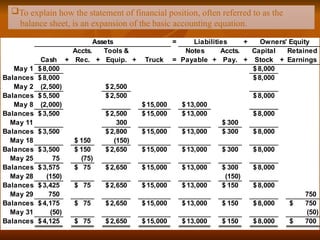
To explain how the statement of financial position, often referred to as the
balance sheet, is an expansion of the basic accounting equation.
21.
Assets = Liabilities+
Cash +
Accts.
Rec. +
Tools &
Equip. + Truck =
Notes
Payable +
Accts.
Pay. +
Capital
Stock +
Retained
Earnings
May 1 8,000
$ 8,000
$
Balances 8,000
$ 8,000
$
May 2 (2,500) 2,500
$
Balances 5,500
$ 2,500
$ 8,000
$
May 8 (2,000) 15,000
$ 13,000
$
Balances 3,500
$ 2,500
$ 15,000
$ 13,000
$ 8,000
$
May 11 300 300
$
Balances 3,500
$ 2,800
$ 15,000
$ 13,000
$ 300
$ 8,000
$
May 18 150
$ (150)
Balances 3,500
$ 150
$ 2,650
$ 15,000
$ 13,000
$ 300
$ 8,000
$
May 25 75 (75)
Balances 3,575
$ 75
$ 2,650
$ 15,000
$ 13,000
$ 300
$ 8,000
$
May 28 (150) (150)
Balances 3,425
$ 75
$ 2,650
$ 15,000
$ 13,000
$ 150
$ 8,000
$
May 29 750 750
Balances 4,175
$ 75
$ 2,650
$ 15,000
$ 13,000
$ 150
$ 8,000
$ 750
$
May 31 (50) (50)
Balances 4,125
$ 75
$ 2,650
$ 15,000
$ 13,000
$ 150
$ 8,000
$ 700
$
Owners' Equity
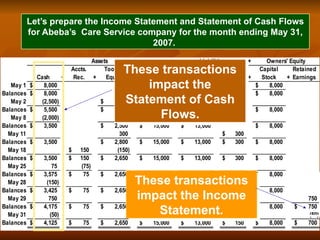
These transactions
impact the
Statement of Cash
Flows.
These transactions
impact the Income
Statement.
Let’s prepare the Income Statement and Statement of Cash Flows
for Abeba’s Care Service company for the month ending May 31,
2007.
22.
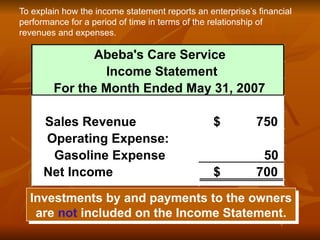
Investments by andpayments to the owners
are not included on the Income Statement.
To explain how the income statement reports an enterprise’s financial
performance for a period of time in terms of the relationship of
revenues and expenses.
Abeba's Care Service
Income Statement
For the Month Ended May 31, 2007
Sales Revenue 750
$
Operating Expense:
Gasoline Expense 50
Net Income 700
$
23.
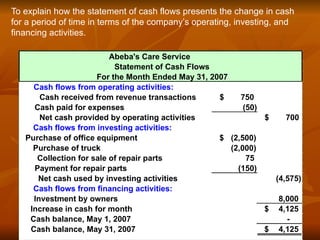
To explain howthe statement of cash flows presents the change in cash
for a period of time in terms of the company’s operating, investing, and
financing activities.
Abeba's Care Service
Statement of Cash Flows
For the Month Ended May 31, 2007
Cash flows from operating activities:
Cash received from revenue transactions 750
$
Cash paid for expenses (50)
Net cash provided by operating activities 700
$
Cash flows from investing activities:
Purchase of office equipment (2,500)
$
Purchase of truck (2,000)
Collection for sale of repair parts 75
Payment for repair parts (150)
Net cash used by investing activities (4,575)
Cash flows from financing activities:
Investment by owners 8,000
Increase in cash for month 4,125
$
Cash balance, May 1, 2007 -
Cash balance, May 31, 2007 4,125
$
24.
Abeba’s Care Service
Statementof Cash Flows
For the Month Ended May 31, 2007
Cash flows from operating activities:
Cash received from revenue transactions 750
$
Cash paid for expenses (50)
Net cash provided by operating activities 700
$
Cash flows from investing activities:
Purchase of office equipment (2,500)
$
Purchase of truck (2,000)
Collection for sale of repair parts 75
Payment for repair parts (150)
Net cash used by investing activities (4,575)
Cash flows from financing activities:
Investment by owners 8,000
Increase in cash for month 4,125
$
Cash balance, May 1, 2007 -
Cash balance, May 31, 2007 4,125
$
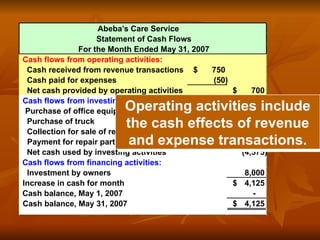
Operating activities include
the cash effects of revenue
and expense transactions.
25.
Abeba Care Service
Statementof Cash Flows
For the Month Ended May 31, 2007
Cash flows from operating activities:
Cash received from revenue transactions 750
$
Cash paid for expenses (50)
Net cash provided by operating activities 700
$
Cash flows from investing activities:
Purchase of office equipment (2,500)
$
Purchase of truck (2,000)
Collection for sale of repair parts 75
Payment for repair parts (150)
Net cash used by investing activities (4,575)
Cash flows from financing activities:
Investment by owners 8,000
Increase in cash for month 4,125
$
Cash balance, May 1, 2007 -
Cash balance, May 31, 2007 4,125
$
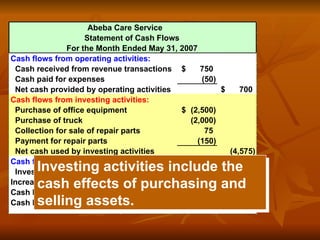
Investing activities include the
cash effects of purchasing and
selling assets.
26.
Abeba Care Service
Statementof Cash Flows
For the Month Ended May 31, 2007
Cash flows from operating activities:
Cash received from revenue transactions 750
$
Cash paid for expenses (50)
Net cash provided by operating activities 700
$
Cash flows from investing activities:
Purchase of office equipment (2,500)
$
Purchase of truck (2,000)
Collection for sale of repair parts 75
Payment for repair parts (150)
Net cash used by investing activities (4,575)
Cash flows from financing activities:
Investment by owners 8,000
Increase in cash for month 4,125
$
Cash balance, May 1, 2007 -
Cash balance, May 31, 2007 4,125
$
Financing activities include the cash
effects of transactions with the owners
and creditors.
27.
Assets = Liabilities+
Cash +
Accts.
Rec. +
Tools &
Equip. + Truck =
Notes
Payable +
Accts.
Pay. +
Capital
Stock +
Retained
Earnings
May 1 8,000
$ 8,000
$
Balances 8,000
$ 8,000
$
May 2 (2,500) 2,500
$
Balances 5,500
$ 2,500
$ 8,000
$
May 8 (2,000) 15,000
$ 13,000
$
Balances 3,500
$ 2,500
$ 15,000
$ 13,000
$ 8,000
$
May 11 300 300
$
Balances 3,500
$ 2,800
$ 15,000
$ 13,000
$ 300
$ 8,000
$
May 18 150
$ (150)
Balances 3,500
$ 150
$ 2,650
$ 15,000
$ 13,000
$ 300
$ 8,000
$
May 25 75 (75)
Balances 3,575
$ 75
$ 2,650
$ 15,000
$ 13,000
$ 300
$ 8,000
$
May 28 (150) (150)
Balances 3,425
$ 75
$ 2,650
$ 15,000
$ 13,000
$ 150
$ 8,000
$
May 29 750 750
Balances 4,175
$ 75
$ 2,650
$ 15,000
$ 13,000
$ 150
$ 8,000
$ 750
$
May 31 (50) (50
Balances 4,125
$ 75
$ 2,650
$ 15,000
$ 13,000
$ 150
$ 8,000
$ 700
$
Owners' Equity
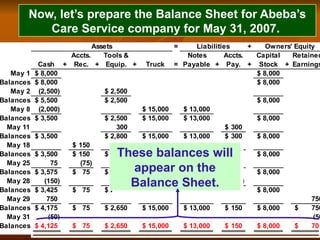
Now, let’s prepare the Balance Sheet for Abeba’s
Care Service company for May 31, 2007.
These balances will
appear on the
Balance Sheet.
28.
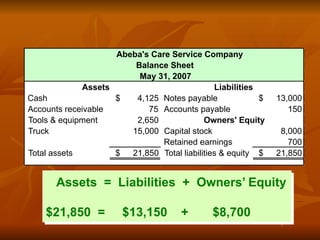
Assets = Liabilities+ Owners’ Equity
$21,850 = $13,150 + $8,700
Cash 4,125
$ Notes payable 13,000
$
Accounts receivable 75 Accounts payable 150
Tools & equipment 2,650
Truck 15,000 Capital stock 8,000
Retained earnings 700
Total assets 21,850
$ Total liabilities & equity 21,850
$
Assets Liabilities
Owners' Equity
Abeba's Care Service Company
Balance Sheet
May 31, 2007
29.
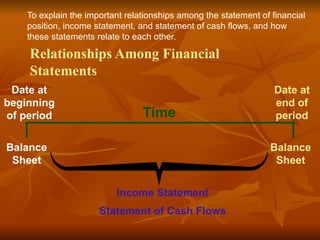
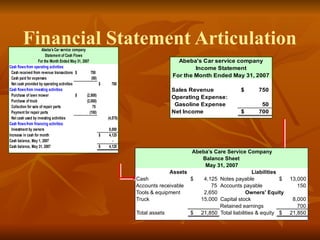
Relationships Among Financial
Statements
Dateat
beginning
of period
Date at
end of
period
Balance
Sheet
Balance
Sheet
Time
Income Statement
Statement of Cash Flows
To explain the important relationships among the statement of financial
position, income statement, and statement of cash flows, and how
these statements relate to each other.
30.
Financial Statement Articulation
Abeba'sCar service company
Statement of Cash Flows
For the Month Ended May 31, 2007
Cash flowsfrom operating activities:
Cash received from revenue transactions 750
$
Cash paid for expenses (50)
Net cash provided by operating activities 700
$
Cash flowsfrom investing activities:
Purchase of lawn mower (2,500)
$
Purchase of truck (2,000)
Collection for sale of repair parts 75
Payment for repair parts (150)
Net cash used by investing activities (4,575)
Cash flowsfrom financing activities:
Investment by owners 8,000
Increase in cash for month 4,125
$
Cash balance, May 1, 2007 -
Cash balance, May 31, 2007 4,125
$
Abeba's Car service company
Income Statement
Sales Revenue 750
$
Operating Expense:
Gasoline Expense 50
Net Income 700
$
For the Month Ended May 31, 2007
Cash 4,125
$ Notes payable 13,000
$
Accounts receivable 75 Accounts payable 150
Tools & equipment 2,650
Truck 15,000 Capital stock 8,000
Retained earnings 700
Total assets 21,850
$ Total liabilities & equity 21,850
$
Assets Liabilities
Owners' Equity
Abeba’s Care Service Company
Balance Sheet
May 31, 2007
31.
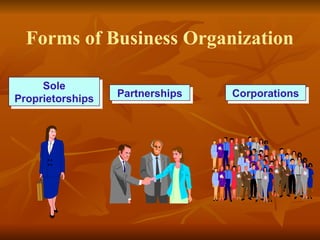
Forms of BusinessOrganization
Sole
Proprietorships Partnerships Corporations
32.
Forms of BusinessOrganization
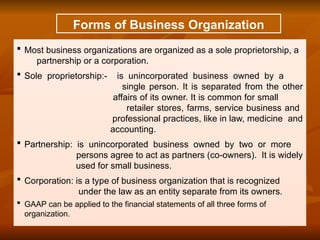
Most business organizations are organized as a sole proprietorship, a
partnership or a corporation.
Sole proprietorship:- is unincorporated business owned by a
single person. It is separated from the other
affairs of its owner. It is common for small
retailer stores, farms, service business and
professional practices, like in law, medicine and
accounting.
Partnership: is unincorporated business owned by two or more
persons agree to act as partners (co-owners). It is widely
used for small business.
Corporation: is a type of business organization that is recognized
under the law as an entity separate from its owners.
GAAP can be applied to the financial statements of all three forms of
organization.
33.
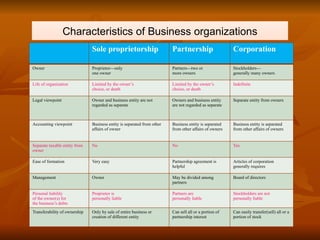
Characteristics of Businessorganizations
Sole proprietorship Partnership Corporation
Owner Proprietor—only
one owner
Partners—two or
more owners
Stockholders—
generally many owners
Life of organization Limited by the owner’s
choice, or death
Limited by the owner’s
choice, or death
Indefinite
Legal viewpoint Owner and business entity are not
regarded as separate
Owners and business entity
are not regarded as separate
Separate entity from owners
Accounting viewpoint Business entity is separated from other
affairs of owner
Business entity is separated
from other affairs of owners
Business entity is separated
from other affairs of owners
Separate taxable entity from
owner
No No Yes
Ease of formation Very easy Partnership agreement is
helpful
Articles of corporation
generally requires
Management Owner May be divided among
partners
Board of directors
Personal liability
of the owner(s) for
the business’s debts
Proprietor is
personally liable
Partners are
personally liable
Stockholders are not
personally liable
Transferability of ownership Only by sale of entire business or
creation of different entity
Can sell all or a portion of
partnership interest
Can easily transfer(sell) all or a
portion of stock
34.
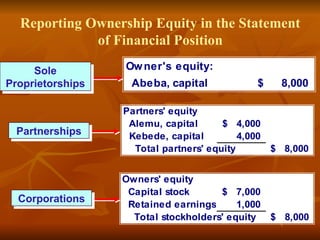
Reporting Ownership Equityin the Statement
of Financial Position
Owner's equity:
Abeba, capital 8,000
$
Sole
Proprietorships
Partners' equity
Alemu, capital 4,000
$
Kebede, capital 4,000
Total partners' equity 8,000
$
Partnerships
Owners' equity
Capital stock 7,000
$
Retained earnings 1,000
Total stockholders' equity 8,000
$
Corporations
Editor's Notes
#3 There are three fundamental financial statements used in accounting.
The income statement shows revenues and expenses.
The balance sheet is a listing of all asset, liability, and equity account balances that do not appear on the income statement.
The statement of cash flows shows how the company receives and spends its cash.
#11 All the financial statements are interrelated. We can start with the balance sheet at the beginning of an accounting period, analyze the income and cash flows of the company, and arrive at the ending balances that will appear on the balance sheet.
#13 The business entity principle states that the transactions of individual owners of a business and those of the business must be separate.
#14 The cost principle tells us that accounting information is based upon actual cost incurred. We refer to this as historical cost.
The going-concern assumption states that in the absence of information to the contrary, the business entity is assumed to continue operations into the foreseeable future.
The objectivity principle states that accounting information must be unbiased and based upon independent evidence.
The stable-dollar assumption tells us that we will only record accounting information that can be expressed in monetary units, usually dollars in the United States.
#15 The balance sheet is an inventory of assets, liabilities, and equity at the end of the month. Our total assets are equal to three hundred thousand dollars. This includes cash of twenty-two thousand five hundred dollars, notes receivable of ten thousand dollars, supplies of two thousand dollars, and the balances in the remaining asset accounts.
Liabilities include notes payable of forty-one thousand, accounts payable of thirty-six thousand and salaries payable of three thousand dollars. The accounts in the owners’ equity section of the balance sheet are capital stock of one hundred-fifty thousand dollars and retained earnings of seventy thousand dollars.
Notice that the total assets are equal to the total liabilities plus owners’ equity.
#16 The basic accounting equation states that assets are equal to liabilities plus equity of a company. The equation makes sense because it states that assets must be equal to the claims against those assets.
There are two broad categories of claims against an asset: Claims by creditors (called liabilities), or after all creditor claims are satisfied, the residual owners (the stockholders) have a claim on those assets.
#18 Part I
On May 1st, Jill Jones and her family invested $8,000 in JJ’s Lawn Care Service and received 800 shares of stock in return. Let’s see how the balance sheet would look immediately after this transaction.
Part II
The cash account of JJ’s Lawn Care increased by eight thousand dollars and the capital stock of the company also increased by eight thousand dollars. Notice that the basic accounting equation is in balance. Total assets are equal to total liabilities plus owners’ equity.
#19 Part I
On the 2nd of May, JJ’s Lawn Care purchased a riding lawn mower for $2,500 cash. Let’s see how the balance sheet looks now.
Part II
The cash account has been reduced by the $2,500 spent and the tools and equipment account has been increased by the same amount. One asset, cash, was merely traded for another, the riding lawn mower. Owners’ equity is not changed by the transaction and the basic accounting equation is still in balance.
#20 All of these transactions have been placed on this slide, in the appropriate columns for the accounts they’ve impacted. Let’s verify the balance in each account and get ready to prepare the financial statements for JJ’s Lawn Care.
#21 Part I
All of the transactions that impacted the cash account will appear on the statement of cash flows.
Part II
The revenues and expenses that caused the change in retained earnings will appear on the income statement of the company.
Part II
Let’s begin by preparing the income statement and statement of cash flows for JJ’s Lawn Care for the period ended May 31, 2007.
#22 Part I
JJ’s Lawn care has one revenue for services for $750, and one expense for gasoline of $50. So the net income for the month of May is $700. Remember, net income is the excess of revenues over expenses incurred during the accounting period.
Part II
Investments by owners and payments to owners do not appear on the income statement. These amounts appear on the company’s balance sheet.
#23 Here is the statement of cash flows for JJ’s Lawn Care for the month ended May 31, 2007. Notice the three sections of the statement. If there was beginning balance for cash this balance should be add with the balance of cash change during the period and the result will be its ending cash balance for that period.
#24 Cash flows from operating activities include the $700 in net income calculated on the previous screen.
#25 JJ’s had a cash outflow for investing activities. The company invested in the riding lawn mower, truck, and repair parts; however, the company recovered some of the cost of repair parts by selling them to ABC Lawns.
#26 The only financing activity was the original investment by the owners of JJ’s Lawn Care.
The cash inflows and outflows resulted in an increase in cash of $4,125 during the month. Because the cash account had a zero balance at the beginning of the month, the ending balance in the cash account is $4,125.
Let’s finish by preparing the balance sheet for JJ’s Lawn Care.
#27 Here are the account balances to use when preparing the balance sheet.
#28 Part I
Asset accounts are listed on the left side of the balance sheet and the liabilities and owners’ equity accounts on the right.
Feel free to go back to the previous screen and see all the account balances that appear on the balance sheet.
Part II
As a final check, make sure that the accounting equation is still in balance. The total assets of $21,850 is exactly equal to the total of the company’s liabilities plus owners’ equity. Notice that the balance sheet lists all assets, liabilities, and equities on a certain date. In this example, the date is May 31, 2007.
#29 All the financial statements are interrelated. We can start with the balance sheet at the beginning of an accounting period, analyze the income and cash flows of the company, and arrive at the ending balances that will appear on the balance sheet.
Let’s see how this works in the JJ’s Lawn Care example.
#30 Part I
This is the balance sheet for JJ’s Lawn Care at the end of May.
Part II
Net income impacts the retained earnings of the company.
Part III
The statement of cash flows not only provides the balance in the cash account, but also details information about the acquisition and disposition of assets and liabilities as well as changes in the owners’ equity balance. It’s clear to see how all the financial statements articulate with each other.
#31 There are three general forms of business operations.
A proprietorship is a business owned by just one individual.
A partnership is owned by two or more individuals. Some partnerships have several thousand partners.
A corporation is owned by individuals who normally are not active in the day-to-day operations of that business. For example, you may become an owner of IBM by purchasing shares of stock on the New York Stock Exchange. While you are a part owner, you do not necessarily work for IBM nor are you active in the operations of the company.
#34 Part I
The owners’ equity section of the balance sheet will look different for each type of business entity. For a sole proprietorship, there will be a capital account for the owner, and a drawing account to record payments to the owner.
Part II
For a partnership, each partner has a separate account, where changes are tracked over time. There’s also a separate drawing account for payments made to each partner.
Part II
To review, a corporation will show owners’ contributions in the capital stock account and accumulated earnings of the company in the retained earnings account.
You should be able to tell the form of business by looking at the equity section of a balance sheet.