
Sales Force Organization

Reporters:
Fenella Marie Barrion
Krisma C. Fidelino
BSBA 3
Task Of Sales Organization
           The nearly universal adoption of the marketing concept has meant that most companies
have reorganized their sales and marketing activities to reflect the stronger commitment to their
cusThe nearly universal adoption of the marketing concept has meant that
most companies have reorganized their sales and marketing activities to
reflect the stronger commitment to their customers. This trend has
enhanced the importance of sales force organization.

Three basic tasks must be accomplished by the organizing effort:

1. Maintenance of order in achieving sales force goals and objectives
2. Assignment of specific tasks and responsibilities
3. Integration and coordination with other elements of the firm

1. Maintenance of order in achieving sales force goals and objectives
2. Assignment of specific tasks and responsibilities
3. Integration and coordination with other elements of the firm
An effective sales force organization provides the structure for
achieving sales objectives. Structure is “ the sum total of the ways in
which an organization divides its labor into distinct tasks and then
achieves coordination among them”.

         Organizational structure also permits the assignment of specific
tasks to a position whose incumbent is then charged with responsibility
for accomplishing that task.

        Integration and coordination is a third aspect of sales force
organization. the organizational structure allows the coordination of the
various functional areas of the firm.
Developing A Sales Organization

        Developing a sales organizational structure is not an easy
task. The keys to organizational design are consistency and
coherence.

These comments suggest that sales managers must recognize, and
then deal with, some basic organizational issues when developing a
sales organization. The five major issues are:
1. Formal and informal organizations
2. Horizontal and vertical organizations
3. Centralized and decentralized organizational structures
4. The line and staff components of the organization
5. The size of the company
Formal and Informal Organizations

        Every firm has a formal organization and an informal
organization.

         The formal organization is a creation of management,
where as the informal organization is often developed from social
relationships existing in the organization.

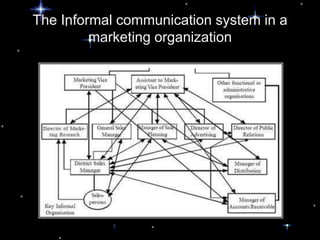
        Sometimes called the grapevine, the informal organization
is basically a communications pattern that emerges to facilitate the
operation of the formal organization.

       Most formal organizations would be totally ineffective if it
were not supporting informal organization.
The Informal communication system in a
         marketing organization
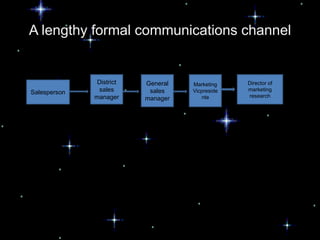
A lengthy formal communications channel


               District   General   Marketing    Director of
Salesperson    sales       sales    Vicpreside   marketing
              manager                  nte       research
                          manager
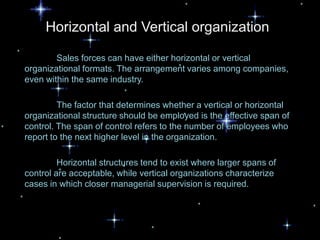
Horizontal and Vertical organization

        Sales forces can have either horizontal or vertical
organizational formats. The arrangement varies among companies,
even within the same industry.

         The factor that determines whether a vertical or horizontal
organizational structure should be employed is the effective span of
control. The span of control refers to the number of employees who
report to the next higher level in the organization.

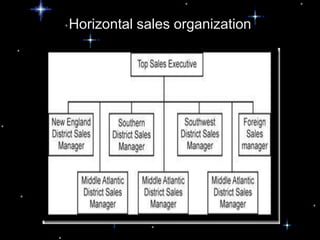
         Horizontal structures tend to exist where larger spans of
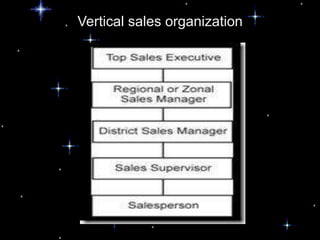
control are acceptable, while vertical organizations characterize
cases in which closer managerial supervision is required.
Horizontal sales organization
Vertical sales organization
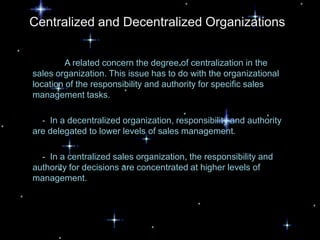
Centralized and Decentralized Organizations


         A related concern the degree of centralization in the
sales organization. This issue has to do with the organizational
location of the responsibility and authority for specific sales
management tasks.

  - In a decentralized organization, responsibility and authority
are delegated to lower levels of sales management.

  - In a centralized sales organization, the responsibility and
authority for decisions are concentrated at higher levels of
management.
Line and Staff Components


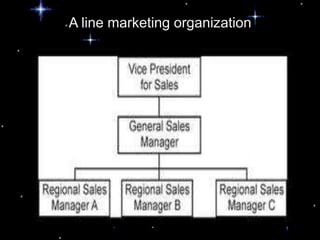
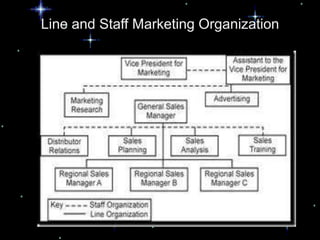
          Marketing organizations also feature line and staff
components. A line function is a primarily activity, and a staff
function is a supporting activity. In a marketing
organization, the selling function is the line
components, where as advertising, marketing
research, marketing planning, sales training, and distributor
relations are usually considered staff roles.
         although the use of the terms line and staff has been
criticized in many quarters, the basic premise behind them
remains applicable to marketing organizations.
A line marketing organization
Line and Staff Marketing Organization
Company Size and Organization


   - The attention given sales as a distinct function is primarily
dependent upon the owner/manager’s abilities and interests.

    - In some cases the owner/manager will have strong sales
background and, in fact, he or she may be the company’s top
salesperson.

    - In the other cases, the owner/manager does not have a sales
background and hires one or more salespeople.
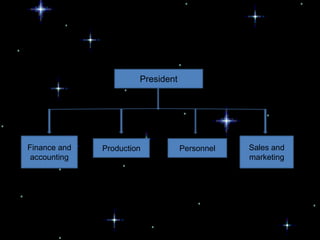
Functional Company Organization


                       President


Finance and   Production           Personnel   Sales and
 accounting                                    marketing
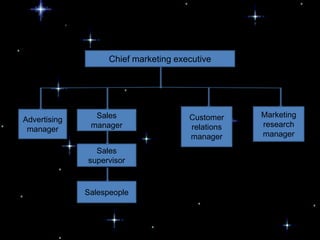
Functional Marketing Organization

                    Chief marketing executive


                Sales                  Customer    Marketing
Advertising
               manager                 relations   research
 manager
                                       manager     manager

                Sales
              supervisor


              Salespeople
Basic Types of Sales Organization


         The very existence of a field selling organization, as
well as the circumstances surrounding its operation, depend on
a variety of factors. These factors determine the nature and
complexity of the sales organization.

There are 4 types of sales organization
1. Geographic Specialization
2. Customer Specialization
3. Product Specialization
4. Combination Organizations.
Geographic Specialization


     Field sales personnel are given the responsibility for
direct selling activities in a given geographical area, or
territory. the sales representative is responsible for selling
the firm’s full line of products.
Customer Specialization


  Sales forces may be specialized by customers for
various reasons. The firm’s customers may require that
the vendor’s salespeople possess specialized
knowledge about their industry.

  IBM is an example of a firm that uses specialized
sales forces for different classes of customers.
Product Specialization

  - Product specialization allows salespeople and sales managers
to concentrate their efforts on particular product lines, brands, or
individual items.

 - the primary disadvantage of product specialization is that, in
many cases, two or more salespeople from the same company
call on the same customers.

 - although customers have the advantage of the specialized
product knowledge provided by each salesperson, they may
resent the extra time that must be spent dealing with additional
representatives.
Combination Organizations


    Geographic, customer, and product specialization are
the basic approaches to organization. Most sales forces
are a combination of two or more of these basic types.

    An industrial products company may have separate
sales forces for its two product lines: shears and fasteners.
Each of these sales forces may then be organized by
geographical location , such as by district or regional office.
Current Organizational Trends

   The tradition forms of sales organization are
undergoing careful security, as a companies search for
new and better ways to serve their markets.

    For consumer goods and service companies, the new
organizational approaches involve efforts to modify the
product manager from of organization.

    Industrial manufacturers are looking closely at
organizational strategies to adapt to the changes in
industrial buying and develop more specialized sales
forces.
Strategic Business Unit
  - A variation of the product form of organization is the strategic business
    unit(SBU), in which similar businesses are grouped together in a single
    organizational unit.

Adapting the Industrial Sales Force
 - Important changes in industrial buying brought about by corporate
   mergers and acquisitions, different kinds of corporate financing, the
   increased size and complexity of businesses, and environmental
   factors have changed industrial selling.

Industrial Sales Force Specialization
  - Zimmer and Hugs tad suggest three alternative approaches for
    structuring an industrial sales organization. Two of these,
    psychographic and sociocultural specialization, are variations of
    customer organization, the third , functional specialization, involves the
    assignment of a specific sales role to each salesperson.
The Field Sales Manager

    Field selling organizations are quite varied. Some may
have elaborate district offices with a full complement of
support personnel.

    Others may consist of a small one-room office staffed only
by an answering service. As a result, the field sales manager’s
job can range over a wide spectrum.

   At one extreme, the manager may be a desk-bound
executive; at the other, the manager may be a territorial sales
representative who happens to have been assigned some
administrative duties.
Concepts of Effective Sales Organization


    The sales organization should be built around activities,
rather than around the people involved in the activities. This
simple concept allows the organization to be more permanent
and stable.

    One widely cited article argues that there are two basic
sales activities: sales development and sales maintenance.
Others see a basic division between planning and operating
activities. Regardless of the tasks identified, the key factor is
that the organization be activity-oriented , not people-oriented.
Group Similar Functions Together
  - A colorally to the concept of organization by activities is that similar
functions should be grouped together. Marketing research and
production should not administratively report to the operations vice
president simply because the chief marketing executives is un
interested in marketing research.

People and Structure Are Both Critical
  - Both people and structure influence organization effectiveness.
Statements such as “ABC Enterprises is a good organization,” reflect
this situation. What is really meant is that ABC Enterprises is
represented by good people. The structural aspects of the organization
may in fact be very weak.
  - The reverse is also true: many difficulties that are attributed to
organizational problems can be, in fact, people-related problems.
Thank You!

Mktg.5

  • 1.
    Sales Force Organization Reporters: FenellaMarie Barrion Krisma C. Fidelino BSBA 3
  • 2.
    Task Of SalesOrganization The nearly universal adoption of the marketing concept has meant that most companies have reorganized their sales and marketing activities to reflect the stronger commitment to their cusThe nearly universal adoption of the marketing concept has meant that most companies have reorganized their sales and marketing activities to reflect the stronger commitment to their customers. This trend has enhanced the importance of sales force organization. Three basic tasks must be accomplished by the organizing effort: 1. Maintenance of order in achieving sales force goals and objectives 2. Assignment of specific tasks and responsibilities 3. Integration and coordination with other elements of the firm 1. Maintenance of order in achieving sales force goals and objectives 2. Assignment of specific tasks and responsibilities 3. Integration and coordination with other elements of the firm
  • 3.
    An effective salesforce organization provides the structure for achieving sales objectives. Structure is “ the sum total of the ways in which an organization divides its labor into distinct tasks and then achieves coordination among them”. Organizational structure also permits the assignment of specific tasks to a position whose incumbent is then charged with responsibility for accomplishing that task. Integration and coordination is a third aspect of sales force organization. the organizational structure allows the coordination of the various functional areas of the firm.
  • 4.
    Developing A SalesOrganization Developing a sales organizational structure is not an easy task. The keys to organizational design are consistency and coherence. These comments suggest that sales managers must recognize, and then deal with, some basic organizational issues when developing a sales organization. The five major issues are: 1. Formal and informal organizations 2. Horizontal and vertical organizations 3. Centralized and decentralized organizational structures 4. The line and staff components of the organization 5. The size of the company
  • 5.
    Formal and InformalOrganizations Every firm has a formal organization and an informal organization. The formal organization is a creation of management, where as the informal organization is often developed from social relationships existing in the organization. Sometimes called the grapevine, the informal organization is basically a communications pattern that emerges to facilitate the operation of the formal organization. Most formal organizations would be totally ineffective if it were not supporting informal organization.
  • 6.
    The Informal communicationsystem in a marketing organization
  • 7.
    A lengthy formalcommunications channel District General Marketing Director of Salesperson sales sales Vicpreside marketing manager nte research manager
  • 8.
    Horizontal and Verticalorganization Sales forces can have either horizontal or vertical organizational formats. The arrangement varies among companies, even within the same industry. The factor that determines whether a vertical or horizontal organizational structure should be employed is the effective span of control. The span of control refers to the number of employees who report to the next higher level in the organization. Horizontal structures tend to exist where larger spans of control are acceptable, while vertical organizations characterize cases in which closer managerial supervision is required.
  • 9.
  • 10.
  • 11.
    Centralized and DecentralizedOrganizations A related concern the degree of centralization in the sales organization. This issue has to do with the organizational location of the responsibility and authority for specific sales management tasks. - In a decentralized organization, responsibility and authority are delegated to lower levels of sales management. - In a centralized sales organization, the responsibility and authority for decisions are concentrated at higher levels of management.
  • 12.
    Line and StaffComponents Marketing organizations also feature line and staff components. A line function is a primarily activity, and a staff function is a supporting activity. In a marketing organization, the selling function is the line components, where as advertising, marketing research, marketing planning, sales training, and distributor relations are usually considered staff roles. although the use of the terms line and staff has been criticized in many quarters, the basic premise behind them remains applicable to marketing organizations.
  • 13.
    A line marketingorganization
  • 14.
    Line and StaffMarketing Organization
  • 15.
    Company Size andOrganization - The attention given sales as a distinct function is primarily dependent upon the owner/manager’s abilities and interests. - In some cases the owner/manager will have strong sales background and, in fact, he or she may be the company’s top salesperson. - In the other cases, the owner/manager does not have a sales background and hires one or more salespeople.
  • 16.
    Functional Company Organization President Finance and Production Personnel Sales and accounting marketing
  • 17.
    Functional Marketing Organization Chief marketing executive Sales Customer Marketing Advertising manager relations research manager manager manager Sales supervisor Salespeople
  • 18.
    Basic Types ofSales Organization The very existence of a field selling organization, as well as the circumstances surrounding its operation, depend on a variety of factors. These factors determine the nature and complexity of the sales organization. There are 4 types of sales organization 1. Geographic Specialization 2. Customer Specialization 3. Product Specialization 4. Combination Organizations.
  • 19.
    Geographic Specialization Field sales personnel are given the responsibility for direct selling activities in a given geographical area, or territory. the sales representative is responsible for selling the firm’s full line of products.
  • 20.
    Customer Specialization Sales forces may be specialized by customers for various reasons. The firm’s customers may require that the vendor’s salespeople possess specialized knowledge about their industry. IBM is an example of a firm that uses specialized sales forces for different classes of customers.
  • 21.
    Product Specialization - Product specialization allows salespeople and sales managers to concentrate their efforts on particular product lines, brands, or individual items. - the primary disadvantage of product specialization is that, in many cases, two or more salespeople from the same company call on the same customers. - although customers have the advantage of the specialized product knowledge provided by each salesperson, they may resent the extra time that must be spent dealing with additional representatives.
  • 22.
    Combination Organizations Geographic, customer, and product specialization are the basic approaches to organization. Most sales forces are a combination of two or more of these basic types. An industrial products company may have separate sales forces for its two product lines: shears and fasteners. Each of these sales forces may then be organized by geographical location , such as by district or regional office.
  • 23.
    Current Organizational Trends The tradition forms of sales organization are undergoing careful security, as a companies search for new and better ways to serve their markets. For consumer goods and service companies, the new organizational approaches involve efforts to modify the product manager from of organization. Industrial manufacturers are looking closely at organizational strategies to adapt to the changes in industrial buying and develop more specialized sales forces.
  • 24.
    Strategic Business Unit - A variation of the product form of organization is the strategic business unit(SBU), in which similar businesses are grouped together in a single organizational unit. Adapting the Industrial Sales Force - Important changes in industrial buying brought about by corporate mergers and acquisitions, different kinds of corporate financing, the increased size and complexity of businesses, and environmental factors have changed industrial selling. Industrial Sales Force Specialization - Zimmer and Hugs tad suggest three alternative approaches for structuring an industrial sales organization. Two of these, psychographic and sociocultural specialization, are variations of customer organization, the third , functional specialization, involves the assignment of a specific sales role to each salesperson.
  • 25.
    The Field SalesManager Field selling organizations are quite varied. Some may have elaborate district offices with a full complement of support personnel. Others may consist of a small one-room office staffed only by an answering service. As a result, the field sales manager’s job can range over a wide spectrum. At one extreme, the manager may be a desk-bound executive; at the other, the manager may be a territorial sales representative who happens to have been assigned some administrative duties.
  • 26.
    Concepts of EffectiveSales Organization The sales organization should be built around activities, rather than around the people involved in the activities. This simple concept allows the organization to be more permanent and stable. One widely cited article argues that there are two basic sales activities: sales development and sales maintenance. Others see a basic division between planning and operating activities. Regardless of the tasks identified, the key factor is that the organization be activity-oriented , not people-oriented.
  • 27.
    Group Similar FunctionsTogether - A colorally to the concept of organization by activities is that similar functions should be grouped together. Marketing research and production should not administratively report to the operations vice president simply because the chief marketing executives is un interested in marketing research. People and Structure Are Both Critical - Both people and structure influence organization effectiveness. Statements such as “ABC Enterprises is a good organization,” reflect this situation. What is really meant is that ABC Enterprises is represented by good people. The structural aspects of the organization may in fact be very weak. - The reverse is also true: many difficulties that are attributed to organizational problems can be, in fact, people-related problems.
  • 28.