Tyre Industry AnalysisBy : 	     Gagan Pareek
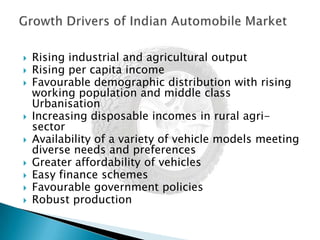
Economic growth drivers….GDP growth as per RBI is 8.5%  .Robust industrial growth backed by improvement in consumption demandIncrease in infrastructure spending.Substantial improvement in domestic demand.Increased thrust of the government on infrastructure projects.All time high sales growth of few major automobile companies eg:  Maruti Suzuki India Limited sold a total of 10,18,365 vehicles in 2009-10.
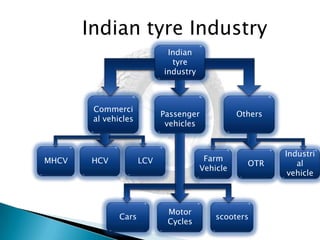
Indian tyre IndustryIndian tyre industryPassenger vehiclesCommercial vehiclesOthersMHCVHCVLCVFarm VehicleOTRIndustrial vehicleCars Motor Cyclesscooters
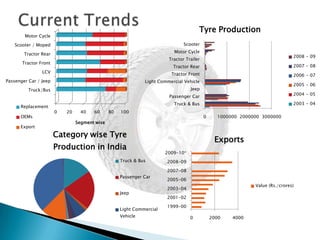
AN OVERVIEW OFINDIAN TYRE  INDUSTRYFinancial Year 2009-2010 Turnover of Indian Tyre Industry Rs. 25,000Crores Tyre Production (Tonnage) 13.50 lakh M.T. Tyre Production – All Categories (Nos.) 971 Lakh Tyre Export from India (Value) :Rs. 3000  croresNumber of tyre companies: 36 Industry Concentration 10 Large tyre companies account for over 95% of total tyre production.
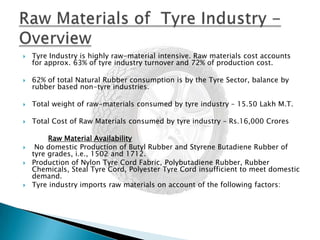
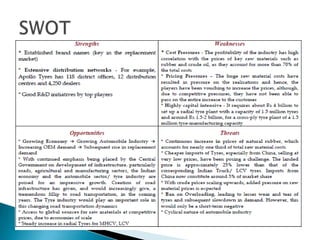
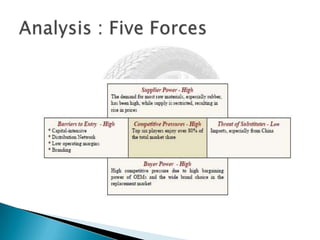
Raw Materials of  Tyre Industry - Overview     Tyre Industry is highly raw-material intensive. Raw materials cost accounts for approx. 63% of tyre industry turnover and 72% of production cost.62% of total Natural Rubber consumption is by the Tyre Sector, balance by rubber based non-tyre industries.Total weight of raw-materials consumed by tyre industry – 15.50 Lakh M.T.Total Cost of Raw Materials consumed by tyre industry – Rs.16,000 CroresRaw Material Availability   No domestic Production of Butyl Rubber and Styrene Butadiene Rubber of tyre grades, i.e., 1502 and 1712.Production of Nylon Tyre Cord Fabric, Polybutadiene Rubber, Rubber Chemicals, Steal Tyre Cord, Polyester Tyre Cord insufficient to meet domestic demand. Tyre industry imports raw materials on account of the following factors:
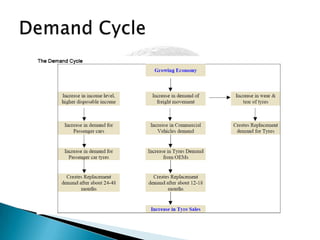
Demand Cycle
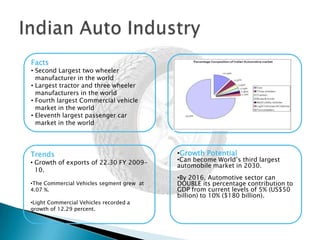
Indian Auto IndustryFactsSecond Largest two wheeler manufacturer in the world
Largest tractor and three wheeler manufacturers in the world
Fourth largest Commercial vehicle market in the world
Eleventh largest passenger car market in the world
Growth Potential
Can become World’s third largest automobile market in 2030.
By 2016, Automotive sector can DOUBLE its percentage contribution to GDP from current levels of 5% (US$50 billion) to 10% ($180 billion).TrendsGrowth of exports of 22.30 FY 2009-10.
The Commercial Vehicles segment grew  at 4.07 %.
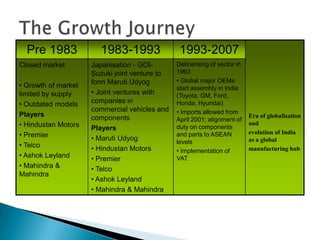
Light Commercial Vehicles recorded a growth of 12.29 percent. The Growth Journey
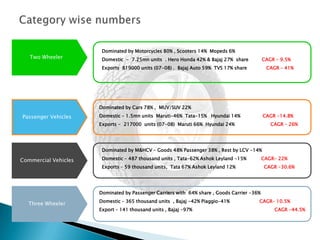
Category wise numbersTwo Wheeler Dominated by Motorcycles 80% , Scooters 14%  Mopeds 6%Domestic  -  7.25mn units  . Hero Honda 42% & Bajaj 27%  share         CAGR – 9.5%Exports  819000 units (07-08) .  Bajaj Auto 59%  TVS 17% share             CAGR – 41%Passenger VehiclesDominated by Cars 78% ,  MUV/SUV 22%Domestic – 1.5mn units  Maruti-46%  Tata-15%   Hyundai 14%               CAGR -14.8%Exports -  217000  units (07-08)  Maruti 66%  Hyundai 24%                        CAGR – 26%Commercial VehiclesDominated by M&HCV – Goods 48% Passenger 38% , Rest by LCV -14%Domestic – 487 thousand units , Tata-62% Ashok Leyland -15%          CAGR- 22%Exports – 59 thousand units,  Tata 67% Ashok Leyland 12%       CAGR -30.6%Three WheelerDominated by Passenger Carriers with  64% share , Goods Carrier -36%Domestic – 365 thousand units  , Bajaj -42% Piaggio-41%                    CAGR- 10.5%Export – 141 thousand units , Bajaj -97%                                                       CAGR -44.5%
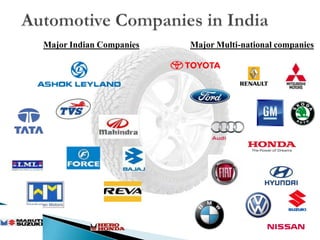
Automotive Companies in IndiaMajor Multi-national companiesMajor Indian Companies
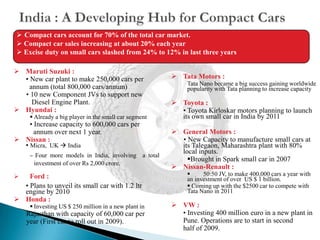
India : A Developing Hub for Compact CarsCompact cars account for 70% of the total car market.
 Compact car sales increasing at about 20% each year
 Excise duty on small cars slashed from 24% to 12% in last three years
Maruti Suzuki :	• New car plant to make 250,000 cars per	  annum (total 800,000 cars/annum)       • 10 new Component JVs to support new          Diesel Engine Plant.Hyundai :

Final tyre

  • 1.
  • 2.
    Economic growth drivers….GDPgrowth as per RBI is 8.5% .Robust industrial growth backed by improvement in consumption demandIncrease in infrastructure spending.Substantial improvement in domestic demand.Increased thrust of the government on infrastructure projects.All time high sales growth of few major automobile companies eg: Maruti Suzuki India Limited sold a total of 10,18,365 vehicles in 2009-10.
  • 3.
    Indian tyre IndustryIndiantyre industryPassenger vehiclesCommercial vehiclesOthersMHCVHCVLCVFarm VehicleOTRIndustrial vehicleCars Motor Cyclesscooters
  • 4.
    AN OVERVIEW OFINDIANTYRE INDUSTRYFinancial Year 2009-2010 Turnover of Indian Tyre Industry Rs. 25,000Crores Tyre Production (Tonnage) 13.50 lakh M.T. Tyre Production – All Categories (Nos.) 971 Lakh Tyre Export from India (Value) :Rs. 3000 croresNumber of tyre companies: 36 Industry Concentration 10 Large tyre companies account for over 95% of total tyre production.
  • 5.
    Raw Materials of Tyre Industry - Overview     Tyre Industry is highly raw-material intensive. Raw materials cost accounts for approx. 63% of tyre industry turnover and 72% of production cost.62% of total Natural Rubber consumption is by the Tyre Sector, balance by rubber based non-tyre industries.Total weight of raw-materials consumed by tyre industry – 15.50 Lakh M.T.Total Cost of Raw Materials consumed by tyre industry – Rs.16,000 CroresRaw Material Availability   No domestic Production of Butyl Rubber and Styrene Butadiene Rubber of tyre grades, i.e., 1502 and 1712.Production of Nylon Tyre Cord Fabric, Polybutadiene Rubber, Rubber Chemicals, Steal Tyre Cord, Polyester Tyre Cord insufficient to meet domestic demand. Tyre industry imports raw materials on account of the following factors:
  • 6.
  • 7.
    Indian Auto IndustryFactsSecondLargest two wheeler manufacturer in the world
  • 8.
    Largest tractor andthree wheeler manufacturers in the world
  • 9.
    Fourth largest Commercialvehicle market in the world
  • 10.
    Eleventh largest passengercar market in the world
  • 11.
  • 12.
    Can become World’sthird largest automobile market in 2030.
  • 13.
    By 2016, Automotivesector can DOUBLE its percentage contribution to GDP from current levels of 5% (US$50 billion) to 10% ($180 billion).TrendsGrowth of exports of 22.30 FY 2009-10.
  • 14.
    The Commercial Vehiclessegment grew at 4.07 %.
  • 15.
    Light Commercial Vehiclesrecorded a growth of 12.29 percent. The Growth Journey
  • 16.
    Category wise numbersTwoWheeler Dominated by Motorcycles 80% , Scooters 14% Mopeds 6%Domestic - 7.25mn units . Hero Honda 42% & Bajaj 27% share CAGR – 9.5%Exports 819000 units (07-08) . Bajaj Auto 59% TVS 17% share CAGR – 41%Passenger VehiclesDominated by Cars 78% , MUV/SUV 22%Domestic – 1.5mn units Maruti-46% Tata-15% Hyundai 14% CAGR -14.8%Exports - 217000 units (07-08) Maruti 66% Hyundai 24% CAGR – 26%Commercial VehiclesDominated by M&HCV – Goods 48% Passenger 38% , Rest by LCV -14%Domestic – 487 thousand units , Tata-62% Ashok Leyland -15% CAGR- 22%Exports – 59 thousand units, Tata 67% Ashok Leyland 12% CAGR -30.6%Three WheelerDominated by Passenger Carriers with 64% share , Goods Carrier -36%Domestic – 365 thousand units , Bajaj -42% Piaggio-41% CAGR- 10.5%Export – 141 thousand units , Bajaj -97% CAGR -44.5%
  • 17.
    Automotive Companies inIndiaMajor Multi-national companiesMajor Indian Companies
  • 18.
    India : ADeveloping Hub for Compact CarsCompact cars account for 70% of the total car market.
  • 19.
    Compact carsales increasing at about 20% each year
  • 20.
    Excise dutyon small cars slashed from 24% to 12% in last three years
  • 21.
    Maruti Suzuki : •New car plant to make 250,000 cars per annum (total 800,000 cars/annum) • 10 new Component JVs to support new Diesel Engine Plant.Hyundai :

Editor's Notes

  • #10 Two wheelers - Majority of exports are to Bangladesh, Sri Lanka, Bhutan and Nepal• PV - Exports are made to South America, Africa, Europe, Latin America and the Middle East.CV - Major portion of the exports are to Sri Lanka, Gulf countries and Africa 3 Wheelers Auto exports to Sri Lanka, Egypt, Nepal, Bangladesh among other countries
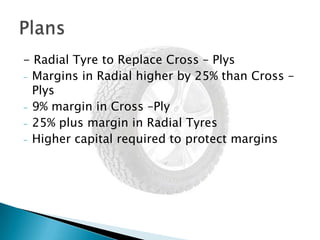
  • #21 Tyre industry set for structural shift: Currently, manufacturing radial tyres is farmore capital intensive than cross-plys. Investment per tonnes per day (tpd) is3.2x of cross-ply at Rs6.1cr/tpd. On the other hand, the selling price of radialtyres is around 20% higher than the cross-ply tyres. Taking into account thedifference in capital requirements and consequent impact on asset turnover,interest cost and depreciation, to generate similar RoCE and RoE, the tyrecompanies would need to earn EBITDA margins of around 21% compared toaround 9% being earned on cross-ply tyres. Thus, higher capital requirementswill help protect margins from upward bound input costs, as the businessmodel evolves bearing in mind final RoEs rather than margins. With the sectorset for a structural shift and apparent pricing flexibility, it will result in animprovement in RoCE and RoE of the tyre manufacturers going forward.